
“A Long, Strange Trip”: An Engineer’s Journey Through FM College Radio


Today is World College Radio Day, and it’s more important than ever to honor and preserve free airwaves for our communities, now and for the generations to come. Sounding Out! is marking the day with a special post devoted to the intergenerational relationships that power college radio and keep it lit, whether over the terrestrial airwaves or via online streaming. College radio binds campus and community in tangible ways and builds deep and long lasting connections, as Sean Broder’s (WHRW 90.5 Class of 2025) conversation with Freddie Montalvo (WHRW 90.5 Class of 1987) certainly shows. Tune in to the people and keep it locked on college radio. –SO! Eds
—
In 2026, Binghamton University’s WHRW 90.5FM will celebrate its 60th birthday. Ferdinand “Freddie” Montalvo has been an prominent member of the station for 45 of those years, which means he has experienced many changes in radio’s culture and technology. Supplemented by his experience as a professional electrician, Freddie’s enthusiasm for a traditional approach to broadcasting has remained unchanged through the station’s many alterations, bringing undeniable authenticity to the forefront of the station, and showing newcomers how they can do the same.
An expressive medium, college radio has enabled students of all backgrounds to project their voice and music taste as far as the radio waves take them. Whereas some former college radio DJs apply their newfound power of expression to other professional fields, others like Freddie have only continued to develop their broadcasting style, which is why I wanted to get his perspective on college radio’s evolutions. Freddie has never lost sight of the art and the value of individualized broadcasting in the age of streaming music, and he generously shares it with incoming members who seek their own voices.

I met Freddie for this interview in the station’s current location in the basement of the university union. WHRW has three studios, one of the largest record libraries in the northeastern United States, and a common space that’s layered in stickers, posters, and graffiti spanning several generations of broadcasters. I found him in WHRW’s primary studio, CR-1, serving as the required broadcaster for a student talk show. As this was the end of the Spring ‘25 semester at BU, I was able to briefly catch the thank yous and goodbyes of the hosts at the conclusion of their final show. Freddie continues to host his own weekly radio show–Dimenciones on Saturdays from 7-10 PM on terrestrial radio 90.5 in the Greater Binghamton area and via WHRW’s livestream–but his additional involvement as an engineer for others at the station continues to enable newcomers to develop and project their own voices, even if they’re not certified broadcasters themselves. This post offers some excerpts of our in-depth conversation concerning Freddie’s life and rich history with WHRW, as well as his perspective on the continued importance of college radio, and of course some of the many valuable music recommendations he shared over our two hours together.
—
Freddie’s journey into the world of FM radio began in 1976, when the South Bronx native transferred from Bronx Community College to Binghamton University. It wasn’t until ‘79 that he would be introduced to the station by a friend of his who was hosting a Latin music show on the campus station WHRW 90.5, which had Freddie instantly hooked. Coming from a Puerto Rican family, it meant a lot to Freddie to join his friend in the station’s Latin Department; he became the first Latino program director in 1981 and the first Latino general manager in 1982. While serving leadership roles and maintaining his weekly programming, Freddie attended Binghamton through the work-study program BOCES (Boards of Cooperative Educational Services). It’s here that he trained to become an electrician, further intertwining his personal connection to WHRW:
BOCES… they taught you the fundamentals and at that time, I was getting involved at the station, and it was like a synergy of that, you know? Between electronics and radio broadcasting. So, at that time I was going to school in the evening, I went to the BOCES program 8-4/8-5, went to school at night, was doing radio, so everything was involved and influencing each other.
As a leading member of his department, Freddie embraced the alternative radio that WHRW was known for, broadcasting an assortment of music ranging from Latin Jazz to Cumbia, Disco, Salsa, and Santana… not to mention his confirmed favorite song: “Sofrito” by Mongo Santamaria.
In the decades following his transfer to BU, he has established a home and marriage in Binghamton, describing his life’s journey in the city as “a long, strange trip.”
—
WHRW has been a free format station since it began in 1966, giving each DJ and engineer freedom to play their favorite pieces of music within the FCC guidelines. WHRW has always been, according to Freddie, about “protecting that alternativeness on campus and off campus… we weren’t copying anybody.” He brings attention to what he calls the “great social redeeming value” of alternative broadcasting, which surpasses the confines of the station and not only enriches the surrounding community, but influences future forms of expression by DJs, or “broadcasters” as Freddie calls them.
When you record your shows and listen to yourself that’s how you develop your sense of style… The voice is an instrument, and you learn to modulate when you turn that mic on, always make sure you have on your headset, and that’s how you develop your style. ‘Cause at first you don’t realize these things, but as you evolve, you’ll notice these different nuances.

As his career progressed and Freddie became an installer technician, he increased accessibility to new musical programs for local residents, most notably, MTV. Combining this work with his many hours at the station, Freddie felt a great sense of pride and responsibility in bringing the forefront of new music to the lives of countless listeners. “I always called it therapeutic radio,” he explained to me, bringing attention to WHRW’s commercial-free programming, and the station’s ability to allow for its broadcasters to express their personalities. Freddie has never felt the need to possess an alter-ego while broadcasting as many do, explaining that members of the station are “audiophiles experiencing music, certain different genres, and that’s what we’re presenting. And when you do a show, you’re that show. That is your artwork in action.”
In addition to producing unique art on air, each WHRW broadcaster makes and plays hourly “carts,” public service announcements that are the closest thing to commercials on 90.5. There too, the station’s members have managed to transform the regulation-required station identifiers, PSAs, promos, and announcements into pre-recorded miniature productions; each about a minute long. During Freddie’s earlier years at the station, engineers made carts on Ampex audio track tape machines, quite different from the digital editing software utilized today. While traditional, bulky tape machines offered creative possibilities, they were be far less forgiving of errors than modern audio editing software. As Freddie told me,
there’s a certain thing that you can do with reel-to-reel recorders, where you could do sound-on-sound and sound-with-sound, and what that does is it creates an echo effect that is different from the electronic echos that you can do with the software… The mixing and the editing was hardcore, it was physical.
One of Freddie’s favorite promotional carts was “La Emisora Que Vuela,” made several years ago on the Ampex by a DJ apprentice of his, Francisco Reyes. Freddie remembered that it took eight full hours of recording, splicing, and layering for the minute-long audio production. Rightfully so, he refers to both the production process and final recording as true art, going on to describe the context of the dialogue:
So it’s like a gathering in a Latin household talking about different foods. And… It’s like a sitcom in a sense because he’s goofing with the different characters and he’s talking about, you know, the foods to be prepared. You say, well, who is this guy? That’s when he starts talking and saying: ‘you’ve got to be listening to WHRW in Binghamton.
“La Emisora Que Vuela” (“The Station That Flies”) -Francisco Reyes
The Ampex isn’t the only thing that has changed during Freddie’s 45+ years at WHRW. Other significant changes to the technologies utilized for broadcasting over the years. Because the station has always operated 24 hours a day, it required a certified broadcaster to remain on air at any given time for many decades. More recently, an automated system has allowed for some time slots to be occupied by a digital playlist, inevitably creating a distinct gap between WHRW’s night owls and early risers. Additionally, physical media such as vinyl records and CDs are no longer necessary for radio shows on WHRW. After the implementation of a Eurorack–which allows DJs to use an aux chord to play their shows–most current station members went digital. Despite this change and preference, Freddie remains loyal to the art of digging through physical media, for him primarily CDs, in order to find music that portrays his personality and taste.
Not too many people have FM radios at home, which was the norm. Everybody had records, they were listening to FM radio, and the only way you could listen to the station was tuning in with an FM radio. Today, everybody’s into Spotify… they’re not pulling records, they’re not pulling CDs, there’s no more really hands-on, it’s all plug in a laptop and sitting back… But that’s just me because I came from a different era, you know, where we had the hands-on with vinyl… once they put that Eurorack in there, it’s not the same. That’s why we have to have turntable classes to teach people how to work with the vinyl cause most of the younger crowd didn’t grow up playing 45s or lps, you know?… That’s when you’re definitely an audio aficionado.

Despite the sonic and technological changes that have permanently altered radio broadcasting, Freddie urges people of all backgrounds to get involved with radio given the opportunity; especially on the rare occasion that the station is free-format like WHRW has been since its inception. Technological changes aside, WHRW harbors the unique and deeply personal environment that deems college radio so valuable. Today, more than ever it is vital to understand the importance of large-scale audial expression in the face of vastly different musical soundscapes, as explained by Freddie:
This (the station) is the focal point for social interaction relating to music but, you know, today it’s more Spotify based, which is not the greatest because with a CD or an LP, you’re able to read the line-in notes, you get to read about the musicians, the group, the transition of between groups. Just think about Led Zeppelin. Zeppelin, let’s say Led Zeppelin 1, 2, and 3: different LPs, different flavors in their musical repertoire, you know? And you’re reading the LP, and you’re reading about the musicians and all the songs and the line and all… I’m not sure if Spotify has the same thing today… it’s not interactive. With LP’s, you’re fully engaged with that LP as you’re listening to it, whereas with that it’s just, you know, a certain song, or if you go looking for a little bit of tidbit, but it’s not the same experience. With the LP you get to see, you get to feel the artwork… it has to be different from the laptop experience… it’s more tactile.
Today, everything is digitized, it’s not like we have our live broadcaster or radio DJ… it’s not visceral in that sense… radio is different today. ‘Corporate radio’, as they refer to it… There’s no personality in it, and if there is a personality, it’s more blahblahblahblahblah and very little with the music and all… Even today, I listen to some DJs that I was listening to then and they’re still around today, and there’s a difference between that time and today. But, their influence must have influenced me unknowingly, and so as I experienced radio here, it’s vastly different from what I thought about radio at that time.
The thing is, when you do radio here [at WHRW], it is different than if you weren’t doing radio just listening to your laptop or Spotify. When you’re doing radio, you are engaging actively and producing your own show… It will influence you too, you know, we always used to say here: ‘expand your horizons’ and not just stay in a certain genre. As you experience WHRW, you will be listening to certain things, or you should be listening to certain things, and exposed to certain things, and that’s what opens your whole view, you know, musically, orally. And so, what you were listening to two years ago might be vastly different from what you are listening to today. And, when you go back home and you listen to radio you say ‘man, I could do better than that shit!
WHRW is vital for those who have ever been involved in its community, expressed to its truest extent by Ferdinand Montalvo. Members define the atmosphere within the station and the growth of the station outside of it. Despite the many technological changes to broadcasting, college radio has continued to build a symbiotic relationship with its members and the local community of listeners.
—
Featured Images: Courtesy of Ferdinand “Freddie” Montalvo
—
Sean Broder is a recent graduate of Binghamton University in Binghamton, NY, where he was a trained DJ at WHRW 90.5 FM as well as an English Literature major. He was a Sounding Out! intern in Spring and Summer 2025. He’s from New Rochelle, New York and has always had a great love for music.
—

REWIND! . . .If you liked this post, you may also dig:
“Vous Ecoutez La Voix du Peuple”: The Kreyol Language Pirate Radio Stations of Flatbush, Brooklyn–David Goren
Listening (Loudly) to Spanish-language Radio–Dolores Inés Casillas
“Chicana Radio Activists and the Sounds of Chicana Feminisms“–Monica De La Torre
Radio and the Voice of the Aymara People – Karl Swinehart
Share this:

Radio de Acción: Violent Circuits, Contentious Voices: Caribbean Radio Histories
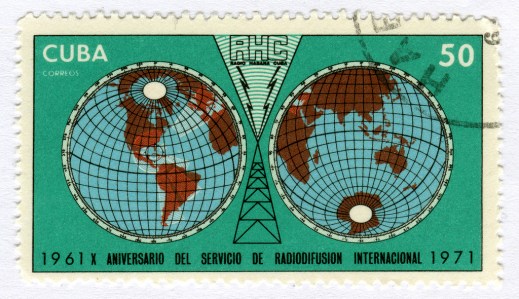

This month Sounding Out! inaugurates a four-part series slated to appear on the Thursday stream into May entitled “Radio de Acción”: Broadcasting in Latin America and the Caribbean, edited by Cornell Assistant Professor in Comparative Literature Tom McEnaney.
Tom has been a key contributor to SO! over the years — check out his articles on Orson Welles and Twin Peaks, two excellent and vivid pieces I wish I could’ve written. We’re excited to have Tom as our guide to the many frequencies of Latin American and Caribbean radio, helping us “tune North American antennas South for a while,” as he proposes in his series introduction below. Gather round, dear listeners, I think the transmission’s about to start …
— SCMS/ASA Special Editor Neil Verma
—
It’s difficult to keep the radius of radio within national boundaries. Or so it has often seemed in the Americas. The first Argentine broadcast, on August 27, 1920, transmitted a performance of Wagner’s Parisfal that accidentally reached ships in Brazil. Border radio in Spanish and English has bled across the frontiers between Mexico and the United States since at least the early 1930s. And if listeners from Alabama to Washington State tuned their shortwave receivers right in the early 1960s, they would have heard the exiled civil rights activists Robert F. and Mabel Williams’ famous tag line: “You are tuned to Radio Free Dixie, from Havana, Cuba, where integration is an accomplished fact.”
In Spanish, “radio” can mean the sonic broadcasting it denotes in English, but also radium, the spoke of a wheel, a radius (and the bone of the same name), an orbit, or a sphere of influence. Our series title, Radio de Acción, plays on an inter-linguistic pun, which takes the “radius of action” or “area of operations” the phrase connotes in Spanish, and thinks of radio broadcasting as changing the cultural, historical and political fields it engages through particular types of “radio action.”
Acknowledging language’s role in widening or narrowing that radius, the four posts in this special series help tune our ears to a diversity of voices from Latin America and the Caribbean. Over the next few months Radio de Acción will explore the multilingual history of radio in the Caribbean, an Aymara / Spanish talk show in Bolivia, a Cuban-born writer’s radio dramas produced in German, and the Spanish / English radio program Radio Ambulante, which its creators describe as “This American Life, but in Spanish, and transnational.” Featuring posts from Alejandra Bronfman, Karl Swinehart, and Carolina Guerrero, our series sets out to turn North American antennas South for a while.
I’m especially excited to begin the series by welcoming University of British Columbia History Professor, Alejandra Bronfman, whose extraordinary story of radio in the Caribbean below serves as an ideal overture to Radio de Acción. Don’t move that dial.—
— TM
—
The most striking example of radio’s power in the political dramas of the Caribbean took place in Havana, Cuba in March of 1957. A group of student activists opposed to the Cuban dictator Fulgencio Batista’s regime attempted to assassinate him and simultaneously occupied one of Havana’s most popular stations, Radio Reloj. Locking out the broadcasters, who usually spent the day reading the news and announcing the time every minute on the minute, the activists declared Batista’s death, and their victory. It may be that their plan depended precisely on the uncertainty they created. Whether Batista was actually dead mattered less than the reaction they hoped to incite with their declaration. Batista did not die that day; the students’ plot was foiled; and the attempt ended in death for most of the assailants. However, the failure was only temporary—another group of radio rebels would overthrow Batista less than two years later—and the 1957 takeover cemented radio’s undisputed role as bearer of truth and center of power.
In this post I consider radio’s relationship to violence in connection to its creation of truth, mendacity and illusion. Radio publics in the Caribbean emerged amidst conflict, and, as the 2000 assassination of the Haitian broadcaster Jean Dominique suggests, there is still much at stake in their existence as arbiters of political practice and cultural affiliation.
In the earliest years, radio competed for attention in Caribbean soundscapes full of talk and music rooted in the legacies of slavery. In Haiti, a US occupation (1915-1934) coincided with the development of wireless technology by the US military. Military officials understood the potential of wireless for communication among ships. When US marines landed in Port-au-Prince in 1915, they immediately landed a radio set as well. Although wireless linked the marines to their passing ships, it was not yet a cultural medium sustaining a connection to familiar songs and voices. Haiti was a confusing, disorienting place for many of them: some were disappointed to have been sent there rather than the European front of WWI, others raised in the American South were appalled at the power and status of Haitians of African descent. As remembered by one marine, the sound of Haiti could terrify: “No movies, no radio, none of the features of civilized life to which he was accustomed… Drums boomed continuously. …the drums seemed to him to be the voice of the evil one, always booming in his ears, threatening him, tempting him.”

John Huston Craige, “Black Bagdad” (New York: Minton, Balch and Co, 1933)
Most confusing of all was the language. 90% of Haitians spoke Kreyol, which is not French, and not like anything the marines had probably heard before. Documents of the occupation record their efforts to turn what they heard as noise into comprehensible signals. They understood how crucial it would be to obtain information from market women, whose perambulations through the countryside, in weekly walks from their villages to market towns, allowed them to gather news and gossip. If they could convince these women to become informants, and then use radio to relay crucial knowledge between strategic points–the terrain was difficult, with paths rather than roads and frequent rain and flash flooding made travel unpredictable—they might somehow begin to locate and crush insurgencies. The installation of radios signaled the Marines’ efforts to exercise control and insert themselves into these circuits of talk and rumor. But results were paltry. Documents from the early phase of the occupation speak to unreliable technology, lack of knowledge about how to use it, its burdensome heft (radio sets had to be hauled by donkeys through the dense forests), and frequent sabotage.
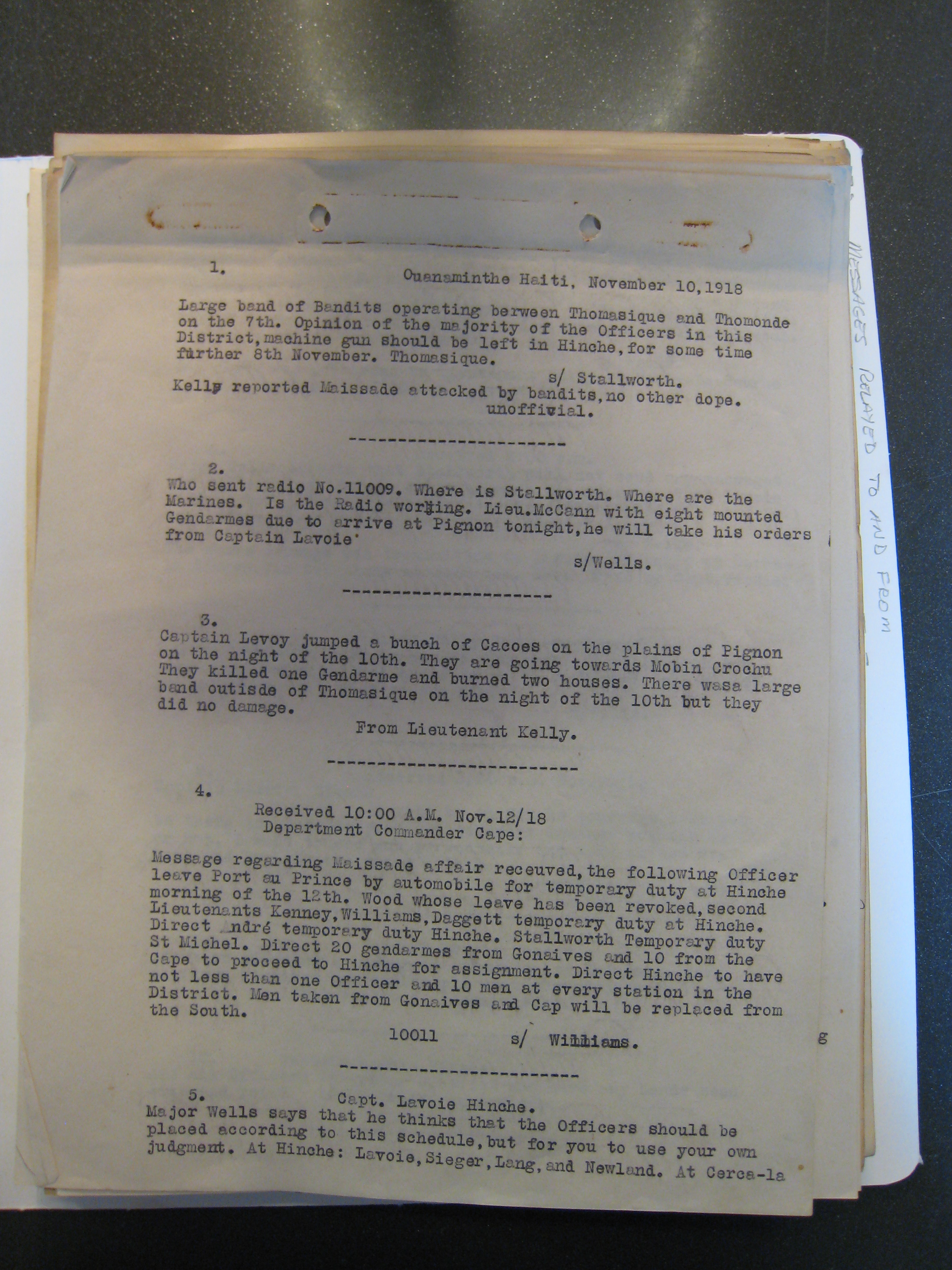

“Messages relayed to and from Cap Haitien via Ouanaminthe”, Entry 173 Chief of the Gendarmerie D’ Haiti, General Correspondence 1919-1920, Operations against hostile bandits, RD 127, United States National Archives
They also speak to desperation and macabre inventiveness in the face of fear. Some Marines discovered that they could try getting the ‘truth’ out of Haitians in novel ways. They applied wires from radio sets to Haitian people’s bodies, and shot electric current through them during interrogation sessions, hoping to use their “new media” to simultaneously terrorize bodies and extract information from them. Electrotorture enacted, literally, the relationship between technology, the production of knowledge and imperial violence.
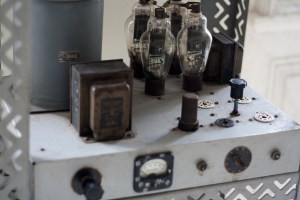
“Rádio que Che transmitia programas revolucionários enquanto estava entocado na montanha” by Flickr user Marco Gomes, CC BY-NC-SA 2.0
The histories of radio played out in different registers elsewhere in the Caribbean. While Haiti eventually acquired a broadcasting station in 1926, there was no local radio in Jamaica until 1939.. British colonial officials, distracted by their bloated empire and feeling the economic pinch in any case, had no appetite for building a local station, though Kingston’s residents frequently called for one. While wealthy residents of Jamaica who could afford shortwave receivers had the world at their fingertips—the BBC, US programs, music from Cuba’s powerful stations—the majority of Jamaicans listened instead to their own voices in songs and popular theater, mostly in Jamaican patois.
As the British Empire relegated Jamaica to the margins, capital, people, and many sounds came from the US. Indeed, strapped British officials conscripted amateur radio operators and their US-bought equipment for state purposes. When passing British ships needed to test communications, they asked amateurs to donate their time and expertise. The most prominent of those, the New Yorker John Grinan, achieved some fame in the ham radio world for his experiments with shortwave radio. A participant in the first exchange of transatlantic signals, and one of the operators who helped relay Tom Heeney’s 1928 boxing match against Gene Tunney between New York and New Zealand (via Jamaica), Grinan lent his technological expertise to the British. When striking Jamaican workers cut telephone and telegraph lines amidst labor unrest in the summer of 1938 colonial officials, lacking access to wireless equipment, asked amateur operators like Grinan to police the rebellion, relaying whatever information they could from their rural stations to Kingston.
In the aftermath, colonial officials hoped the new radio station, created with equipment donated by Grinan, would provide a means of calming the unruly masses through educational broadcasting. But the new station’s programming was so dull, and receivers were so expensive and so unreliable, that few listened. It was only in the late 1950s, through the contributions of people like the actress, writer, and radio personality Louise Bennett that the sounds of patois eased radio’s participation into voluble soundscapes long populated by sound systems, music and talk.
As Bennett joked and chided in patois and local musicians like Bob Marley finally got air time, their performances rescued radio from its elitist roots and people finally tuned in.
By that time in Cuba, both the government and its opposition knew that controlling radio meant wielding power, or at least creating the illusion of that power. Cuba’s commercial ties to the US meant that it took part in its neighbor’s vociferous radio culture. Ads, radios, programs and music crisscrossed the Atlantic and shaped transnational listening. By the 1930s, a large radio public tuned in regularly to radionovelas, music and news available throughout the day. So it seemed to make perfect sense when governments claimed airspace to propagate messages and dissenters tampered with communications networks or deployed underground broadcasts—often from outside of Cuba—to convey their discontent. It was this radio world in which students decided that in order to topple a dictator you needed to occupy a radio station.

“Before going to sleep, Pepito and Bebita listen to a story transmitted by their grandfather, from New York or Chicago.” “Carteles,” January 1923.
Understanding Caribbean radio as a regional history—defined more by circuits and soundwaves than national borders—brings new dimensions to bear on radio histories more generally. Spanning the Caribbean allows me to think about how various listening publics came to be and the contingent nature of those publics. Imperial politics, machines—as instruments of curiosity, desire and violence—and voices converged and diverged in distinct ways to conjure particular publics in particular moments. In order to overcome disturbing origins, radio needed to take part in pre-existing publics. In Jamaica, the inclusion of programs in patois resuscitated a feeble medium. The voices of people like Louise Bennett rendered radio a welcome attraction rather than a patronizing nuisance. In Haiti, radio publics also grew as Kreyol radio plays replaced US-sanctioned programming. Francois Duvalier understood that he could use radio to appeal to many people, drawing them in with celebrations of Haiti’s African roots and Kreyol language. When he became dictator soon after, the publics were already captive. On the other hand, Cuba did not have such a stark linguistic divide. So as soon as radio blanketed the country it could take part in fuelling political rifts. Listening in Cuba meant choosing sides, as all sides spoke through the radio. As the oppositional 1950s turned into the revolutionary 60’s, the battle of voices—the Voice of America, the Voice of Martí, the Voice of Fidel, continued. Understanding the region as a transfer point for empire and capital places the Caribbean at the center of many aspects of the history of communications technologies. It also colors that history with troubling tones whose listeners are long overdue.
—
Alejandra Bronfman is Associate Professor of History at the University of British Columbia, where she teaches courses on Caribbean and Latin American history, historical theory and practice, race in the Americas, and media histories. She is currently working on two projects: A Voice in a Box: Media, Empire and Affiliation in the Caribbean, which records the unwritten histories of sonic technologies in the early twentieth century, and Biography of a Sonic Archive, which draws from the extensive career of Laura Boulton to interrogate the use of recordings in the making of a sonic, exotic Caribbean. http://alejandrabronfman.wordpress.com/
—
Featured image: “Cuba 1619 – 10th Anniversary of Radio Havana Cuba” by Flickr user Joseph Morris, CC BY-NC-ND 2.0
—
REWIND! . . .If you liked this post, you may also dig:
Decolonizing the Radio: Africa Abroad in the Age of Independence– Samantha Pinto
“Everyone I listen to, fake patois…”– Osvaldo Oyola
Hello, Americans: Orson Welles, Latin America, and the Sounds of the “Good Neighbor”– Tom McEnaney
Share this:


Current Top Posts





April 2021

January 2020

November 2019

October 2019

August 2019

April 2014

November 2017

March 2015

December 2017

October 2015
 Sounding Out!
Recent Comments