
Sound Designing Motherhood: Irene Lusztig & Maile Colbert Open The Motherhood Archives

A Conversation Article in Chat with Irene Lusztig, Director of The Motherhood Archives and Sound Designer Maile Colbert
In 2011 filmmaker Irene Lusztig contacted me about designing sound and composing for her film project, The Motherhood Archives.
Irene had spent several years buying discarded educational films on eBay and working in historical archives to amass an unusual and fascinating collection of archival films aimed at teaching women how to be pregnant, give birth, and look after babies. The Motherhood Archives uses this extraordinary archival treasure trove to form a lyrical essay film excavating hidden histories of childbirth in the twentieth century, illuminating our changing narratives of maternal success and failure, and raising questions about our social and historical constructions of motherhood.
I was immediately intrigued by her concept and construction process as well as her desire to work with sound design in a very collaborative manner at an earlier stage in the project than most filmmakers would. Geographically distant, Irene and I mostly worked by “satellite,” using email, chat, Skype, phone, and file sharing software to communicate and send files. We did manage to have a few production weeks in New York and Santa Cruz, but the majority of the work was woven back and forth across an ocean and continent…California to Lisbon, Portugal, West Coast to West Coast. Rather than hindering, this method lent itself to an exquisite corpse nature to the work. In the creation of this article we followed much the same process, using an initial Gmail chat.
Maile Colbert (MC): So, I’m both shy and excited about asking this… why me, Irene?
Irene Lusztig (IL): I had heard your work in both Adele Horne’s film [The Tailenders, 2005] and Rebecca Baron’s [How Little We Know of Our Neighbors, 2005], both films with beautiful sound.
.
The sound in How Little We Know of Our Neighbors in particular does something with natural / unnatural that I was really interested in – field recordings that somehow become other kinds of things as they are layered, transformed, and processed. I think of myself as a documentary maker / artist who is invested in actuality, but not very invested in traditional documentary form, and I think your sound has similar investments and disinvestments. It begins with the sounds of the real world but takes those sounds to very unexpected places that are often quite far from their original context.
.
MC: I love that you brought up the “natural/unnatural.” It not only really describes well my work and approach in general, but also the experience we get in your film with mediated motherhood. We would often talk about certain sections being very science fiction…then you think, wow, this really happened, this is part of a history that led up to our experience now, and one I’m currently having, having recently become pregnant for the first time!
IL: I think there is a lot to say about science fiction and sound! First, there is a great tradition of feminist science fiction that I feel like our work is very connected to: Margaret Atwood, Ursula Le Guin, and even stuff like Shulamith Firestone’s futuristic vision of external uteruses. A lot of that work has in common a willingness to “make strange” or denaturalize aspects of female reproduction and mothering in ways that feel radical.
MC: I’m not sure if I was able to contain my excitement when you first mentioned a section felt sci-fi to you. This is something that I think has a root back in my childhood. My father was and is an obsessive science fiction film watcher: I grew up with a soundtrack of The Day the Earth Stood Still and Lost in Space. These soundscapes that “weren’t” became such a part of what I wanted to listen to.
.
IL: I always thought I had no interest in science fiction when I was younger, but I think growing a human inside my own body probably shifted my relationship to that!
I think science fiction is almost always expressing our anxieties about the future, about our technologies, about things that we struggle to control. And of course questions and anxieties about trying and failing to control things are completely at the heart of our experiences with pregnancy, birth, and learning to be new mothers in the 21st century. As are questions around technological mediations that we feel ambivalent about, whether it’s fertility technologies, medicalized birth technologies, or things like baby monitors or worrying about whether the iPad is rewiring your baby’s brain. So science fiction feels like a sonic space that totally makes sense for negotiating these maternal anxieties.
MC: One of our biggest struggles was trying to make sure things weren’t too dark for the audience.
IL: People often respond with anxiety to the film and its sound design. I’ve never before made a film where the sound comes up so often in post-screening discussions, and generally the question is something like “why is the sound so dark / scary / anxiety-provoking?” It seems very specific to the subject of The Motherhood Archives – how anxious we are societally about the whole topic, and also how uncomfortable we are being open about these anxieties.
MC: I’m still shocked at how shocked I am when I realize how some people react to this film, how uncomfortable they are. U.S. society seems just as afraid of birth as death in this manner! We speak of each in such a similar way and we’re not allowed the complexity of, for example, being simultaneously anxious about how this will affect our careers and identity, and how in love we are when we hear that heartbeat!
IL: Do you think of yourself as a feminist artist? I ask because becoming a mother (and making art about motherhood) has made me much more aware of myself as a feminist artist.
MC: I absolutely consider myself a feminist– it’s woven into every part of my life and my work. I’m also beginning to feel this in a new way with the pregnancy: I recently lost a gig I was really looking forward to because there was an assumption that I couldn’t do it somehow because I was pregnant. A recent interviewer asked me about how I navigate motherhood and my work, and I couldn’t help consider that this question would never come up with a male artist.

My recent recordings of my future daughter growing and moving have been wonderful to listen to: watery and subdued, you still feel like you’re only getting a little of her sonic world, so mysterious. But it reminds me of when I was a child – in any body of water I loved to dive down to the bottom, let go of my breath and just rest there as long as I could…it was an ultimate peace. I loved the visual perspective of the world above me, but most loved the deep gentle filter of everything aural coming through this watery world. Some might argue that peace refers to our first soundscape experienced…and listening to my own active womb, it doesn’t seem far-fetched.
IL: There are a lot of watery sounds in the film! My friend Irene Gustafson made this great connection between all the water in the soundtrack and the voiceover passage in the twilight sleep section about how the “soothing sound of running water muffles newborn cries to prevent the formation of what are called islands of memory.” That description of water literally being used to erase memory allows all the water sounds throughout the film to become a metaphor for the erasure of historical memory… the fact that we no longer remember the historical moment where feminists were advocates for anesthetic drugs and medicalized childbirth, for instance…the many ways that the histories in the film are now forgotten.
.
MC: I think sounds are like cells in a way…they carry a memory, even though abstracted.
That’s why I love working with natural sources initially, something comes through from that palette, a shadow is carried from its initial source. As animals, we use sound for information, much processing and translation happens that we aren’t even aware of. So I do feel like when a sound is removed by processing, it still carries its source information with it, and we pick up on some of that.
IL: Talking about cellular memory makes me think about the section of the film that a friend described as “crispy cells:” the image is from a very early 20th century educational film about reproduction – sheep cells that are dividing and reproducing – and the sound is the sound of the magnetosphere, which I love!
.
MC: I find listening to the magnetosphere sort of grounds me. I use a VLF recorder very often when I travel. If there are lightening storms or space weather, like solar storms, you get these very beautiful and strange soundscapes. I often use the recordings in my work, but your film is the first that seemed to demand them as a sound source! That section just called out for them, in their “pure” form. When you placed them there and sent it to me, I was blown away…it seemed like that was the sound of the video itself somehow.
I’ve been collecting and working on my sound library for over a decade now, and I’ve never been in a situation where a client or collaborator was interested in it in such a hands-on way. It seemed so right to share it with you and build upon it together for this project. For each sound – some of them going way back – I still remember the source, recording conditions, what was surrounding it (or rather what it was surrounding usually!). They become symbols, but also memory triggers. Now some of them have changed and were saved with this project, so there are generations as well. And the historic archival sounds you added to it…they come with their own history and memory; your film and their use is then added to that.
IL: Speaking of archival sound, one of the most amazing (to me) moments in our collaboration was really close to the end when you sent me the end credit sound. We’ve actually never talked about this because as soon as you sent it I totally intuitively and immediately knew that it was perfect. The sound is a backwards transformation of the wax cylinder Chopin Waltz recording that is used earlier in the film during the pregnant ballet sequence. There’s something so brilliant about your instinct to bring back that very polite, restrained music at the end, but have it reversed – both because it turns something familiar and half-remembered on its head, but also because I think it says something about history that is so attuned to the way the film works. The film thinks about histories of childbirth, but the chronological structure is circular, not linear – which I think of as a kind of challenge to the conventional forward-marching progress narrative. History is always haunting the present, and history is always circular. It makes amazing and beautiful sense that this music that we’ve heard before returns at the end in this uncanny backwards form.
—
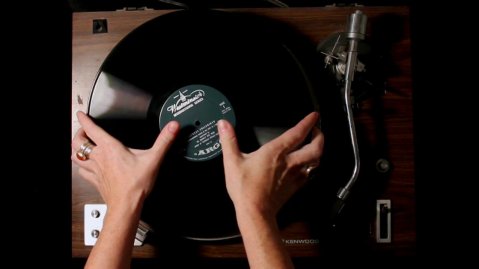
Maile Colbert is a multi-media artist with a concentration on sound and video who relocated from Los Angeles, US to Lisbon, Portugal. She is a regular writer for Sounding Out!
—
 REWIND! . . .If you liked this post, you may also dig:
Wayback Sound Machine: Sound Through Time, Space, and Place— Maile Colbert
Sounds Like a Baby— Liana Silva-Ford
Playing with Bits, Pieces, and Lightning Bolts: An Interview with Sound Artist Andrea Parkins— Maile Colbert
Share this:

GLaDOS, the Voice of Postfeminist Control

Warning, spoilers ahead. Image borrowed from ElderGeek.
Much has been written about Portal, it has won at least seven “Game of the Year” awards and has been ranked as the “Best Game of all Time” by Gamesradar. Perhaps because both the hero and antagonist are women, it has also been the object of several cultural critiques. One blogger writes, “GLaDOS [the game’s villian] is the archetypical oppressed woman.” In an article published by GamePro (a mass-market game review magazine) GLaDOS is considered a “feminist icon.” Although “feminist icon” is a bit extreme, GLaDOS does have a lot to do with feminism. When seen in light of Rosalind Gill’s (2007) essay, “Postfeminist media culture,” GLaDOS, and her wry, disembodied voice, hold striking parallels to the immanence of surveillance in today’s world.

GLaDOS and Chell. Borrowed from gryphonworks @ deviantART.
At their core, the games in Valve Software’s Portal series are relatively straightforward: you are put in control of a female character named Chell, who is attempting to escape from the Aperture Science Laboratory complex. Equipped, mainly, with a portal gun (think Yellow Submarine, “Hole in My Pocket”), Chell traverses precipices, laser drones, acid pits and everything in-between. As she navigates and manipulates these obstacles, a disembodied Orwellian voice guides Chell from one puzzle to the next. This is the voice of GLaDOS (Genetic Lifeform and Disk Operating System), a self-aware computer who runs the joint (at least in Portal 1) and is keeping you around for further “testing.” Where Portal is claustrophobic, just you and GLaDOS, Portal 2 is a little more dynamic. A third character, Wheatley, is introduced. In both games, however; there is an inescapable feeling of surveillance and scrutiny. GLaDOS’s monotonous voice is everywhere, the robotic platforms of the Aperture complex are the only appendages of her body to be found.
What to make of the GLaDOS’s character? Although she is helpful at first when guiding Chell through the early tests, GLaDOS quickly adopts a sarcastic tone – putting Chell down, and belittling her mistakes. G. Christopher Williams of PopMatters reads into the backstory a bit. He points out that GLaDOS is modeled on the personality of the Aperture Science CEO, Cave Johnson’s, wife: Caroline. In the second game there is a tape of Johnson elaborating:
Brain Mapping. Artificial Intelligence. We should have been working on it thirty years ago. I will say this—and I’m gonna say it on tape so everybody hears it a hundred times a day: If I die before you people can pour me into a computer, I want Caroline to run this place.
Now she’ll argue. She’ll say she can’t. She’s modest like that.
But you make her.
Hell, put her in my computer. I don’t care.
GLaDOS, then, has a bit of a history. Within this history there is a glass ceiling. GLaDOS has had a dampening sphere installed to limit her “irrational thinking,” and curb her “misbehavior.” Tellingly, this sphere whispers terrible ideas to her in a babbling male voice. At the end of Portal 1, Chell destroys the dampening sphere, and GLaDOS is free to get revenge on the society that has caged her. At this key moment, the tonality of her voice shifts from accommodating to sultry.
This change in voice accompanies a change in disposition. As Chell continues her adventures in Portal 2, GLaDOS returns with a set of suspiciously cutting remarks. Several barbs are made about Chell gaining weight, being unintelligent, and being adopted. In the sequel, GLaDOS is especially critical of Chell’s body. These pot-shots figure perfectly into Gill’s (2007) hallmarks of postfeminism: 1) the increased self-surveillance of the female body, 2) the increase of surveillance in new social sectors, and 3) a focus on the psychological transformation of one’s self, or interior life. Chell, the avatar, isn’t being judged on her weight (or lack thereof). Instead, GLaDOS’s remarks cut to the player, who recognizes that neither they nor Chell fit GLaDOS’s ideal. Although, in the narrative, GLaDOS typifies an extension of invisible and disembodied surveillance into new spheres of life, her comments act to foster self-surveillance in the embodied player.
GLaDOS’s comments have even jarred some users in the Steam Users’ Forums (Steam is Valve’s online distribution platform). In a thread entitled, “Portal 2 Sexist,” one user, loodmoney, asked if anyone else found GLaDOS’s fat jokes off-putting. To this, another user, Killalaz replied, “GLaDOS is trying to discourage/dishearten the testers. Chell is a woman, what bothers a woman more than being called fat? Not much. . .psychological warfare so to speak.” Although Killalaz may be reading too literally into Portal 2’s narrative, he is right about one thing: to some extent, GLaDOS, and therefore Valve Software, is waging psychological warfare on us all. Later in the thread another user, BC2 Cypher, demonstrates the extent that attitudes of self-surveillance can work to mold one’s psyche, “I don’t see the issue he’re. I actually used to BE fat. Lost 72 pounds when I was 15. 232 – 160. It’s not like Chell is even fat. That is the joke.” The real joke, if there is one, is that so many players are content to reduce GLaDOS’s comments to a self-contained dialogue between fictional characters. What is heard, actually, relates directly to the way dialogue from Portal is internalized. In these forums, the voice of GLaDOS is reproduced; it mediates the bodies of some fans (by supposing an ideal weight), and surveils the bodies of others (by guiding the dialogue).
But, when I play Portal, I occasionally smirk at GLaDOS’s comments. They are cutting satire. If GLaDOS is a feminist icon, it is because she is a voice that everyone carries with them at all times. The voice in our heads, that causes us to judge and shape ourselves, while simultaneously passing unkind judgment on to others. GLaDOS is iconic of the postfeminist condition – a condition where surveillance is assumed and internalized. And, our bodies are shaped through the hyper-mediation of games like Portal, and characters like GLaDOS, as they replicate themselves in web forums, and in our own voices.
AT


Share this:


Current Top Posts





April 2021

January 2020

November 2019

October 2019

August 2019

April 2014

November 2017

March 2015

December 2017

October 2015
 Sounding Out!
Recent Comments