Tag Archive | Gustavus Stadler

Sounding Out! Unplugged: “Power in Listening” (August 2026)
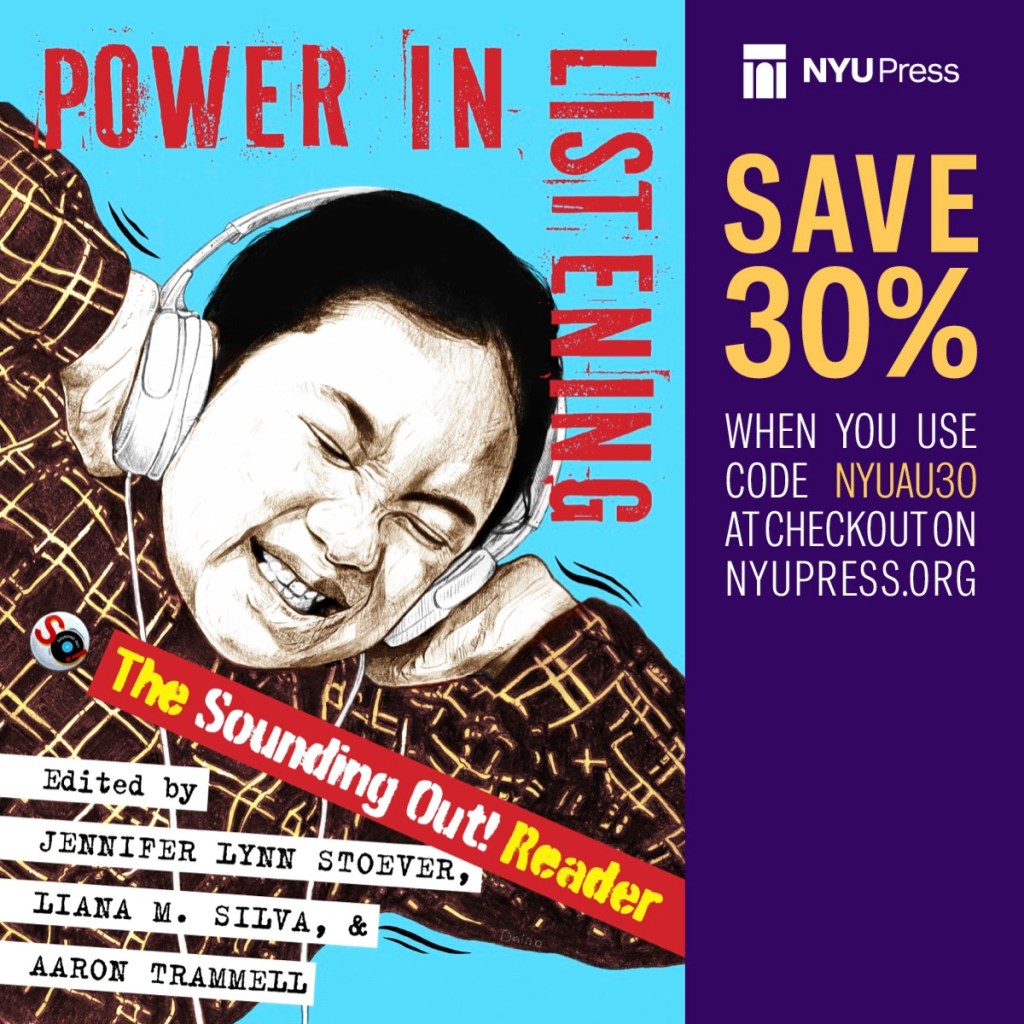
The cover for our forthcoming SO! anthology, coming to you on August 25, 2026 from NYU Press, original cover illustration by Dan Torres (aka Daino)

Hello listeners + readers!

We usually take July as a BYE month to celebrate our yearly blog-o-versary, but this year, we are going bigger! Team SO! is pausing for the full summer–June, July, AND August–to catch our breath in advance of the publication of the official Sounding Out! print anthology, Power in Listening (New York University Press) on August 25, 2026 (although you can pre-order now, if you’d like at Indiepubs, direct from NYU, and other book outlets). This book is a long time coming and we are really proud of what we have put together. It’s a fresh mix of brand new essays with fan-favorites that have been revised, expanded and fully updated to the present, with an introduction by the editorial collective and a forward by SO!‘s very own Neil Verma.

Power in Listening is a love letter to everyone who has participated in the ongoing collective project of the blog over our first 15 years and a fantastic way to kick off the future together. Like the blog, it’s sharp, accessible, gorgeously written, diverse, and ready for the classroom, the library, the beach, public transit, the coffee shop, the couch on a rainy day, the club . . .wherever you love to read, but now you can be unplugged too, which we all need more than ever. Scroll down for more details about the book, including a full author list!

Enjoy the coming months–the book will be out there catching eyes in August and the blog will grab your ears once again this September! Please help us spread the word about the book– we’d love it if you’d tell two friends, so that they two friends, and so on, and so on, and so on. . .or you can share social media, whatever works for you!

Thank you and SO! looking forward–see you in September!

JLS, SO! Ed-in-Chief

P.S. Details to come on release parties, conference events, speaking engagements, podcasts, broadcasts, and all that good stuff! If you’d like us to come out your way to talk about the book, the blog, and all things sound, we have a Google form for that! Contact NYU Press at this link if you are interested in reviewing the book on your publication: https://nyupress.org/resourcesold/for-media/

How listening shapes power

Power in Listening explores how listening shapes—and is shaped by—power. From the politics of “sad girl” Spotify playlists to the sonic architectures of surveillance and the gendered voices of Siri and Alexa, this collection investigates how sound and listening inform identity, embodiment, and social life. How does Beyoncé’s remix of her “elevator incident” expose the surveillance of Black bodies? How do deaf listeners use multiple senses to navigate sound? How are Latina voices racialized through ideas of volume and tone?

Building from the groundbreaking Sounding Out! blog, Power in Listening curates 36 new, revised, and expanded essays from scholars, artists, DJs, and activists across more than twenty disciplines. Together, they trace how auditory culture intersects with race, gender, sexuality, technology, and media—from radio and tape to streaming and AI.

Accessible yet rigorous, this reader reveals sound studies in motion: a field that listens as a form of inquiry, protest, and care. Each essay connects theory and everyday experience, offering tools to hear the world—and each other—more critically. Power in Listening invites readers to experience listening as a social practice, a political act, and a method of understanding one’s place within a resonant and contested public sphere.

Authors

Neil Verma, Nichole Prucha, Rami Stucky, Max Abner, Ola Mohammed, Christie Zwahlen, Art Blake, Liana Silva, Maria Chaves Daza, Tara Betts, Marlén Ríos, Kimberly Williams, Samantha Ege, Aaron Trammell, Christina Giacona, Andrew Salvati, Kemi Adeyemi, Enongo Lumumba-Kasongo, Andreas Pape, AO Roberts, Milena Droumeva, Steph Ceraso, Linda O’Keeffe, Michael Levine, Amanda Gutierrez, Asa Mendelsohn, Rebecca Lentjes, Priscilla Peña Ovalle, Justin Burton, Gustavus Stadler, Dolores Inés Casillas, Jennifer Lynn Stoever, Chris Chien, Benjamin Tausig, Hubert Gendron-Blais, Maile Costa Colbert, and Dustin Tahmahkera

Section Titles and Topics

  • Sonic Presents
  • Putting The “I” in Listening: Memoir as Method
  • The Sound You Make Is Not Your Own: Our Social Voices
  • “Hop With It, Rock With It”: Listening to Popular Culture 
  • Bits and Screeches: Technology and Sound
  • Hitting the Streets: Space, Place, and Sound
  • Panaudicism: Sound and Surveillance
  • Listening While White: Sound and Racial Privilege 
  • “Can You Hear Me Now?”: Sound, Agency, and Activism

What folks are saying. . .

Spotlighting the work of emerging scholars under innovative rubrics like space, gender, time, race, and power, Power in Listening curates an impressive array of authors and disciplinary approaches of the highest caliber. This is a welcome, fresh take on the field of sound studies. ~Roshanak Kheshti, author of Modernity’s Ear: Listening to Race and Gender in World Music

From voice and memoir to technology, space, race, surveillance, and activism, Power in Listening centers captivating soundworkers. and shows how listening can unsettle hierarchies and make new worlds audible. This sharply curated collection brings together newly revised classics from the blog as well as bold new essays that treat listening not as neutral perception, but as a site of power, struggle, pleasure, and possibility. Smart, generous, and unapologetically loud, this book doesn’t just reflect a field. It changes how you hear it. ~Karen Tongson, author of Norm Porn: Queer Viewers and the TV That Soothes Us

Not only chronicles the dynamism of the field of sound studies, but also beckons readers to find the listening experience to be an unmistakably political social practice. Power in Listening is an exceptional achievement, uniting scholars and artists across countless disciplines to foster conversations and new scholarship for years to come. ~Iván Ramos, author of Unbelonging: Inauthentic Sounds in Mexican and Latinx Aesthetics

Jennifer Lynn Stoever is Associate Professor of English at Binghamton University, founding Editor-in-Chief of Sounding Out!, and author of The Sonic Color Line: Race and the Cultural Politics of Listening.

Liana Silva is Managing Editor of Sounding Out! She is a teacher, writer, reader, and editor living in Houston, TX. She graduated from Binghamton University’s Department of English in 2012. In the past she was Editor-in-Chief of the professional publication Women in Higher Education.

Aaron Trammell is Assistant Professor of Informatics and Core Faculty in Visual Studies at UC Irvine and author of Repairing Play: A Black Phenomenology and The Privilege of Play. He is Editor-in-Chief of the journal Analog Games Studies and was an honoree of the hobby game industry’s prestigious Diana Jones Award.

The Top Ten Sounding Out! Posts of 2015!

The holidays are here and to celebrate Sounding Out! has compiled a list of 2015’s top ten most popular posts (according to views). So, cozy up to that monitor, queue up that epic album you’ve been meaning to listen to, and take a second to revisit some of our best memories this year.
chc01700001220001001
Vincent Andrisani
To conceive of Havana in sound is to think not of the material spaces of the city, but rather, across them. From inside the home, residents participate in conversations taking place in the streets, while those in the streets often call for the attention of their friends or family indoors. Through windows, open doors, and porticoes, residents engage in interpersonal exchanges that bring neighbourhood communities to life. To listen across these spaces is to listen trans-liminally from the threshold through which sounds must pass as they animate the vibrant social life of the city. Such an act is made most apparent by the voices of vendedores ambulantes, or, mobile street vendors. “¡El buen paquete de galleta!” (“The good packs of cookies!”), “¡Se compran y se vendan libros!” (“I’m buying and selling books!”), and most famously, “¡Mani! ¡Mani!”(“Peanuts! Peanuts!”) are some of the pregones—the musical cries—heard through the streets and into the home. . . . [CLICK TO READ MORE]
.
LMS loud
Liana Silva
I was 22 years old when someone called me deaf. I was finishing my bachelor’s degree at the University of Puerto Rico, Rio Piedras campus. After four years of living in San Juan, I still hadn’t gotten used to the class and race microaggressions I encountered regularly because I was a brown girl who grew up in the country and was going to school in the urban capital, el área metropolitana. These microaggressions were usually assumptions about who I was based on how I talked: I called pots a certain way, I referred to nickels in another way, and I couldn’t keep my voice down–all indications, according to my “urban” friends, that I grew up in the country. But being called “deaf” was a new one. . . . [CLICK TO READ MORE]
.
andré carrington
Twenty-five years after Do the Right Thing was nominated but overlooked for Best Picture, Spike Lee is about to receive an Academy Award. At the beginning of that modern classic, Rosie Perez danced into our collective imaginations to the sounds of Public Enemy. Branford Marsalis’s saxophone squealing, bass guitar revving up, she sprung into action in front of a row of Bed-Stuy brownstones. Voices stutter to life: “Get—get—get—get down,” says one singer, before another entreats, “Come on and get down,” punctuated by James Brown’s grunt, letting us know we’re in for some hard work. In unison, Chuck D and Flavor Flav place us in time: “Nineteen eighty-nine! The number, another summer…” The track’s structure, barely held in place by the guitar riff and a snare, accommodates Marsalis’s saxophone playing continuously during the chorus, but intermittent scratches and split-second samples make up the plurality of the sounds. The two rappers’ words take back the foreground in each verse, and their cooperative and repetitive style reinforces the song’s message during the chorus, when they trade calls and responses of “Fight the power!” . . . . [CLICK TO READ MORE]
.
181316646_9c6a08bf67_z
Robin James
Dove and Twitter’s #SpeakBeautiful tries to market its brand by getting Twitter users to rally behind the hashtag. The idea is to encourage women to talk about their bodies and other women’s bodies only in positive terms–and to encourage interaction on Twitter. But why is tweeting, which is entirely text-based, called “speaking”? And what does it mean to speak beautifully, since beauty is usually an issue of body image? In other words, why give this campaign that specific name? . . . . [CLICK TO READ MORE]
Tara-Transitory-3-web
Justyna Stasiowska
The shivering on your skin gradually builds like a soft electric shock that presses you down to the floor. The whole experience feels like an earthquake, with vibrations pricking through bone into organs. The affective tonality of the performance puts the body in a state of alarm, where listening turns into self-observation. Your perception is immersed in sensing the materiality of a room filled with other bodies, all attuning to the low frequencies resonating with the architecture of space, trying to maintain equilibrium. You refocus away from the artist to yourself and the rest of the audience, realizing the depth of your feelings of total connection. . . . [CLICK TO READ MORE]
.
 .
5533321889_274538f7c1_b
Mitchell Akiyama
In October of 1973, two young sound recordists embarked on an ambitious field trip across Canada, traversing over 7000 kilometers to commit the national soundscape to tape. From St. John’s, Newfoundland to the harbor of Vancouver, British Columbia, Bruce Davis and Peter Huse pointed their microphones at the things they felt best exemplified their vast country. . . . [CLICK TO READ MORE]
.

http://www.loc.gov/pictures/collection/lomax/item/2007660276/ Alan Lomax (left) and youngster on board boat, during Bahamas recording expedition

Mark Davidson
In 1987, two years after the three hundredth anniversary of Johann Sebastian Bach’s birth, musicologist Susan McClary published a now-classic article titled “The Blasphemy of Talking Politics during the Bach Year,” in which she reflected on her experiences at a number of Bach events in 1985. Using Theodor Adorno’s 1950 essay “Bach Defended against His Devotees” (written on the two-hundredth anniversary of the composer’s death) as a jumping-off point, McClary defied Bach scholars who viewed the German Baroque master’s music as sacrosanct and unimpeachable, and performed a brazen deconstruction of Bach’s most revered works: the Brandenburg Concerto No. 5 and Cantata No. 140 (“Wachet Auf”). For McClary, the turn was critical: “we must confront Bach and the canon and resituate him in such a way as to acknowledge his prominence in musical and non-musical culture while not falling victim to it ( 60)”. . . . [CLICK TO READ MORE]
 .
True revolutionaries are Guided by Love
Maria P. Chaves Daza
In October 1991 at the University of Arizona fall reading series, Gloria Anzaldúa read several poems and short stories–work now held at the UT-Austin Collection. Recently, I sat in my living room listening to the recording, feeling the buzz of her presence, the audible excitement in the Modern Languages Auditorium that Gloria Anzaldúa is about to speak. After some welcoming statements and a poem by Rita Magdaleno, inspired by Magdaleno’s reading of Borderlands, Anzaldúa takes the stage. . . . [CLICK TO READ MORE]
 .

"ateliers claus - 140522 - monophonic - Radio Femmes Fatales" by Flickr user fabonthemoon, CC BY-NC-SA 2.0

Christine Ehrick
Several years ago, while aboard a commercial airline awaiting take off, I heard the expected sound of a voice emerging from the cockpit, transmitted via the plane’s P.A. system. The voice gave passengers the usual greeting and general information about weather conditions, flight time, etc. What was unusual, and caught the otherwise distracted passengers’ attention, was the fact that the voice speaking was female. People looked up from their magazines and devices not because of the “message” but because of the “medium”: a voice that deviated from the standard soundscape of commercial aviation, a field comprised mostly of men. . . .  [CLICK TO READ MORE]
 .
white noise
Gustavus Stadler
What does an ever-nearer, ever-louder police siren sound like in an urban neighborhood, depending on the listener’s racial identity? Rescue or invasion? Impending succor or potential violence? These dichotomies are perhaps overly neat, divorced as they are from context. Nonetheless, contemplating them offers one charged example of how race shapes listening—and hence, some would say, sound itself—in American cities and all over the world. Indeed, in the past year, what Jennifer Stoever calls the “sonic color line” has become newly audible to many white Americans with the attention the #blacklivesmatter movement has drawn to police violence perpetrated routinely against people of color. . . . [CLICK TO READ MORE]

Featured image by bostik_ @Flickr CC BY-NC-ND.

tape reelREWIND! . . .If you liked this post, you may also dig:

Misophonia: Toward a Taxonomy of AnnoyanceCarlo Patrão

Sounding Out! Podcast #38: Radio Frequencies, Radio Forms, LIVE — Monteith McCollum and Jennifer Stoever

Mediated Sexuality in ASMR Videos — Emma Leigh Waldron