
Gendered Ears
While there is a rich discussion in cultural studies about gendered representation in popular music, there remains very little about gendered listening experiences—or, more accurately—gendered perceptions of other’s listening experiences. Big Ears: Listening for Gender in Jazz Studies, one of the newest offerings from Duke’s Refiguring American Music series, makes promising headway in this direction, initiating a conversation about the way in which various types of listening practices—that of fans, musicians, and critics—are coded in the largely male dominated world of jazz. In popular music, however, this conversation has remained more nascent. As a female practitioner in the field with multiple identities—fan, vinyl collector, academic critic, consumer, blogger—it is uncomfortable how frequently I find people making very circumspect and circumscribed assumptions about the way in which I listen to music.
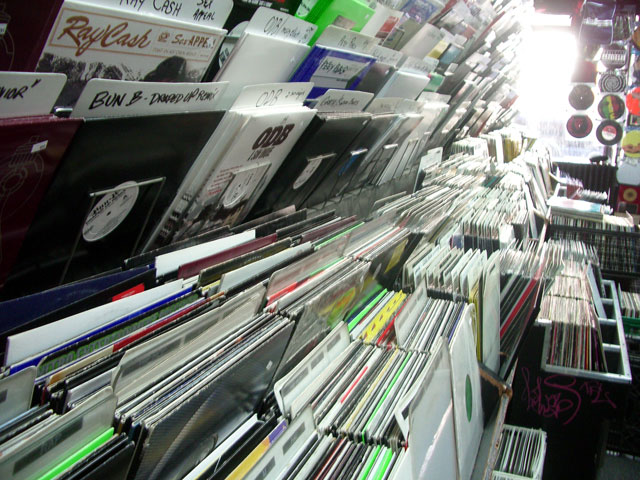 I have been collecting vinyl since the days when it was just called “buying records.” My first purchase at age 5, made via my Dad, was The GoGos’ Beauty and the Beat, which I still own, now carefully tucked into a plastic sleeve. And, thanks to my Dad’s gentle lesson in how to handle vinyl, it isn’t in very bad shape, either. Record collecting was a thrill my father shared with me, creating a connection between us that sometimes held when other bonds were endangered. No matter what, I always wanted to call him and tell him when I finally found a mint copy of Michael Jackson’s Off the Wall at a thrift store or Prince’s Purple Rain with the poster still inside.
A number of weeks ago, I was on a routine summer Saturday morning mission: trolling the yard sales in my neighborhood for kid’s stuff, used books, and vinyl. While I never expect to find the holy grail of record albums at a yard sale, I am always willing to flip through piles of Barbara Streisand, Eddie Rabbit, Billy Joel, and Herb Alpert in the hopes I might uncover it. Usually, I just end up taking in the ripe dusty smell and silently cursing the sad condition of the vinyl I find there, hating to leave even the most scratched-up Mantovani warping in the full summer sun. But you never know.
On this particular Saturday, I was vinyl hunting with my infant son strapped to my chest and had my dog, He Who Cannot Be Named, pulling at the leash. In effect, I had suburban motherhood written all over my body as I strained on my tip-toes to reach records at the back of the pile and whispered to my sleeping son about why I was so excited to find a Les Paul and Mary Ford record. In the midst of my record reveries, I overheard a man next to me begin telling the proprietor of the yard sale about his record collecting habit. He went on and on about how long he has been collecting, how many records he has, how he “just got back from buying a thousand records off a guy in Appalachin.”
My hackles were instantly raised by this conversation about record-size. I already felt a bit left out, as this man obviously chose to ignore the woman actually looking at the records in favor of the only other man around. Vinyl collecting remains an overtly male phenomenon, as Bitch Magazine discussed in their 2003 Obsession issue. Although I am embodied evidence that women do collect vinyl, I am used to being in the complete minority at record shows, music conferences, and dusty basement retail outlets and overhearing countless conversations just like this one. In spite of myself, I decided to jump in to the conversation. . I thought I would cast out a lifeline to my fellow vinyl junkie, as the yard sale guy was obviously not interested and just humoring the record geek in front of him in the hopes that he would cart away the entire stack. Plus, I miss geeking out with someone else who loves records. After a lifetime in urban California, I now live in a small town in Upstate New York. While the record bins are not so tapped out here, it is lonely going for a record head. So I said to him, “I collect records too. I can’t believe you found so many records in Appalachin.” My invitation down the path of geekdom, however, was rebuffed. “Oh,” he said, barely looking up, “yeah. It happens all the time.” And then back to yard sale guy.
I tried not to take it personally, but it became impossible after this same scene was re-enacted at four or five different houses down the block. This guy was like a cover version of the Ancient Mariner, compelled to tell man after man all about the size of his enlarging record collection, the beloved albatross around his neck: “Man, have you ever tried to move a thousand records all at one time? They are so heavy and they take up so much space!”
And, I was the invisible witness to his tale of obsession, love, and woe, silently flipping through records just a few steps ahead of him. That is ultimately how I knew he did not see me as an equal rival in the world of vinyl hunting—he let me get ahead and stay ahead in the bins, neither sneaking peeks at what I pulled or, fingers flying, moving faster and faster in the hopes of overtaking me. He just assumed that I, dog in hand and baby on chest, would pull complete crap.
My listening ears then, bear the weight of my gender and the limited ways in which women are expected to engage with music. Women remain perpetually pegged as teeny-bopper fan club leaders and screaming Beatle fans, perpetually deafening themselves to the “real music.” Despite the deft critiques of Norma Coates, Susan Douglas, and Angela McRobbie, in which the early Beatles audience is re-imagined as proto-feminist and teenaged girls’ bedrooms are viewed as sites of cultural competency rather than deaf consumerism, my female ears remain cast as those of a groupie but never an aficionado, as if the two are somehow mutually exclusive. Imagine the Ancient Mariner’s surprise when this vinyl mama plucked pristine copies of The Cure’s Faith, The Fania All Stars Live at Yankee Stadium, and Aretha Franklin’s Live at the Fillmore West right out from under his own blind ears.
–JSA


Share this:

The Grain of the Voice or the Contour of the Ear?
One of the most exciting possibilities emerging within sound studies is the emphasis on the listener and his/her role in shaping a sound’s meaning and content. Sounds disconnected from their contexts of reception rarely answer our questions about the past, but merely make for new listening experiences in the present. Thinking with our ears is profound, but thinking through our ears can be life-changing—moving us closer to an understanding of sound’s power and its intensive connection to memory and the emotive forces of both life and death.
Until very recently, I had not heard the sound of my Grandmother’s voice in over eight years. I had actually never expected to hear it again, as she died in 2001. It is a clichéd understatement that I loved my grandmother very much; when she died, I was barely a “real” adult and I felt like we had just gotten acquainted. However, I thought I had already made peace with the passing of her beloved throaty crackle into the world of furtive dreams and spotty memory, until one night in 2004, when this loss was suddenly found.
Somewhere around two a.m. on a weekday, the phone rang. Once you are past a certain age, the shrill peal of a telephone after midnight can be downright terrifying. Someone has died. Someone is calling from jail. Someone’s life is in shreds. Nothing good. My hand hovered over the receiver for a second, as I rubbed my tired eyes and steeled myself for whatever might be at the other line.
“Hello,” I mumbled, hesitatingly.
Silence, for a second. And, then, the keen of my sister’s voice, choked through tears, “I found it.”
Inexplicably, my groggy listening ears automatically knew precisely what “it” was : an oral history of my grandmother I recorded in 1998, on teeny-tiny tapes in an itsy-bitsy recorder my sister used to record her professor’s lectures. I borrowed it, and like a good sister, I returned it. Tapes included. At the time, I thought there would be plenty more opportunities to have deep convos with Grandma. I had always assumed my sister recycled it, replacing my grandmother’s words with her bio prof’s. With three little gasped words, I realized she hadn’t.
You’d think my first reaction would be excitement—and I was thrilled, but in the nineteenth-century sense. My heart was pierced by even the thought of hearing my Grandmother’s voice again; the imagined sound tremored through me and, in a moment of pure protective reflex, I immediately cast the receiver away. In a sense, I had heard my grandmother’s ghost. The sounds magnetized on that tape seemed to resurrect her and mock the promise of that hour of conversation, when we had no idea what lay ahead.
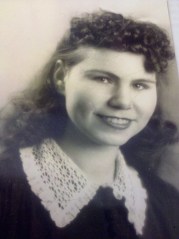
Even though I made the conscious decision not to listen to the tape, I let the thought of her audio presence haunt me for five years. I could not escape the thought of her voice both in my memory and in this new audio embodiment. Oddly enough, I surrounded myself with pictures of my Grandmother as remembrances—cheeky 1940s shots from her youth as well as seasoned photos of us together—but those images brought me cool comfort. Their framed borders demarcated a long-gone past. When my chest got too tight, I could look away. Not so with the vibrations of her voice, which sounded out the contours of her absent body. Her voice threatened too much wonder, and with it, an attendant dose of insatiable longing. Unlike the frozen photographic slices of life, the sound had an animated heft to it. It breathed.
Ultimately, I was unable to listen to the tape through my own ears. It wasn’t until the birth of my son that I even considered playing it. Suddenly, my grandmother wasn’t mine alone, but also the great-grandmother my son would never really know. The new relation between the two of them allowed me to fashion another set of ears; I became a new listener, connected to the voice by life rather than death, by shared possibility rather than the solipsism of grief. So on a snowy night last January, I finally pressed play. With my infant son in my arms, I listened, at long last, to that beautiful crackling voice spinning stories of her childhood in Iowa and adult life in California. Ironically, I almost immediately realized there were actually two dead voices on that tape. I had long since shed the happy-but-halting girlish voice of my youth like an ill-fitting skin, but hadn’t quite realized it until I heard my old nervous laughter fill the speakers. I realized that, someday, I’ll have to introduce my son to that young woman too.
JSA
My Grandma and I talk about WWII and the sinking of the Ruben James:
Grandma Maryanne’s Interview Segment 1
My Favorite part of the interview:
Grandma Maryanne’s Interview Segment 2


Share this:


Current Top Posts





April 2021

January 2020

November 2019

October 2019

August 2019

April 2014

November 2017

March 2015

December 2017

October 2015
 Sounding Out!
Recent Comments