
Look Away and Listen: The Audiovisual Litany in Philosophy
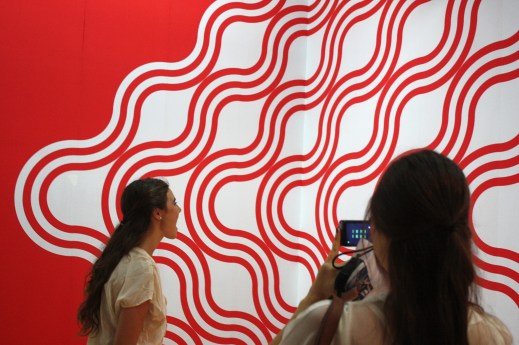
This is an excerpt from a paper I delivered at the 2017 meeting of the Society for Phenomenology and Existential Philosophy.
—

“Compressed and rarefied air particles of sound waves” from Popular Science Monthly, Volume 13. In the public domain, via Wikimedia Commons.
According to sound studies scholar Jonathan Sterne in The Audible Past, many philosophers practice an “audiovisual litany,” which is a conceptual gesture that favorably opposes sound and sonic phenomena to a supposedly occularcentric status quo. He states, “the audiovisual litany…idealizes hearing (and, by extension, speech) as manifesting a kind of pure interiority. It alternately denigrates and elevates vision: as a fallen sense, vision takes us out of the world. But it also bathes us in the clear light of reason” (15). In other words, Western culture is occularcentric, but the gaze is bad, so luckily sound and listening fix all that’s bad about it. It can seem like the audiovisual litany is everywhere these days: from Adriana Cavarero’s politics of vocal resonance, to Karen Barad’s diffraction, to, well, a ton of Deleuze-inspired scholarship from thinkers as diverse as Elizabeth Grosz and Steve Goodman, philosophers use some variation on the idea of acoustic resonance (as in, oscillatory patterns of variable pressure that interact via phase relationships) to mark their departure from European philosophy’s traditional models of abstraction, which are visual and verbal, and to overcome the skeptical melancholy that results from them. The field of philosophy seems to argue that we need to replace traditional models of philosophical abstraction, which are usually based on words or images, with sound-based models, but this argument reproduces hegemonic ideas about sight and sound.
 For Sterne, the audiovisual litany is traditionally part of the “metaphysics of presence” that we get from Plato and Christianity: sound and speech offer the fullness and immediacy that vision and words deny. However, contemporary versions of the litany appeal to a different metaphysics. For example, Cavarero in For More Than One Voice argues that the privileging of vision over sound is the foundation of the metaphysics of presence. “The visual metaphor,” she argues, “is not simply an illustration; rather, it constitutes the entire metaphysical system” (38). The problem with this videocentric metaphysics is that it “legitimates the reduction of whatever is seen to an object” (Cavarero 176) and it cannot “anticipate” or “confirm the uniqueness” of each individual (4). In other words, it objectifies and abstracts, and that’s bad. If vision is the foundation of the metaphysics of presence, one way to fix its problems is to replace the foundation with something else. Cavarero thinks vocal resonance avoids the objectifying and abstracting tendencies that images and text supposedly lend to philosophy.
Similarly, in the same way that the traditional audiovisual litany “assume[s] that sound draws us into the world while vision separates us from it” (Sterne 18), Barad’s argument for agential realism in Meeting the Universe Halfway assumes that diffraction draws theorists into actual contact with matter while “reflection still holds the world at a distance” (87). Agential realism looks is the view that even the most basic units of reality, like the basic particles of matter, exercise agency as they interact to form more complex units; diffraction is Barad’s theory about how these particles interact. This litany of distance-versus-relationality and external objectivity versus immersive materiality structures Barad’s counterpoint between reflection and diffraction. For example, she contrasts traditional investment in reflective surfaces—“the belief that words, concepts, ideas, and the like accurately reflect or mirror the things to which they refer-makes a finely polished surface of this whole affair” (86)–with diffractive interiorities, which get down to “the real consequences, interventions, creative possibilities, and responsibilities of intra-acting within and as part of the world” (37). But how do we know Barad is appealing to an audiovisual litany? We know because her fundamental concept–diffraction–describes the behavior of waveforms as they encounter other things, and 21st century Western scientists and music scholars think sound is a waveform. When two or more waves interact, they produce “alternating pattern[s] of wave intensity” or “increasing and decreasing intensities” (Barad 77), like ripples in water or alternating light frequencies.

“diffracted hydrogen” by Flickr user candace, CC BY 2.0
Barad appeals to notions of consonance and dissonance to explain how these patterns interact. For example, when diffracting light waves around a razor blade, “bright spots appear in places where the waves enhance one another-that is, where there is ‘constructive interference’-and dark spots appear where the waves cancel one another-that is, where there is ‘destructive interference’” (Barad 77). This “constructive” and “destructive” interference is like audio amplification and masking: when frequencies are perfectly in sync (peaks align with peaks, valleys with valleys), they amplify; when frequencies are perfectly out of sync (peaks align with valleys), they cancel each other out (this is how noise-cancelling headphones work). Constructive interference is consonance: the synced patterns amplify one another; destructive interference is dissonance: the out-of-sync patterns mask each other. Both types of interference are varieties of resonance, a rational or irrational phase relationship among frequencies. Rational phase relationships are ones where the shorter phases or periods of higher frequencies are evenly divisible into the longer phases/periods; irrational phase relationships happen when the shorter phases can’t be evenly divided into the longer wavelengths. Abstracting from waveforms to philosophical analysis, Barad often uses resonance as a metaphor to translate wave behavior into materialist philosophical methods. However, even though most of Barad’s examples throughout Meeting the Universe Halfway are visual, she’s describing what scientists call acoustic relationships.
For example, Barad argues that “diffractively read[ing]” philosophical texts means processing “insights through one another for the patterns of resonance and dissonance they coproduce” (195; emphasis mine). Similarly, she advises her readers to tune into the “dissonant and harmonic resonances” (43) that emerge when they try “diffracting these insights [from an early chapter in her book] through the grating of the entire set of book chapters” (30). As patterns of higher and lower intensity that interact via ir/rational phase relationships, diffraction patterns are a type of acoustic resonance. Appealing to acoustics against representationalism, Barad practices a version of the audiovisual litany. And she’s not the only new materialist to do so—Jane Bennett’s concept of vibration and Elizabeth Grosz’s notion of “music” also ontologize a similar idea of resonance and claim it overcomes the distancing and skeptical melancholy produced by traditional methods of philosophical abstraction.

“Painter” by Flickr user Flood G., CC BY-NC-ND 2.0
There are also instances of the audiovisual litany in phenomenology. For example, Alia Al-Saji develops in the article “A Phenomenology of Critical-Ethical Vision” a notion of “critical-ethical vision” against “objectifying vision,” and, via a reading of Merleau-Ponty, grounds the former, better notion of sight (and thought) in his analogy between painting and listening. According to Al-Saji, “objectifying vision” is the model of sight that has dominated much of European philosophy since the Enlightenment. “Objectifying vision” takes seeing as “merely a matter of re-cognition, the objectivation and categorization of the visible into clear-cut solids, into objects with definite contours and uses” (375). Because it operates in a two-dimensional metaphysical plane it can only see in binary terms (same/other): “Objectifying vision is thus reductive of lateral difference as relationality” (390). According to Al-Saji, Merleau-Ponty’s theory of painting develops an account of vision that is “non-objectifying” (388) and relational. We cannot see paintings as already-constituted objects, but as visualizations, the emergence of vision from a particular set of conditions. Such seeing allows us “to glimpse the intercorporeal, social and historical institution of my own vision, to remember my affective dependence on an alterity whose invisibility my [objectifying] vision takes for granted” (Al-Saji 391). Al-Saji turns to sonic language to describe such relational seeing: “more than mere looking, this is seeing that listens (391; emphasis mine).
This Merleau-Pontian vision not only departs from traditional European Enlightenment accounts of vision, it gestures toward traditional European accounts of hearing. Similarly, Fred Evans, in The Multivoiced Body uses voice as a metaphor for the Deleuzo-Guattarian metaphysics that he calls “chaosmos” or “composed chaos” (86); he then contrasts chaosmos to “homophonic” (67) Enlightenment metaphysics. According to Evans, if “‘voices,’ not individuals, the State, or social structures, are the primary participants in society” (256), then “reciprocity” and “mutual intersection” (59) appear as fundamental social values (rather than, say, autonomy). This analysis exemplifies what is at the crux of the audiovisual litany: voices put us back in touch with what European modernity and postmodernity abstract away.

“Image from page 401 of “Surgical anatomy : a treatise on human anatomy in its application to the practice of medicine and surgery” (1901)” by Flickr user Internet Archive Book Images
The audiovisual litany is hot right now: as I’ve just shown, it’s commonly marshaled in the various attempts to move past or go beyond stale old Western modernist and postmodernist philosophy, with all their anthropocentrism and correlationism and classical liberalism. To play with Marie Thompson’s words a bit, just as there is an “ontological turn in sound studies,” there’s a “sound turn in ontological studies.” But why? What does sound DO for this specific philosophical project? And what kind of sound are we appealing to anyway?
The audiovisual litany naturalizes hegemonic concepts of sound and sight and uses these as metaphors for philosophical positions. This lets philosophical assumptions pass by unnoticed because they appear as “natural” features of various sensory modalities. Though he doesn’t use this term, Sterne’s analysis implies that the audiovisual litany is what Mary Beth Mader calls a sleight. “Sleights” are, according to Mader in Sleights of Reason,“conceptual collaborations that function as switches or ruses important to the continuing centrality and pertinence of the social category of a political system like “sex” (3). Sleights, in other words, are conceptual slippages that render underlying hegemonic structures like cisheteropatriarchy coherent. More specifically, sleights are “conceptual jacquemarts” (Mader 5). Jacquemarts are effectively the Milli Vanilli of clocks: sounds appear to come from one overtly visible, aesthetically appealing source action (figures ringing a bell) but they actually come from a hidden, less aesthetically appealing source action (hammers hitting gongs). The clock is constructed in a way to “misdirect or misindicate” (Mader 8) both who is making the sound and how they are making it. A sound exists, but its source is misattributed. This is exactly what happens in the uses of the audiovisual litany I discuss above: philosophers misdirect or misindicate the source of the distinction they use the audiovisual litany to mark. The litany doesn’t track the difference between sensory media or perceptual faculties, but between two different methods of abstraction.

Screenshot from Milli Vanilli’s video “Don’t Forget My Number”
This slippage between perceptual medium and philosophical method facilitates the continued centrality of Philosophy-capital-P: philosophy appears to reform its methods and fix its problems, while actually re-investing in its traditional boundaries, values, and commitments. For example, both new materialists and sound studies scholars have been widely critiqued for actively ignoring work on sound and resonance in black studies (e.g., by Zakiyyah Jackson, Diana Leong, Maire Thompson). As Zakiyyah Jackson argues in “Outer Worlds: The Persistence of Race in Movement “Beyond the Human,” new materialism’s “gestures toward the ‘post’ or the ‘beyond’ effectively ignore praxes of humanity and critiques produced by black people” (215), and in so doing ironically reinstitute the very thing new materialism claims to supercede. Stratifying theory into “new” and not-new, new materialist “appeals to move ‘beyond’…may actually reintroduce the Eurocentric transcendentalism this movement purports to disrupt” (Jackson 215) by exclusively focusing on European philosophers’ accounts of sound and sight. Similarly, these uses of the litany often appeal only to other philosophers’ accounts of sound or music, not actual works or practices or performances. They don’t even attend to the sonic dimensions of literary texts, a method that scholars such as Jennifer Lynn Stoever and Alexander Weheliye develop in their work. Philosophers use the audiovisual litany to disguise philosophy’s ugly politics—white supremacy and Eurocentrism—behind an outwardly pleasing conceptual gesture: the turn from sight or text to sound. With this variation of the audiovisual litany, Philosophy appears to cross beyond its conventional boundaries while actually doubling-down on them.
—
Featured image: “soundwaves” from Flickr user istolethetv
—
Robin James is Associate Professor of Philosophy at UNC Charlotte. She is author of two books: Resilience & Melancholy: pop music, feminism, and neoliberalism, published by Zer0 books last year, and The Conjectural Body: gender, race and the philosophy of music was published by Lexington Books in 2010. Her work on feminism, race, contemporary continental philosophy, pop music, and sound studies has appeared in The New Inquiry, Hypatia, differences, Contemporary Aesthetics, and the Journal of Popular Music Studies. She is also a digital sound artist and musician. She blogs at its-her-factory.com and is a regular contributor to Cyborgology.
—
 REWIND! . . .If you liked this post, you may also dig:
From “listening” to “filling in”: where “La Soeur Écoute” Teaches Us to Listen-Emmanuelle Sontag
The Listening Body in Death –Denise Gill
Re-orienting Sound Studies’ Aural Fixation: Christine Sun Kim’s “Subjective Loudness”-Sarah Mayberry Scott
Share this:

SO! Reads: Damon Krukowski’s The New Analog

 Analog revival has gained traction across many media in recent years, but perhaps nowhere so strikingly as in sound. The shifting formats and fortunes of a digitally reshaped music industry invite, for many, the counterposition of a bright nostalgic picture. Yet artists and engineers whose work has spanned the transition from analog to digital sound find that the romanticization of the former can have a weird overreach. For example, when Dave Grohl produced a digital-decrying documentary on the LA studio Sound City, engineer Larry Crane was bemused that “Grohl seems to be attributing the arc of his career to the magic in a Neve console.” Recordists like Crane find themselves in between the Scylla and Charybdis of digital-era music: on one side, the embrace of new tools that are as entangled with corporate control structures as they are convenient; on the other, a skepticism that overshoots its mark, fetishizing old technologies and cementing a previous generation’s in-crowd as gatekeepers. Decades after digital media triggered one of the most momentous transitions in sound recording, the debate around their use is anything but settled. Tied up in this contest are questions of how and what pre-digital media will be preserved, but also problems like whose use of technology in music-making constitutes authentic talent and who has authority in the determination.
 When Damon Krukowski steers into these waters with The New Analog: Listening and Reconnecting in a Digital World (The New Press: 2017), he is quick to qualify that his memorializing of pre-digital practices “is hardly a Luddite’s call” (12). Noting the “all-or nothing response” that “dominates popular discussion of the many anxieties provoked by the digital revolution” (9), Krukowski contrasts the disruption-embracing “clean break” with life on the “technological island” (8) of confining one’s practice to outmoded materials. Addressing a reader who lives more or less contentedly in a contemporary media world, he speaks as a kind of expatriate of the analog island. He, too, lives in the digital present, but he sees it through the lens of decades spent working with and listening through analog machines. His project of defending analog listening practices takes inspiration from the efforts of urbanist Jane Jacobs, who labored to turn back the tide of redevelopment and suburbanization by celebrating the organic functionality of city life. His central argument for preservation is that “what we are losing in the demolition of analog media is noise” (197, emphasis original). Noise becomes a character in The New Analog akin to the city block in Jacobs’s work: a wrongly maligned figure that has quietly formed the basis of experience and utility in the old mode.
Though Krukowski’s definition of noise is flexible in some ways, he casts the digital as its uncompromising antithesis. This position precludes what could make the book more forward-looking in its aim: a consideration that noise might become a new kind of character in the digital realm rather than disappearing at its edge. Noise shows up in analog media as buzzing undercurrents and as modes of distortion when electrical signals exceed their ranges; digital media, while lacking these, are replete with moments of failure when a system is fed the wrong kind of information or pushed beyond its intended bounds. In their repetition, these moments of error become a new kind of noise that, just like analog noise, forms an unremovable layer of our experience in mediated environments. By declining to look for digital noise and instead focusing so squarely on noise as something lost to the digital transition, Krukowski misses a chance to center a more significant linkage with Jacobs: many of the problems he sees in digital-era sound are not due to the inherent nature of digital media but rather to the same motives of control and segregation underpinning the drive toward suburbanization.
Yet his original and thoughtfully cast historical route points us toward these culprits, even when the language drifts toward a more technologically deterministic stance. It is thus that his book still provides a vibrant body of historical consideration we can leverage in using noise to reshape our digital ways of listening. The moments when Krukowski lets technology stand in for the human motives that construct it give unfortunate cover to what should be the targets of such a critique. But his real concern toward the digital era arises from specific changes in the landscape of aural awareness, and he ultimately succeeds in the task of elevating his argument above the cliché of deterministic digital-bashing by setting its true focus not on the digital but on the era.

headphones by Flickr user Chris, (CC BY-NC-ND 2.0)
Readers might be surprised, for instance, to discover that The New Analog’s first chapter covers a development in sound — the transition from mono to stereo — that has nothing to do with digitization at its outset. The chapter narrates the release of Pink Floyd’s The Dark Side of the Moon as a critical moment in consumer audio’s treatment of headphones as the ideal listening space. This movement toward individualized experience becomes a crucial part of setting the stage for the actual entrance of the digital. The design of digital media, Krukowski demonstrates, has not just carried forward this trend but absorbed it as a guiding principle, and has effected the same transformation not just in listening to music but across all kinds of daily situations. “The stream of digital information can put each of us in a different space than the others, even as we hurtle together through a tunnel on fixed tracks,” (49) Krukowski observes of the changed social experience of riding a subway. The comment makes an easy metaphoric return to music: digital design is now funneling sonic experience into a small number of streaming platforms, each promoted on the appeal of moving out of a collective listening space into one of personal curation. Claiming that a dangerous disorientation can arise in the separation of such neatly personalized spaces from their messier surroundings, the chapter closes with a cautionary tone: bad things can happen when we follow along with the digital logic of turning a once noisy situation into “a stream that is signal only” and when we stop “paying attention to noise.” (51, emphasis original).
Noise closes out each chapter, constituting the shared floor on which the book’s arguments stand. This construction calls for scrutiny, because noise is a notoriously slippery figure. As Marie Thompson notes in her recent interview with SO!, subjective and objective definitions both lay claim to noise, bringing along problems of politicized value judgment and erased context. At the same time, the term’s many meanings (electrical, legal, musical, etc.) serve as useful bridges. In Sound Ideas: Music, Machines, and Experience, Aden Evens uses noise as a primary example when he suggests a “productive ambiguity” can prompt connections that help different disciplines approach meeting points. Krukowski would, it seems, endorse this idea. He couples his formulation of noise to that of analog — an analog medium is identifiable by its noisiness, and noise is the substrate by which meaning takes hold in an analog medium.
Is it fair, though, to chain the figure of noise so tightly to analog recording that we must say it is wholly lost in the move to digital? In arguing that digitally mediated communication lacks the analog mode’s quality of perceivable distance, Krukowski lists perceptual coding — the application of “psychoacoustic research to digital sound processing” (75) — as one culprit. Jonathan Sterne, in MP3: The Meaning of a Format, points to perceptual coding’s advent as a moment when noise was domesticated. Where engineers had long sought to minimize noise, perceptual coding meant that “communication engineering exhibited a new attitude toward noise. Once you can use signal to hide noise, the game is up. Noise ceases to matter as a perceptual category.” This change in noise’s status does not eradicate it or lessen its importance, though. According to Sterne, this domestication made noise more available as a site for artistic exploration and subversion. But if noise is a key foundation on which we find meaning through listening, as Krukowski compellingly argues, and noise has been subjected to a great domestication, what does that say about the forces at work upon our listening?
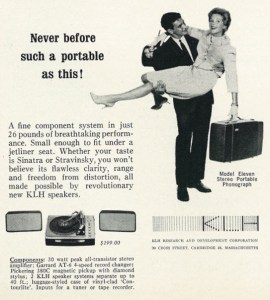 A fascinating answer emerges in a thread that pops up multiple times across Krukowski’s anecdotes: the relationship between patriarchal domesticity and the shaping of digital sound. In the chapter on stereo, he includes an ad from a 1962 Playboy issue where a man carries a woman as if across a threshold; she, in turn, holds a stereo set in its portable case. The ad pairs the stereo and the wife as two laudable choices in the man’s domestic assemblage. Both are manageable enough for him to carry home, yet both promise to extend his control — Krukowski notes that such marketing material touted stereo products as letting their owners occupy “the producer’s chair” (28) by granting listeners new agency over the mix. That focus on idealized male consumers echoes still through gendered suppression in musical exchange: as Elizabeth Newton writes, “Though women have collected vinyl since the inception of the medium, female collectors, like the women musicians being collected, often lack representation in public space that is commensurate with their actual involvement.”
True to the analogy with Jane Jacobs’s struggle against the developer Robert Moses, the patriarchal force that has ingrained itself so thoroughly in digital audio is also a suburbanizing one, keyed to a politics of racial segregation that frequently cites noise as a justification. In “‘Just Be Quiet Pu-leeze’: The New York Amsterdam News Fights the Postwar ‘Campaign against Noise,’” Jennifer Stoever documents how “white press discourse on Puerto Rican migration firmly attached ‘noise’ to the voices, bodies, and neighborhoods of Puerto Rican migrants — portraying white flight to the suburbs as a justifiable escape to suburban refuges of peace and quiet and targeting urban areas such as Harlem in ‘antinoise’ campaigns” (PAGE). Regina Bradley traces this “connection between whiteness and quiet” through to a contemporary moment in her SO! post “Fear of a Black (in the) Suburb.” The history of racially targeted noise ordinances intersects Krukowski’s narration of the proto-digital movement toward private listening. He quotes LL Cool J’s “I Can’t Live Without My Radio” as a noise-ordinance-defying affirmation of boombox listening, the antithesis of headphones and their sonic compartmentalization. Dwelling on the song’s line “Terrorizing my neighbors with the heavy bass,” he points to the artist’s intentional use of noise as a political implement, bound up jointly in his listening and his music making.
For Krukowski, the song is noteworthy in demonstrating a practice lost to the wave of noise-eradicating digital development in sound. If we approach it with the consideration that noise might not have been lost but rather domesticated, however, it serves more as a guidepost. Were he looking to LL Cool J’s example as one in need of a digital-era parallel, Krukowski might arrive at a different treatment of Kanye West’s post-release revisions of his album The Life of Pablo than he gives later in the book. Rather than describing West’s changes as “art severed from its own history” (169), he could instead credit the album’s uniquely digital instability as a moment of usurping the corporate platform as the arbiter of a record’s final version — an instance of harnessing digital noise within a digital environment to reorient its assumed parameters of authority and a prompt for listeners to consider their own role in deciding what version of the text should prevail.
Though Krukowski declines to bring it to the forefront, the involvement of a domesticating and segregating force lends further weight and precision to The New Analog’s historical argument. Returning to his invocation of Jane Jacobs, Krukowski analogizes the dichotomy of street and home with that of analog and digital. “Noise has a value of its own—the value of shared space and time,” he writes. “The urban spaces we occupy are built on that commonality. The street is a noisy place. And the street has value, as Jane Jacobs pointed out” (207, emphasis original). The contrast between analog street and digital home reaches back to rescue the book from the flawed pronouncement that digital tools themselves are the problem. We are left to consider a much richer historical argument about the alarming success that efforts of domestication and power-consolidation have found in intertwining themselves with digital media.
In that light, readers looking for an actionable takeaway from The New Analog shouldn’t just unsubscribe from streaming services and start (or resume) buying vinyl records. They should redirect their attention toward the very thing of whose existence Krukowski seems skeptical: digital noise. Even though the digital home is built to confine, there are new noisy streets outside it to be explored. Krukowski recounts how the band Can endeavored to let their recording studio “compose on its own” and to become an activating, curating conduit for the sounds of tape machines. “In Can’s studio technique,” he writes, “noise and signal are equally significant materials…. the noises in it are no less human than the signals” (138). If we look for digital noise, we will see that it bears no less potential for meaning and beauty than Can’s analog noise, as artists are already proving with techniques like glitch and sampling. We as listeners can do more to help realize that aim by celebrating digital noise, by recognizing what it reveals and critiques. For a project that with less care could have steered off into the welcoming terrain of nostalgic grievance, The New Analog offers a surprising amount to point our way forward.
Holly Herndon’s “Home” uses sonic and visual sampling to turn the surveillant gaze of an intimate digital space back on itself.
—
Featured image: “Scenes From The Recording Studio” by Flickr user G. Dawson, CC BY-NC-ND 2.0
—
Andy Kelleher Stuhl is a writer, sound artist, and software developer focused on creative infrastructures and the politics of mediated sonic exchange. His work looks to musicians for inspiration and aims to apply musical creativity as a model for new paths in such domains as digital humanities and the critique of technology. His research has investigated the phenomenon of analog fetishism from the perspective of sound engineer communities and, more recently, the process and aspirations behind interactive musical works. He holds a master’s degree in Comparative Media Studies from the Massachusetts Institute of Technology and a BA in Science, Technology, and Society from Stanford University.
—
 REWIND! . . .If you liked this post, you may also dig:
SO! Reads: Susan Schmidt Horning’s Chasing Sound: Technology, Culture and the Art of Studio Recording from Edison to the LP— Enongo Lumumba-Kasongo
SO! Reads: Jonathan Sterne’s MP3: The Meaning of a Format–Aaron Trammell
Digital Analogies: Techniques of Sonic Play–Roger Moseley
Evoking the Object: Physicality in the Digital Age of Music–-Primus Luta
Share this:


Current Top Posts





April 2021

January 2020

November 2019

October 2019

August 2019

April 2014

November 2017

March 2015

December 2017

October 2015
 Sounding Out!
Recent Comments