
Gendered Sonic Violence, from the Waiting Room to the Locker Room

This past August 2016, professional “pick-up artist” Dan Bacon caused a stir with his article “How to Talk to a Woman Who is Wearing Headphones.” The article was published on TheModernMan, a site pledging to “make [a woman] want to have sex with you ASAP.” Bacon offers step-by-step “instructions” for pick-up artists to overcome the obstacle of being rendered inaudible by the music a woman might be listening to:
She will most likely take off her headphones to talk to you when you say, ‘Hey, how’s it going?’, but if she doesn’t, just smile, point to her headphones and confidently ask, ‘Can you take off your headphones for a minute?’ as you pretend to be taking headphones off your head, so she fully understands what you mean.
His article was criticized in articles that appeared in The Guardian, Washington Post, Slate, and other news sites, which pointed out that Bacon and his followers advocated ignoring a clear visual signifier of privacy in pursuit of sex. Not only did Bacon feel entitled to a woman’s time, they suggested, but also to an audience. What Bacon insists is “two, [sic] normal human beings having a conversation” is in fact a belief in his unilateral right to be heard.
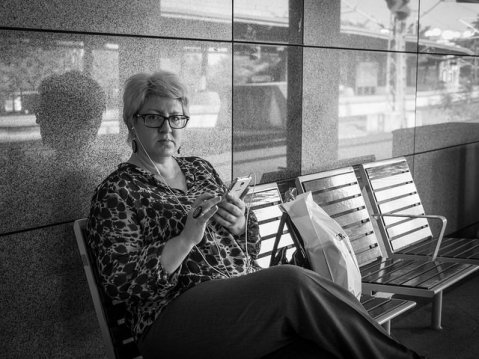
Image by Flickr User Chris Wolcott, Attribution 2.0 Generic (CC BY 2.0)
I witness a similar gendered dynamic of forced listening each week outside of a women’s health clinic in New York, where I volunteer as a clinic escort. Evangelical protesters from a handful of churches line the sidewalks outside the clinic every Saturday morning during the hours that they know abortions have been scheduled (in addition to pap smears, screenings for sexually transmitted infection, prenatal care, transgender services, etc.). Escorts walk with patients down the block to the front door. The sidewalk becomes a space of physical and emotional risk as protesters block the pathway with large, gruesome signs and their flailing limbs (at times physically assaulting volunteers and patients), as well as filming and photographing patients in the hopes of inducing shame.
Among their most intrusive weapons is the scream, which male protestors direct at patients, nurses, doctors, volunteers, security guards, and passersby. While women are abortion protestors, too, they generally get relegated to note-taking, sign holding, and pamphlet distribution, almost never given the authority to “sidewalk preach” or scream. In my experience of listening to this masculine screaming, words lose all sense and become pure sensation. Some patients wince, most speed up their pace, a few burst into nervous laughter, and almost all are stunned into speechlessness as they experience what one volunteer calls “the ripping apart of silence.”
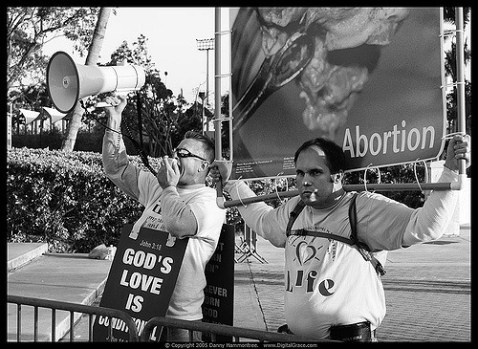
Anti-Abortion protest in Miami, 2006, Image by Flickr User Danny Hammontree, Attribution-NonCommercial-NoDerivs 2.0 Generic (CC BY-NC-ND 2.0)
During otherwise quiet moments, when nobody is walking down the sidewalk, a handful of men including a pastor and a high school science teacher pace the strip of sidewalk directly in front of the clinic entrance, preaching about sexual immorality and the “black genocide” taking place behind its soundproof walls. When a woman turns the corner down the sidewalk, they immediately begin to raise their voices. The men shout loudly as they attempt to chase women away from the door: “You don’t have to do this”; “Don’t be a murderer”; “You should have kept your legs closed.” The women and children accompanying these men plead in tones of pure desperation: “Your baby has a heartbeat at three weeks”; “You will regret it”; “Let us help you.” Volunteers chatter to the patients, trying to babble over the cacophony; the clinic has been forbidden from broadcasting amplified sound, though Janis Joplin and other artists used to play from speakers at the entrance.
A sample of anti-abortion protestors’ sonic technique, by Youtube user ehipassiko
At other clinics in the United States, protesters use amplified sound in violation of city sound permit requirements. In Tulsa, Oklahoma, the Catholic Church purchased the land across the street from the reproductive services clinic. Every weekday morning protesters gather there to sing, pray, and yell at cars and the patients getting out of them. Sitting in the midst of signs declaring “ALL LIVES MATTER” and “TULSA’S AUSCHWITZ,” a boombox faces the front door of the clinic and blasts Christian rock music. A clinic escort in Tulsa, who is also a Unitarian priest, described her experience with amplified sound in a sermon titled “A Womb of One’s Own”:
I stood near the driveway entrance where the protestors had placed a CD player blaring Christian music (which I happened to know) and so I stood near it and sang softly while they continued to shout. After about 20 minutes of shouting from afar, while I stood singing to the music, one of the protesters came near the CD player and began to pray for me—loudly. I stood quietly as he yelled a prayer for my misdirection, for my false prophethood, for my broken soul.
In Charlotte, North Carolina, volunteers track decibel levels on their phones in the hopes of getting the local police to issue a citation.
Cities4Life breaking the sound permit laws. CMPD won’t write a ticket. pic.twitter.com/40wLCnkx6V
— QC Clinic Escorts (@QCClinicEscorts) October 22, 2016
.
If, as Jonathan Sterne states in The Audible Past, “listening is a directed, learned activity” (19), then women and gender-nonconforming people must learn the art of hearing but actively not listening, of learning to direct one’s attention elsewhere to ignore catcalls and shouts of abuse. Christine Ehrick points out that vocal sound is not only a signifier of gender, it’s also a signifier of power. To ignore a male voice yelling over one’s own, or over one’s headphones, requires a stamina that contradicts the expectation of female receptivity and submission; Bacon asserts that “most women are polite” and will take off their headphones when asked. Even as patients overcome their shock and put up a wall against the shouting, protesters and volunteers must perfect the act of directed listening, focusing on the commentary to take note of periodic death threats, bomb threats, and any other unusual comments in spite of the repetition of the preaching and aural abuse. They must also speak and listen guardedly to each other, as protesters eavesdrop on conversations between volunteers, hoping to discover their identities so as to shame and harass them in the public and professional sphere.
Anti-abortion protesters push their agenda through their conflation of the public and private, the internal and external, the oral and aural. They continue to yell even once the patients have made their way into the clinic, despite the fact that the waiting room is soundproof—silent except for the occasional murmured conversation, soft piano music, or cartoons. In his essay “Broadcasting the body: the ‘private’ made ‘public’ in hospital soundscapes” in Georgina Born’s 2013 collection Music, Sound and Space, Tom Rice discusses the blurring of the internal and external in hospital environments, where patients must put on “mental headphones” as a form of “studied unawareness” (174). Despite the private, internal nature of illness, in hospitals there exist “threats to bodily boundaries and bodily control” (184). The right-to-life movement has capitalized on this blurring of boundaries since its 1984 film The Silent Scream. If their posters of mangled fetuses bring the unseen into the realm of the visible, their shouting brings the unheard into the realm of the audible as they give voice to these silent fetuses: “Mommy, mommy, don’t kill me!”

41st MARCH FOR LIFE RALLY in front of the US Supreme Court on 1st Street between Maryland Avenue and East Capitol Street, NE, Washington DC on Thursday afternoon, 22 January 2015 by Elvert Barnes Protest Photography, Attribution-ShareAlike 2.0 Generic (CC BY-SA 2.0)
When anti-abortion protesters gather in public spaces such as sidewalks, they affirm Judith Butler’s claim in Notes Toward a Performative Theory of Assembly that “if there is a body in the public sphere, it is presumptively masculine and unsupported, presumptively free to create, but not itself created. And the body in the private sphere is female, ageing, foreign, or childish, and always prepolitical” (75). The loudest protesters use their male bodies and male voices to assert their right to create sound and to be listened to by female ears. The masculine voices emanating from these presumptively male bodies stridently invade, interrupt, and attempt to shape private and prepolitical spaces, extending even to the uterus—what one would think would be the most private and prepolitical of spaces. At its most troubling, the loud, relentless insistence by the right to an audience translates to the desired ownership of non-male bodies. This desire for control–and its performative rhetoric enacted in the public sphere–originates in the absence of female bodies and voices, in the exclusively male private sphere of “locker room talk.”
***
This was locker room talk. This was locker room talk. I’m not proud of it . . . This was locker roomtalk. Yes, I’m very embarrassed by it, and I hate it, but it’s locker room talk. –Donald Trump in the third presidential debate, 19 October 2016
The stridency of the 2016 election cycle has revealed the gendered nature of public space and sonically blurred the boundaries between the theoretically public space of streets and the metaphoric masculine privacy of the metaphorical “locker room.”
“Locker room talk” has been the term used by right-wing pundits–and the candidate himself– to excuse the recently re-played 2005 recording of US presidential candidate Donald Trump bragging to radio and TV host Billy Bush about various sexual conquests: “I moved on her like a bitch”; “Grab them by the pussy”; “You can do anything.” Trump’s statement following the release of the tape in October 2016 emphasized a patriarchal delineation of space, in which male bodies are always safe and non-male bodies almost never are: “This was locker-room banter, a private conversation that took place many years ago.”
Trump’s insistence on a private space, in which men can talk amongst themselves with no consequences, reverses the dynamic outside of the hospital, in which the private is made public. It also further demonstrates the blurrability—and even portability—of private space, which white males arm themselves with and freely replicate in public spaces. Not only does such private “banter” affirm the assumption of the superiority of the male voice and the stigmatization of the female voice, it silences the voices of the women affected by Trump’s actions, while objectifying women-writ-large into currency exchanged between men. And indeed, women’s prior allegations were all but ignored by the press and the public until the release of Bush tapes.
We had to hear it from Trump’s own mouth to believe it.
***
In Modernity’s Ear, Roshanak Kheshti discusses the “feminization of listening” via sound reproduction and particularly the world music industry, which mythologizes the sound of the “other” in service of white female ears (27). Constructed in terms of a male heteronormative fantasy, the ear has come to resemble a vagina, “an organ to be penetrated by an active sonic force” (67). In this construction not even headphones–which ideally afford a visual signal calling for privacy and the gendered privilege of uninterrupted listening–are enough to shield non-male ears from the average scheming pick-up artist.
Kheshti’s arguments can be fittingly applied to gender-specific spaces of both the locker room and the abortion clinic. Male-asserted power dynamics of speaking and listening work to create spaces spaces that silence female needs, voices, and agency. In the public space outside the clinic, such practices deem women an ear for hearing patriarchal arguments against abortion, and in the private space of the locker room, objectify them as a vagina for “grabbing.”
The spatializing of power dynamics via sound has forced women to become versed in aural refusal, to keep our ears closed the same way we are encouraged to “keep our legs closed.” This aural refusal, however, all too often renders women silent in public, patriarchal spaces. Feminist initiatives like “Shout Your Abortion” and “Hollaback,” a movement to end street harassment, have given women voice within these structures of gendered sonic violence. The initial criticism faced by Hollaback, regarding racism in their viral video, alongside the targeting of non-white women and couples outside the clinic, suggests that the intersectional dimension of listening in public needs further examination in hopes of reaching an understanding of what equitable public space would sound like. Ultimately, however, with these and other movements, women are asserting not only our right to harassment-free public and private space, but our right to create sound, to speak, and to be heard.
—
Featured Image: “Yell!” by Flickr User Vetustense Photorogue, Attribution-NonCommercial 2.0 Generic (CC BY-NC 2.0)
—
Rebecca Lentjes is an NYC-based writer and gender equality activist with plans to pursue graduate studies in ethnomusicology at Stony Brook University. Her work has appeared in VAN Magazine, Music & Literature, TEMPO Quarterly Review of New Music, Bachtrack, and I Care If You Listen. By day she works as an editor and translator at RILM Abstracts of Music Literature; by night she hatches schemes to dismantle the patriarchy.
—
 REWIND!…If you liked this post, check out:
I Can’t Hear You Now, I’m Too Busy Listening: Social Conventions and Isolated Listening–Osvaldo Oyola
Gendered Voices and Social Harmony–Robin James
Vocal Gender and the Gendered Soundscape: At the Intersection of Gender Studies and Sound Studies—Christine Ehrick
Share this:

The Magical Post-Horn: A Trip to the BBC Archive Centre in Perivale

Suddenly we heard a Tereng! tereng! teng! teng! We looked round, and now found the reason why the postilion had not been able to sound his horn: his tunes were frozen up in the horn, and came out now by thawing, plain enough, and much to the credit of the driver. —The Adventures of Baron Munchausen, 1865
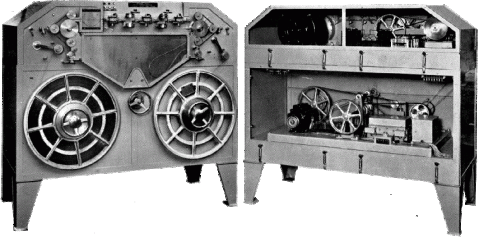
At the BBC Archive Centre in Perivale, London, the proverbial “weight of the past” becomes literal for researchers of sound history. Housed in a massive, unattractive hangar-like building in an industrial park to the northwest of London, the archives suit their environment, one which speaks of practical and solid shapes far more than the lyrical, dainty ivory tower. And by weight, I mean by serious, and sometimes dangerous, poundage: the very first machine created to record off of radio, invented around 1930, was a steel pedestal with bus wheel-sized reels on either side. Audio Coordinator of the BBC Archives, John Dell, explained that not only was this machine laborious to load, but it used magnetic steel tape as its recording surface, which could come free from the reels and lacerate incautious operators as it unspooled and bunched.
The weight of these objects, however, is also metaphoric. The earliest recording in my personal audio drama library, sourced off the invaluable Archive.org, is a 1933 episode of Front Page Drama, a dramatized version of an American Weekly Hearst publication. The past stands monumentally huge if this type of machine, the Marconi-Stille Wire Recorder, was the apparatus that allowed those 15 minutes of 1933 to be captured and, eventually, fed into my 2015 headphones as an MP3.
I listen to much of my audio drama, whether old and crackling like Front Page Drama, or new and podcast-y, while commuting, usually on the London Underground. The episode of Front Page Drama in question I heard during a marathon session when I knew very little could or would interrupt me: on an twelve-hour transatlantic plane ride. I quite like the audio-visual play between listening to audio drama that is new to me versus the familiar but never identical sights of the commute; as Primus Luta remarked in 2012, it’s rare for us to engage our full attention on the aural medium.
While listening to Front Page Drama and episodes of Lum and Abner on that flight, I had to wonder how I was prioritizing my listening time. Who had recorded these episodes from the 1930s? Who had later taken the trouble to digitize them and upload them to Archive.org? Why, for example, were these particular recordings freely available yet I couldn’t find an MP3 anywhere of texts I wanted to share more widely, such as Don Haworth’s On a Summer’s Day in a Garden (1975) or Angela Carter’s Come Unto These Yellow Sands (1978)? Both of these recordings are in the BBC back catalogue; I know, because the BBC supplied them to me—but only the basis of a visit to the archive.
Archive.org is bountiful and accessible, the Perivale archives much more exclusive, but both seem to lack curation. The only hope for accessing things like Haworth or Carter outside the British Library’s Sound and Moving Image Archives is that someday a rogue MP3 or BitTorrent will show up online. The archive does seem, in Neil Verma’s words, then, “transformed before dispersing in space, plucked from the air and mineralized like fossils” (Theater of the Mind, 227); like Primus Luta’s weighty but playful experiment, Schrödinger’s Cassette, which suspended music in concrete to be risked, or remain aurally untouched forever. This seems too often to be the impossible choice.
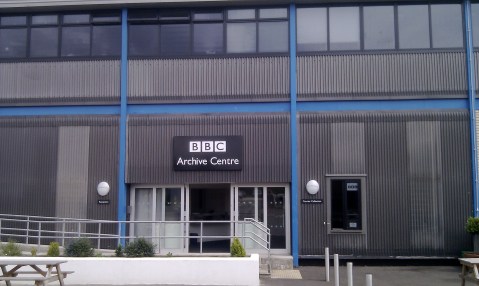
BBC Perivale Field Trip, Image by Flickr User Hatters! (CC BY-NC 2.0)
The BBC archive storage is eclectic and generally arranged for access by BBC staff rather than for researchers. The BBC Written Archives at Caversham are restricted to academics, and likewise, the speed of gaining access to sound files from Perivale is predicated on the amount of time BBC staff have to devote to it—naturally, the BBC’s own departments have priority, such as BBC Radio 4 Extra, the archival digital radio station, whose backlog of requests for digitised material from the Perivale archive apparently covers 20 pages. The sound collections consist of commercial recordings on shellac (90 RPM records) and vinyl (78 RPMs) as well as impressively dinner-plate sized compilation transcriptions which require a special turn-table on which to play and digitize them. The BBC Sheet Music archive is in Perivale, as well, with original handwritten scores filling shelves.
The second half of the British and Irish Sound Archives conference 2015 afforded a privileged glimpse of the archive storage and technical facilities housed on site. Most of my fellow attendees were archivists of one sort or another, asking detailed questions about transcription devices, fidelity, and storage. Having recently completed my PhD from Swansea University in English in radio drama, I had made countless requests to this very facility through the British Library’s Sound and Moving Image request service; now I, at long last, hoped to see where my digitised sound files were coming from. However, we weren’t shown any recordings made on tape cassette or CD but instead Betamax audio-only. Unseen, too, were the data banks holding all the digitised content, but what myself and my fellow archivists had mainly come to see were the tangible objects making this content possible.

78s at BBC Perivale, Image by Flicker User Hatters! CC BY-NC 2.0
In the physical copies of the Radio Times of the 1940s and ‘50s, also housed at the British Library at St Pancras (and now available, like all of the Radio Times up to 2009, on BBC Genome), there can be found a little asterisk in the listings for drama, which signifies that the drama was broadcast from a recording, rather than live. The later recording machines of the ‘30s through ‘50s, upon which these recordings would have been made, did not decrease appreciably in size, though perhaps in weight. “If I were to drop this,” Dell told us as he carefully handled a dark blue celluloid tube, about the size and circumference of a toilet paper roll, “it would bounce. I’m not going to drop it,” he added. Then the magic began: via a custom-made device, we heard a few bars of a music hall song from circa 1900. The recording was surprisingly clear. It was agonizing when Dell turned it off after only a few seconds.
There is something incredibly seductive about old recordings. In “The Recording that Never Wanted to Be Heard and Other Stories of Sonification,” from The Oxford Handbook of Sound Studies, Jonathan Sterne and Mitchell Akiyama question the desire for “sonification” of ever-older recordings, especially when such desires manifest in the creation of a digital sound file in 2008 for “the world’s oldest recording,” a phonoautogram from 1860, which was nevertheless never intended to be played back—the phonoautograph was intended as a device to make the aural visual (555). Radio drama writer Mike Walker really summed up the seduction of old recordings for me in his 2013 BBC Radio 4 ghost story The Edison Cylinders, with a character who is seduced as a scholar and as a participant in a time-traveling mystery by old recordings: a sound engineer in need of money, she agrees to digitize what seem like boring diary entries from a British imperialist, only to be intrigued by his Victorian domain beyond her rather empty modern existence. Unfortunately for her, these particular recordings are reaching beyond the grave to try to kill her.

Edison Cylinder Exposed, by Flickr User fouro boros, CC BY-NC 2.0
Although they do reach out from the grave, most early sound recordings aren’t out to kill you. They do however, present common and vexing issues of authenticity. By this, I mean specifically the provenance of the recording—is the recording of who or what it says it is? On the first day of the conference, Dell regaled us with tales of two cylinder recordings surfacing in the mid-twentieth century, of William Gladstone giving a speech. The words of the speech were identical, but the voices were completely different. Who was the real Gladstone? How could you authenticate the voice of a dead person? Dell further deepened the mystery by telling us the tale of two boxes of wax cylinder recordings in the Perivale archive, whose provenance is torturously (and tantalizingly) unclear. We glimpsed these mysterious, yellow-cream-colored cylinders, somewhat wider and fatter than the celluloid tubes, in situ, but were they original Edison cylinders from the 1880s? The piercing desire to believe these cylinders might contain the voices of Gladstone, the future Edward VIII, or even Henry Irving, are potentially “perils of over-optimism,” as Dell puts it.
All the archivists at this event referred to the serendipity of discovering surprises on recordings. Simon Elmes, whose official title reads “Radio Documentarist, Creative Consultant, and Former Creative Director, BBC Radio Documentaries,” made this manifest as he discussed a subject treated in his documentary from 2005, Ambridge in the Decade of Love. The Archers—an exceptionally long-running BBC radio soap which conjures up visions of rural Englishness and persists among a very dedicated, though mostly older, fan base—like much radio drama and emblematic of gendered attitude toward radio soaps, was not recorded in its first few decades.

Empty Shelves at BBC Perivale, Image by Flickr User Bill Thompson, Image cropped by SO!, (CC BY-NC-ND 2.0)
Likewise, anyone researching radio drama before the 1930s is playing a game of roulette; whether any scripts survive will depend entirely on the literary reputation of the author who may have had enough clout to publish them in book form. Even in the case of Lance Sieveking, the acknowledged creative aesthete behind early BBC radio drama, we lack concrete evidence of his most important work, The End of Savoy Hill (1932). And The Truth About Father Christmas (1923), the first original drama written specifically for British radio? Forget about it—it was made for children’s radio.
To return to The Archers, though daily 15-minute scripts were being churned out by Ted Kavanagh from the first years of the 1950s, the broadcasts themselves went missing into the ether (after all, no one suspected the show would still be going after sixty years). Transcription discs, meant for an overseas market, were found in a box in the BBC Archives, giving a reasonably complete overview of The Archers during the 1950s and ‘60s. Elmes was ebullient about this discovery.
While I got the general sense that the other archivists at the conference were amused but indifferent toward this particular trove, to me it was inspiring. I believe the future of audio drama will rely more and more on serials, so the rediscovery of these Archers episodes epitomizes to me the past, present, and future of audio drama in that it speaks of audience involvement and even audience interaction or co-production, which seems key for audio drama going forward, and the aspect of serialization which has vastly overtaken the single drama on television if not on radio.

Harry Oakes as Dan Archer and Gwen Berryman as Doris Archer, 1955.
Nevertheless, even if pursuit of these aural rainbows is a foolish one, such desire also enables scholarship. The hope of finding “originals” inspired me personally to discover the birth of what can conceivably called audio drama. Having researched audio drama from the first known broadcast dramas in English (the adaptations: 2LO London’s Five Birds in a Cage in 1922, WGY Schenectady’s The Wolf in 1922, British Broadcasting Company’s Twelfth Night in 1923; original drama: WLW Cincinnati’s When Love Awakens in 1923, British Broadcasting Company’s Danger in 1924), I was astounded to learn that listeners from World War I might have enjoyed short, dramatized stories on the celluloid tubes (according to Tim Crook, the first audio drama of this nature is a war drama from 1917). While archives such as the Cylinder Preservation and Digitization Project of the University of California at Santa Barbara care for these recordings in the same way they do for musical and speech recordings, there is a significant lack of scholarship on them.
If commentary on specific pre-radio audio drama is scarce, it is heartening to read dissections of the performative aspects of “actuality,” such as Brian Hanrahan’s anatomy of Gas Shell Bombardment, 1918. Wonderfully, in discussing the “staging” of this war-time recording, Hanrahan brings in traditions from theatre and silent film in addition to the phonograph. Professor David Hendy has persuasively argued that some of the organizing tenets behind the British Broadcasting Corporation, whose management was by and large made up of ex-soldiers, was predicated on a desire for silence and calm, ordered, managed sound after the cacophony of war. Perhaps “cylinder” drama, then, is not really of its time and properly belongs to earlier, or later, cultural milieux.

Wax cylinder playback at BBC Perivale, Image by Flickr User Hatter! CC BY-NC 2.0
The ephemera of the medium presents a recurring problem in radio drama studies, a weighty feeling of doom. With the future of the BBC’s existence currently perilous, one wonders what the consequences will be for archives like those housed at Perivale. If the internal function of the archives (for the BBC to make use during Radio 4 Extra broadcasts, for example) disappears, will the archives be opened to wider use? Or will material without commercial potential simply be discarded? Who would make the decision as to what was commercially viable and how would they make such decisions?
And the problem with the medium seemingly begins with wax cylinders. A beautiful, lyrical story from Baron Munchausen—alias Rudolph Erich Raspe, a German author who created a fictional travel writer and chronic teller of tall tales based on a real nobleman infamous for his boasting—cited by many of those fascinated with sound recordings is worth repeating here: the Baron is traveling in Russia in a snowy landscape and desires the postilion to blow his horn to alert other travellers that their sleigh will be coming around the bend. Unfortunately, the cold makes the horn incapable of any audible sound. Disappointed, they make their way to an inn. Diedre Loughridge and Thomas Patteson cite the “Frozen Horn” from their online Museum of Imaginary Instruments: “After we arrived at the end inn, my postilion and I refreshed ourselves: he hung his horn on a peg near the kitchen fire; I sat on the other side.” Warmed by the fire, the horn now begins to play its reserved tunes.
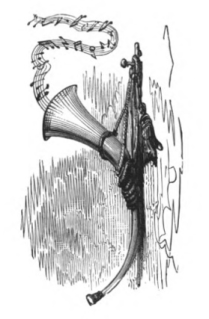
Illustration by Gustave Doré, 1865. Listen to ABC radio feature on the “Frozen Post Horn” and the Museum of Imaginary Instruments here
With a little leap of the imagination, it’s not difficult to see the parallels with the reality of sound recording limitation. The wax cylinders could only be played a few times before the sound degrades completely. Tin cylinders are not much better. This is the reason why the two Gladstone voices could be both “real” and “fake.” Celluloid is more durable, yet witness the reluctance of Dell to play one for longer than a few seconds, for preservation reasons.
Sound recordings are only as good as the medium on which they are recorded, a fact that surprisingly holds true even today. We were told by our BBC hosts that discs of shellac, vinyl, and acetate whose contents have already been digitised will not be discarded—digital recordings are ultimately taken from these physical originals.
In the future, we might invent means of reproduction and playback which could provide more fidelity to the original event lifted from the physical recording, in which case it will be the MP3s that will be redundant. There’s something both very modern and very old-fashioned about this. Once at a dinner party, I launched full-force into my postdoctoral rant about the eventual possible degradation of the MP3 as a recording format, that it was not infallible as we had been led to believe. I was surprised that I was wholly believed; furthermore, the older people participating in the conversation rued the disappearance of their CDs, tape cassettes and, vitally, their LPs, for the oft-cited reasons (which Primus Luta distills as the pricelessness of old recordings to one’s personal history, and the “fuller” sound ans weighty materiality, one resonating with one’s emotional past).

Vinyl at BBC Perivale, including a lot of John Peel’s old records. Image by Flickr User Hatter! (CC BY-NC 2.0)
I admit, before I came to the UK and experienced the never-perfect but always interesting presence of BBC Radio, I treated radio as a background medium. I suppose recorded sound had always interested me, and I had had a strong relationship with local, classical music radio (Classical KHFM Albuquerque). However, I could not have predicted ten years ago that I would become a passionate proponent of audio drama and sound studies more generally. I’m almost embarrassed now at my excessive love of audio drama; I make almost no distinctions between “high” art like Samuel Beckett and Tom Stoppard and fan fiction radio serials like Snape’s Diaries as produced by Misfits Audio: I listen to almost anything.
And, truly, the future of audio drama is only assured if people keep listening. The digitisation and availability of cylinder recordings makes study of them more accessible, so the way is paved for further studies of the earliest audio drama. It is imperative that researchers continue to request sound recordings from the BBC, even if they have to use the relatively inconvenient system currently available.
There are signs that things are improving and that more people than ever before want to access such materials. As Josh Shepperd puts it brilliantly, “Sound trails continue where paper trails end.” As Director of the Radio Preservation Task Force at the Library of Congress, his efforts have underlined the fact that often it is the local and the rural whose radio or audio history vanishes more quickly than the national or the metropolitan. This would historically be the case with the BBC as well, which for a long time privileged London sound above regionalism (and, some would argue, still does). Since 2015, the British Library (and the Heritage Lottery Fund) have invested significantly in the Save Our Sounds campaign, positing that within 15 years, worldwide sound recordings must be digitized before recordings degrade or we no longer have the means to play the material.
Out of curiosity, I downloaded the more than 600-page listing, the Directory of UK Sound Collections, assembled rather hastily through the Save Our Sounds project in 20 weeks, and comprising more than 3,000 collections and more than 1.9 million objects. This document makes for fascinating and eclectic reading, ranging as it does between a Sound Map of the English town of Harrogate to the archives of the Dog Rose Trust, which mainly provides recorded tours of English cathedrals for those who are blind. Undoubtedly, there are wodges of local or forgotten drama in these archives, too. The linking up of these archives and making them more widely accessible suggests how important sustained, collective effort is to unfreezing radio’s archival post-horn, delivering more of its unique tunes.
—
Featured Image: “The Route to Open Data” at BBC Perivale, Image by Flickr User Hatter! (CC BY-NC 2.0)
—
Leslie McMurtry has a PhD in English (radio drama) and an MA in Creative and Media Writing from Swansea University. Her work on audio drama has been published in The Journal of Popular Culture, The Journal of American Studies in Turkey, and Rádio-Leituras. Her radio drama The Mesmerist was produced by Camino Real Productions in 2010, and she writes about audio drama at It’s Great to Be a Radio Maniac.
—
 REWIND!…If you liked this post, you may also dig:
Only the Sound Itself?: Early Radio, Education, and Archives of “No-Sound”–Amanda Keeler
“Share your story” – but who will listen?–Fabiola Hanna
SO! Amplifies: Indie Preserves
The Sound of Radiolab: Exploring the “Corwinesque” in 21st Century–Alexander Russo
Share this:


Current Top Posts





April 2021

January 2020

November 2019

October 2019

August 2019

April 2014

November 2017

March 2015

December 2017

October 2015
 Sounding Out!
Recent Comments