
“Once the word ‘sound’ was in the title, it opened up a kind of door”: A Conversation with Eric Weisbard

DOI: https://doi.org/10.59350/4m3ag-44345
Last March, I attended the first Experience Music Project (EMP) Pop Conference in New York City. (See my pre-conference round-up for SO!, and my blog post for IASPM-US on my post-conference impressions.) Post-conference, I had the opportunity to interview Eric Weisbard, co-founder and organizer of EMP Pop Conference. One late March morning, we talked via phone about the story behind Pop Con, rock critics and academics, and the intersection of Sound Studies and Popular Music Studies.
Weisbard is currently a professor at the University of Alabama’s American Studies department. In addition to organizing Pop Con, he is also the Vice President of the International Association for the Study of Popular Music (US Branch) and Associate Editor of the Journal of Popular Music Studies. He has also edited three collections of essays drawn from Pop Con presentations: This Is Pop: In Search of the Elusive at Experience Music Project (2004), Listen Again: A Momentary History of Pop Music (2007), and Pop When the World Falls Apart: Music in the Shadow of Doubt (2012).
In 2001, Weisbard was invited, along with his wife (rock critic and journalist Ann Powers), by the Experience Music Project Museum in Seattle to organize their first rock music conference. “I was a grad-school-dropout turned New-York-media-rock-critic-guy” Weisbard explained, “and when I was asked to work on a conference my one framing idea was we will mix academics and non-academics.” The conference has been going strong for ten years now, and has expanded from Seattle to Los Angeles and, this year, New York City.
Part of Weisbard’s approach to Pop Con is rooted in his move from self-declared “grad-school-dropout” to music editor at The Village Voice and SPIN. Weisbard created the well-known Village Voice column “Sound of the City,” which he admits was inspired by Charlie Gillet’s 1970 book The Sound of the City. (Gillet’s book also inspired the theme of this year’s conference.) Weisbard saw in the conference a place where academics and non-academics alike could converse together about music. He pointed out, “this is a place where there’s room for enthusiasm, for intellectual work, but we call it a pop conference; we won’t put barriers to the ability of the ordinary person to come and put something out. The last few years it’s become a free conference, an important step to making it accessible and not just for academics.”
Considering the location of the conference, I asked him what the soundscape of this year’s Pop Con sounded like to him, in retrospect. Three things stood out to Weisbard: the collision of cultures in New York City’s soundscape, the sound of media (embodied in the voices present at the conference), and the music that came from the conference rooms. Weisbard reflected:

“For me, I might point to three things: the most familiar and most cliché is the cultural collision side of the New York City soundscape. You’d have a conference panel at 905/907 [at the Kimmel Center, where the conference was held]; every time I was there I’d hear music from below [….] Another aspect, which is more specific and maybe undertheorized, is the sound of media. I don’t mean media as abstract tools for disseminating information but media in terms of people who have to say clever things on a regular basis and who have to use words all the time. To me, that’s a very particular kind of sound. One of the things that’s interesting of being in New York, and having the non-academic side of the conference (which had been ebbing and is suddenly coming back full swing) is that from academics to journalists to people in the business, [it] was a loud version of my sonic memory of being a media guy in New York. Media chatter, a kind of chatter that’s loudest in New York. New York allows you to be face to face with people all the time [….] Number three is how music itself floated through the other two realms. You might hear a song, as an example, or one night I saw vaudeville songs of the bowery, a late night offering. [This could be in reference to Poor Baby Bree’s presentation during the conference.–Ed.] We’re not a music conference, we are a music writing conference, but nonetheless music is at the core. That would be third thing; typically you listen to music at a conference, at home, in car, and there are all more directly ways of listening to music. Music permeated things but at intervals. It’s appearance was not predictable. You didn’t know where it would pop up.”
Yes, music was everywhere, and so was sound. The title of this year’s conference opened up the conversation to Sound Studies Scholars. Weisbard pointed out, “when we came up with the theme, which is a riff on Charlie Gillett’s line on “the sound of the city,” we recast it as ‘Sounds of the City,’ in keeping with what we’ve always wanted to do at the conference, which is emphasize different kinds of music. In an interesting way, once the word ‘sound’ was in the title, it opened up a kind of door: in exactly the same way that being in New York we think about the city, when you think about cities you think about sound.”
From the beginning of the interview, Weisbard explained that he was still trying to understand what Sound Studies comprises and where it intersects with Popular Music Studies. More importantly, Weisbard pointed out that some may talk about Sound Studies to avoid associating with Popular Music Studies, which may point to a tension between the fields: “My biggest concern about the phrase ‘Sound Studies is that it is a defensive way for critics who think that if they talk about ‘Popular Music Studies,’ they won’t sound as serious.” Weisbard acknowledged that these questions of legitimacy have plagued Popular Music Studies for a while.
When I asked Weisbard about what Sound Studies can learn from Popular Music Studies, he admitted that he still didn’t have a clear grasp of Sound Studies to be able to offer a strong opinion. However, he shared an example of what he thought was a strong contribution to the field that was, also, accessible to people outside of the field: “The latest pop music collection, Pop When The World Falls Apart, has an essay from Martin Daughtry on listening as it’s undertaken by soldiers in Iraq. That was a presentation. When I saw the presentation as a 20-minute talk, I remember feeling more moved than any presentation on music I had ever heard. That’s where I feel like Sound Studies work can be as satisfying as any work on music [….] Daughtry wrote with a sense of almost confronting something terrifying, while trying to understand how people listen.”
The tension between the academic and the popular is something Weisbard grapples with in his own work. (He stated, “Anything that’s a purely academic version of how to present work is flawed and has to be challenged”). At the moment he is working on a book on commercial radio formats. He describes it as such: “I’m interested in how formatting music (different from genres) creates parallel mainstreams. I’m interested in how every button can represent a different construction of the middle.” For Weisbard, his academic work and the work he does as a rock critic bleed into one another. “It’s about using the rock critic’s ability to enjoy cultural weirdness” he said, “and the historian’s tendency to keep on digging and get to the bottom of it. I definitely see my work in conversation with people who are grappling with the nature of pop music in general. I love that the word “pop” emphasizes the commercial, trashy, places where it’s least likely called authentic, or [seen as an] embodiment of progressive values. It simply has to live or die on its own. I think academic work should too.”
What’s next for EMP? It will return next year to Seattle, but the theme has not yet been decided. In fact, Weisbard says that EMP’s return the year after is never a sure thing:”There was no guarantee in 2002 that we’d become big [….] The provisional nature [of the conference] is one of its best qualities. There’s absolutely nothing guaranteeing whether it comes again. There’s no organization attached to it, you don’t have a job from it. It depends on the people working. A gathering doesn’t work if people don’t come.”
—
Liana M. Silva is co-founder and Managing Editor of Sounding Out!
—
Share this:

“Sensing Voice”*
*a longer version of this piece is forthcoming in Senses & Society 6 (2), July 2011.

Bathroom Recital 2007
In 2007, I received an invitation to a recital that would take place in my bathroom; the artist offered to present an underwater concert in my tub. My reaction? “Crazy,” I thought. “Why go to the trouble of singing in an element so far from ideal?” After a year of mulling it over, though, I finally realized that what I had dismissed for its hopeless impracticality might—precisely because it was impractical—offer fresh perspectives on singing and listening by resituating these familiar activities in vastly unfamiliar territory.
The underwater singing practiced by contemporary American soprano and performance artist Juliana Snapper challenges audiences to confront their unexamined assumptions about the relationships between the voice and materiality, the sensed and the singular. How do the physical and sensory properties of singers’ and listeners’ bodies affect and participate in the music we create and the sounds we hear? How do the physical space within and the matter through which sound travels shape what we hear? And how do the relations between these aspects affect what it feels like to sing, and what it is possible to hear?
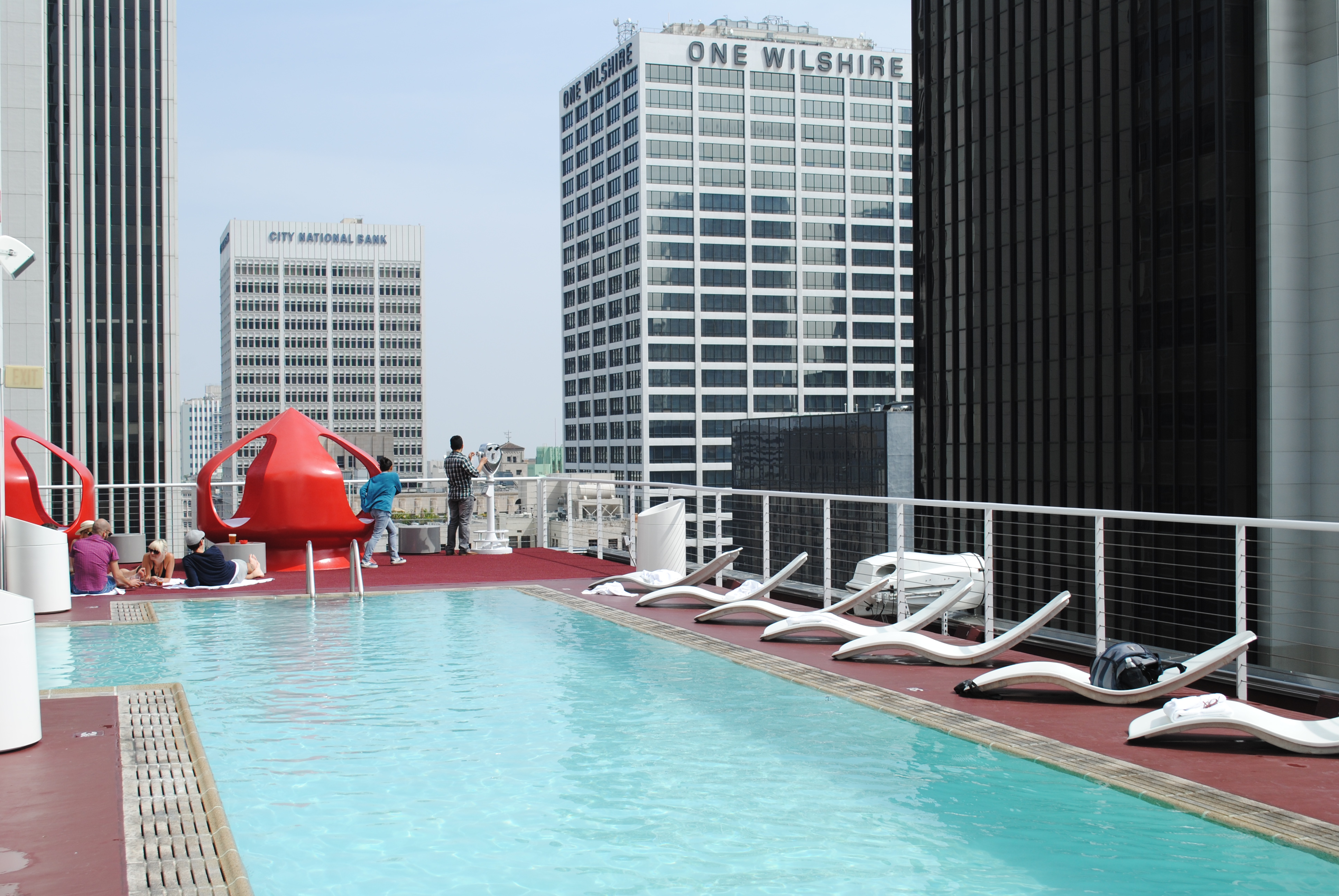
The rooftop bar at the Standard Hotel, downtown LA
During the spring of 2010, while I was working on an article about Snapper’s project and teaching a seminar on the multi-sensory aspects of music, Snapper offered to mount a participatory version of her project for my class. She took us through some exercises in a large swimming pool in downtown Los Angeles. The first exercise paired us up; one person gently held the other under water, while the person underwater made sounds. I was paired with Natalia, who shouted––but with my ears above the water I couldn’t hear her voice.

The author with Natalia Bieletto (under water). Aquaopera #4/Los Angeles, 28 April 2010.
So we tried another strategy: one person made sounds underwater while the rest of us put our heads and ears in – and then we could hear her. We found that the deeper into the water we descended, the more difficult it was to sing high notes. Fast tempi were also difficult to maintain; Natalia’s attempt resulted in muddled sounds.
We found that the deeper into the water we descended, the more difficult it was to sing high notes. Fast tempi were also difficult to maintain; Natalia’s attempt resulted in muddled sounds. Surprisingly, while sung sounds didn’t seem very loud, small internal throat sounds were incredibly powerful. These exercises demonstrate how much the medium through which sound waves flow affects their characteristics: their speed, direction and so on. It also shows that in order to register sound, the listening body (including the head) must be immersed in the material through which the sound flows.

The next exercise linked the six of us together
The next exercise linked the six of us together by the arms; three participants stood in a line, with their backs against three others. We sang in a drone-like manner, playing with our voices above the water, at its surface, and then slowly sinking into it. We felt the sonic vibrations largely through direct contact with each other’s bodies. Of course sound also passed through the air and water, but because the most immediate path was from one body to another, this was the sensation that overpowered us.
At the end of the day, gathered around the poolside fireplace, we discussed how different singing felt in a liquid environment. We’d discovered that aural experience is predicated on physical contact with sound waves through shared media, in this case water and air, flesh and bone. We noted that the shared medium makes a great differenceto how we experience the voice, and that the sound we ultimately hear depends partly on what is sung, and partly on the medium through which it passes (and how our bodies interact with that medium). In other words, in Snapper’s workshop we discovered that sound is a multi-sensory experience, tactile as well as aural. It also became clear that sound and music involve much more than traditional theories and notation can capture. (For a more thorough discussion of the differences between singing and sound underwater and in air, please see my forthcoming article.)
-

- At the Standard poolside fireplace.
-

- Hyunjong Lee and Zachary Wallmark.
-
- Sam Baltimore and Alexandra Apolloni.
-

- Jill Rogers.
I would like to underscore here that the character of a given sound source is not stable. Instead it is dependent on specific material conditions, and on particular relationships between the elements involved. A sound signal will move with a given speed depending on the material––air, water, metal, glass, etc.––through which it is propelled. As humans register the sound it will move more or less directly through the ear drum or bones (and then transfer to the inner ear) depending on the relationship between the material through which it is propelled and the materiality of the ear. The part of the body that registers sound also plays a role in its apparent directionality.

Juliana Snapper.
For example, our ability to hear in “stereo”––two distinct signals, left and right––is the result of sound entering our bodies from two directions (two ears). Because we most frequently deal with sound as it is propelled through air, we take this as a given and adjust our musical and acoustic research (and thus our concert halls and (performance spaces accordingly).
By highlighting the material aspects of sound and their reception, Snapper reminds us that what we hear depends as much on our materiality, physicality, and cultural and social histories as it does on so-called objective measurements (decibel level, soundwave count, or score), which are themselves mere images. Our experience of sound is a triangulation of events in which physical impulses (sonic vibrations), our bodies’ encultured capacity to receive these vibrations, and how we have been taught to understand them are at constant play, and subject to negotiation. In the experience of sound, what becomes clear is not a stable explanation of what sound or music is. Instead we are led to understand that each such account is a composite manifestation of our perception of sound at a given moment in time and place.
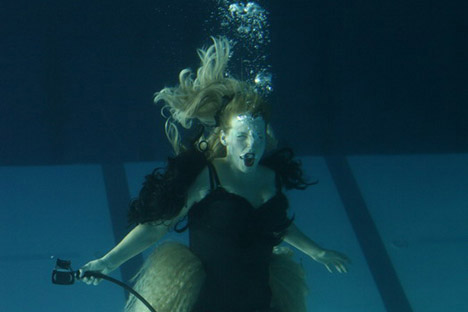
Juliana Snapper
Share this:




Current Top Posts





April 2021

January 2020

November 2019

October 2019

August 2019

April 2014

November 2017

March 2015

December 2017

October 2015


Recent Comments