
The Top Ten Sounding Out! Posts of 2015!



—
Featured image by bostik_ @Flickr CC BY-NC-ND.
—

REWIND! . . .If you liked this post, you may also dig:
Misophonia: Toward a Taxonomy of Annoyance — Carlo Patrão
Sounding Out! Podcast #38: Radio Frequencies, Radio Forms, LIVE — Monteith McCollum and Jennifer Stoever
Mediated Sexuality in ASMR Videos — Emma Leigh Waldron
—
Share this:

Unsettling the World Soundscape Project: The Bell Tower of False Creek, Vancouver


DOI: https://doi.org/10.59350/s4k5c-dcg27
Welcome back to Unsettling the World Soundscape Project, a series edited by Randolph Jordan that looks critically and creatively at early acoustic ecology along with the writings and subsequent compositions of WSP members, assessing its continuing role for sound studies today. This series follows strongly in the spirit of “Sound Studies 2.0,” a running theme here on SO! this year that Editor-in-Chief Jennifer Stoever has described as “the movement of the field beyond the initial excitement for and indexing of sound toward new applications and challenges to the status quo.”
In the first article of the series, Mitchell Akiyama unpacked the WSP’s monumental ten-hour Soundscapes of Canada of 1974, situating the broadcast’s innovative work historically while also pointing out problems of diversity and representation that could inform how we might listen and create in the future. In this second article, Guest Editor Randolph Jordan offers some of his own highly innovative research, drawing on the notion of “unsettled listening” that he described so vividly here last summer, and focusing on how sound calls attention to territorial boundaries and contested land appropriation from Native peoples of Vancouver.
—
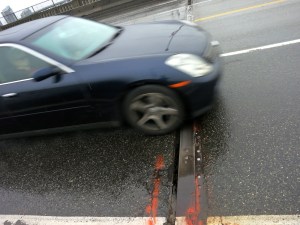
For a few months in 2013, an intense clanging sound emanated from Vancouver’s Burrard Bridge spanning False Creek. A pothole on the surface had opened up next to the metal connector sitting directly atop of the southwest concrete pillar on the shore, activated by passing traffic and intensified by the hollow concrete structures below.
By coincidence, the pothole’s acoustic profile, the “area over which it may be heard before it drops below the level of ambient noise,” was roughly equivalent to the east/west boundaries of Kitsilano Indian Reserve at its peak acreage established in 1877.
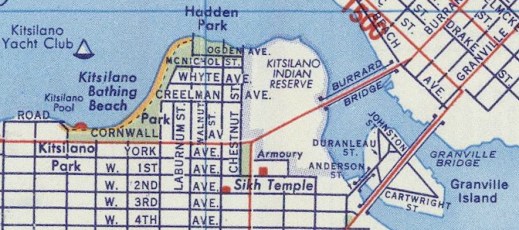
In the century to follow, the reserve would be carved up for a variety of uses and by 1965 it was gone. But in 2013, 100 years after the government – without securing official title to the land – paid the reserve’s residents to leave, the sound of the pothole set the past resonating as the rhythmic clanging reached out to draw the surrounding acoustic environments together while sounding out their roles in contesting indigenous claims to the area. Fitting, then, that the hole sounded loudest directly under the bridge on the south shore, site of newly restituted reserve lands awarded to the Squamish Nation in 2002 after the decommissioning of the railway passage that marked the original reserve’s first transgression in 1899.
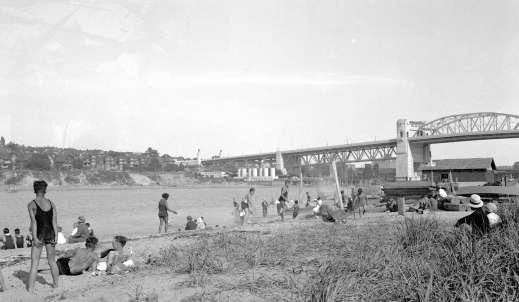
The sound of bridge traffic calling attention to contested land use challenges stereotypical notions about indigeneity in the modern city by upending biases against urban noise pollution typical in early acoustic ecology and exemplified by the work of the World Soundscape Project (WSP). The pothole sound became the locus of my investigation into the value of thinking longitudinally across the Vancouver archive of the WSP, the first assignment given to me by original member Barry Truax as supervisor of my postdoc at Simon Fraser University from 2012-14. I argue that if we use urban noise as a tool for mapping out uncomfortable and subordinated histories, we can rethink the effects of such urban noise on the articulation of cultural space across the WSP archive and imagine new possibilities for future iterations of the project’s Vancouver research.
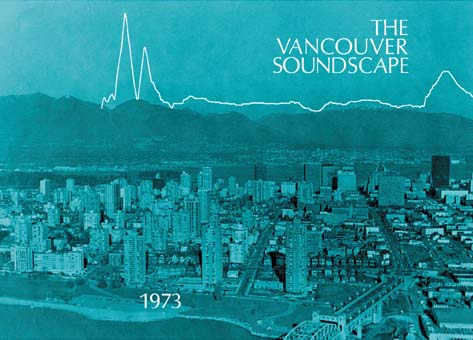
First question: what documentation of traffic noise around Burrard Bridge exists in the WSP’s three major sets of documentation in Vancouver from the ‘70s, ‘90s and 2010s? Using the Google Map I created to plot recording locations across the archive, I listened to those from which bridge traffic might have been audible. Sure enough, the sound of bridge traffic is present on the original ’73 tapes recorded nearby. In fact, the ‘73 release of The Vancouver Soundscape LP addresses these bridge recordings in a conversation between project director R. Murray Schafer and the recordists, who describe this traffic noise as a source of frustration while attempting to capture the sound of tinkling masts from the boats in the marina beneath.
Here the message seems clear: traffic noise is blight upon more valued sounds in and around the city. This position is corroborated by the very cover of the LP that features a graphic representation of a soundwave from a recording of chirping frogs interrupted by a passing car, the example of urban imbalance with which Schafer concludes the final side of the album.
A few years after the ’73 release, however, Hildegard Westerkamp and Bruce Davis wrote the catalog page for the original set of tapes in which they refer to the traffic sounds as a “noisy, broad wash” that “frames the delicate rigging tinkle of the moored boats.” This is a more aesthetically motivated take on urban din that Westerkamp explores to creative effect in her 1986 piece Kits Beach Soundwalk. A decade after that, Robert MacNevin wrote in the catalog notes for his recording under the bridge that the rhythm of the traffic was part of the “very beautiful” fabric of this sonic tapestry that included the masts swaying in the breeze. This shift in attitude also played into the presentation of the archive on the ’96 Soundscape Vancouver CD. Now under the direction of Barry Truax, this second release featured a selection of soundscape compositions that celebrated all manner of urban sounds as interesting in their own right.
It was very difficult to ascertain whether or not the traffic sounds in these recordings were in any way connected to potholes on the surface. Yet hearing Vancouver’s urban sound through the shifting perspectives of the WSP’s contributing members provided a framework for assessing the value of their work. So I turned to the next question: how might hearing urban noise like bridge traffic, as “staged” by the WSP, contribute to listening to the area in a way that can unsettle its appearance of stability and reveal the tense histories of contestation that have defined it since the time of first contact through to the present day?
On the issue of cultural politics we find less progress across the two official Vancouver releases. Both make some mention of indigenous presence in the land and tie these references to their concerns over urban noise pollution. The ’73 LP opens with the sound of the ocean primordial, lapping against the shore, with wind and birds following in short order. Amidst these, the voice of a Squamish man begins speaking in his native tongue, soon interrupted by an emerging seaplane flying low overhead, ushering in the era of Vancouver’s incorporation as a city and the ensuing industrial development. Only someone who understands the spoken language here will know if the WSP’s narrative runs counter to the story being told by the Squamish man, for no translation is offered either in the grooves or within the jacket.
Well-intentioned though they were, the WSP’s problematic construction of machine noise as despoiler of the wilderness is made worse by putting the only voice given to indigenous peoples in the service of this didactic construction. In so doing they contribute to relegating urban indigenous presence to a thing of the past rather than accounting for the consistent and continuing presence of First Nations communities in the city – a luxury they afford to the Greek and Chinese communities later on the disc when these are presented as vibrant and living parts of Vancouver’s modern fabric in a track entitled “The Music of Various City Quarters” (a multicultural gesture they would move away from on the trip across Canada that Mitchell Akiyama unpacked in the previous post in this series).
Similarly, in a brief documentary about Vancouver’s changing sounds on the ’96 release, Westerkamp comments on the intrusive presence of the air conditioning system in the Museum of Anthropology on the U.B.C. campus, marring visitors’ experience of “some of B.C.’s most fascinating Native artifacts.” Westerkamp’s respect for indigenous culture comes through clearly enough. Yet the WSP’s presentation of local indigeneity takes a step backward here as the living voice speaking a dying language heard in ’73 has given way to just plain old dead people in ’96, best contemplated in the quietude of Arthur Erikson’s high modernist design for the building.

The WSP might just as easily have critiqued this space as an example what Schafer has called the “glazed soundscape” in which sound is cut off from the world visible through large windows, an architectural situation that emphasizes the disconnection between the indigenous culture on display within and the living Native presence in the city outside the museum walls. The fact that the building’s design heightens the perception of the ventilation sound is, like the pothole on the bridge, an example of how urban noise can be heard to mark out indigenous displacement in the city.
Standing under the bridge on the 40th anniversary of the 1973 recordings, and the 100th anniversary of the reserve payouts of 1913, I imagined the pothole as a recasting of the church bell as marker of territorial boundaries, sounding out the colonial encroachment of municipal infrastructure upon 19th Century reserve lands well into the 21st. And so in a multimedia work on the site, I dub the bridge the “Bell Tower of False Creek” for its power to unsettle ideas about the role of urban noise in articulating culture in the modern city, and I wonder what shape the next WSP release might take.
The key lies in deeper consideration of the intersection of soundscape composition and the WSP archive as mutually enriching sites of practice. The positive move on the ’96 release came in actively putting the ‘90s archival recordings in dialogue with the ‘70s material, creatively exploring longitudinal relationships in ways that move in the direction of the post-Foucauldian thrust for artists and researchers to “use archives in a more self-conscious way” as Jaimie Baron puts it (3). Yet they stopped short of “actively promot[ing] a critical attitude towards [the materials] and their uses within the institutions” from which they originate, a key characteristic of archival collage identified by William Wees (47).
The time is right for a critical investigation of the ways in which the WSP’s own construction of the archive itself has delimited its possible uses and how they have controlled the staging of its content these past four decades. In so doing, they might also become more culturally astute in assessing how their biases against certain kinds of urban sound have shaped their presentation of the cultures that live within earshot.
—
Randolph Jordan wanted to be a rock star. Now he teaches cinema and the humanities at Champlain College and Concordia University in Montreal. Draw your own conclusions. After completing his Ph.D. in the interdisciplinary Humanities program at Concordia in 2010 he took up a two-year postdoctoral research fellowship in the School of Communication at Simon Fraser University. There he investigated geographical specificity in Vancouver-based film and media by way of sound studies and critical geography, research that will inform the last chapter of his book An Acoustic Ecology of the Cinema (now under contract at Oxford University Press). If you can’t find him hammering away at his manuscript, or recording his three young children hammering away at their Mason & Risch, look for him under Vancouver’s Burrard Bridge where he spends his “spare time” gathering and shaping film and sound material for his multimedia project Bell Tower of False Creek. Or visit him online here: http://www.randolphjordan.com
—
All images provided by the author, unless otherwise noted.
—

REWIND! . . .If you liked this post, you may also dig:
SO! Amplifies: Cities and Memory — Stuart Fowkes
Listening to Disaster: Our Relationship to Sound in Danger — Maile Colbert
Unsettled Listening: Integrating Film and Place — Randolph Jordan
—
Share this:




Current Top Posts





April 2021

January 2020

November 2019

October 2019

August 2019

April 2014

November 2017

March 2015

December 2017

October 2015


Recent Comments