
Sounding Out! pushing sound studies into the red since 2009
  • About
    • About Us
    • Editorial Collective
      • Jennifer Lynn Stoever
      • Liana M. Silva
      • Aaron Trammell
    • Editorial Statement
    • Contact
  • People
    • Writers
      • Writers A-N
        • A-B
          • Kemi Adeyemi
          • Kaj Ahlsved
          • Wanda Alarcon
          • Andrew Albin
          • Kevin Allred
          • Eddy Francisco Alvarez Jr.
          • Tim Anderson
          • Kevin Archer
          • Michael Austin
          • Gina Arnold
          • Shauna Bahssin
          • Kathleen Battles
          • Benjamin Bean
          • Airek Beauchamp
          • Tara Betts
          • Colin Black
          • Thomas Blake
          • China Blue
          • Trevor Boffone
          • Yvon Bonenfant
          • Marcus Boon
          • Esther Bourdages
          • Bill Bahng Boyer
          • Regina N. Bradley
          • Mark Brantner
          • Alejandra Bronfman
          • Cassie J. Brownell
          • Justin D Burton
        • C
          • C.L. Cardinale
          • Leonardo Cardoso
          • andré carrington
          • Aaron Carter-Ényì
          • Dolores Inés Casillas
          • Daniel Cavicchi
          • Steph Ceraso
          • Rui Chaves
          • Maria P. Chaves Daza
          • Norma Coates
          • Debra Rae Cohen
          • Maile Costa Colbert
          • James Cook
          • Claire Cooley
          • Gabrielle Cornish
          • Ian Coss
          • Rui Costa
          • Adam Craig
          • Ashon Crawley
        • D-E
          • Mark Davidson
          • Marcia Dawkins
          • Monica De La Torre
          • Mike D’Errico
          • Peter DiCola
          • Jacqueline Dowdell
          • George Drake Jr.
          • Meghan Drury
          • Ian Dunham
          • Justin Eckstein
          • Christine Ehrick
          • Samantha Ege
          • Nina Sun Eidsheim
          • Lawrence English
          • Marcella Ernest
          • Everything Sounds
        • F-G
          • Ziad Fahmy
          • David Font-Navarrete
          • Rob Ford
          • Juan Sebastian Ferrada
          • Nicole Furlonge
          • Milton Garcés
          • Luis-Manuel Garcia
          • Jennifer Garcon
          • Josh Garrett-Davis
          • Erik Granly Jensen
          • Christina Giacona
          • Denise Gill
          • Mike Glennon
          • Benjamin Gold
          • Kariann Goldschmitt
          • Travis Gosa
          • Carolina Guerrero
          • Norie Guthrie and Scott Carlson
        • H
          • Michelle Habell-Pallán
          • David Hadbawnik
          • Mack Hagood
          • Magz Hall
          • Fabiola Hanna
          • Brían Hanrahan
          • Steven Hammer
          • Melissa Helquist
          • David Hendy
          • Yessica Garcia Hernandez
          • Bridget Hoida
          • Shakira Holt
          • Seth S. Horowitz
          • Joshua Hudelson
          • John Hyland
        • J-K
          • Katharine Jager
          • Priya Jaikumar
          • Robin James
          • Gabriela Jimenez
          • Imani Kai Johnson
          • Randolph Jordan
          • Jeanette S. Jouili
          • Loren Kajikawa
          • Damien Keane
          • Amanda Keeler
          • Elizabeth Keenan
          • Sarah Kessler
          • Roshanak Kheshti
          • Dorothy Kim
          • Bill Kirkpatrick
          • Nicholas Knouf
          • Melle Jan Kromhout
          • Danijela Kulezic-Wilson
        • L-Mi
          • Caleb Lázaro Moreno
          • Rebecca Lentjes
          • Nati Linares
          • Mary Caton Lingold
          • Jay Loomis
          • Eric Lott
          • Bronwen Low
          • Enongo Lumumba-Kasongo
          • Ashley Luthers
          • Marit J. MacArthur
          • Alexis Deighton MacIntyre
          • Owen Marshall
          • Carter Mathes
          • Tom McEnaney
          • Marci McMahon
          • Leslie McMurtry
          • John Melillo
          • Asa Mendelsohn
          • Aurelio Meza
          • Jeb Middlebrook
          • Bonnie Millar
          • April Miller
          • Lee M. Miller
          • Gabriel Salomon Mindel
        • Mo-N
          • Dave Molk
          • David Mollin
          • Madison Moore
          • Nancy Morales
          • Kristin Moriah
          • Roger Moseley
          • Seth Mulliken
          • Timothy Murray
          • Jordan Musser
          • Sionne Neely
          • Elizabeth Newton
          • Tavia Nyong’o
      • Writers O-Z
        • O-R
          • Michael O’Brien
          • Julia Grella O’Connell
          • Mandie O’Connell
          • Linda O’Keeffe
          • Josh Ottum
          • Priscilla Peña Ovalle
          • Osvaldo Oyola
          • Marla Pagán-Mattos
          • Andreas Pape
          • James Parker 
          • Leonard J. Paul
          • Caroline Pinkston
          • Samantha Pinto
          • Murray Pomerance
          • Scott Poulson-Bryant
          • Primus Luta
          • Lucreccia Quintanilla
          • Iván Ramos
          • Anthony W. Rasmussen
          • Ian Rawes
          • Lilian Radovac
          • Marlen Ríos-Hernández
          • AO Roberts
          • Tara Rodgers
          • Christopher Roman
          • Pablo Roman-Alcala
          • Alexander Russo
        • S
          • reina alejandra prado saldivar
          • Andrew J. Salvati
          • Ted Sammons
          • Luz María Sánchez
          • Michelle Sauer
          • Jentery Sayers
          • Meg Schedel
          • Holger Schulze
          • A. Brad Schwartz
          • Cam Scott
          • Sarah Mayberry Scott
          • D. Travers Scott
          • Susana Sepulveda
          • Christina Sharpe
          • Rebecca Shores
          • Shayna Silverstein
          • Aram Sinnreich
          • Phillip Sinitiere
          • Jonathan Skinner
          • Jacob Smith
          • Suzanne E. Smith
          • Emmanuelle Sonntag
          • Gustavus Stadler
          • Justyna Stasiowska
          • Jonathan Sterne
          • Andy Kelleher Stuhl
          • Pavitra Sundar
          • Rajna Swaminathan
          • Karl Swinehart
        • T-Z
          • Dustin Tahmahkera
          • Ariel Taub
          • Toniesha L. Taylor
          • Karen Tongson
          • Alexander J. Ullman
          • Vanessa K. Valdés
          • Shawn VanCour
          • Neil Verma
          • J. Martin Vest
          • Salomé Voegelin
          • Laura Wagner
          • Gayle Wald
          • Daniel A. Walzer
          • Yun Emily Wang
          • Jon M. Wargo
          • Eric Weisbard
          • Alex Werth
          • Kimberly Williams
          • Ben Wright
          • Nabeel Zuberi
          • Christie Zwahlen
    • Guest Editors
      • Airek Beauchamp
      • Justin D Burton
      • Luis-Manuel Garcia
      • Magz Hall
      • Dorothy Kim
      • Tom McEnaney
      • Christopher Roman
      • Katherine Spring
      • Neil Verma
    • Podcasters
      • Frank Bridges
      • Leonardo Cardoso
      • Brooke Carlson
      • Maile Colbert
      • David B. Greenberg
      • K. A. Laity
      • Eric Leonardson
      • Sonia Li
      • Monteith McCollum
      • Andrea Medrado
      • Nick Mizer
      • Leonard J. Paul
      • Craig Shank
      • Jennifer Lynn Stoever
      • H. Cecilia Suhr
      • James Tlsty
      • Salomé Voegelin
      • Naomi Waltham-Smith
      • Daniel A. Walzer
      • Cynthia Wang
      • Anne Zeitz
    • Advisory Board
    • Associate Book Review Editor
    • Interns
      • Spring 2025 Interns
        • Sean Broder
        • Alex Calovi
      • Former Interns
        • Shauna Bahssin
        • Kaitlyn Liu
        • Mikal McKay
        • Jenna Perez
        • Daniel Santos
        • Dhruv Sehgal
        • Hannah Srulevich
        • Michele Quiles
        • Kamryn Scott
        • Ariel Taub
        • James Tlsty
        • Allison Young
  • Resources
    • Sounding Out Index
    • Cite SO!
    • SO! QR Code
    • Teaching SO!
    • SO! Reads: Book Review Index
    • Click for Series and Forums Index
  • Podcast
    • Podcast Editorial Statement
    • Podcast Episode Guide
    • Regular Podcasters
      • Marcella Ernest
  • Submit
    • To Blog (PAUSED AS OF 12/16)
    • To Podcast
  • Home
  • CFP Archive
    • Call For Pitches for SO!’s Print Volume + Blog: Sonic Presents Due 30 JAN 2023
    • EXTENDED!! CFP: Hate and NonHuman Listening, Due 14 July 2025
    • EXTENDED through 11/30 CFP: “Racial Bias in Speech AI,” Due 15 Nov 2022
    • CFP: The Grain of the Audiobook, Due 7 OCT 2019
    • CFP: Mingus Ah Um at 60, Due 5/20/19
    • CFP: Soundwalking While POC, Due 12/3/18
    • CFP: No Pare, Sigue Sigue: Spanish Rap & Sound Studies, Due 10/1/2018
    • CFP: Amplifying Du Bois at 150, Due 5/1/18
    • CFP: Gendered Sounds of South Asia, Due 7/15/17
    • CFP: Sound in the K-12 School, Due 4/15/2017
    • CFP: Sound, Ability, and Emergence, Due 1/15/17
    • CFP: Punk Sound, Due 9/15/16
    • CFP: Digital Humanities and Listening, Due 4/10/16
    • CFP: Medieval Sound, Due 11/15/15
    • CFP: Sound and Affect, Due 8/15/15
    • CFP: Gendered Voices, 12/15/2014
    • 2014-2015 Call for Guest Editors!
    • CFP: Round Circle of Resonance: José Esteban Muñoz, 9/15/14
    • CFP: Sound and Surveillance, 7/15/14
    • CFP: Sound and Pleasure, 4/15/14
    • ASA/SCMS Call for SO! Guest Editors Due 11/21
    • CFP: Sound and Cities, 11/15/13
    • CFP: Sound and Play 7/15
    • CFP: Sound and Sports, 4/15/13
    • CFP: Sound and Creative Processes, 1/1/13
    • CFP: Sound and Pedagogy, 7/1/12
    • CFP: Aural Tricks and Sonic Treats, 9/1/11
August 2, 2021  
  • by smayberryscott
  • in Acoustic Ecology, American Studies, Article, Civic Engagement, Cultural Studies, Humanism, Listening, Medicine, Place and Space, Rhetoric, Sound, Sound Studies, Soundscapes, The Body
  • 5 Comments

Sonic Lessons of the Covid-19 Soundscape
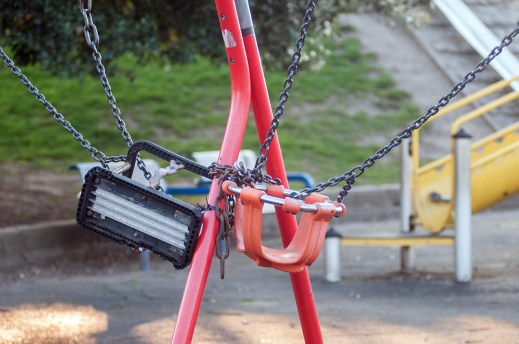
It’s understandable to resist reading or thinking about Covid in late-2021, even as the Delta variant’s new surges are making headlines around the world. Covid has surrounded and overwhelmed us for over a year, and many people’s reluctance to engage meaningfully with it at this time is fueled by feelings of fatigue, mental exhaustion, and frustration. However, I urge in this post that we have a continued responsibility to sustain our sonic engagement and listen to what the Covid-19 soundscape teaches us.

Covid-19, as most of us now know now, is a virus caused by the coronavirus strain SARS-CoV-2. While the symptoms of Covid-19 are many and varied, one symptom seemed most vital and censorious—a nagging and persistent dry cough that became referred to as the “Covid cough” in everyday vernacular. The Covid cough became an intrusive and yet all too familiar presence in the Covid soundscape—an isolated acoustic environment that allows us to study its characteristics. For instance, investigations within the Covid soundscape have studied the noise annoyances of traffic, neighbors, and personal dwellings; have recorded the quieting of the usually bustling streets of New York City; have researched whale stress hormones linked to less noise pollution in our ocean waters; and have analyzed  the reception and aural imagery of sirens. I seek to add to this research by bringing the sounds of the Covid body (or a body perceived to have Covid) into the larger soundscape conversation.

It is of vital importance to attend to the Covid soundscape while we are still in it because the Covid soundscape is bound by time and place and is ever-changing. Once Covid is eradicated, our access to the sounds surrounding it disappear as well. So, I dwell in the soundscape where the Covid cough is still an everyday reality. With the Covid cough present in approximately sixty percent of Covid cases according to WebMD, the cough quickly became the virus’s warning bell, identifying who might be infected with the virus. In the early days of the viruses’ rapid spread in the United States, coughing became an acoustic red flag—a sign that danger could be near. So much about the virus and its spread was unknown, and the uncertainty heightened desires for control and reassurance. Because of this, we attended to coughing in ourselves and others, consciously and unconsciously, in ways we probably never had before.
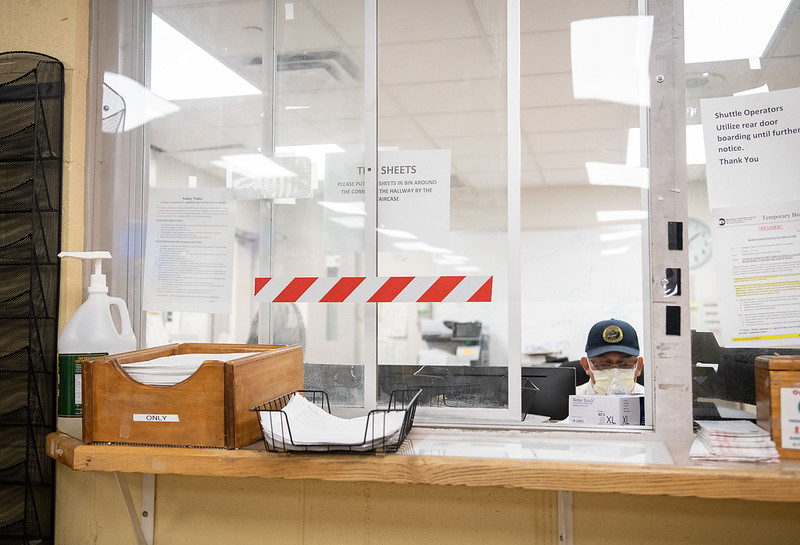
“MTA Installs Plexiglass and Vinyl Barriers to Protect Employees and Riders During COVID-19 Pandemic,” Photo: Jessie Mislavsky / MTA NYC Transit, April 21, 2020 (CC BY 2.0)

All of this auditory attention focused on coughing is a process of listening. Different from hearing—perceiving sounds—listening requires attentiveness and consideration. Listening to sounds, as Ceraso states, “influences our feelings and behaviors as we move through the world” (176). I, like Eckstein and other sound scholars, insist that sound is an argument and that sounds have persuasive power. Sounds can evoke different responses from different people—perhaps your favorite song elicits painful memories for someone else. Listening then, can be personal. However, sound studies scholars know, and Covid-19 has amplified, that listening is also shaped by social and cultural contexts (Rice, “Listening”). During the pandemic, people listened to bodies in ways that were shaped by the news, the medical community, the culture, and the environment. While listening as a medical practice is used to diagnose and treat, the listening I refer to here is not one of compassionate care, but rather a practice of fear, surveillance, and othering.

For many people—in the United States, particularly white, hetero, cis-gendered, able-bodied, people—their bodily sounds came under social and cultural scrutiny for the first time——bringing up issues of autonomy and self-control. “It’s just allergies,” folks muttered while passing someone in the grocery store, just as a cough that could no longer be suppressed escaped their lips. Suddenly, as suspicious eyes were cast every which way, people felt compelled to disclose their medical histories to complete strangers in order to have their coughs—their bodily sounds—be deemed socially acceptable and their public presence allowable. Shildrick reminds us that bodies are leaky, but Western medicine and practice reinforce European-descended cultural teachings that our bodily boundaries should be secure (i.e. not leaky) and that otherness should be excluded. The “Covid cough” taught many of us for the first time that our bodies are leaky, noisy, and permeable, and they are not always under our command. Listening to our bodies took on an all-new meaning as we attended to our bodily sounds in hyper-vigilant ways.
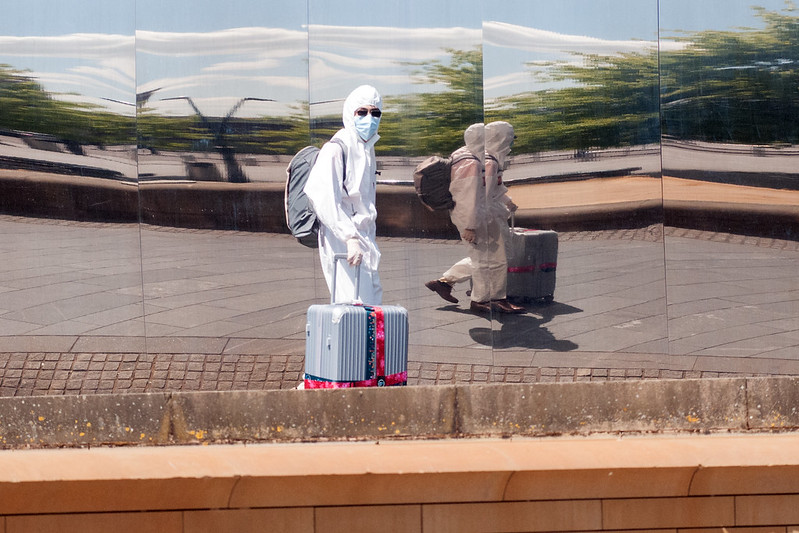
Coronavirus Traveller May 14, 2020 (COVID-19) Sheffield, UK, Image by Tim Dennell (CC BY-NC 2.0)

Attending to the leaky, noisy nature of bodies, however, was certainly not new to everyone. Stoever’s The Sonic Color Line details the hypervigilance and rigid compliance long demanded of Black and brown bodies—often violently—by the white listening ear’s norms regarding “propriety” and personhood.  Ehrick’s concept of the “gendered soundscape” thinks through surveillance in regard to female-presenting bodies and vocal gender. Casillas’s notion of “listening loud(ly)” while Chicanx, Martin’s Black feminist soundwalk methodology , and Blake’s discussion of the “gas station voice” many trans people take on to protect themselves from attack reminds us that the stakes for surveillance are higher at the intersection of race, gender, class, sexuality, accent, and citizenship status, but that resistance can also be also quite powerful.

For individuals with health conditions, impairments, or disabilities, too, concerns about control and disclosure are not recent issues, as their bodies have long been listened to in ways non-disabled bodies simply have not. For example, for a time after my mother had emergency surgery for colon cancer, her body required the use of a colostomy bag. One day she and I were shopping in a department store when a sales clerk heard my mother’s body leak (i.e. make sounds that we’ve been taught to believe are only acceptable in private spaces and bathrooms). The sales associate listened to my mother’s body in a way that bordered on disgust and looked at her in a way that beckoned my mom to justify her leaky, fallible body.

This kind of listening—the surveillance of others’ bodies—is used to regulate and control bodies, and is a long-standing tradition in disability history. For instance, St. Pierre  highlights the embodied act of stuttered speech that is not only constructed by cultural norms but that challenges our cultural fantasy of the body as an invisible channel for communication and disrupts the disabled/able-bodied binary. Mills’s research on deafness and hearing technologies explores the irony and paradox that hearing aids and cochlear implants were invented to “treat” the invisible disability of deafness, but yet visibly mark their wearers. And while not explicitly writing of disabled bodies, Booth and Spencer contend that non-vocal bodily sounds are rhetorical and therefore create rhetorical challenges and provoke us into attempted management of the sounds our body produces. Individuals with impairments, diseases, and disabilities have long been listened to, scrutinized, and surveilled in these ways. Such listening is culturally bound and rooted in the ableist myth that bodies should be self-contained and controlled at all times.

As the Covid-landscape meant that our ability to visually surveil bodies was diminished due to masks, barriers, and plexiglass partitions, our impulse to sonically surveil became heightened. Thus, many of us listened differently.  Our fears of being surveilled were heightened by the fear of the Other—in this case, the fear of being othered as unwell. Our anxiety about the Covid cough was attached to ableism and the horror of being perceived as sick because, as Davis states, the “nightmare of the body is one that is deformed, maimed, mutilated, broken, diseased” (Normalcy: Link 7). The Covid cough reminded all of us that we are not as self-controlled and autonomous as we would like to think, and that we are all capable of being–or of becoming–a dissed (diseased or disabled), othered body, if we are not already.
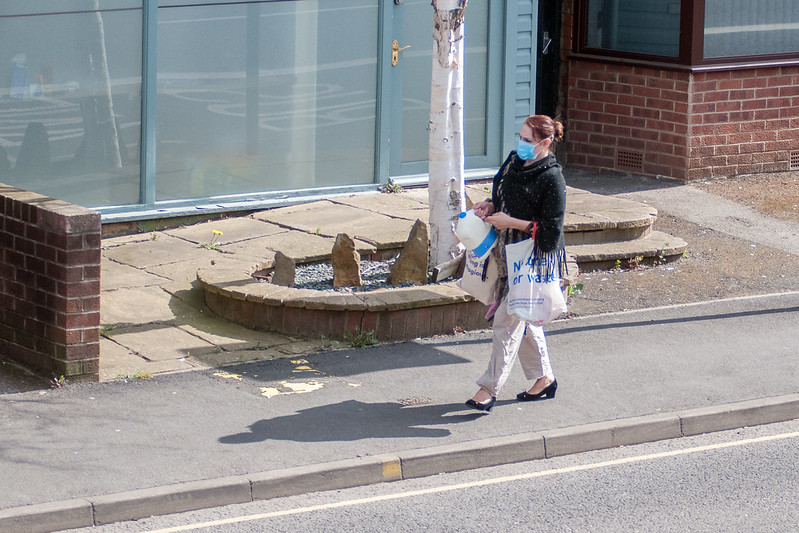
“Lockdown LIfe -Coronavirus (COVID-19) Sheffield, UK,” Image by Tim Dennell (CC BY-NC 2.0)

But what if we could revisit the Covid cough and consciously listen to it in other, less fear-driven ways? If we move from listening to the cough as a surveillance practice and situate our listening as a critical rhetorical practice–a practice that examines the relationship of discourse and power and advocates for social change–then we can begin to think about what the Covid cough can teach us. Novak and Sakakeeny claim that sound only becomes known through its materiality. The Covid cough is indelibly material and embodied; it requires lungs and airways, breath and mucus. The Covid cough, distinguishable from other coughs, was described similarly by medical professionals around the world, reminding us that while listening is a highly cultured act, our sound bodies are comprised of blood, bones, and organs—substance that tethers our listening practices to a material body. We are, as Eidsheim claims in Sensing Sound, interconnected in material terms: “we cannot exist merely as singular individuals” (20). The stuff and guts of our material bodies reminds us of our connectivity, of our shared humanity, of our oneness.

The sound of the Covid cough, then, assures us of our vulnerability—a vulnerability precipitated by our lived, material body. It is important to note that not all individuals have been equally vulnerable. Individuals who are immunocompromised and essential workers, for instance, were much more susceptible to being exposed to the Covid-19 virus, as was anyone unable to work to home and many Black and brown Americans made more vulnerable by years of racist neglect by the nation’s health care system. But, still, no one is invincible. The sounds of the Covid-19 soundscape reify this truth and reinforce that through our material bodies, we are interconnected; we are all sound, and sounding, bodies.
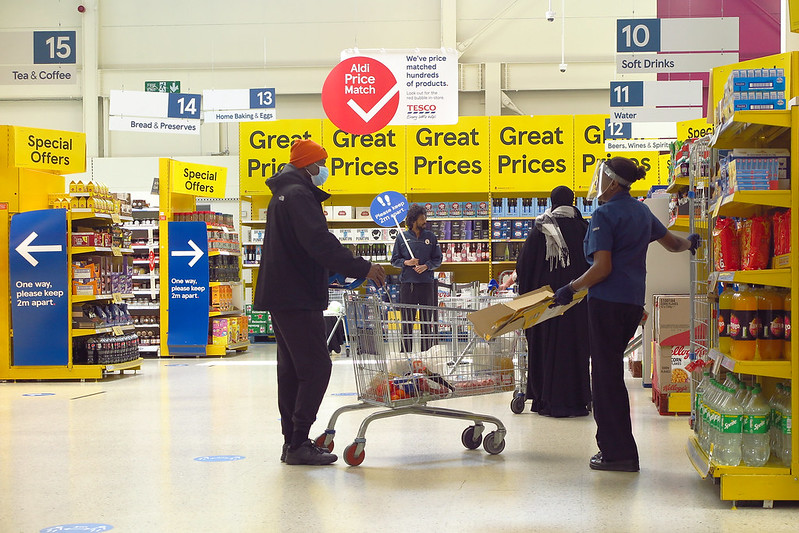
“Lockdown LIfe -Coronavirus (COVID-19) Sheffield, UK,” Image by Tim Dennell (CC BY-NC 2.0)

Covid-19 brought, and is still bringing, daily horrors. The sounds of the Covid-19 soundscape are not yet absent from our consciousness or our communities. My hope is that by re-immersing ourselves into its soundscape, we can continue to remember that our fight against Covid-19 is a collective one and that we all have a shared responsibility toward our fellow humans. It is also important for sound studies to think critically and rhetorically about normalized listening practices and how those practices shape cultural understandings of what it means to be sick or disabled. Listening is not only an embodied practice; it also has bodily implications. While the Covid-19 soundscape heightened our awareness of our own vulnerability and, for some, their fears of “the other”—and (hopefully) some reflexivity on how one’s own listening can drive practices of othering—it also reassured many of our connectivity, for better or worse.

We remember those whose lives were lost to Covid-19. We listen to honor them and we listen to learn. . .and hopefully we can listen to one another with renewed empathy to build new collectivities that will forever change the Covid soundscape, along with the many other intersecting inequities that collectively brought us here too.

—

Featured Image: Coronavirus, Playground on Lockdown, Sheffield, UK, Image by Tim Dennell (CC BY-NC 2.0)

—

Sarah Mayberry Scott (Ph.D., University of Memphis) is Assistant Professor of Communication Studies at Arkansas State University in Jonesboro, Arkansas. Her research centers on representations and rhetorics of deafness. Scott is particularly interested in how sound impacts the Deaf community and how multi-modal literacies can be of particular interest and utility. She explores these issues in her works, “Re-Orienting Sound Studies’ Aural Fixation: Christine Sun Kim’s ‘Subjective Loudness,’” (2017), “Disability Gets Dissed: How Listening Rhetorically with Cultural Humility Amplifies the Concerns of Disability Culture,” (2021), and “Toward a More Just Rhetorical Criticism Through Situated Listening” (in press).

—

tape reel

REWIND! . . .If you liked this post, you may also dig:

my mother’s voice, my father’s eye, and my other body: the sound of deaf photographs— Cara Cardinale

SO! Reads: Steph Ceraso’s Sounding Composition: Multimodal Pedagogies for Embodied Listening--Airek Beauchamp

SO! Podcast #79: Behind the Podcast: deconstructing scenes from AFRI0550, African American Health Activism – Nic John Ramos and Laura Garbes

Queer Timbres, Queered Elegy: Diamanda Galás’s The Plague Mass and the First Wave of the AIDS Crisis– Airek Beauchamp

Share this:

  • Click to email a link to a friend (Opens in new window) Email
  • Click to print (Opens in new window) Print
  • Tweet
  • Share on Tumblr
  • Click to share on Reddit (Opens in new window) Reddit
Like Loading...

Related

Tags: Covid Cough, Covid-19 Soundscape, Sarah Mayberry Scott, SARS-CoV-2

« Previous post
Next post »

Trackbacks / Pingbacks

  1. Top Ten Sounding Out! Posts of 2024! | Sounding Out! - December 23, 2024
  2. Listening Together/Apart: Intimacy and Affective World-Building in Pandemic Digital Archival Sound Projects | Sounding Out! - January 22, 2024
  3. The Top Ten Sounding Out! Posts of 2020-2022! | Sounding Out! - December 12, 2022
  4. For your week 1 post, you were invited to offer a starting definition of sound s - Kesi Essays - April 24, 2022
  5. Dispatches from the Underground // August 2, 2021 - I Heart Noise - August 2, 2021

Leave a comment Cancel reply

This site uses Akismet to reduce spam. Learn how your comment data is processed.

This is a large button to press to be added to our mailing list

ISSN 2333-0309

Translate

Recent Posts

  • Impaulsive: Bro-casting Trump, Part I
  • Top Ten Sounding Out! Posts of 2025!
  • SO! Reads: Marisol Negrón’s Made in NuYoRico: Fania Records, Latin Music, and Salsa’s Nuyorican Meanings 
  • Finding Resonance, Finding María Lugones
  • Press Play and Lean Back: Passive Listening and Platform Power on Nintendo’s Music Streaming Service

Archives

Categories

Search for topics. . .

Looking for a Specific Post or Author?

Click here for the SOUNDING OUT INDEX. . .all posts and podcasts since 2009, scrollable by author, date, and title. Updated every 5 minutes.

this is a widget to subscribe to our podcast on iTunes

Join 14.5K other subscribers

Like us on Facebook!

Like us on Facebook!

Current Top Posts

  • Beyond the Grave: The “Dies Irae” in Video Game Music
    Beyond the Grave: The “Dies Irae” in Video Game Music
  • Impaulsive: Bro-casting Trump, Part I
    Impaulsive: Bro-casting Trump, Part I
  • Unsettling the World Soundscape Project: Soundscapes of Canada and the Politics of Self-Recognition
    Unsettling the World Soundscape Project: Soundscapes of Canada and the Politics of Self-Recognition
  • A Conversation With Themselves: On Clayton Cubitt’s Hysterical Literature
    A Conversation With Themselves: On Clayton Cubitt’s Hysterical Literature
  • Faithful Listening:  Notes Toward a Latinx Listening Methodology
    Faithful Listening:  Notes Toward a Latinx Listening Methodology

Ongoing Series

Latest 5 Forums

This is an image representing the Haitian Radio//Radyo Aysien Forum

April 2021

this is an image that links to our audiobook series from jan 2020

January 2020

this is an image that links to our Next Gen Sound Studies Forum

November 2019

this image links to our Mingus Ah Um at 60

October 2019

this is an image linking to our soundwalking while POC series

August 2019

Top 5 Forums

This image links to our Sound and Technology Series

April 2014

this links to the Gendered Soundscapes of India Forum

November 2017

this links to our Gendered Voices Forum

March 2015

This image links to our Sound and Pedagogy Forum

December 2017

This links to the hysterical sound forum.

October 2015

Recent Comments

Unknown's avatarImpaulsive: Bro-cast… on Taters Gonna Tate. . .But Do P…
Unknown's avatarTop Ten Sounding Out… on Faithful Listening:  Notes Tow…
Unknown's avatarTop Ten Sounding Out… on “Keep it Weird”: L…
Unknown's avatarTop Ten Sounding Out… on “Just for a Few Hours, W…
Unknown's avatarTop Ten Sounding Out… on Clapping Back: Responses from…

RSS Feeds

  • RSS - Posts
  • RSS - Comments

Sounding Out!

Website Powered by WordPress.com.

  • Comment
  • Reblog
  • Subscribe Subscribed
    • Sounding Out!
    • Join 9,479 other subscribers
    • Already have a WordPress.com account? Log in now.
    • Sounding Out!
    • Subscribe Subscribed
    • Sign up
    • Log in
    • Copy shortlink
    • Report this content
    • View post in Reader
    • Manage subscriptions
    • Collapse this bar
 

Loading Comments...
 

    %d






