
Re-orienting Sound Studies’ Aural Fixation: Christine Sun Kim’s “Subjective Loudness”
Editors’ note: As an interdisciplinary field, sound studies is unique in its scope—under its purview we find the science of acoustics, cultural representation through the auditory, and, to perhaps mis-paraphrase Donna Haraway, emergent ontologies. Not only are we able to see how sound impacts the physical world, but how that impact plays out in bodies and cultural tropes. Most importantly, we are able to imagine new ways of describing, adapting, and revising the aural into aspirant, liberatory ontologies. The essays in this series all aim to push what we know a bit, to question our own knowledges and see where we might be headed. In this series, co-edited by Airek Beauchamp and Jennifer Stoever you will find new takes on sound and embodiment, cultural expression, and what it means to hear. –AB
—
DOI: https://doi.org/10.59350/js45s-ypk38
A stage full of opera performers stands, silent, looking eager and exhilarated, matching their expressions to the word that appears on the iPad in front of them. As the word “excited” dissolves from the iPad screen, the next emotion, “sad” appears and the performers’ expressions shift from enthusiastic to solemn and downcast to visually represent the word on the screen. The “singers” are performing in Christine Sun Kim’s conceptual sound artistic performance entitled, Face Opera.
The singers do not use audible voices for their dramatic interpretation, as they would in a conventional opera, but rather use their faces to convey meaning and emotion keyed to the text that appears on the iPad in front of them. Challenging the traditional notions of dramatic interpretation, as well as the concepts of who is considered a singer and what it means to sing, this art performance is just one way Kim calls into question the nature of sound and our relationship to it.
Audible sound is, of course, essential to sound studies though sound itself is not audist, as it can be experienced in a multitude of ways. The contemporary multi-modal turn in sound studies enables ways to theorize how more bodies can experience sound, including audible sound, motion, vibration, and visuals. All humans are somewhere on a spectrum between enabled and disabled and between hearing and deaf. As we grow older most people move farther toward the disabled and deaf ends of the spectrum. In order to experience sound for a lifetime, it is imperative to explore multi-modal ways of experiencing sound. For instance, the Deaf community rejects the term disabled, yet realizes it is actually normative constructs of hearing, sound, and music that disable Deaf people. But, as Kim demonstrates, Deaf people engage with sound all of the time. In this case, Deaf individuals are not disabled but rather, what I identify as difabled (differently-abled) in their relationship with sound. While this term is not yet used in disability scholarship, it is not completely unique, as there is a Difabled Twitter page dedicated to, “Ameliorating inclusion in technology, business and society.” Rejection of the word disabled inspires me to adopt difabled to challenge the cultural binary of ability and embrace a more multi-modal approach.
Kim’s art explores sound in a variety of modalities to decenter hearing as the only, or even primary, way to experience sound. A conceptual sound artist who was born profoundly deaf, Kim describes her move into the sound artistic landscape: “In the back of my mind, I’ve always felt that sound was your thing, a hearing person’s thing. And sound is so powerful that it could either disempower me and my artwork or it could empower me. I chose to be empowered.”
For sound to empower, however, cultural perception has to move beyond the ear – a move that sound studies is uniquely poised to enable. Using Kim’s art as a guide, I investigate potential places for Deaf within sound studies. I ask if there are alternative ways to listen in a field devoted to sound. Bridging sound studies and Deaf studies it is possible to see that sound is not ableist and audist, but sound studies traditionally has suffered from an aural fixation, a fetishization of hearing as the best or only way to experience sound.
Pushing beyond the understanding of hearing as the primary (or only) sound precept, some scholars have begun to recognize the centrality of the body’s senses in sound experience. For instance, in his research on reggae, Julian Henriques coined the term sonic dominance to refer to sound that is not just heard but that “pervades, or even invades the body” (9). This experience renders the sound experience as tactile, felt within the body. Anne Cranny-Francis, who writes on multi-modal literacies, describes the intimate relationship between hearing and sound, believing that “sound literally touches us,” This process of listening is described as an embodied experience that is “intimate” and “visceral.” Steph Ceraso calls this multi-modal listening. By opening up the body to listen in multi-modal ways, full-bodied, multi-sense experiences of sound are possible. Anthropologist Roshanak Kheshti believes that the differentiation of our senses created a division of labor for our senses – a colonizing process that maximizes the use-value and profit of each individual sense. She reminds her audience that “sound is experienced (felt) by the whole body intertwining what is heard by the ears with what is felt on the flesh, tasted on the tongue, and imagined in the psyche” (714), a process she calls touch listening.
Other scholars continue to advocate for a place for the body in sound studies. For instance, according to Nina Sun Eidsheim, in Sensing Sound, sound allows us to posit questions about objectivity and reality (1), as posed in the age-old question, “If a tree falls in the forest and no one is there to hear it, does it make a sound?” Eidsheim challenges the notion of a sound, particularly music, as fixed by exploring multiple ways sound may be sensed within the body. Airek Beauchamp, through his notion of sonic tremblings, detaches sound from the realm of the static by returning to the materiality of the body as a site of dynamic processes and experiences that “engages with the world via a series of shimmers and impulses.” Understanding the body as a place of engagement rather than censorship, Cara Lynne Cardinale calls for a critical practice of look-listening that reconceptualizes the modalities of the tongue and hands.

As these scholars have identified, privileging audible sound over other senses reinforces normative ideas of communication and presumes that individuals hear, speak, and experience sound in normative ways. These ableist and audist rhetorics are particularly harmful for individuals who are Deaf. Deaf community members actively resist these ableist and audist assumptions to show that sound is not just for hearing. Kim identifies as part of the Deaf community and uses her art to challenge the ableist and audist ideologies of the sound experience. Through exploring one of Christine Sun Kim’s performance pieces, Subjective Loudness, I argue that we can conceptualize sound studies in the absence of auditory sound through the two concepts Kim’s piece were named for, subjectivity and loudness.
In creating Subjective Loudness, Kim asked 200 Tokyo residents to help her create a musical score. Hearing participants were asked to use their bodies to replicate sounds of common 85 dB noises into microphones. The sounds Kim selected included: the swishing of a washing machine, the repetitive rotation of printing press, the chaos of a loud urban street, and the harsh static of a food blender. After the list was complete, Kim has the sounds translated into a musical score, sung by four of Kim’s closest friends. The noises then become music, which Kim lowers below normal human hearing range for a vibratory experience accessible to hearing and non-hearing individuals alike; The result is music that is not heard but rather felt. As vibrations shake the walls, windows, and furniture audience members feel the music.
Kim’s performance expands upon current understandings of the body in sound by incorporating multiple materialities of sound into one experience. Rather than simply looking at an existing sound in a new way, she develops and executes the sound experience for her participants. Kim types the names of common 85 dB sounds, what most hearing people may call “noise” on an iPad – a visual representation of the sound.
By asking participants to use their bodies to replicate these sounds – to change words into noise – Kim moves visual representation moves into the audible domain. This phase is contingent on each participant’s subjective experience with the particular sound, yet it also relies on the materiality of the human body to be able to replicate complex sounds. The audible sounds were then returned to a visual state as they were translated into a musical score. In this phase, noise is silenced as it is placed as musical notes on a page. The score is then sung, audibly, once again shifting visual into audible. Noise becomes music.
Yet even in the absence of hearing the performers sing, observers can see and perhaps feel the performance. Similar to Kim’s Face Opera, this performance is not just for the ear. The music is then silenced by reducing its volume beyond that of normal hearing range. Vibrations surround the participants for a tactile experience of sound. But participants aren’t just feeling the vibrations, they are instruments of vibration as well, exerting energy back into the space that then alters the sound experience for other bodies. The materiality of the body allows for a subjective experience of sound that Kim would not be able to as easily manipulate if she simply asked audience members to feel vibrations from a washing machine or printing press. But Kim doesn’t just tinker with the subjectivity of modality, she also plays with loudness.

In this performance Kim creates a think interweaving of modalities. Part of this interplay involves challenging our understanding of loudness. For instance, participants recreate loud noises, but then the loud noise is reduced to silence as it is translated into a musical score. The volume has been dialed down, as has the intensity as the musical score isolates participates. The sound experience, as the score, is then sung, reconnecting the audience to a shared experience. Floating with the ebb and flow of the sound, participants are surrounded by sound, then removed from it, only to then be surrounded again. Finally, as the sound is reduced beyond hearing range, the vibrations are loud, not in volume but in intensity. The participants are enveloped in a sonorous envelope of sonic experience, one that is felt through and within the body. This performance combats a long-standing belief Kim had about her relationship with sound.
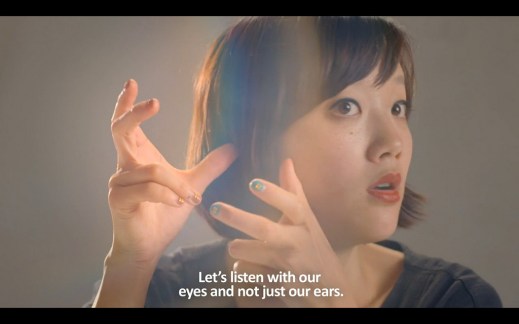
As a child, Kim was taught, “sound wasn’t a part of my life.” She recounted in a TED talk that her experience was like living in a foreign country, “blindly following its rules, behaviors, and norms.” But Kim recognized the similarities between sound and ASL. “In Deaf culture, movement is equivalent to sound,” Kim stated in the same talk. Equating music with ASL, Kim notes that neither a musical note nor an ASL sign represented on paper can fully capture what a music note or sign are. Kim uses a piano metaphor to make her point better understood to a hearing audience. “English is a linear language, as if one key is being pressed at a time. However, ASL is more like a chord, all ten fingers need to come down simultaneously to express a clear concept in ASL.” If one key were to change, the entire meaning would change. Subjective Loudness attempts to demonstrate this, as Kim moves visual to sound and back again before moving sound to vibration. Each one, individually, cannot capture the fullness of the word or musical note. Taken as a performative whole, however, it becomes easier to conceptualize vibration and movement as sound.

In Subjective Loudness, Kim’s performance has sonic dominance in the absence of hearing. “Sonic dominance,” Henriques writes, “is stuff and guts…[I]t’s felt over the entire surface of the skin. The bass line beats on your chest, vibrating the flesh, playing on the bone, and resonating in the genitals” (58). As Kim’s audience placed hands on walls, reaching out to to feel the music, it is possible to see that Kim’s performance allowed for full-bodied experiences of sound – a process of touch listening. And finally, incorporating Deaf and hearing individuals in her performance, Kim shows that all bodies can utilize multi-modal listening as a way to experience sound. Kim’s performances re-centers alternative ways of listening. Sound can be felt through vibration. Sound can be seen in visual representations such as ASL or visual art.
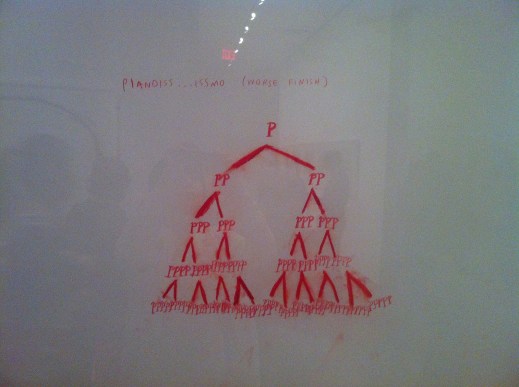
Through Subjective Loudness, it is possible to investigate subjectivity and loudness of sound experiences. Kim does not only explore sound represented in multi-modal ways, but weaves sound through the modalities, moving the audible to the visual to the tactile and often back again. This sound-play allows audiences to question current conceptions of sound, to explore sounds in multi-modalities, and to use our subjectivities in sharing our experiences of sound with others. Kim’s art performances are interactive by design because the materiality and subjectivity of bodies is what makes her art so powerful and recognizable. Toying with loudness as intensity, Kim challenges her audience to feel intensity in the absence of volume and spark the recognition that not all bodies experience sound in normative ways. Deaf bodies are vitally part of the soundscape, experiencing and producing sound. Kim’s work shows Deaf bodies as listening bodies, and amplifies the fact that Deaf bodies have something to say.
—
Featured image: Screen capture by Flickr User evan p. cordes, (CC BY 2.0)
—
Sarah Mayberry Scott is an Instructor of Communication Studies at Arkansas State University. Sarah is also a doctoral student in Communication and Rhetoric at the University of Memphis. Her current research focuses on disability and ableist rhetorics, specifically in d/Deafness. Her dissertation uses the work of Christine Sun Kim and other Deaf artists to explore the rhetoricity of d/Deaf sound performances and examine how those performances may continue to expand and diversify the sound studies and disability studies landscapes.
—

REWIND! . . .If you liked this post, you may also dig:
Introduction to Sound, Ability, and Emergence Forum –Airek Beauchamp
The Listening Body in Death— Denise Gill
Unlearning Black Sound in Black Artistry: Examining the Quiet in Solange’s A Seat At the Table — Kimberly Williams
Technological Interventions, or Between AUMI and Afrocuban Timba –Caleb Lázaro Moreno
“Sensing Voice”*–-Nina Sun Eidsheim
Share this:

The Listening Body in Death

Editors’ note: As a discipline Sound Studies is unique in its scope—under its purview we find the science of acoustics, cultural representation through the auditory, and, to perhaps mis-paraphrase Donna Haraway, emergent ontologies. Not only are we able to see how sound impacts the physical world, but how that impact plays out in bodies and cultural tropes. Most importantly, we are able to imagine new ways of describing, adapting, and revising the aural into aspirant, liberatory ontologies. The essays in this series all aim to push what we know a bit, to question our own knowledges and see where we might be headed. In this series, co-edited by Airek Beauchamp and Jennifer Stoever you will find new takes on sound and embodiment, cultural expression, and what it means to hear. –AB
—
My voice melds with the sound of the water pouring from the hose, as I gently massage the waste, blood, and tears from the body of the deceased. In the act of washing the dead, water is simultaneously sound, spirit, and sensory experience for the deceased and for the washer herself.
Washing the deceased in groups of three, our individual solo voices punctuate space at our own paces and intensities. Our sound soothes and cleanses the deceased as much as our washing. The melodic recitations we provide when gently holding the deceased are the most important components of ritual cleansing before one is buried. We repeatedly sound “Forgiveness, o Teacher [e.g., God]” while exhaling and inhaling. Often we recite the Tekbir—which articulates God’s greatness—adding a melodic architecture to our textured calls for forgiveness.
In washing the dead, we touch the deceased with respect and humility. “Please,” a family member will often beg, “please do not use cold water.” We quickly respond, “of course, this sister is still sensing us.”
Approaching the grieving we smile and gently say, “she is only without breath.” We turn on the water and gently command: “bring me your hand.” And the bereaved joins hands with the washer and feels the warmth of the water. We espouse a tactility exclusively belonging to the washer—as the choreographer and improviser of mourning—with the one who is left alive and in grief.
Our touch and voices alter with each separate experiencing of washing the dead. Because each deceased woman is her own person with her different body and causes of death, no encounter is the same. In the way that we leverage our own bodily movements of lifting and turning the deceased’s body, we actively chose to duet with sounds pouring from the mourning family members in the room. If the mourners are silent, we tend to fill the space with our sound. Our recitations are not only for ritual per se, but exist to offer pleasing sounds to the dead herself.
We recite believing, as Muslims do, that her soul still hears us. While “dead,” she can communicate with all or part of her former body, cooperating with us, the living, as we mediate mourning and prepare her body for burial.
One of the most hard-drawn sensory lines we assume and maintain is the border of death. Death ostensibly marks the end of our constellation of sense experience, engenders the limit of the body, and demarcates the edges of aurality. While we know that hearing remains the last of the senses experienced in dying, scholars of sound studies have yet to extend our exceptional inquiries on hearing, aurality, and listening into posthumous auralities practiced by multiple communities throughout the world. How might sound studies scholars attend to the multi-sensory perceptions and auralities that extend beyond the grey where western epistemological structures end?
As a specialist of Ottoman and Turkish classical musics, I have long been interested in how variant Sunni Islamic practices—themselves rooted in centuries of philosophical debates outside of those generated in “the west”—unsettle categories that many scholars globally assume to be fixed and natural. My current projects have led me to consider the intensity of diverse listening structures attuned to violent thresholds of death in Turkey’s Aegean and Mediterranean seas.
In fall of 2016, my ethnography on listening towards posthumous aurality brought me to Karacaahmet Cemetery in Istanbul, a critically important burial ground of the Ottoman Empire and reportedly the second largest cemetery in the world. Here I was apprenticed to the women of Karacaahmet, practicing Sunni Muslims and official state employees who provide the service of conducting the Islamic rituals of washing the dead. During this time I had the privilege of laying dozens of women and girl-children of all ages, diseases, and accidents to rest with sound.
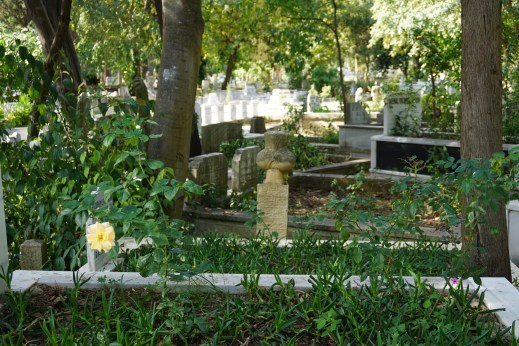
Walking in Karacaahmet. Istanbul, September 2016. Photograph by the author.
In taking posthumous aurality seriously, I have few paths of translation available to me. I am challenged by normative secular belief structures that we may uncritically reproduce in scholarship. Death is not necessarily the end of aurality. Provincializing western critical theory and engaging ethnographic insight from non-western eschatologies—the areas of theology concerned with death and dying—invites one path for expanding our structures of listening beyond a body’s end.
For decades now, scholars have studied the body not as an accomplished fact but rather as a process. Yet in the body praxis long upheld in Islamic death rituals in Turkey, the vitality, socialization, and subjection of the body does not end in death, but rather passes into an alternate sensory and dialogically sonic realm. Death offers a space akin to what Bohlman and Engelhardt have considered as the sonic emptiness of religious ontologies, or “a space of perception and experience, not of silence and absence.”
Posthumous aurality, as I define and explore it, takes both an ethnographic and a sound studies approach to consider sensory possibilities of death. In this liminal space of mingled bodies—the bodies of the dead, the washers as care laborers, and the deceased’s mourning family members—I listen at a crossroads in which local belief structures mediate and structure sounds, soundings, silences, and voicing.
In Muslim cemeteries in Istanbul, it is believed that there is life in the grave. Death is described in terms of development, progression, pathway, and mere transition from one stage of life to another stage. The barzakh, the barrier of the grave and time spent dwelling posthumously in it, is an interstitial zone entered upon death which the soul can experience pleasure and pain, socialize and commune with others. There exists no necessary binary of life versus death, sound versus silence in these spaces.
The barzakh is a stage of movement, a zone of transference and oscillation. The body is a listening body—its soul communicates and lingers around it, sensing the sounds and touch offered by the washers. Ottoman poetry abounds about such sensings, echoing the understanding the body is a cage and the spirit is incarcerated in it. Artists of the word—with wording historically experienced aurally—narrate the body as wishing for its release (e.g., death) and the possibility of being reunited with its beloved (e.g., the divine) and returning to the earth as soil.
Sonic generosity in the face of death requires washers to engage a modality of listening, touch, and sounding to send an individual to the next realm to await resurrection. Her soul circles the room where we wash her body, listening and participating with us sonically, called back to her body in the grave three times before it is closed.
We believe we hold the body in its second most intimate moment in life, after that of its emergence from the womb. The scent of death fills our nostrils as we sweat to lift the deceased after we finish shrouding her and sprinkling the shroud with rose water. Gently, we ease her into the pine box that transports her to her grave.
And after we are done washing someone—whether we refer to her as “sister,” “aunt,” or “daughter”—we later, in our back tea room, remark upon the grieving of the family members joining us in the room and the discovery of ailments or sores on our sister.
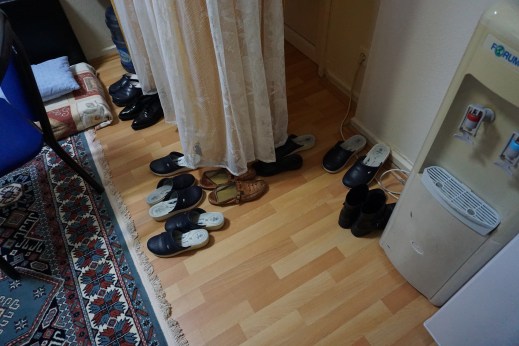
The shoes that we shed at the entrance to our back tea room. Istanbul, October 2016. Photograph by the author.
In these moments of collective sharing, we discover ourselves in our shared similarities with the dead. Wisdom is, after all, listening in tandem with others and recognizing that which is most human in all of us.
In the context of Cairo, Egypt, Charles Hirschkind has beautifully analyzed “the ethical and therapeutic virtues of the ear.” Yet in washing the dead, I produce and engage in a space beyond the pieties maintained by circulating listening structures in particular places. I enter a particular and intimate form of relationality—not a relationship to myself as a subject or the subjection of the dead other, but rather to relationality itself as a form of the sonorous. Jean-Luc Nancy reminds us that the sonorous “outweighs form.” In listening towards posthumous aurality, I am ushered into a unique corporeal and sensorial form of access. Posthumous aurality is simultaneously “mine” and also shared.
Posthumous aurality renders all of our bodies—including that of the literal post-human dead—as capable of being influenced by others in that place. Sharing posthumous auralities in tandem with the washers, the grieving, and the deceased echoes in a space that is indissociably material and spiritual, internal and external, singular and plural.
The critical theories and methodologies of sound studies tend to not center diverse non-western tenets of sensory apparatus espoused by individuals and communities who perceive sound outside of the boundaries of western metaphysics. Posthumous auralities—when translated and mediated linguistically—offers a sound path to understanding the continuations and transformations of sense experience that occur in death. Tuning into posthumous auralities in Turkey’s urban Muslim cemeteries has helped me recover sounds long unheard because they have been relegated to the boundaries of our academic disciplines and the fringes of our very lives.
—
Featured Image: A view from Eyüp Sultan. Istanbul, October 2016. Photograph by the author.
—
Denise Gill is assistant professor of ethnomusicology at Washington University in St. Louis in the Departments of Music; Women, Gender, and Sexuality Studies; and Jewish, Islamic, and Near Eastern Languages and Cultures. Her research has been supported by Fulbright and ACLS. Her book, Melancholic Modalities: Affect, Islam, and Turkish Classical Musicians (Oxford, 2017), introduces methodologies of rhizomatic analysis and bi-aurality for scholars of sound, musical practices, and affect. Her current projects focus on listening structures of death, refugee loss, and acoustemologies of Muslim cemeteries and shrines in Istanbul. A kanun (trapezoidal zither) player, Denise has performed in concert halls in Turkey, the U.S., and throughout major cities in Europe.
—
REWIND! . . .If you liked this post, you may also dig:
Something’s Got a Hold on Me: ‘Lingering Whispers’ of the Atlantic Slave Trade in Ghana–Sionne Neely
The Amplification of Muted Voices: Notes on a Recitation of the Adhan–David Font-Navarrette
“An Ear-splitting Cry: Gender, Performance, and Representations of Zaghareet in the U.S.“-Meghan Drury
Share this:




Current Top Posts





April 2021

January 2020

November 2019

October 2019

August 2019

April 2014

November 2017

March 2015

December 2017

October 2015
 Sounding Out!
Recent Comments