
Norman Corwin: Radio at the Intersection of Art and Commerce
 Editor’s Note: Today, Shawn VanCour continues our summer series “Tune In to the Past,” which explores the life and legacy of radio broadcaster Norman Lewis Corwin, the “poet laureate of radio” who died last summer at the age of 101. Sounding Out!‘s three-part exploration of his legacy by radio scholars Neil Verma (June), VanCour (July), and Alex Russo (August) not only gives Corwin’s work new life (and critique), but also speaks to the growing vitality of radio studies itself. And now, a word from our sponsor, Shawn VanCour.–JSA
—
An experiment in radio is something nobody ever tries except strange people with a funny look. Good businessmen know better than to try experiments . . . . on account of you can’t play too safe when it comes to trying out new things.
–Unaired passage from script for “Radio Primer,” Twenty-Six by Corwin, May 4, 1941
The story of Norman Corwin is by now a familiar one: joining such illustrious figures as Irving Reis, William Robson, and Orson Welles, Corwin led a new generation of sound artists in developing pioneering techniques of radio drama that exploited the medium’s potential as a “theater of the mind” and inaugurated the celebrated “Golden Age” of network broadcasting. In death as in life, Corwin has been much praised for these contributions, and for his signature style so eloquently analyzed by Neil Verma in the opening volley of this SO! series.
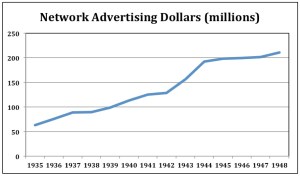
Advertising dollars spent on network radio programming from 1935-1948, based on data compiled in the 2002 edition of Christopher Sterling and John Kittross’s Stay Tuned: A History of American Broadcasting. Advertiser investment climbed sharply, spurred by a corresponding growth in network affiliates.
However, as Erik Barnouw notes in his preface to LeRoy Bannerman’s biography of this broadcasting legend, Corwin’s story is also bound up with a larger economic history of radio, unfolding during a period of intensified growth in and controversy surrounding commercial broadcasting. From Corwin’s first show for CBS in 1938 to his last network broadcast in 1947, the percentage of affiliated stations in the country grew from 52 to 97, while investment by commercial advertisers more than doubled. To answer critics of commercialism and give its network signs of distinction, CBS dramatically increased its public service commitments (what David Goodman refers to as “radio’s civic ambition”), investing heavily in “sustaining” (unsponsored) shows that gave producers like Corwin room for unprecedented aesthetic experimentation.
This second, institutional dimension of Corwin’s story warrants further consideration. Observing the Marxist adage that history is made by individuals not in conditions of their own making, I propose that assessing Corwin’s legacy for radio and sound studies demands we attend not only to the what of that legacy–the techniques Corwin pioneered and programs he produced–but also to its how and why: the institutional context that spawned and encouraged these aesthetic innovations. How, in other words, did commercial concerns at the structural level shape and enable the rise of the “Corwinesque” as a viable mode of sonic expression? What peculiar set of economic relations undergirded these grand experiments in twentieth century sound art, and what lessons might this period offer for understanding creativity and aesthetic innovation in subsequent eras such as our own?
Sounds of Commerce
Corwin’s 1941 play, “A Soliloquy to Balance the Budget,” opened with the sounds of an adding machine and voice of a “soliloquist” tabulating the cost of each musical note and on-air gag. Such is the secret soundtrack of every broadcast since commercial radio’s inception, as one of the past century’s largest and most successful industries dedicated to the business of packaging and selling sounds for corporate profit.
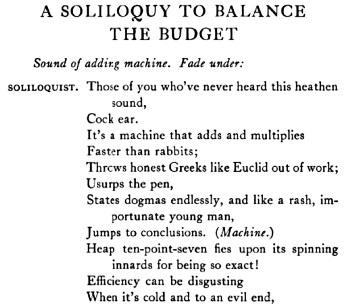
Excerpt from script for “A Soliloquy to Balance the Budget,” broadcast on CBS’s Twenty-Six by Corwin series, June 15, 1941.
Rather than seeing the flowering of the Corwinesque as a brief but “golden” reprieve from an otherwise dark history of commercial mediocrity, I propose we use the case of Corwin to critically interrogate presumed antipathies between opposing forces of art and commerce in U.S. broadcasting, and seemingly intractable tensions between competing goals of public service and corporate profit. Might we see in Corwin, instead, an instance where concerns with profit margins in fact facilitated aesthetic innovation, and where goals of public service and commercial success entered into strategic (if temporary) alignment?
This perspective is by no means intended as a neoliberal apologia for the commercial system. Yet, at the same time, the modes of aesthetic experimentation in which Corwin engaged were never so antithetical to run-of-the-mill commercial forms as traditional histories have implied. Corwin contributed to both sustaining and commercial programs, and the techniques he developed were eagerly copied by radio ad-writers. Moreover, public service programming for CBS was no mere loss leader, but rather offered opportunities for financial profit both in its own right and as part of a larger system of coordinated transmedia flows. Listening for the sounds of commerce in these programs demands a more sophisticated grasp of industry economics than the reductive binaries of traditional histories allow, beginning with an interrogation of the Romantic ideology of art on which those binaries rest.

Merita was a longtime sponsor of The Lone Ranger on radio and television beginning in 1938. Image by Flickr user Jeffrey.
De-Romanticizing Radio Art
Unlike other radio greats such as Robson and Welles who worked extensively on commercial series, what distinguishes Corwin in traditional accounts is his alignment with a protected sphere of noncommercial programming. Hired by CBS to work on sustaining series such as the Columbia Workshop, Corwin was celebrated by contemporaries like Richard Goggin as “pleasantly isolated from ‘commercial’ broadcasting,” with its “struggle for sales and maximum audiences” (63-4). His official biographer similarly praised him as an artist who “flourish[ed] in a freedom of ‘sustaining’ programming [that was] the hallmark of the Golden Age” and “refused to forsake this liberty for commercial earnings, although corporations clamored for his talent” (5).
Corwin himself directly contributed to this anti-corporate mythos. In a 1944 book on radio writing, he advised those aspiring to work in radio to “Do the opposite of what a sponsor or an agency executive tells you, if you want to write originally and creatively” (53), while including regular jabs at network and advertising executives in scripts for sustaining shows such as his “Radio Primer” or “Soliloquy to Balance the Budget.” But by 1947, Bannerman explains, “the contest for higher ratings” had won out, and Corwin exited the network arena for greener pastures and a new job with the United Nations (10). In a 1951 article for The Writer, Corwin now recommended that “the writer who wants to do the best work in his power, in defiance of formula,” simply “forget radio,” and “until such time as [it] returns to a constructive attitude toward public service and the esthetic values in writing, look upon [it] as a trade outlet, not an art” (1, 3).
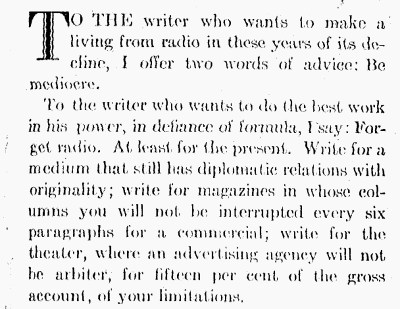
Opening lines of February 1951 essay by Corwin for The Writer, in which aspiring writers who wish to exercise their creative freedom are advised to “forget radio” and look elsewhere.
Setting aside the dubious merit of a narrative that denies any real aesthetic achievements for the 15 years preceding and 65 years following Corwin’s ten-year run in network radio–the apogee of a tragically brief “Golden Age”–we may recognize the conception of creativity espoused here as a distinctly Romantic one. Within this view, so-called “true art” flouts the rules and formulas on which commercially driven mass art depends, and is pursued for purposes other than financial gain. This Romantic ideology of art has been repeatedly challenged, from earlier work by M. H. Abrams, to more recent critiques by Noel Carroll and R. Keith Sawyer. My own concern is not with its veracity per se, but rather with the historical exclusions needed to sustain its underlying binaries of art/commerce and public service/commercialism vis-à-vis the work of Norman Corwin. These exclusions (acts of forgetting on which remembrances of Corwin’s legacy are grounded) may be grouped into three basic categories: the selective operations of canon-formation, cross-fertilization of techniques in commercial and sustaining programming, and profitability of public service within the CBS business model.
Canon-Formation
The received view immediately works to remove Corwin from the sphere of commercial programming, marginalizing his contributions to sponsored series such as the Cresta Blanca Carnival—whose ad agency Corwin himself commended for checking the customary “fear of anything suggesting artistic endeavor” (402)—or Dupont’s Cavalcade of America, for which he wrote his “Ann Rutledge” play, better known from its later revival on the Columbia Workshop. So, too, does it single out among his many production credits a comparatively small list of broadcasts for which he wrote his own scripts, while limiting its purview to his radio works at the expense of his contributions to other media. (For a comprehensive list of Corwin’s creative works, including his many commercial film and television productions, see the appendix in this volume.) As with all processes of canon-formation–a crucial component of what Michel Foucault calls the “author-function”–bids for Corwin’s artistry thus entail a series of selective filtering operations. The totality of the individual’s creative labor is negated within a synecdochical logic of “best” works that renders the exceptional as typical and relegates the typical to the realm of historical oblivion. What other “Corwins” might further scrutiny reveal?
Cross-Fertilization
Efforts to preserve the purity of Corwin’s art by maintaining its opposition to and inherent tension with commercial broadcasting also ignore the extent to which the advertising industry itself embraced Corwin’s techniques. In 1942, trade magazine Broadcasting reported with much clamor Corwin’s acceptance of a bronze medal at New York’s Annual Advertising Awards Dinner, given to honor an “individual, who by contemporary service has added to the knowledge or technique of radio advertising” (22). Authors of popular radio writing manuals noted, in particular, the impact of Corwin’s technique of “choral speech,” which Barnouw in his 1945 Radio Drama in Action claimed was “so successful with listeners that . . . producers of dramatized commercials . . . [now] use [it] for spot announcements to sell soap flakes” (204-5).
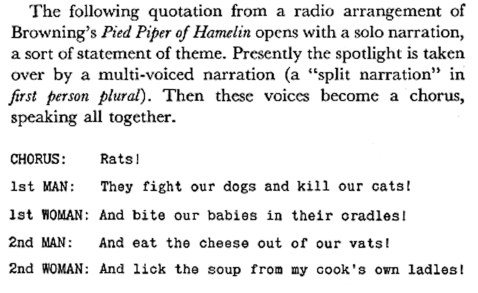
Example of choral speech from script for episode of Corwin’s 1938-39 Words Without Music, reproduced in Barnouw’s 1939 Handbook of Radio Writing
Choral Speech in ad for Ajax household cleanser, late 1940s
Omitted from later accounts, such lost tales of cross-fertilization suggest not simply blind spots in the received view, but a fundamental abnegation: the separation of art and commerce as much an achievement of historical memory as historical fact.
Profitability of Public Service
Positioning the art of Corwin in contradistinction to growing tendencies toward commercialism also ignores the tremendous profitability of public service programming within CBS’s business model, both in its own right and as part of a system of carefully coordinated, cross-platform media flows. As Barnouw notes in Vol. 2 his 1968 History of Broadcasting series, CBS ramped up its investment in sustaining programming during the 1930s as part of a race with NBC to attract affiliates and expand its national network. Whereas NBC charged affiliates for sustaining shows to defray production costs, CBS provided stations with sustaining programs at no charge in exchange for guaranteed carriage of its sponsored series. (NBC stations, by contrast, were given right of refusal for any sponsored shows they wished to opt out of.) For CBS, sustaining shows presented not a financial burden but a path to commercial profitability. Attracting stations eager for free “quality” programming, the network drew fresh revenue in membership fees for each new affiliate it added. Eager to capitalize on these expanded economies of scale and willing to pay the corresponding ad rates, sponsors in turn flocked to the network, giving CBS valuable new accounts and further revenue boosts.
Recognizing their economic value, CBS heavily promoted sustaining stars like Corwin as talented auteurs who represented the network at its best, while working to parlay their products across multiple media platforms. In a 1942 Broadcasting ad promoting Corwin’s newly published script collection, Thirteen by Corwin, the network highlighted his artistry while tracing its corporate signature into his own, reminding readers that these plays were “written and produced under the sponsorship of the Columbia Broadcasting System,” as a new “literature of the air . . . . [whose] first editions . . . [are] printed in decibels instead of type” (62-3).
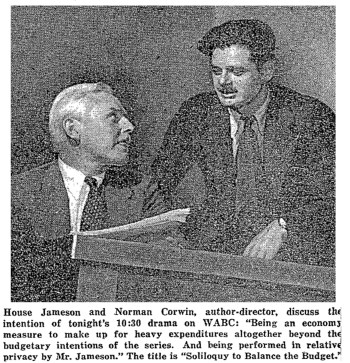
Images of a well-oiled network publicity machine at work. Newspapers such as the New York Times frequently printed network-supplied publicity stills and promotional copy in their radio sections. Here’s a publicity still of Corwin with actor House Jameson preparing for the the “Soliloquy” episode of Twenty-Six by Corwin (6-15-41).
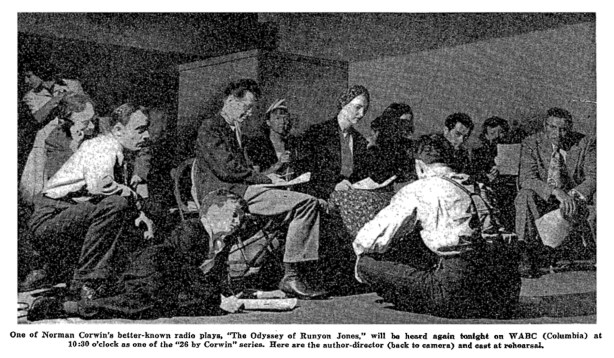
Publicity still of actors rehearsing for an encore presentation of Corwin’s critically acclaimed radio play, “Odyssey of Runyon Jones” (11-26-41).
Corwin’s 1945 VE-Day celebration, “On a Note of Triumph,” was released not only in print, but also on disc by Columbia Records, converting an otherwise ephemeral sustaining feature into a source of direct profit while advancing the larger Columbia brand.
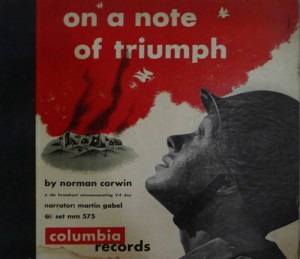
Cover art for 1945 Columbia Records release of Corwin’s “On a Note of Triumph” – leveraging content across media platforms for increased profit potential.
Whether attracting new affiliates and sponsors, or offering opportunities to improve brand recognition and exploit ancillary markets, CBS’s public service programming thus operated not in opposition to commercial forces but rather in the service of the network’s larger bid for economic competitiveness.
Lessons for Radio and Sound Studies
My remarks here are not intended to impugn Corwin’s artistic integrity, nor to imply a lack of commitment to loftier civic goals by CBS executives. The question, again, is a structural one: within what institutional context do the forms of aesthetic expression associated with “the Corwinesque” become possible and desirable? Put simply, how and why, from a structural perspective, do innovations in radio and sound art occur, and what forms can they take under given conditions?
Such inquiries are ill-served by presuming ipso facto oppositions between art and commerce or public service and commercial profit. Indeed, while often resting uneasily together, in the American system they have been bedfellows from the very beginning. To presume, moreover, that aesthetic innovation demands a protected space of noncommercial programming, or that such a space inherently fosters meaningful alternatives to commercial fare, would be a mistake. Within the received view, the legacy of Norman Corwin can be read only as a tale of lament: the death of public service and triumph of commercialism over art. Instead, I suggest we critically interrogate both present and past alike: the “Golden Age” is gone and likely never was, while closer scrutiny of earlier or subsequent eras may reveal aesthetic and institutional complexities hitherto unsuspected.
In a historical moment characterized by an unprecedented proliferation of new media outlets and alternative distribution platforms, but also an extreme concentration of media ownership, can we chart a critical trajectory that avoids both the Scylla of knee-jerk anti-capitalism and Charybdis of hyberbolic neoliberal and techno-utopian praise?

Conflicting attitudes toward contemporary sound industries. User-generated images responding to the SodaHead.com post, “Is Hannah Montana a Tool of the Devil?”, offer excoriating views on the cultural effects of commercialization and conglomeration.

Meanwhile, popular books such as Start and Run Your Own Record Label celebrate opportunities for creative autonomy and aesthetic innovation afforded by niche marketing and digital distribution technologies.
The proper course, whether studying conditions and possibilities for sound art in Corwin’s era or our own, lies somewhere in between.
—
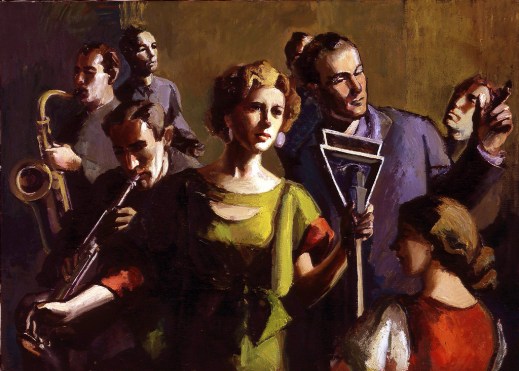
Featured Image Credit: Julia Eckel, Radio Broadcast, 1934, Courtesy of the American Art Museum. An idealized representation, it contains no scripts in hand, no call numbers on the microphone and, importantly, no sponsors’ symbols on the wall.
—
Shawn VanCour is a media historian and lecturer in Film and Media Studies at the University of South Carolina. He has published articles on radio music and sound style in early television, as well as essays on Rudolf Arnheim’s radio theory and the origins of American broadcasting archives. He is currently completing a book on production practices and aesthetic norms for early radio programming and pursuing work for a second project on the radio-television transition of the 1940s-1950s.
Share this:

Orality and Cybernetics in Battleship
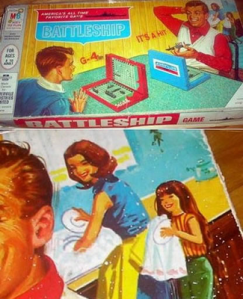
The gendered space of play. Borrowed from superpunch.blogspot.com.
His moment has come. After having scoured each vector of a ten by ten grid, the young tactician makes his move. “G-4,” he announces, possessing some intelligence of a large ship in the south-west quadrant of enemy territory. There is a moment of tension, as his dad sizes up the situation. “It’s a hit,” Dad admits, smiling, as he resignedly lifts a token from his board. The women in the family beam proudly from the kitchen. For a brief moment the social hierarchy is undermined as the house patriarch on the front of the Battleship box concedes victory to his progeny.
Sound has been integrated in different ways into the production of simulated warfare after World-War II. Simulated warfare involves, namely, the cybernetics of paper machines (as board games have been coined by Matthew Kirschenbaum), and the gradual effacement of oral mediation therein. As technologies of interactivity improve, the need for oral communication amongst the games participant’s decreases. The following is a case study of four Battleship commercials that aims to chronicle a set of shifting cultural tendencies parallel to the integration of sound-effects within the material game-form.
As Ong (1982) has noted, writing is powerful because it mediates the vastness of imagination. Once spoken words become grounded in text and inscribed on paper, they become, “locked in our visual fields forever” (p. 11). This is not as totalizing as it sounds, for as words are recirculated in oral cultures, the trace of writing yields slowly to the performative nature of ritual, oral culture. The rules of tabletop games, such as Battleship, although first established in the manual included with the game, are passed through oral ritual more often than not (Fine, 2002; Bowman, 2010). The oral maintenance of game rules is a practice which lends itself, critically, to the cultural attitudes of the group which maintains them. As is evident in the box art above, the game of Battleship is a gendered space where the rules have likely been explained (and maintained) by the household patriarch, then shared with his enthusiastic son.

Borrowed from badhaven.com.
There is an ideological element at play here as well. The box art for Battleship is unmistakably American. From Milton Bradley’s strong red-and-blue branding to the white trim of the son’s shirt, dad’s sweater and the soap suds in the kitchen. After all, the company owed its success to America and the war effort. A 1940s bailout saw Milton Bradley producing landing gear for fighter planes and gunstock for soldiers alongside portable game kits for soldiers seeking diversions in their down-time. The production of board games in post-World War II America owes as much to the military-industrial complex, as the production of video games does today (Dyer-Witherford and dePeuter, 2009). The relationship between the military production and simulation has been well documented by Crogan (2011), who has argued that the production of game interfaces, from the start, has been the by-product of a military desire to map real space onto the virtual in the design of ballistics. To this point, the bombastic introduction to a late-1960s commercial for Battleship (see video below) should come as no surprise. The sonic blast of a real-world battleship is calculated to lure consumers into believing that the game is an authentic simulation of maritime warfare.
The players in this commercial are actively engaged in a discussion amongst themselves. They laugh, and joke as they engage one-another in a tactical crossfire. In some cuts, the players seem particularly engrossed in the games strategy. Even though the commercial showcases two players actively engaged in oral communication, it is important to note that the players are both white males, and that the winner callously gloats as his opponent tumbles into the water. Milton Bradley’s connection to the American military is distinct here, and it plays out as a set of social relationships between the players. Reminiscent of Cold-War politics, the games action plays out as a series of tactical exchanges. Consumers are urged to practice at winning in their living-rooms, or on the go. The portable elements of Battleship are played down in an advertisement about 15 years later. Here, Battleship is situated as a centerpiece of family life.
Also integrating stock footage of real-world military battleships the narrative in this mid 1980s commercial begins with a squabble over domestic space. The actors are (at first) two boys (10 and younger), playing Battleship in the bedroom. After winning, the older boy banishes his younger brother, presumably forever, from his bedroom. Although this act could easily be imagined as selfish, in the context of the 1985 nuclear family, competition is fostered and encouraged. In a second skit, the older boy emerges again victorious at Battleship, his opponent (and father) slouches, consoled by the mother while the grandfather eagerly congratulates the young victor. Electronic Battleship is introduced here as a product as well, and the players are depicted commanding the electronic elements of the game. Feedback is given to the players sonically, as programmed game moves result in dynamic military explosions. There is still a residue of oral communication here, notably the father lamenting, “You sunk my battleship,” as the older boy lets out a strong cheer. Even though the embarrassed father is a commercial trope designed to stimulate the consumer imagination of aspiring child tacticians, it also functions as an in-joke for caring parents looking to instantiate intellectual (mathematical) competition as a centerpiece of domestic life in the age of Reagan’s Star Wars economics and family values.
Ten years later, the commercial narrative has more to do with overt warfare than family life. The competing children are spliced alongside clips of competing Navy officers performing various technical tasks on a real Battleship. As the background music takes on a tense, and somewhat militaristic tone, a command to “Man your battle stations,” is echoed as the two boys careen into their chairs. No longer is the narrative established as a civil exchange between two military masterminds, Electronic Talking Battleship uses sound to enhance the player experience of the simulation. When a hit is scored, a quick shot of the player pumping their fist and shouting is quickly replaced by stock footage of a battleship-explosion. Even wavy radio-lines are used to enhance the over-the-top comic feel of the product’s sound. A number of shots showcase the players programming their battle-stations. The commercial explicitly connects the discourse of soldier-controlled military technology, to player controlled information technology. Good players are able to program on their toes, the only conversation between players is a series of taunts and cheers. At one point, a player refers to the rules. Electronic Talking Battleship is evidence of the increasing capital of information technologies, and deterioration of orality in electronic games in the mid-1990s.
A final, 1997, commercial for Electronic Talking Battleship disposes entirely of the oral element of gameplay. The commercial begins with a child in what seems like an office conference room. After he presses a green button, a virtual matrix appears before him, and two navy officers materialize across the table from him. The viewer is to assume that one is an officer, and the other his superior. The narrative has the Navy officers desperately trying strategies against a hooting and smiling child. The Navy officers are a metaphor for the game’s computer, which can, at this point, serve as a virtual Battleship opponent. The affective work of companionship, which was once performed by one’s friends and family is now, in at least this commercial, replaced by a machine interface. The oral communication, which once governed the rule-set in a social space, has been outsourced to a machine which governs the rules, precisely, in cybernetic space
As computers begin to take a more active role in our culture, a by-product is the exchange of oral ritual for cybernetic participation. This odd shift can be read as having both positive and negative potential. One positive aspect is the estrangement of the social hierarchies which have been a necessary for the ritual infrastructure of oral communication dating back to Homeric times. While the children in the commercials (and on the original box) seem increasingly autonomous, they also begin to dialogue less with themselves, and more with the game. This, unfortunately, is the negative potential of this cybernetic shift. Where the early advertisements of the game depicted a product which provided a potential escape from a war-ravaged world, later advertisements seek to situate the consumer in the center of the action. A common thread amongst these social, and technical shifts is the instantiation of an electronic voice and interface as keeper of the rules. And, with this shift, the military discursivity of the game-form and its accompanying electronics is inscribed, and made to seem innocent in our imagination and understanding of childhood games and play.
—
Aaron Trammell is co-founder and multimedia editor of Sounding Out! He is also a Media Studies PhD student at Rutgers University.
Share this:


Current Top Posts





April 2021

January 2020

November 2019

October 2019

August 2019

April 2014

November 2017

March 2015

December 2017

October 2015
 Sounding Out!
Recent Comments