
Sound Bites: Vampire Media in Orson Welles’s Dracula

 Welcome back to our continuing series on Orson Welles and his career in radio, prompted by the upcoming 75th anniversary of his 1938 Invasion from Mars episode and the Mercury Theater series that produced it. To help us hear Welles’s rich radio plays in new and more complicated ways, our series brings recent sound studies thought to bear on the puzzle of Mercury‘s audiocraft.
From Mercury to Mars is a joint venture with the Antenna media blog at the University of Wisconsin, and will continue into the new year. If you missed them, check out the first installment on SO! (Tom McEnaney on Welles and Latin America) and the second on Antenna (Nora Patterson on “War of the Worlds” as residual radio).
This week, Sounding Out! sinks its teeth into Orson Welles’s “Dracula,” the first in the Mercury series, and perhaps the play that solicits more “close listening” than any other—back in 1938, Variety yawned at Welles’s attempt at “Art with a capital A” and dismissed his “Dracula” as “a confused and confusing jumble of frequently inaudible and unintelligible voices and a welter of sound effects.” Here’s the full play, listen for yourself:
It’s a good thing that our guide is University of South Carolina Associate Professor and SO! newcomer Debra Rae Cohen. Cohen is a former rock critic, an editor of the essential text on radio modernism, and has also recently written a fascinating essay on the BBC publication The Listener, among other distinguished critical works on modernism. Below you’ll find the most detailed close reading of Welles’s “Dracula” (and of Welles as himself a kind of Dracula) ever done.
Didn’t even know Welles ever played Count Dracula? That’s just the first of many surprises you’ll discover thanks to Debra Rae’s keen listening.
So (to borrow a phrase), enter freely and of your own will, dear reader, and leave something of the happiness you bring. – nv
—

Orson Welles
It’s one of the best-known anecdotes of the Mercury Theater: Orson Welles bursts into the apartment where producer John Houseman is holed up cut-and-pasting a script for Treasure Island, the planned debut production, and announces, only a week before airing, that Dracula will take its place. At a time when Lilith’s blood-drenched handmaidens on the current season of True Blood serve as an analogue for our own cultural oversaturation with vampires, it’s worth recalling why, in 1938, this substitution might have been more than merely the indulgence of Welles’s penchant for what Paul Heyer calls “gnomic unpredictability” (The Medium and the Magician, 52).
In fact, 1938 was a good year for vampire ballyhoo; Tod Browning’s 1931 Dracula film had been rereleased only a month before to a new flurry of Bela Lugosi press. Welles’s last-minute switch was a savvy one, allowing him to capitalize on the publicity generated by the continuing popularity of the film (and the popular Hamilton Deane and John Balderston stage adaptation from which it largely drew), while publicly disdaining its vulgarity in favor of what he seemed peculiarly to consider the high-culture status of Stoker’s original novel. Here he is defending the book:
But more importantly, Welles’s production reclaimed and exploited the novel’s own media-consciousness, a feature occluded in the play and film versions, and one to which the adaptation into radio adds, as it were, additional bite. Dracula introduced several of the radio innovations we’ve come to associate with the Mercury Theater (and The War of the Worlds in particular)—first-person retrospective narration, temporal coding, the strategic use of media reflexivity—but Stoker’s novel may have made such innovations both alluring and inevitable.

Stoker’s Dracula is made up of a patchwork of documents—shorthand diaries, transcribed dictation cylinders, newspaper clippings—that do not simply serve as a legitimizing frame, as in Frankenstein. Instead, they are deeply self-referential, obsessively chronicling the very processes of inscription and translation between media by which the novel is built. Confronted with the terrible threat of Dracula free to prey on London’s “teeming millions,” Mina Harker vows thus: “There may be a solemn duty, and if it come we must not shrink from it. …I shall get my typewriter this very hour and begin transcribing.” Processes of ordering information serve, as critics since Friedrich Kittler have noted (see for example here, here, and especially here), as the way to combat the symbolic threat of vampirism that, as Jennifer Wicke argues, stands in for “the uncanny procedures of modern life,” and a threat that may have already colonized intimate spaces of the text itself (“Vampiric Typewriting,” 473).
That threat, in the novel, sounds oddly like . . . radio. Seeping intangibly through the cracks of door frames, invading domestic spaces, riding through the ether “as elemental dust,” materializing abruptly in intimate settings, communicating across land and sea while rendering his receiver passively malleable, Stoker’s Dracula is terrifying by virtue of his insidious ubiquity, a kind of broadcast technology avant la lettre.

A 1931 Grosset & Dunlap edition of Dracula, with images from Browning’s film.
In adapting Dracula for radio, then, Welles could play on the deep division in the novel between the ordered forces of inscription and the Count’s occult, uncanny transmissive force in order to exploit the anxieties connected with the medium itself. Even the double role Welles plays in the production—both Dracula and the doctor Arthur Seward—functions in this regard as more than bravura.
Seward’s primary role in the drama as compère, or advocate, threads together Dracula’s multiple documentary “narration,” through what became the familiar Mercury device of retrospect-turned-enactment. As Seward, Welles performs an argumentative and editorial function that’s nowhere in Stoker’s novel, where the various documents make up a file that is explicitly uncommunicated, because unbelievable, for a case no longer necessary to make. Shuffling the various documents that make up the “case,” Seward stands outside of definite place, but also outside of time, animating “the extraordinary events of the year 1891” by directly addressing an audience of a medium that does not yet exist. Here is part of Seward’s address:
Seward is our first “First Person Singular,” and yet his persona is unsettlingly thin. Though his voice at the outset is strong and urgent, it feels bland compared with the dense goulash of “Transylvanian” effects that competes for our attention through the first ten minutes of the production—hoofbeats, thunder, wolf howls, whinnies, the sound of a coach seemingly about to clatter to bits, the singsong of prayers muttered, perhaps, in some exotic foreign tongue. The “documents” on which Seward’s claim to the trust of the audience rides are overwhelmed by the sound that saturates them. Here is the scene:
It’s not until nearly 20 minutes into the production that Seward reveals his own connection with the story—as the lover of Lucy Westenra—and from this moment forward Welles allows Seward’s authority in the “present” to be eroded by his bland inefficacy in the scenes of the “past.” By Act II, he has ceded authority by telegraph to Dr. Van Helsing (Martin Gabel, in a brilliantly crafted performance):
Without the didactic authority of Van Helsing and with small claim on audience sympathy, Seward becomes, through the second half of the production, a strangely insecure advocate, whose claim on authentic first person experience often disrupts, rather than augments, his role as presenter.
The listener does not consistently “follow” Seward either narratively or sonically—indeed, he is often displaced to the sonic periphery by Dr. Van Helsing. In the final confrontation with Dracula, Seward is explicitly shooed to the outer margins of the soundscape to pray.

Orson Welles as The Shadow in a CBS promotional photo, 1937 or 1938
Here the technical exigencies of Welles’s double role support a subtext that his unmistakable voice has already suggested: that Seward is here the “other” to Dracula (as, later, his Kurtz would be to his Marlow), waning as he waxes. As Lucy is weakened through Dracula’s occult ministrations, so too is Seward sapped of vitality, his romantic passages voiced as strangely bloodless, while Dracula’s wring from Lucy an orgasmic sonic response. Penetrating the intimate chamber Seward ineffectively desires to protect, Dracula replaces him as the production’s central sonic presence—who even when silent, possesses the sonic space.
Contrast Seward’s feeble voice during his night-time vigil here,
to Dracula’s seductive visit here,
Welles needed to distinguish his Dracula from Lugosi’s, employing, rather than an accent, a kind of sonorous unplaced otherness. But his performance shares the ponderous spacing of syllables that, in Lugosi’s case, derived from phonetic memorization of his English script; in other words, Welles is “recognizable” as Dracula without “playing” him. As an analogue to Lugosi’s glacial movement, Dracula’s voice is here surrounded by depths of silence in an otherwise effect-busy soundscape.
From the beginning, Dracula is also sonically on top of the listener, uncomfortably intimate, as in this scene of a close shave:
And although Dracula’s voice is not heard for a full thirteen minutes after Lucy’s death, it nevertheless seems to inhabit all available silences, until he quietly seeps through the door frame of Mina Harker’s bedroom:
The closely-miked phrase “blood of my blood” is reprised throughout the second half of the production—it is repeated seven times, by both Dracula and Mina (Agnes Moorhead), though it occurs only once in the novel—underscoring the ineffable aurality of Dracula’s “transmission.” The line doesn’t present as meaning, but as a tidal echo, the pulse of a carrier wave. While it signals an action unrepresentable to the ear—Dracula’s literal bite or its resonances of memory and desire—it also functions as a “signal” in the sense that Verma describes, as a repetitive element that compels listenership like an incantation (Theater of the Mind, 106). This is the power against which the “documents” are marshaled, the power of “pure” radio—ironically the very power that allows them to be shared. And the hypnotic thrum of radio rips them to shreds.

A recent CD edition of Welles’s Dracula by CSI Word
Indeed, the closing minutes of the drama present the vampire hunters, the novel’s forces of inscription, as an array of anxious noises marshaled against this lurking silence. The frenzied pacing of the final chase back to Transylvania—an element of Stoker’s novel that both plays and film sacrificed—gathers momentum through ever-shorter “diary entries” delivered, breathlessly, over the sound effects of transport:
Welles exploits the familiarity of his audience with a mechanism that Kathleen Battles calls a “radio dragnet”; the forces of order deploy the ubiquity of radio itself to shore up social cohesion, enlisting the audience within their ranks (Calling all Cars, 149). But here that very process is, simultaneously, unsettled and undermined by the identification of Dracula himself with invisible transmission. As Van Helsing repeatedly hypnotizes Mina to tap in on her communion with Dracula—radio, in a sense, deploying radio—the listener is aware of being both eavesdropper and the sharer of rapport, a position that implicates her in Mina’s enthrallment. Here is part of the sequence:
This identification intensifies in the climactic sequence, completely original to Welles’s adaptation, in which Dracula, at bay before his enemies, weakened by sunlight, calls upon the elements of his undead network:

Cover art featuring the “undead network” from a 1976 vinyl pressing of Welles’s “Dracula”
This tour-de-force moment for Welles is also the point when radio shatters the documentary frame and undermines its logic. Though Mina hears Dracula, the others do not, and as Van Helsing’s “testimony” attests, even she does not remember it. This communication can’t, then, be part of Seward’s “evidence.” Rather, it is the radio listener—Dracula’s real prey—who who has received Dracula’s transmission, who has heard across time and space what no one else present can hear: “You must speak for me, you must speak with my heart.”
Although Mina refuses this rapport by staking Dracula at the last possible second—or does she refuse it? Is this not perhaps the Count’s secret wish?—the effect of the uncanny communion persists beyond Seward’s summation, beyond Van Helsing’s subsequent account of Dracula’s end. It renders almost unnecessary Welles’s famous playful post-credits epilogue, in which he abruptly adopts Dracula’s tones to tell us that, “There are wolves. There are vampires”:
But with the hypnotic reach of radio at your disposal, who needs them?

Orson Welles in The Third Man (Reed, 1949)
—
Featured Image Adapted from Flickr User Andrew Prickett
—
Debra Rae Cohen is an Associate Professor of English at the University of South Carolina. She spent several years as a rock & roll critic before returning to academe. Her current scholarship, including her co-edited volume Broadcasting Modernism (University Press of Florida, 2009, paperback 2013) focuses on the relations between radio and modernist print cultures; she’s now working on a book entitled “Sonic Citizenship: Intermedial Poetics and the BBC.”
—
 REWIND! . . .If you liked this post, you may also dig:
“The Sound of Radiolab: Exploring the ‘Corwinesque’ in 21st Century Public Radio”–Alexander Russo
“One Nation Under a Groove?: Music, Sonic Borders, and the Politics of Vibration”–Jonathan Sterne
“Radio’s ‘Oblong Blur’: Notes on the Corwinesque“– Neil Verma
Share this:

Toward a Practical Language for Live Electronic Performance

Amongst friends I’ve been known to say, “electronic music is the new jazz.” They are friends, so they smile, scoff at the notion and then indulge me in the Socratic exercise I am begging for. They usually win. The onus after all is on me to prove electronic music worthy of such an accolade. I definitely hold my own; often getting them to acknowledge that there is potential, but it usually takes a die hard electronic fan to accept my claim. Admittedly the weakest link in my argument has been live performance. I can talk about redefinitions of structure, freedom of forms and timbral infinity for days, but measuring a laptop performance up to a Miles Davis set (even one of the ones where his back remained to the crowd) is a seemingly impossible hurdle.
Mind you, I come from a jazzist perspective, which means that I consider jazz the pinnacle of western music. My classicist interlocutors will naturally cite the numerous accomplishments of classical composers as being unmatched within jazz. That will bring us to long debates about the merits of Charles Mingus and Duke Ellington as a composers, which leads, for a good many, to a concession on the part of Duke at least, but an inevitable assertion of the general inferiority U.S. composers compared to the European canon. And then I will say “why are we limiting things to composition when jazz goes so much further than the page?” To which I will get the reply: “orchestral performers were of the highest caliber.” Then I will rebut, “well why was Europe so impressed by Sidney Bechet?” But I digress.
Why talk about classical music in a piece on electronic music, you, my current interlocutor, may ask? Well, in placing electronic music in a historical context, its current stage of development keeps pace with the mental cleverness found in classical but applies it to different theoretical principles. The electronic musician’s DAW (Digital Audio Workstation) file amounts to the classical composer’s score; the electronic musician’s DSP (Digital Signal Processor) parallels the classical composer’s orchestra. I could call electronic music “the new classical” and I’d have a few supporters. But. . .taking it to the level of jazz? Electronic music would have to include not only the mental cleverness, but the physical cleverness as well.
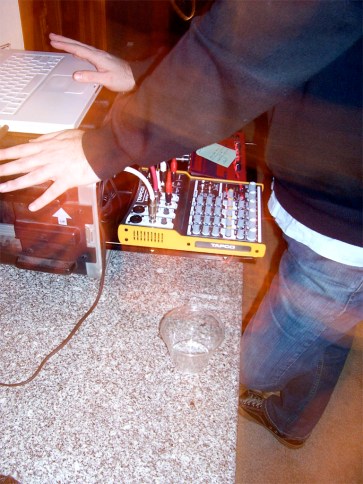
Electronic artist using Ableton 5 Live, Image by Flickr user Nofi
Let’s back up for a bit. A couple years back, I did a piece for Create Digital Music on Live Electronic performance. I talked to a diverse group of artists about their processes for live performance, and I wrote it up with some video examples. It ended up being one of the most discussed pieces on CDM that year, with commentary ranging from fascination at the presentation of techniques to dismissal of the videos as drug-addled email inbox management.
This was to be expected, because of the lack of a language for evaluating electronic music. It is impossible to defend an artist who has been called a hack without the language through which to express their proficiency. Using Miles Davis as an example–specifically a show where his back is to the audience–there are fans that could defend his actions by saying the music he produced was nonetheless some of the best live material of his career, citing the solos and band interactions as examples. To the lay person, however, it may just seem rude and unprofessional for Davis to have his back to the audience; as such, it cannot be qualitatively a good performance no matter what. Any discussion of tone and lyrical fluidity often means little to the lay person.
The extent of this disconnect can be even greater with electronic performances. With his back turned to the audience, they can no longer see Miles’ fingers at work, or how he was cycling breath. Even when facing the crowd, an electronic musician whose regimen is largely comprised of pad triggers, knob turns, and other such gestures which simply do not have the same expected sonic correspondence as, for example, blowing and fingering do to the sound of a trumpet. Also, it is well known that the sound the trumpet produces cannot be made without human action. With electronic music however, particularly with laptop performances, audiences know that the instrument (laptop) is capable of playing music without human aid other than telling it to play. The “checking their email” sentiment is a challenge to the notion that what one is seeing in a live electronic performance is indeed an “actual performance.”
In the time since writing the CDM piece, I’ve seen well over a hundred live sets, listened to days worth of live recordings, spoken in-depth with countless artists about their choices on stage, and gauged fan reactions many times over: from mind-blowing performances in barns to glorified electronic karaoke in sold-out venues, tempo locked beat matching to eight channel cassette tape loops, ten thousand dollar hardware to circuit bent baby toys. After all of that, I still don’t know that I can win the jazz vs. electronic music debate, but I will at least try.
*****
A while back, I was paging through the December 2011 edition of The Wire when I came upon a review of a Flying Lotus performance, the conclusion of which stood out:
On record, the music has the unruly liquidity of dream logic wandering from astral pathways down alphabet street, returning via back alleys on its own whims. Maybe the listening mind, presented with pretty straight analogues of those tracks, rebels, expecting something more mercurial, more improvised. The atmosphere in the venue reflected this upper-downer tension and constraint: the crowd noise was positive, but crowd movement was minimal – a strange sight in the midst of FlyLo’s headier jams. When the hall emptied there was a grumbling undercurrent as the tide of humanity was spilling slowly down the Roundhouse steps, whispers of it must have reached the upper levels. One casualty high above leaned over to berate them: “You don’t know, even understand, what you just FELT.” Sadly though, he didn’t stick around to enlighten anyone.
It should be noted that there are positive reviews of the show, and while not necessarily the best gauge, the videos from the event may seem to tell a different story.
What stood out for me from the review however, was that in trying to write about what the writer felt was a less than stellar performance, there was only one critique which could directly be attributed to the music, which was to say that Flying Lotus performed “straight analogues” of his tracks. Beyond that, the writer was left describing the feelings from the audience.
Feelings are tricky things. We all have them and they are the fundamental point of connection we seek when experiencing music. The message conveyed through the medium of music is meant to be an emotional one. But measuring those emotions is a task which cannot escape subjectivity. In a case like this when one writer is attempting to speak for the feelings of the whole audience, it becomes really tricky. Sure the writer may consider their analysis to have been objective, but it was still based on their perception of the audience, not the audience’s perception. Even more, this gauging of the audience dynamic does not tell us how the actual music performance was regardless of the varied perspectives from within the audience. I contend that this gap occurs because the language for discussing electronic performance has not yet been established.
Around the time I read The Wire review I was also reading Adam Harper’s Infinite Music, which offers variability as a primary factor of analysis in music. Instead of building on traditional music theory, Harper takes cues from those on the fringes of western music. He builds a concept of ‘music space’ by expanding John Cage’s “sound space,” the limits of which are ear determined. Furthermore, Harper’s non-musical variables and how they play into creating individually unique musical events, strengthens Christopher Small’s notion of musicking as a verb. In this way, Harper creates a fluid language for discussing music which might prove practical for these purposes.
It is helpful to use one of the central concepts of Harper’s music space, musical objects, as a means of distinguishing electronic performance.
Systems of variables constitute musical objects – Adam Harper
Going back to Miles Davis, his instrument is a monophonic musical object with a limited pitch and dynamic range in the upper register of the brass timbre. His musical talent is evaluated based on how he is able to work within those limitations to create variable experiences. His band represents another musical object comprised of the individual players as musical objects as well. The venue in which they are playing is a musical object, as is the audience and Davis’ decision to perform with his back to it. It is the coming together of all of these musical objects that creates the musical event (an alternate event includes the musical object which recorded the performance, and the complete setting of the listener as an individual musical objects upon playing the live recording). In a musical event comprised of these musical objects – Davis performing live in front of an audience with his back turned so he can face the band–it is possible to imagine a similar reaction to the above commentary about Flying Lotus, including a guy berating the audience for not making the connection.
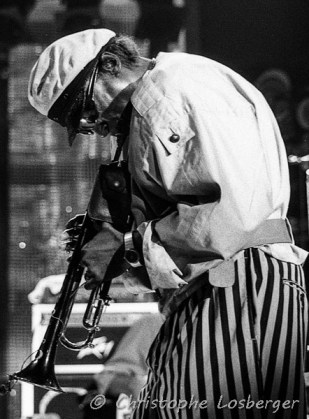
Miles Davis @ Montreux, 8.7.1984 Image by Flickr user Christophe Losberger
In this Davis example however, we could listen to the audio to determine whether or not it was a “good” performance by analyzing the musical objects which can be observed in the recording (note: this would be technical analysis of the performance, not the event or its reception). Does Davis’s tone falter? How strong are the solos? Is he staying in the pocket with the rest of the band? Evaluation of these variables would be a testament to his proficiency which could be compared to other performances to determine if it measures up.
Flying Lotus’s set however is a bit different. Yes, we could listen back to the audio (or watch the video) and determine if indeed it measures up to other sets he has performed, but unlike with Davis, we cannot translate what we hear directly to his agency. When we hear the trumpet on the Davis recording we know that the sound is caused by him physically blowing into his instrument. When we hear a bass in a Flying Lotus set, there isn’t necessarily a physical act associated with the creation of the sound. With all of the visual cues removed in the Davis example, we can still speak about the performance aspect of the music; the same is not necessarily so about an electronic set, even with visual cues. In many electronic sets, it is only when something goes wrong that actual agency in the music being performed can be attributed.
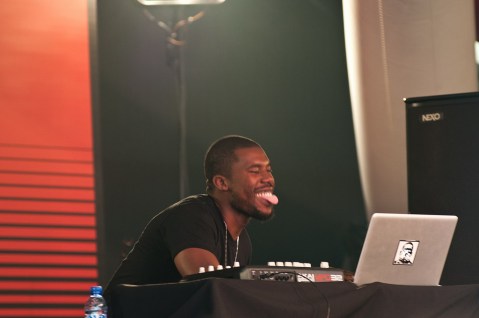
Flying Lotus,@ SonarDome, Sonar 2012, Image by Flickr user Boolker
Where the advent of the laptop and DSP advances for music have expanded creative possibilities, they only shroud what the performers using them are actually doing in more mystery. It’s an esoteric language, or perhaps languages, as ultimately each artist’s live rig configuration amounts to different musical objects, across which there may not be compatibilities.
However, in certain musical circles there are common musical objects. Perhaps the most common musical object for performance in electronic music right now is Ableton Live, which results in common component musical objects across performances by different artists. Further, an Ableton Live set can sound just like a Roland 404 set, which can sound just like a DJ set with a Kaoss pad, all of which can sound identical to a set not performed live but produced in the studio (or bedroom as the case may be) for a podcast. The reason for this is that much of the music is already fixed. What changes is the sequencing of these fixed pieces of music over time, their transitions and the variety of effects employed. The goal for these types of sets is a continuous flow of pre-arranged music, which parallels that of a DJ set.
In the past few years, the line between a live electronic set and a DJ set has been blurred extensively. Fans have become fairly critical of artists, to the point that it has become standard practice for promoters to list whether performances will be live or a DJ set. Even on the DJ end of the spectrum there’s a lot of questions, as artists have been called out for their DJ set being an iPod playlist. To qualify as a live set however, an artist must be doing more than just playing songs. How much more is debatable, but should it be?

Flying Lotus – Sónar 2012 – Jueves 14/05/2012, Image by Flickr user scannerfm
Nobody in their right mind would call Miles Davis a hack. Even if they didn’t like specific performances, few would question his proficiency with the instrument. The reason for this is that his talent rises above the standard performance, beneath which someone could be qualified as a hack. If a trumpet player spent a whole night performing only shrill notes of a C major chord around middle C, without properly qualifying that their performance would be so constrained as a stylistic choice, one might consider calling that artist out as a hack (I apologize in advance to the serious musician that fits in this description).
The rationale behind this assessment is based on knowing the potential variability of the instrument and realizing that the performer is not exploring any of that variability. Perhaps there could be other layers of variability (e.g. an effects chain) added to the trumpet to make it interesting musically, but it can be objectively said that they don’t measure up to a standard quality of a trumpet player. If we say that the trumpet has an extensive dynamic range, a tonality which can go from smooth to harsh and a pitch range of just over three octaves, we can see how the player in our example is exhibiting quite a low proficiency.
This goes across all styles of trumpet playing. Were a style to impose limitations on a player, it could be said that the style did not allow for the full expression of proficiency on the instrument. A player within that style could be considered proficient in that context, but would require a broader performance to be analyzed for general proficiency. So the player in our example could be a master of “Shrill C” trumpet, but in order to compare with a Miles Davis they would have to perform out of style. Conversely, Miles Davis may be one of the world’s greatest trumpet players, but possibly the worst “Shrill C” trumpet player ever.
From this we can see that the language of variability provides a unique way to objectively speak on the performance of musical objects, while fully taking into account the way styles can play into performance. Using this language we open the world of electronic performance up for analysis and comparison.
—
This is part one of a three part series. In my next installment, I will use some of the language here to analyze the instruments and techniques used in electronic performance today. Once we have a fluid language for describing what is being used, I believe we will be better equipped to speak about what happens on stage.
—
Featured Image by Flickr User Scanner FM, Flying Lotus – Sónar 2012 – Jueves 14/05/2012
—
Primus Luta is a husband and father of three. He is a writer and an artist exploring the intersection of technology and art, and their philosophical implications. He is a regular guest contributor to the Create Digital Music website, and maintains his own AvantUrb site. Luta is a regular presenter for the Rhythm Incursions Podcast series with his monthly showRIPL. As an artist, he is a founding member of the live electronic music collectiveConcrète Sound System, which spun off into a record label for the exploratory realms of sound in 2012.
—
 REWIND! . . .If you liked this post, you may also dig:
Experiments in Agent-based Sonic Composition–Andreas Pape
Evoking the Object: Physicality in the Digital Age of Music–-Primus Luta
Sound as Art as Anti-environment–Steven Hammer
Share this:


Current Top Posts





April 2021

January 2020

November 2019

October 2019

August 2019

April 2014

November 2017

March 2015

December 2017

October 2015
 Sounding Out!
Recent Comments