
Bob Seger, Champion of Misfits
 Bob Seger and the sort of classic rock he performs, embodies and represents, for me (and apparently many others), the relentlessly uncool. Youth, drugs and nonconformity have long been my standards of “rock,” and within this triad, Bob Seger’s formal, cinematic songs, have always come across as a little tired. Osvaldo Oyola wrote specifically last week about these foibles: the stilted piano and canned Chuck Berry riffs sound more like parody than gospel, while the parade of effects on Seger’s voice, also quite derivative, could have also fit on a Bruce Springsteen album (although you could replace the influence of Chuck Berry with that of the quintessentially less cool Phil Spector). Problematically, even though I loathe Seger’s catalog, I love Springsteen’s, this of course has made for some very popular conversations at the bar. In fact, it was last July at a local New Brunswick haunt that I had this conversation last. My friend, who will remain nameless, completely disagreed: Seger was cool, I just couldn’t hear it, in fact I had to see it to believe it.
In order to understand Bob Seger, I needed to watch Mask, a 1985 retelling of The Elephant Man starring Eric Stoltz as the deformed Rocky Dennis and Cher as his mother Rusty Dennis. Mask was released two years after Risky Business, and featured a number of Bob Seger songs predominantly in the soundtrack. These songs uniformly mixed to the foreground, often serving as Rocky’s theme, juxtaposed against an ambient soundtrack of songs by black musicians like Little Richard and Gary US Bonds. These black oldies, “Tutti Frutti” and “Quarter to Three,” are used thematically when Rusty’s friends, a bunch of guys in a motorcycle gang, are partying. Not only is Rocky othered from the kids at school because he is ugly, he is poor, raised by a single mother with a drug addiction. Although whiteness takes center stage in this film, it holds a complex relationship to blackness. Rocky and Rusty are atypically white, finding community only with each other and a super-masculine network of bikers; they are misfits, doing their best to pass in a mainstream and affluent white society.
Bob Seger’s “Katmandu,” is the song which introduces Rocky in the opening credits. It is guilty of the trademark Bob Seger whiteness: more refurbished Chuck Berry and piano so droll it could have been played by a metronome. In the context of Rocky and his struggle to identify with white society however, it paints Seger in a different light. Bob Seger’s uncoolness can be read as a failed attempt to pay homage to black musicians like the aforementioned Little Richard and Gary US Bonds. Instead of suggesting a totalizing narrative of white appropriation, I argue that Bob Seger can be understood as a musician who would never be completely accepted by his heroes or critics. Reflected in the posters on Rocky’s wall and Universal’s contract negotiations with Columbia Records (Bruce Springsteen had been first choice for the soundtrack), Seger was not even cool to the director of the film, Peter Bogdanovich, who refered to his music as “inappropriate.”
Toward the end of the movie, Rocky holds his blind girlfriend for the last time. Her parents, disgusted by his face (but probably also by his shabby clothing), keep the two separate. Contradicting the escape narrative of Springsteen’s “Born to Run,” Rocky evinces the power of fantasy toward coping with discrimination: “We can’t run away Diana. But we can sort of run away in our minds. We can remember camp, the mountains and the Ocean…especially New Year’s Eve” (Mask Part 11 4:40). Like Rocky, Seger can’t run away from his whiteness, even though he may not relate to it, or fully embrace it, it is ever present in his recordings. Songs like “Old Time Rock and Roll,” “Katmandu,” and even “Night Moves” are celebrations of music as a forum of imagination – one where identity, be it black or white, can be reimagined as something else. Though “Old Time Rock and Roll,” will sound forever white, it relates the experience of otherness. Try as he might, Seger has no idea how to sound authentically black, and this is evident through both its celebratory lyrics and contrived arrangement.
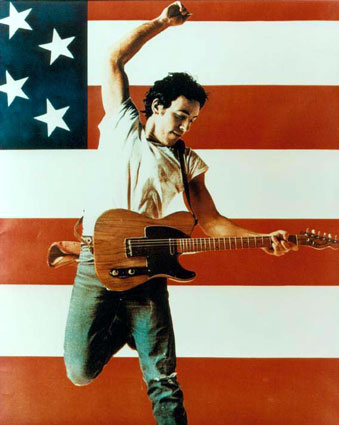 Growing up in a bi-racial household, where, depending on the holiday, my Jewishness could be as visible as my blackness, I feel a strong kinship to figures like Rocky, not completely belonging to any ethnic community. Perhaps this led to a juvenile obsession with Springsteen, who, according to my father, everyone could relate to, regardless of color (he worked at an all-night Jersey Shore diner, the Inkwell, in the early 1970s). Bruce though, was never really misfit, mulatto or poor; whether discussing his working class freehold roots, or his first guitar, his music epitomizes white privilege. Even his stage shows feature Clarence Clemons, The Big (Black) Man, notably subordinate to Bruce, or “The Boss.” Although now, my Bruce phase seems laughable, I wonder if it was also a fantasy of fitting in, of recovering a fantastic and invisible whiteness deep within myself. When he wrote “Old Time Rock and Roll,” was Bob Seger trying to do the same and recover a font of blackness deep within himself? I now see a complex web of identity politics informed by an economic and social history of Rock and Roll, but this holds an uneasy and complex relationship with the part of me that still believes in rock and roll. I was, am, and forever will be the misfit who found an identity in the church of rock and roll. Though the sermons have changed, in high school, Springsteen was the pastor, and I suspect that for my friend at the bar, Seger also conducted service. Even though I could never completely fit in to the rich white world of these artists, I wonder if this speaks to a fundamental affinity. Did Springsteen and Seger ever feel like outcasts, later to find solace in the black cool of Little Richard, Chuck Berry and Fats Domino? In the context of these figures and their music, how could whiteness seem anything but contrived, misfit and ugly – or in truth, is this dialectic really the beat which pushes rock and roll forward?
AT


Share this:

Orchestral Manoeuvers in the Afternoon
 I am not usually one to listen and tell, but this time I feel the need to publicly confess, Katy Perry-style. A few weeks ago, I heard a symphony orchestra. And I liked it. I might even go so far as to say it fairly delighted me. What warmth and depth of sound! What a potent tension between distinguishable instruments and commonly held notes! And oh, the violas! My pleasure in this experience, however, has thrust me in ethical, epistemological, and ontological crisis mode, leaving me to wonder: Who am I? and What on earth has happened to me?
If anyone had told me even six months ago that I would be making this declaration, they would have received a fairly withering sardonic look. Classical music has never been my thing—by politics, class, birth, or taste (of course, if you ask Pierre Bourdieu, taste is hopelessly bound up in the first three, anyway, whether we acknowledge it or not). My working class roots have eschewed Capital-C “Classical” music listening as far back as I can trace: most  immediately, “classical” to my father means one of his musical holy trinity: the Beatles, the Stones, or Hendrix. Next to the electrically-charged and vocally-driven musical traditions that raised me, classical has always seemed sonically uninteresting and unavailable, even as rebellion against Woodstock (unless of course it was the synth patch work of Wendy Carlos that was switching me on to Bach).
However, it wasn’t solely that classical music didn’t speak to me—it was also a matter of what it said when it did. I have encountered some version of classical in so many forbidden, intimidating, and privileged spaces that it often seemed as if the music itself drew borders around me, its booming kettle drums warning me to “keep out” while its mincing violins suggested I had better put on a uniform and grab the hors d’oeuvres tray should I decide to stay. From the report on Haydn I was assigned for 7th grade Music Appreciation to the metronymical Beethoven ticking off my many minimum wage hours at the mall—the lilting soundtrack to the security footage my boss collected every night from the cameras not-so-subtly trained on me—my encounters with classical have almost always been connected with the imposition of power. More recently, I found myself waiting for a bus in downtown L.A. around 2 a.m., where I was pummeled with high-volume classical music blasting from the doorways of high-end condos, echoing down the unusually empty streets. Apparently, building managers feel amplified classical deters homeless people from seeking shelter there, without annoying their well-heeled residents. According to the San Diego Union Tribune, “The music that seems to do the best job of driving people away. . . is baroque”. . .the music characteristic of Bach and my old friend Haydn. I wonder if my 7th grade teacher knows this.
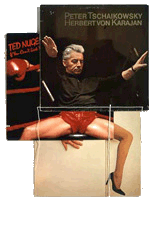
A Christian Marclay Classical
Given experiences like these, I have been unable to simply ignore classical music throughout my life, but I have officially considered myself “a hater.” I have been that punk rocker hooting and hollering for their cello-playing friend in the pin-dropping silences between movements, wishing that everyone would turn around and glare. I have actually called up my local NPR-classical combo station during pledge drives and told them I will increase my donation if and only if they banish the bassoons and switch to a full-time news format. Like all that classical vinyl clogging up the dollar bins at record shows, public classical programming is an ideological holdover from the turn-of-the-last-century, when classical was aligned with white middle class respectability. The streets of my neighborhood in Binghamton, for example—chock full of aging Victorians that were once a sign of industrial prosperity—are named after Schubert, Mozart, and Beethoven, which the local residents of these now crumbling buildings, since chopped up into rooming houses, defiantly call “Beeeeeth-oven.” In the early twentieth century, labels like Victor pumped out classical discs to convince Americans of the “respectability” of the gramophone—that the new machine wouldn’t be used solely to spread Tin Pan Alley, or worse yet, jazz—while offering a lower-cost alternative to expensive opera houses for poorer folks. Distilling orchestra onto portable 12-inch discs has the veneer of democratization and agency, sure—shouldn’t everyone have access to the listening habits of the rich and powerful in their very own homes?—but the practice enforced and upheld the 19th century split between so-called high and low cultures that we still wrestle with today.
Lawrence Levine described this as the division between “highbrow” and “lowbrow” culture. It deemed non-white and/or working class cultural production—categorized as “pop,” “folk,” and/or “vernacular” musics—as the gauche and corrosive soundtrack of lesser minds, while constructing the Eurocentric symphonic hall and the opera house as sacred cultural sites (long with museums and libraries—see Aaron Trammell’s recent post). Elite white gatekeepers in the 19th centuries drew both sonic and discursive borders between “high” and “low” culture, deliberately excluding African American artists, for example, from music’s elite spaces by using language to redact “Othered” sounds from the category of “music” itself. In the white press reception of the Fisk Jubilee Singers, for example—a touring group who combined black musical tradition with European concert performance styles in the 1870s, the first to do so on American stages—recurrent descriptors such as “weird” and “rude,” show white critics attempting to interpellate a new cultural force into their pre-existing musical value systems—marked of course, as “universal”—in ways that would neither threaten nor reveal the white cultural supremacy that undergirded them. The best efforts of the Jubilee Singers were repeatedly presented by white reviewers as uncultivated, emotional, ephemeral, racialized sound that, while
The Jubilee Singers Perform for Queen Victoria
mesmerizing, was not to be categorized as “music”—universal, eternal, artistic—alongside the German composers in vogue at the time. Levine argues that these elites constructed the physical and discursive sites of music as demanding a certain type of discipline, purpose and “most important of all—a feeling of reverence” (146). The term “classical” is part and parcel of this reverence, appearing in the early 19th century, and, according to Alex Ross—the classical music critic for The New Yorker who for the record hates the term—“mirrored the rise of the commercial middle class, which employed Beethoven as an escalator to social heights.”
From my first record purchase—The Go-Go’s Beauty and the Beat (1980)—to my latest, Cee Lo’s The Ladykiller (2010)—I have been on a search for reverence elsewhere, most often smashed up against a sweaty crowd of people, feeling the waves of the giant speaker stack reverberating through my body, shouting along until my vocal chords were completely raw. Jimi Hendrix called this form of reverence “the electric church” in 1969, and Paul Gilroy does a beautiful homage to its power in “Some Soundscapes of the Black Atlantic” describing Hendrix’s vision of music as an inclusive ritual event whose high volumes not only deliver a proper wake-up-call to those who need it, but “promote a direct encounter with the souls of the people involved” (383). Unlike the concert hall’s rarefied air, the sonic cervices of the “electric church” seemed to welcome all comers. Sadly, since moving to Binghamton—a smallish town in upstate New York—my tithes to the electric church have dwindled; against my will, I have become one of those Christmas and Easter types. I hadn’t realized my extreme musical privilege growing up in Los Angeles’ shadow until I found myself in the outer limits of America’s musical infrastructure. However, as my recent symphony encounter has proved, being locked out of the “electric church” has made me more open to the power of musical sound wherever I find it. Not to mention that, in my anxious mental deconstruction of my new appreciation of the orchestra’s roar, I couldn’t help but think that it was because—barring the Dolby soundsystem at the local movie theater—the symphony was easily the loudest thing I have experienced in almost a year.
And maybe that’s it. I have a new loud. Between moving to Binghamton and edging deeper into my 30s, my seemingly immovable aural palate has experienced a major tectonic shift. When I recently discussed my odd ecstatic experience over dinner with visiting sound artist and Binaural Fellow Maile Colbert, she suggested that age may have a lot to do with it. Colbert posited that we don’t fully understand the physical inscription of sound on the body, especially the connection between pleasure and the ways in which sound waves strike our bodies beyond the ear. So, shifting tastes in music may not just be a

Another Christian Marclay Classical
factor of nostalgia or just plain becoming uncool, as marketers would have us believe, but rather a visceral reaction to the new ways in which sound resonates with our thinning skin, hollowing bones, slackening muscles, and disintegrating organs. After turning 30, I found, inexplicably, that I suddenly liked black licorice, so maybe an affinity for the symphony is similarly inevitable. I almost surrendered to this promising explanation, as it meant liking the symphony was part of a natural process that was out of my control, but unfortunately I have read enough Judith Butler—and 19th century music writing—to know that my experience of the “natural” processes of my body are always affected by cultural narratives. Much of what we currently consider to be “old people’s music” was once thought to corrupt and inflame the passions of youth a century ago. So, if I could not safely blame my sudden symphonic pleasures on age, then what?
Before you offer up that perhaps I just heard the “right” performance, the Guinness experience of sound after a lifetime of the aural equivalent of Coors Light, I need to make a second confession. The symphony performance I heard was not the New York Philharmonic doing Mahler’s 6th Symphony, or even the Binghamton Phil’s recent performance of Enigma Variations. Actually, I took my almost-two-year-old to hear the Binghamton University Symphony Orchestra’s 2010 Children’s Concert All Creatures, featuring “Peter and the Wolf” and other pieces of music designed to evoke animals via sound. So the concert was perhaps not your typical orchestra experience, unless it has become common practice to let you touch a spitting cockroach from Madagascar on your way to your seven-dollar seat. I brought my little guy to All Creatures not out of a desire to impose “good music” on him, but because he loves sounds of all kinds and a.m. concerts are few and far between. Older folks like me were visibly in the minority at All Creatures, and the air was hardly rarified; not only was it the most diverse orchestra crowd I have seen to date, but you could wriggle in your seat and clap all you wanted. To the orchestra’s credit, they played as passionately for a sea of six-year-olds as I am sure they would for state dignitaries, and it was fairly stunning to watch young musicians so obviously still falling in love with their instruments.
I’d like to be able to conclude by telling you that I heard the orchestra anew through my son’s still-forming, wide-open ears—an experience I have imagined in an earlier blog—but I have to make one last confession: he was asleep within two minutes of the orchestra tuning up, a chip off the old block. His impromptu snooze left me alone to wrestle with my old nemeses Beeeth-oven and Haydn, as well as the questions rooting the blossoms of my newfound guilty pleasure. Given who I am and where I have come from, was it transgressive to be sitting in the third row of a symphony hall, letting the sound touch me? Or, perhaps, this listening experience was more about where I am now than where I started from. No longer waiting in the wings or cleaning the bathrooms, I am a university faculty member with a front row seat. Was I unconsciously giving in to the powerful (and Eurocentric) aural propaganda of the orchestra, with its visible hierarchies and overwhelming harmonic quest for everything in its “proper” place—precisely the privileged perspective that I daily attempt to dismantle? Or, more than likely, the suddenness of my errant desire simply allowed me to hear new traces of an old refrain: where listening is concerned, resistance and subjection can never be easily separated, let alone painlessly resolved.
Share this:


Current Top Posts





April 2021

January 2020

November 2019

October 2019

August 2019

April 2014

November 2017

March 2015

December 2017

October 2015
 Sounding Out!
Recent Comments