
Thrills, Chills, and Safe Sexuality: The Sounds of Michael Jackson’s “Thriller”

DOI: https://doi.org/10.59350/aznww-8nw44
Next month may mark the 30th Anniversary of the release of Michael Jackson’s Thriller, but chances are that if you are going to a Halloween dance party this year –or have since 1982–the musical highpoint of the night will still be when they play the title track. While thematically and sonically appropriate for Halloween getting down, there is more to the song’s sonic exploration of fear, both its “scary sounds” and the lyrical references to sound–the stolen scream, the creeping from behind–in the role of scaring an audience. There is startling disconnect between the scariness the song describes (and the stock sounds of classic Hollywood horror films it samples) and its ability to make something potentially scary palatable to a pop mainstream. It is not so much the elements of horror themselves that Michael Jackson’s song makes acceptable, but the potential scariness of sexuality for which it is a metaphor.
There is a long tradition of horror movies as metaphors for sexuality, in particular adolescent sexuality. Iconic examples include Michael Landon’s untrustworthy violent tendencies in 1957’s I Was a Teenage Werewolf (a film clearly being referenced in the opening to the John Landis-directed video for “Thriller”) or more recent incarnations like Joss Whedon’s Buffy the Vampire Slayer, where sleeping with your boyfriend can literally lead to the loss of his soul.
While written by Rod Temperton, a white Briton, “Thriller,” as performed by Michael Jackson and produced by Quincy Jones, takes on the horrors of emergent sexuality via a racial lens. The pop song becomes self-referential, metaphorically about the very taboo thrills that have made young white people seek out black music, and their parents fear for the consequences. And while 1983 was a far cry from the 1950s-era outrage over white kids listening to and making their own “black” rock n’ roll, we also can’t forget that it was an era of a newly-launched MTV almost completely devoid of black artists (before hip hop’s explosion among young white males). It was largely Jackson’s popularity, in fact, that prompted MTV to finally include more black artists in its programming.
While references to race in “Thriller” may be oblique, the lyrical references to sex are fairly obvious. The menace of the sexual encounter is present throughout the song as it is in the genre—sex itself is thrilling, desirous despite its potential physical, emotional or even social dangers.The scariness of the late night creature feature on television becomes an excuse to “cuddle close together.” This comforting occurs “all through the night” and the singer “can thrill you more than any ghost would ever dare try” (and the use of “ghost” to make a distinction between it and the singer reverberates with racial meaning). There is a dichotomy present in the song, in that the speaker is both the comfort from the fear of violence, and potentially “the beast about to strike.” Of course “nothing can save you” from that beast, when it is also the figure you are counting on to save you to begin with.
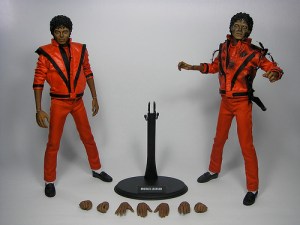
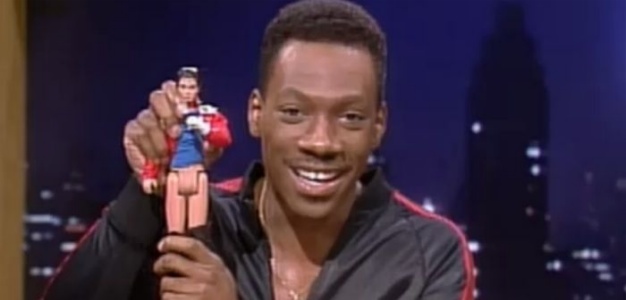
Similarly, at the height of his popularity, Michael Jackson embodied a safe version of black male sexuality. (In contrast, consider Prince, who in the early 80s was putting it all out there with albums like Dirty Mind (1980) and Controversy (1981), and would not get anything remotely like Thriller success until 1984’s Purple Rain). Despite Jackson’s pelvic thrusts or his videos featuring dark alleyway dancing, he represented a form of sexless sexiness, as emasculated in the eyes of the public as his doll (as famously demonstrated by Eddie Murphy on SNL). Perhaps most indicative of that position was Jackson’s bringing Brooke Shields as his date to the 1984 Grammy awards, while having Emmanuel Lewis accompany them. At the time MJ’s Peter Pan latency meant that Brooke was safe from predation and Emmanuel Lewis was an innocent child-friend to the child-like entertainer. Michael Jackson’s persona would not be undone by the accusations of monstrous pedophiliac tendencies for another nine years. Like the Thriller-themed doll pictured, Jackson was safe for both children and mainstream America, despite his ability to be transformed into something ostensibly terrifying.
The song is arranged and produced by Jones to echo this dichotomy of safe danger. The bass groove is a creeping disco loop never arriving, but suggestive of the warning music of the slasher genre. The hook is introduced with a sudden and shocking chords on a synthesizer, like the title screen music of an old monster movie. The high-pitched synthesizer whine that warbles during Vincent Price’s rap emulates the sci-fi spookiness of a theremin. The availability of Vincent Price was a coup for Jones and Jackson—a well-known figure of the genre, but even by 1980s, he was already a throwback to an older and out-of-date notion of horror—known for his low-budget work in Roger Corman films like Masque of the Red Death (1964) and appearances on Scooby-Doo. Furthermore, the song is marked by stock creaks, footsteps, thunderclap, slamming doors, wind and howls, sounds that enter the realm of kitsch. The sound effects are so exaggerated and artificial as to undercut the sense of the scariness the song describes and potentially represents. It disguises the supposed threat of black sexuality so successfully that it is now performed at many a white American wedding.
The campiness of the song’s excess, both sonically and lyrically, takes the edge off the sexual desire—the very thrill the song is meant to evoke. Even John Landis’s vision of the song in his 14-minute long video that remixes the album track for cinematic effect, mixes its film-quality monster effects with a playfulness evident in Jackson’s multiple incarnations in the video. In the movie inside the dream inside the video narrative, he seems more concerned with teasing his date about how easily she is scared (and scaring her some more) than sleeping with her—but his mischievous grin signals an unspoken desire that comes alive in his date’s alternating desire and fear of him. The dangers of werewolves and zombies are always arrested to reveal a level of artifice, a gotcha moment for his date–and for the audience–that undermines any real risk.

The title track on what remains one of the best selling albums in history, “Thriller” evinces the ways in which Jackson and Jones figured out how to perfectly package and promote this tamed sexuality through their manipulation of sound. Sonically, the song (and other songs on Thriller such as “Beat It,” Billie Jean,” and “Wanna Be Startin’ Something”) evokes the tantalizingly forbidden and yet makes it accessible. The infectiousness of “Thriller”‘s groove, along with the appeal of pop hook sung by Jackson’s unmistakable voice, threatens possession of the listener but always allows for her to “change that number on your dial.” Part of what made this music broadly appealing (aside from Jackson’s obvious talent) is its success at dissembling, avoiding the backlash against the figure of “the black beast” rapist while subconsciously evoking the fear of it.
But there is a price to be paid for this sonic disconnection. There was certainly something horrific in Jackson’s physical transformation in the years that followed his Thriller apogee. Could it be that MJ’s desire to further improve on this formula led to what Richard Middleton describes in his book, Voicing the Popular (2006): a change from black child star to a “simulacrum of white middle-class woman” (128)? The extremity of such camp collapsed on itself, allowing that sexual anxiety to flow back through the disconnect his “safe” persona was supposed to shore up. Whatever fear that the sexless sexiness of Michael Jackson was actually a cover for queerness was brought to the fore because he stood accused of molesting little boys, allowing for a depiction of monstrousness that works across both gender and racial lines (and also highlighting a difference in attitude from when girls are the victims).
Photo by Darin House via Flickr
Jackson’s fall from grace may have come in the form of molestation accusations, but it still provides insight into the long history of fear of black America and black music that still lingers, proving that the mainstream’s love can turn to suspicion, even hate, in a heartbeat. Jackson’s broad appeal narrowed significantly when there was even a chance he wasn’t the sexless figure he appeared to be. As James Baldwin, whose writing and social criticism was always focused on the intersection of race and sexuality in America, wrote in 1985’s “Here Be Dragons” in regards to the hysteria of Michael Jackson’s popularity:
The Michael Jackson cacophony is fascinating in that it is not about Jackson at all. I hope he has the good sense to know it and the good fortune to snatch his life out of the jaws of a carnivorous success. He will not swiftly be forgiven for having turned so many tables, for he damn sure grabbed the brass ring, and the man who broke the bank at Monte Carlo has nothing on Michael. . . Freaks are called freaks and are treated as they are treated–in the main, abominably–because they are human beings who cause to echo, deep within us, our most profound terrors and desires.
—
Osvaldo Oyola is a regular contributor to Sounding Out! and ABD in English at Binghamton University.
—
Share this:

Easy Listening: Spreading and the Role of the Ear in Debating
DOI: https://doi.org/10.59350/f1x7n-zjs89
As I write, my institution, the University of Denver, is gearing up to host the first of the 2012 Presidential Debates. The debate promises a polite and eloquent exchanging of reasons on matters of public concerns. This image of “the good man [sic] speaking well,” roughly represented by Obama and Romney, pervades popular culture representations of debate. While there are certainly some forms of debate that stress public reason, like Worlds style debate, most other competitive styles of debate, look and sound very different.
American “Policy Debate,” the type of debate I will explore today, is a high school and collegiate competitive activity where two-person teams argue the merits of governmental legislation. In every round there is an affirmative that advocates an action and a negative defending the status quo, or some alternative. The debate prompts, or resolutions, change yearly and produce research collections comparable to a master’s thesis. But, it is not the research that captures newcomers’ attention. No, it is the velocity that information travels. Indeed, highly successful debaters transform their voice into a high-speed information weapon, sometimes speaking up to 400 words per minute (wpm).
Nobody really knows who decided that speaking quicker than her/his opponents would be a viable strategy. Some allege that David Seikel and Mike Miller, a dominant team from the University of Houston in the late 1960s invented the strategy. However, Miller denies this fact, insisting that the practice of speaking quickly, or “spreading,” predated their success by a couple years. While it is difficult to pin down exactly when talking becomes spreading, studies indicate passive comprehension has a threshold of around 210 wpm. Simply put, spreading is a vocal practice that propagates more arguments than an opponent can rebut, forcing the opposing team into a strategic choice of conceding and/or inadequately responding to some positions.

Almost immediately after its introduction, spreading became a polarizing issue. While some alleged that speed undermined communicative argumentation, others applauded its ability to foster critical thinking. Rate of delivery became a site for what Douglas Ehninger called in 1958 the debate about debate: should debate be concerned with public reason or technical proficiency? Spreading figured prominently in these discussions because it circumscribed debate to the technical sphere, the quick pace precluding lay comprehension. As a site for cultivating what argumentation theorists Ron Greene and Darrin Hicks call “the ethical attributes required for democratic citizenship” (101), debate operates as an ideal problem space to inquire about the relationship between listening and judgment that underwrite argumentative exchanges.
Extracting meaning from a spread requires a trained ear that can delineate the nuance of tone, rhythm, code, and breathing, while translating these sounds into symbols that are then recorded onto a “flow” (a document where participants keep notes of the debate). This technical sphere of argumentation, then, requires what cultural historian Jonathan Sterne calls in The Audible Past: Cultural Origins of Sound Reproduction an “audile technique,” or a set of culturally defined listening practices. Here, spreading denotes not just rate of delivery, but encompasses a range of other practices that attend to the debate. Yoking velocity with technical proficiency, spreading requires an audile technique that attunes the ear to speed, while calibrating the viscera to quickly appraise each position espoused. Extending Sterne’s observations into an embodied theory of listening, I argue that spreading entrains visceral judgment that organizes expertise under the banner of “exchange-value,” instead of its veracity. Reflecting what Jodi Dean calls in Blog Theory: Feedback and Capture in the Circuits of Drive capitalism’s communicative style, I contend, audition in this case privileges flow over content.
Today, debaters are much faster than their 1960s counterparts. Take for example the championship round of this year’s (2012) National Debate Tournament (NDT). The 2012 topic debated the merits of the United States’ democracy assistance in the Middle East.
Finals – NDT 2012 Northwestern BK v Georgetown AM – 1AC + CX
In the speech linked to above, dubbed the first affirmative constructive (1AC), the speaker’s first words are easily audible, but as the seconds expire, the affirmative’s words increase in velocity; syllables collide and contort. The speaker pushes through, taking a split second to take a short, fast breath (called a clutch) before he begins his next word. To the seasoned ear, the voice is instructive; a slower, deeper tone signifying an assertion. also known as a “tag,” and a faster tempo indicating evidence. Out of this buzz, debaters’ are able to discern distinct phrases, like “Arab Spring,” “economic down turn,” and “nuclear war.” In 9 minutes the speaker outlined his advocacy, consisting of multiple scenarios for planetary extinction.
During the 1AC, the negative team is carefully listening, gathering the affirmative’s evidence, and translating the speech into symbolic shorthand, termed flowing. In addition to its purely functional use—to keep track of positions—the flow also provides third party adjudicator(s) a document to evaluate the debate.
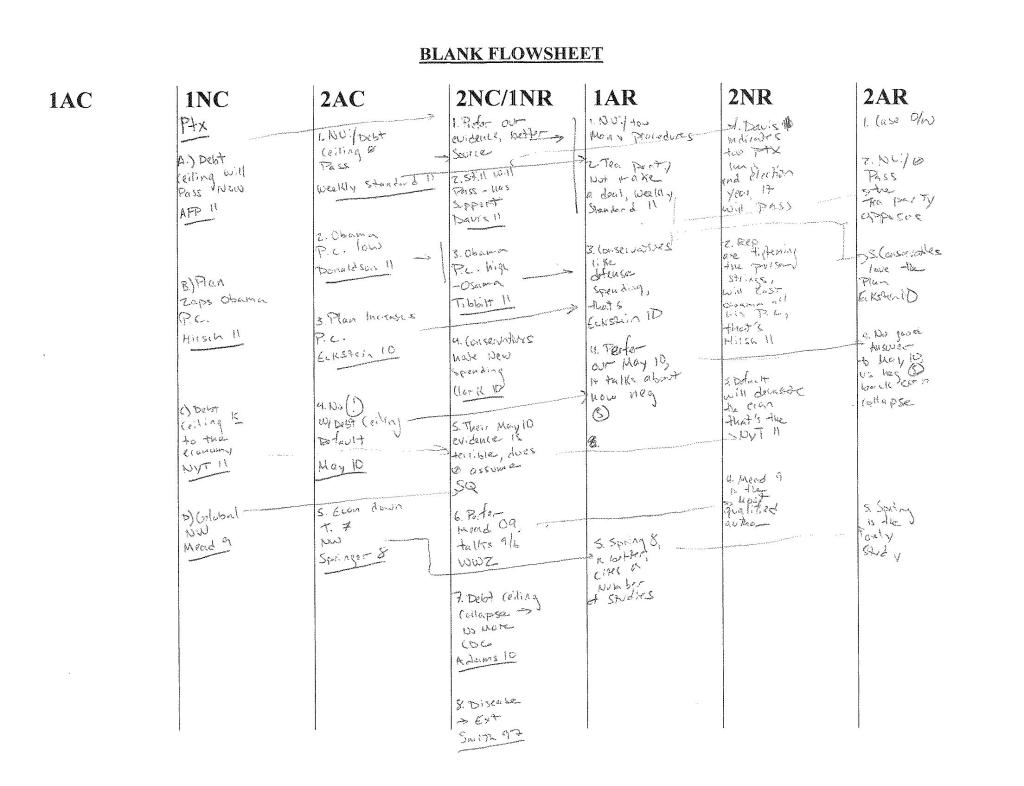
After a period of questioning, the first negative speaker, linked to below, elaborates his positions: a procedural concern that the affirmative is outside the confines of the resolution; two philosophical objections (or critiques); two alternative courses of action that resolve the affirmatives exigencies, while conserving the president’s political capital, so Obama can push for Jackson-Vanik legislation; and finally direct responses to the affirmative position.
Finals – NDT 2012 Northwestern BK v Georgetown AM – 1NC + CX
Coupled with the “burden of rejoinder,” which dictates a conceded argument is a true argument, speed becomes a strategic weapon. The more positions, the more likely one will be missed, granting the other team an advantage. For example, failure to address the negative’s concerns about the Jackson-Vanik legislation means that the affirmative position would result in a US-Russian nuclear war culminating in extinction and probably losing the affirmative the debate. Even less dire claims exert force in the round. For instance, missing the relatively innocuous claim that Obama does not have political capital abrogates the negative’s whole Jackson-Vanik position. After all, what would be the point of Obama conserving capital, if he has none to begin with?
Debating thus requires a refined ear capable of quickly determining a argument’s merit, while allotting the proper amount of attention. If a claim is deemed irrelevant, the debater can focus on a more relevant position, keeping her/his ear piqued for beginning of the next position.

This confluence of speed, evidence, time constraints, and a burden of rejoinder cultivates an instrumental relationship to expertise. Media theorist Jayson Harsin suggests in “The Rumour Bomb: Theorising the Convergence of New and Old Trends in Mediated US Politics” that these “conditions encourage a relationship of viewer to text (slogan, soundbite, fragment) which is essentially fiduciary, based on trust, not critical understanding”(101). Indeed, time constraints coupled with a proliferation of positions, produces a sound to listener relationship, where the veracity is assumed and significance is dictated by strategies, not the least of which is vocal. This is because there is simply not enough time to evaluate the credibility of each piece of evidence read. Patrick Speice and Jim Lyle, two debate coaches, explain that “Debaters have to be focused on the arguments being offered, have to be able to understand them very quickly, and they have to be able to discern which arguments are of the greatest significance for the round.” Evidence, then, is reorganized along a strategic continuum—the more likely an argument may help or hinder a team’s chances of winning, the more important it becomes. This can precipitate a “race to the margins,” where one side tries to find an obscure argument to beat back more probable analysis. This is not to say that one kind of argument is better than the other. But, the rationality used to organize the evidence relegates veracity to the epiphenomenal. This fosters an epistemic leveling, indexing expertise according to its exchange-value.
The repetitive nature of debate inscribes these listening habits into the body, shaping future interaction. Writing on the pious ear, cultural anthropologist Charles Hirschkind explains in The Ethical Soundscape: Cassette Sermons and Islamic Counterpublics, “patterns of sensory attunement configured through continuous practice of such a listening constitute an intensifying perceptual background for […]ethical agency and public reason”(28). Similarly, the practice of listening to debate rounds, along with the movement of the hands, quickness of thought, and so on are burned into an affective substrate, defining the horizons of future action. That is, through the repetition of debates, audile technique is entrained into motor memory, residing just below the conscious register of thought, acting as a potentiality. Most often, this listening technique is activated in the next debate round, the spread’s distinctive sound generating an anamnestic effect, activating the policy debate ear.
In sum, spreading proffers an audile technique concerned with the exchange-value of evidence, where the “best claim” is the one that wins the round. It entrains a technical mode of audition, aiding the debater in making quick decisions. This listening style underwrites a knowledge economy, where expertise becomes just another commodity that is bought, sold, and traded to support pre-formulated opinions. “Under communicative capitalism,” Jodi Dean writes, “an excess of polls, surveys, and assessments circulates, undercutting not only the efficacy of any particular poll or survey but the conditions of possibility for knowledge and credibility as such. There is always another survey, done by another group or association with whatever bias and whatever methodology, displacing whatever information one thought one had” (103).
—
Justin Eckstein is a doctoral candidate and former director of debate at the University of Denver. His work explores the intersection of listening, affect, and argumentation. Justin’s writing has appeared in Argumentation & Advocacy, Relevant Rhetoric, and Argumentation in Context. Currently, he is writing his dissertation on the micropolitics of podcasting in the post-deliberative moment.
—
Share this:




Current Top Posts





April 2021

January 2020

November 2019

October 2019

August 2019

April 2014

November 2017

March 2015

December 2017

October 2015


Recent Comments