
Unlearning Black Sound in Black Artistry: Examining the Quiet in Solange’s A Seat At the Table

 Editors’ note: As an interdisciplinary field, sound studies is unique in its scope—under its purview we find the science of acoustics, cultural representation through the auditory, and, to perhaps mis-paraphrase Donna Haraway, emergent ontologies. Not only are we able to see how sound impacts the physical world, but how that impact plays out in bodies and cultural tropes. Most importantly, we are able to imagine new ways of describing, adapting, and revising the aural into aspirant, liberatory ontologies. The essays in this series all aim to push what we know a bit, to question our own knowledges and see where we might be headed. In this series, co-edited by Airek Beauchamp and Jennifer Stoever you will find new takes on sound and embodiment, cultural expression, and what it means to hear. –AB
—
On May 18th, 2017, Solange Knowles took viewers on an expedition as she glided, danced and “agonized” in a “joyful praise break” on the floor of New York City’s Guggenheim museum. Drawing from the museum’s narrative of introspection and multi-sensory connection, Solange’s performance of “An Ode To. . .” prompted viewers to relearn and reorient the melodies of A Seat at the Table (2016). Solange’s performance in this setting hearkened listeners to new concepts and emotions in the record they didn’t catch before as they consumed it. This begs the question– what other sonic elements have we neglected to identify in A Seat at the Table? And why?
A Seat at the Table integrates topics like race, depression, and empowerment. Although the younger sister of powerhouse Beyoncé Knowles, Solange has managed to carve out her own legion of dedicated listeners from her infusion of Minnie Ripperton-esque vocals, hip-hop production and Gil Scott-Heron storytelling. Thematically, the album incorporates issues of Black Lives Matter and cultural self-preservation. However, Solange weaves personal elements such as vulnerability, futurism and paternity throughout the record as well, which buoy the album to praise but are hardly discussed in the album’s many reviews. Instead, writers and listeners have largely focused on resistance, anger and reactionary concepts.

Image of Solange at Boston’s Calling Music Fest 2013 by Flickr User Jessy Gonzalez, (CC BY-NC-ND 2.0)
Because Solange is a black women, historical signifiers of black embodiment influence both the listeners’ senses and consumption of her album. Solange’s intimate moments and reveals are shrouded by the limitation of black sound to the disruptive, angry or depressive. Such masking demands a listening praxis akin to what sound artist Christine Sun Kim describes as “unlearning.” “I’m trying to unlearn what I’ve been taught by others,” she said in an interview about her work, “and trying to find my own definition of both sound and silence.” This unlearning and re-imagination of sound is a difficult transformation considering how sound is influenced by our racialized, gendered, and religious histories.
Consider the contemporary rhetoric of black sound. Black outcry and screaming is a banal American, banal soundscape. Blackness is grieving. Blackness tiptoes near death. Captivity is a breath away. Black Lives Matter leans on the Civil Rights Movement often sonically. Dr. J Marion Sims, both his medical torture of enslaved women and the widespread belief that black people are inured to pain, still haunts our research methodologies, medical practice and our daily lives. This ushering of strife consumes black life into a sound that bleeds—an aural transfer both material and metaphoric—black sound is never personal, individualized or singular, and such historical misperceptions influences black sound studies. The Western artistic critique of black sound and black artistry overwhelmingly focuses on the reaction of whiteness, black resistance, and little else—because supposedly—there is nothing notable about blackness in and of itself.
For example, revisit the 1968 Olympic photo of Tommie Smith, John Carlos and Peter Norman as they stand on the platform with their medals. What do you see in this photo? Perhaps nationalism, masculinity, aggression, or anger from their bodily gesture to the Black Panther Party Movement? What do you hear in the photo—what is its decibel? An outcry? A rebellious yell? desperate scream?
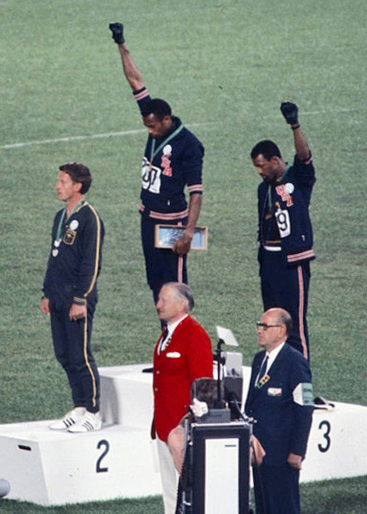
(l-r) Peter Norman, Tommie Smith, and John Carlos during the award ceremony of the 200 m race at the Mexican Olympic games. (creative commons, Wikipedia)
But what other nuances are in the photo? What other critiques are masked by this proscribed sound? In The Sovereignty of Quiet (2012), Kevin Quashie invites us to:
Look again, closely, at the pictures from that day and you can see something more than the certainty of public assertiveness. See, for example, how the severity of Smith’s salute is balanced by the yielding of Carlos’s raised arm. And then notice how the sharpness of their gesture is complemented by one telling detail: that their heads are bowed as if in prayer, that Smith, in fact, has his eyes closed. The effect of their bowed heads is to suggest intimacy…How is it that they are largely icons of resistance, and that vulnerability and interiority are not among all things we are encouraged to read on their image? (Quashie 2-3).
Because of racialized history, we have limited our conceptualization of blackness in literature, film and other mediums. We only hear blackness as it pertains to resistance, grief, and anger—the reaction to whiteness. Black people are verbs instead of nouns. The ’68 Olympic photo is particularly special as it captures the steadfast Western influence that infects our synesthesia because of political and social histories. Moreover, such defects are even internalized in the black artist. As an identity, Quashie argues that “blackness is always supposed to tell us something about race or racism, or about America, or violence, struggle and triumph or poverty and hopefulness (4). Sonically this means blackness in contemporary discourse is critiqued by its decibel of resistance. We cannot read or hear blackness without integrating white pain.
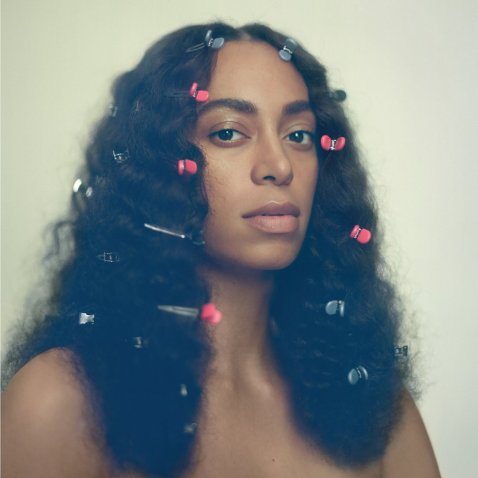
Much like typical readings of the ’68 olympic photo, Solange’s album cover might elicit themes of self-esteem, black-nationalism or even aggression. However, Solange quietly sounds her life transition and personal vulnerability, via her photo, if we would hear it.
But confining view of blackness as pain and resistance prevents us—including those who are black-identifying—from noticing and celebrating vulnerability, grace, and the interiority. Quashie describes interiority as the “inner reservoir of thoughts, feelings, desires, fears, ambitions that shape a human self. . .[it is] expansive, voluptuous, creative; impulsive…more akin to hunger, memory forgetting, the edges of all the humanness one has” (20-21). It’s the tender part of identity shown through subtlety—the desires and dreams spoken through prayer. It’s Martin Luther King Jr. tapping his feet to Coltrane or Tupac Shakur watching dancers to perfect his plié—it’s the soft falsetto Solange uses in her album that bolsters emotional healing and draws avian imagery.
Asking what quiet can bring to our personal, cultural, historical and political understandings of blackness does not signal the imposition of respectability politics or desire for post-racialism. Rather, Quashie’s theory considers how whiteness has constructed and limited our senses as it relates to blackness. Blackness will remain in resistance because of systemic oppression but there is so more to black life. The element of analysis and the sensorium itself needs expansion.
Subsequently, Solange Knowles’ recent album innovatively captures resistance but centers other aspects of black sonic experience: individualization—the nuances of interiority regarding mental health, paternity and forgiveness.
The first track of the song, “Rise,” flutters an anthem of well-being:
Fall in your ways so you can crumble.
Fall in your ways so you can sleep at night.
Fall in your ways so you can wake up and rise
Her tone and pitch is sweet, light and matter-of-fact. The repetition and delivery is similar to a lullaby —reminiscent of Langston Hughes’s poem “Mother to Son”—a soft plea to rest, welcome weariness and any conflict with authenticity but to also travel with a straight back and head looking forward. Fall in your ways… At the 1.11 mark, there is a break of silence in the song; thereafter, the synthesizer yawns into melody with a futuristic twang. This Afrofuturistic moment—the study of blackness as it relates to space, technology, art and futurism— continues later with the production and lyrical content with “Borderline (An Ode To Self Care).” Notably, “Rise” introduces the sonic atmosphere of the record through Solange’s honeyed tonal drops and leaps when she sings “So you can sleep at night.” Her delivery mimics a bird within a thermal lift—her voice calling the plight of the Flying African—the myth that Igbo people escaped slavery by flying back to Africa at night. “Fall in your ways” whispers the discovery and preservation of one’s interiority. Rise emphasizes inner, restorative practice.

Charles Dickson’s “Wishing on a Star” at the California African American Museum, Los Angeles, image by Flickr User ATOMIC Hot Links (CC BY-NC-ND 2.0)
Solange also highlights interiority through her album interludes, mostly narrated by Master P, rapper and owner of No Limit Records. This also relates to her inclusion of paternity alongside maternity—a bright distinction considering her identification with black womanhood and the historical racist exclusion of black fathers in the home (e.g. the Moynihan Report and welfare polices). Solange notes the importance of her father and Master P’s presence with an interview with her sister:
I remember reading or hearing things about Master P that reminded me so much of Dad growing up. And I wanted a voice throughout the record that represented empowerment and independence, the voice of someone who never gave in, even when it was easy to lose sight of everything that he built.
Thus the precursor to each song draws from Master P’s embodiment of kinship, lineage and esteem, traits the teenaged-Solange admired and later internalizes into her interiority.
Through these interludes, Solange redresses Master P’s sonic history, particularly his famous rap catch phrase. As he explains in the interlude “Pedestals“:
I never cried or nothing, and that’s where the, ‘Make ’em say uhh uhh,’ that’s like my pain…that’s my battle cry.
Solange spotlights Master P’s quiet–and accompanying tonal signature—while showing its relation to “louder” elements of masculinization and coping. P’s insoluble moan is a staple throughout his songs and a signature in other No Limit artists’s songs as well.
No longer limited to its “loudness” or flattened to party anthem accompaniment—as this song and sound has all too often been characterized—P’s “battle cry” calls out, sounding a communal harkening of empathy and relation.
. . .uhh uhh. . .
In tracks such as Don’t Touch My Hair, Solange makes Black Lives Matter a key sonic element in her album, but as with her rendering of Master P, in a way that “unlearns” previous assumptions and limitations and reveals how the Black Lives Matter Movement and network is pigeon-holed by American racial ideology and its accompanying sonic constriction. While the catalyst for the movement was white supremacy and police brutality, the movement’s guiding principles also highlight interiority-infused concepts of loving engagement, empathy, and restorative justice. Patrisse Cullors, co-founder of the network, has been vocal about the movement’s integration of the arts and the reimagination of blackness. The focus on black outcry and white sirens muffles the movement’s quiet. The consequences of ignoring the interiority dismisses the whole, black self.
Belying a similar dynamic, many listeners have pinned “Don’t Touch My Hair” as a declaration to whiteness, but considering Solange’s point of view, lyrics and gentle sonic value, makes the meaning of the stretch far wider.
As Solange divulges through the sound of the Mardi Gras trumpet that blares throughout the chorus and changes in volume and texture after the quiet interlude ends at 3:34, black hair is spiritual. As the trumpets blasts in hosannas in gospel celebration, the track also sounds honor, adoration, tribute and preservation in the thick of American, racialized fixation.
The unlearning of confined sensory orientation that Solange’s A Seat at The Table and “An Ode To. . .” demands unveils a progression to time travel, what Michelle Commander’s recent book calls Afro-Atlantic Flight. Solange further incorporates such spiritual, diasporic flight with her homage to Parliament-Funkadelic artist Junie Morrison–who passed just a few months after the record came out–in her futuristic track, “Junie,” punctuated with the light, avian melisma, one of her sonic signatures on the record:
Let’s go to moonlight, then they will never find
Let’s go to home, free from the mother mind.Come on along, along, along, along, along, along, along
—
Featured Image of Solange by Flickr User Greg Chow (CC BY-NC-ND 2.0)
—
Kimberly Williams oversees a Black Cultural Center at Virginia Tech where her work includes advocacy, policy, programming and bloodletting. She received her M.F.A. in poetry at Cornell University where she also became a Callaloo Oxford University fellow. Her thesis studied the sonic flight from the Stono Rebellion into contemporary dance and household rhythm. You can find her work in Gulf Coast, Callaloo, Drunken Boat and more. At night, you can catch her watching 90s live performances of Michael Jackson or Nine Inch Nails.
—
 REWIND! . . .If you liked this post, you may also dig:
The Listening Body in Death –Denise Gill
Black Mourning, Black Movement(s): Savion Glover’s Dance for Amiri Baraka –Kristin Moriah
Moonlight’s Orchestral Manoeuvers: A duet by Shakira Holt and Christopher Chien
How not to listen to Lemonade: music criticism and epistemic violence–Robin James
Share this:

The Love Below (the Mason Dixon Line): OutKast’s Rejection at the 1995 Source Awards

During his acceptance speech at 2017’s Golden Globe awards, actor and rapper Donald “Childish Gambino” Glover thanked the black people of the city of Atlanta for “being alive,” and the Atlanta trap rap group Migos for their single “Bad and Boujee.” As the camera panned out into the crowd, it showed dominantly white faces full of confusion and polite yet uncomfortable laughter. These audience members seemed unfamiliar with Migos and with categorizing a “black” Atlanta (and South) separate from the pop culture hub we know as Atlanta today. Glover’s speech re-affirmed the sentiments of Outkast’s Andre “3000” Benjamin over twenty years’ prior at the 1995 Source Awards, that the (black) South got something to say.
As I’ve argued previously, Andre and Big Boi’s acceptance speech at the Source Awards was the springboard for what I call the “hip hop south,” the social-cultural experiences that frame southern blackness after the Civil Rights Movement. The declaration “the South got something to say”—and the booing that ensued—is important to engaging how southerners see and hear themselves in a contemporary landscape. The Source Award’s dominantly New York audience booing both jolts the ear and affirms hip hop’s hyper-regional focus in the early to mid 1990s. The booing crowd identifies hip hop as northeastern, urban, and rigidly masculine, an aesthetic that was a daunting task for non-northeastern performers to try and break through. Even celebrated west coast artists like Snoop Dogg, who menacingly and repeatedly asked the crowd “you don’t love us?” during the show, struggled with the challenge of being recognized – and respected – by northeast hip hop enthusiasts.

The 1995 Source Awards proved to be the climax of the beef instigated by both West Coast Death Row Records and East Coast Bad Boy Records, the bitter lyrical and personal battle between Tupac Shakur and Notorious B.I.G., and OutKast, a Southern act, chosen as “Best New Rap Group.” The crowd’s increasingly despondent sonic rejection of hip hop outside of New York foregrounds my reading of OutKast’s acceptance speech as blatant and unforgiving southern black protest, a rallying cry that carves a space for the hip hop south to come into existence.
A recap of that night, in which Christopher “Kid” Reid and Salt-N-Pepa presented OutKast their award. Upbeat and playful, Kid says “ladies help me out” to announce the winner, but there is a distinctive drop in their enthusiasm when naming OutKast the winner of the category. The inflection in their voices signifies shock and even disappointment, with Kid quickly trying to be diplomatic by shouting out OutKast’s frequent collaborators and label mates Goodie Mob. The negative reaction from the crowd was immediate, with sharp and continuous booing.
Big Boi starts his acceptance speech, dropping a few colloquial words immediately recognizable as proper hip hop – “word” and “what’s up?” Over a growingly irritated crowd, Big Boi acknowledges that he is in New York, “y’alls city,” and tries to show respect to the New York rappers by crediting them as “original emcees.” Big Boi recognizes he is an outsider, his southern drawl long and clear in his pronunciation of “south” as “souf,” yet attempts to be diplomatic and respectful of New York. There is also a recognition that where he is from, Atlanta, is also a city: his statement, “y’alls city,” is not only a recognition of his being an outsider but a proclamation that he, too, comes from a city—except it’s a different city.
Big Boi’s embrace of Atlanta as urban challenges previous cultural narratives of southerners as incapable of maneuvering within an urban setting. Because of a long-standing and comfortable assumption that the American south was incapable of anything urban (i.e. mass transit, tall buildings, bustling neighborhoods and other forms of communities), beliefs about southerners’ perspectives remained aligned with rural – read ‘country’ and ‘backward’ – sensibilities incapable of functioning within an urban cultural setting. These sensibilities often played out in longhand form via literature or in popular black music, with focus on dialect and language standing in as a signifier of regional and cultural distinction.

Big Boi still repping ATL in 2012, Outside Lands Music Festival, San Francisco, CA, Image by Flickr User Thomas Hawk, (CC BY-NC 2.0)
Consider Rudolph Fisher’s southern protagonist King Solomon Gillis from the short story “City of Refuge” (1925). Fisher’s characterization of Gillis, a black man from rural North Carolina, is one of naiveté and awe for not only New York and its sounds, but the premise of city life in general. In the opening of the story Fisher describes Gillis’s ride on the subway as “terrifying,” with “strange and terrible sounds.” References to the bang and clank of the subway doors and the close proximity of each train as “distant thunder” is particularly striking, a subtle sonic nod to Gillis’ rural southernness and his inability to articulate the subway system outside of his limited southern experiences. The references to “heat,” “oppression,” and “suffocation” also lend premise to southern weather, a well as the belief of the American south as an unending repetition of slavery and its effects.
It is important to point out that Gillis certainly isn’t a fearful man in the literal sense: his reason for migrating to Harlem was out of necessity and desperation after shooting a white man back home to avoid being lynched. Yet Fisher’s attention to sound presents Gillis as an outsider. Further, Fisher describes Gillis as “Jonah emerging from the whale,” both a biblical allusion to triumph over a difficult situation as well as a rebirth, the possibility of a new life and new purpose. This can be connected to the biblical reckoning of southern black folks migrating out of the south for social-economic change and advancement.
Still, southern black folks emerging in the city is not an easy transition, with Gillis’ train ride and his discomfort with the sounds it produces symbolizing the move from one difficult landscape to another. Although Gillis ultimately is confronted with the brutality he was trying to avoid in North Carolina, his repetitive proclamation, “they even got cullud policemans!” amplified his southernness and naiveté. Fisher’s intentional use of written dialect enhances the repetitiveness of the impact of seeing black police officers, which blots out the characteristic of region but not white supremacy as a whole. Gillis’s acceptance of black police officers blurred the binaries of the Great Migration as a testament to black folks not only looking for social-economic change outside of the American South, a terroristic space for blacks, but the unfortunate anxiety of those deciding to remain in the south, complacent in the lack of social equality.

Panel 35 of Jacob Lawrence’s Migration Series, documenting Black Americans’ move to Northern Urban Centers : “They Left the South in Great Numbers. They Arrived in the North in Great Numbers.” Photo by Flickr User Ron Cogswell, (CC BY-NC 2.0)
Seventy years later Big Boi, a Georgian, returns to New York with the confidence of both rural and southern sensibilities outside of the immediately recognizable urban trope embodied by New York. Big Boi’s full embrace of being “cullud,” in both the linguistic and cultural elements that Fisher’s long-hand dialect represented as authentic southernness, is jarring because his intentional embrace of southern blackness as othered anchors his approach to rap music. Big Boi does not posture the south as a space or place in need of escape or reposturing. Rather, the hyper-awareness from both Big Boi and Andre in front of the dominantly New York crowd ruptures the accepted narrative of the south as needing saving by non-southern counterparts. Big Boi’s speech forces the audience to de-romanticize their notions of northeastern supremacy and recognize the south as capable of hip hop. Their direct booing is a sonic representation of that discomfort.
From this perspective, André’s now iconic remarks from the acceptance speech further emphasized Big Boi’s departure from reckoning with northeastern hip hop as the standard. He stumbles in his speech, possibly because of nerves or irritation, and, like Big Boi, must talk over the crowd. André speaks about having the “demo tape and don’t nobody wanna hear it,” a double signifier of not only being rejected for his southernness but also the difficulty of breaking into the music industry. André’s frustration with being unheard as a southerner can also be extended into the actual production of the tape by OutKast’s production team Organized Noize, who drew from southern musical influences like funk, blues, and gospel to ground their beats. Andre’s call-to-arms, “the south got something to say,” rallied other southern rappers to self-validate their own music. It is important to note that André’s rally called to the entire south, not just Atlanta. This is significant in thinking about southern experiences as non-monolithic, the aural-cultural possibilities of multiple Souths and their various intersections using hip hop aesthetics.

OutKast at the Pemberton Music Festival, CREDIT MARK C AUSTIN(CC BY 2.0)
OutKast moves past their rejection at the Source Awards via their second album ATLiens (Atlanta aliens), which offered an equal rejection of hip hop culture’s binaries. The album’s use of ‘otherworldly’ sonic signifiers i.e. synthesizers and pockets of silence that sounded like space travel – embodied their deliberate isolation from mainstream hip hop culture. Still, OutKast didn’t forget their rejection, sampling their acceptance speech in the final track from their third album Aquemini titled “Chonkyfire.” The brazen and hazy riffs of an electric guitar guide the song, with the recording from the source appearing at the end of the track. There is a deliberate slowing down of the track, with both the accompaniment and the recording becoming increasingly muddled. After André’s declaration “the south got something to say,” the track begins to crawl to its end, a sonic signifier of not only the end of the album but also the end of OutKast’s concern with bi-coastal hip hop expectations. Sampling their denial at the Source Awards was a full-circle moment for their music and identities. It was a reminder that the South was a legitimate hip hop cultural space.
In this contemporary moment, there is less focus and interest in establishing regional identities in hip hop. The dominance of social media collapses a specific need to carve up hip hop spaces per physical parameters. Sonically, there is an intriguing phenomenon occurring where rappers from across the country are borrowing from southern hip hop aesthetics, whether it be the drawl, bass kicks, or lyrical performance. Although our focus on social media has seemingly collapsed the physical need to differentiate region and identity, geographical aesthethics remain central to our listening practices. With this in mind, OutKast’s initial rejection from then mainstream hip hop in favor of sonic and cultural reckonings of southern blackness keep them central to conversations about how the Hip Hop South continues to ebb and weave within and outside the parameters of hip hop culture. Their rejection of hip hop’s stage solidified their place on it.
—
Featured Image “Big Boi I” by Flickr user Matt Perich (CC BY 2.0)
—
Regina N. Bradley, Ph.D is an instructor of English and Interdisciplinary Studies at Kennesaw State University. She earned her Ph.D in African American Literature at Florida State University in 2013. Regina writes about post-Civil Rights African American literature, the contemporary U.S. South, pop culture, race and sound, and Hip Hop. Her current book project explores how critical hip hop (culture) sensibilities can be used to navigate race and identity politics in this supposedly postracial moment of American history. Also known as Red Clay Scholar, a nod to her Georgia upbringing, Regina maintains a blog and personal website and can also be reached on Twitter at @redclayscholar.
—
REWIND! . . .If you liked this post, you may also dig:
Caterpillars and Concrete Roses in a Mad City: Kendrick Lamar’s “Mortal Man” Interview with Tupac Shakur—Regina Bradley
I Been On: BaddieBey and Beyoncé’s Sonic Masculinity — Regina Bradley
The (Magic) Upper Room: Sonic Pleasure Politics in Southern Hip Hop—Regina Bradley
Share this:


Current Top Posts





April 2021

January 2020

November 2019

October 2019

August 2019

April 2014

November 2017

March 2015

December 2017

October 2015
 Sounding Out!
Recent Comments