
Living with Noise

Image by Flickr User Bill Selak
[O]ne of the chief values of living with music lies in its power to give us an orientation to time.– Ralph Ellison, “Living with Music” (1955)
Early this past fall, my wife and I moved back to Brooklyn after three years in central New York State. We spent two of those years on a back street in a mostly rural area of Cortland, NY, where are there are more dogs than people and more cows than dogs. Those dogs were probably the most intrusive neighborhood sound—a barker would get going and that’d set off a chain reaction from yard to yard, like a real life version of the “Twlight Barking” from 101 Dalmations. Still, I could get used to it, ignore it, zone out. The only other sounds that penetrated our home were the nearby freight trains, but their sounds are almost soothing—the rhythm of the clacking rails like Paul Simon singing “Everybody loves the sound of a train in the distance. . .” or a relaxation tape.
Now back in New York City, I am very aware of the different degree, frequency and quality of sounds I am subjected to while in my living space. Reconsidering living with noise put me in the mind of Ralph Ellison’s 1955 essay “Living With Music” from High Fidelity magazine. Like the living situation Ellison describes, our new place is a rear-facing apartment and we get the sound of echoing voices, car horns or yowling cats (fighting and/or making more cats) bouncing off the back wall of a garage on the next street. However, as most city-dwellers know, it is our neighbors that provide the most persistent and profound sonic disturbances. Ellison himself was disturbed at an upstairs neighbor’s overzealous singing, vocalizing “[f]rom morning until night.” In our case, another four-family apartment house abuts ours and through the two brick walls sandwiched by two layers of plaster, we can frequently hear the shrill cries of teenage anguish. The violent screaming between teenaged siblings or between one or more of them and their parents can shake the walls. It is difficult to ignore.
 The noise of children in New York City apartments was a topic of a New York Times feature a couple of years ago, but in that article the age of the children makes it easy to sympathize with the parents and to cast the complainers as insensitive villains. Little children cannot be expected to regulate their own crying or the seemingly ceaseless energy that is so easily transformed into cries of glee or the galloping of those baby shoes. In the case of my neighbors, it harder to sympathize when the sound is from near-adult children screaming about how life isn’t fair, or getting forced into frequent violent disagreements with a similarly aged sibling with which they must share a tiny part of an already tiny space—a New York City apartment.
It is easy to get angry when they get going. A teenager is not a chorus of barking dogs, a small crying child, or even some jerk honking his horn a block away who doesn’t realize how far the sound can travel, but ostensibly someone developing into a functional adult. The things they are screaming about can often seem beyond ridiculous to older people, and thus their need to scream about them is particularly offensive when I am simply trying to enjoy a evening of catching up on Mad Men or (more importantly) an afternoon writing my dissertation. As my wife often asks, “Why don’t their parents regulate?” But I try to remind her, it is the attempt to regulate their behavior that often starts the screaming matches. Like a 2-year old testing the range of her voice, these teens are exploring their own boundaries. Furthermore, unlike the class entitlement permeating the NYT Real Estate section feature, the economic reality of living in row houses in Bensonhurst changes expectations regarding the living experience.
The sonic disturbances often come when I am trying to get some writing done, so it is not hard to think about Ellison’s essay, since writing was also what he endeavored to do when bedeviled by his neighbor’s practice of “bel canto style.” The way noise can carry in these apartments creates a form of anonymous intimacy. Think of Duke Ellington’s “Harlem Airshaft,” a musical representation of just that urban intimacy.
As he said of the apartment airshaft that inspired that piece,
You hear fights, you smell dinner, you hear people making love. You hear intimate gossip floating down. You hear the radio. An air shaft is one great loudspeaker, you hear people praying, fighting and snoring.
While I don’t know my neighbors better than a polite nod of hello when I pass them sitting on the stoop, I am ear-witness to their dramas, and more than that I am sometimes drawn into them, finding myself banging the wall with a forearm and calling through the wall “enough already!” Or spending time discussing the family’s private affairs with my wife, speculating about the arguments. Similarly, Ellison’s trepidations about trying to silence his neighbor come from how her practice makes him intimately aware of her aspirations, even as that same intimacy drives him to build a stereo to blast at her in an attempt to conquer their shared sonic space.
Urban sonic intimacy is tightly tied to Ellison’s assertion regarding music and our orientation to time. However, Ellison’s observations can be expanded beyond music, because remember one person’s music is another person’s noise, as Scott Poulson-Bryant discussed in his Sounding Out! post on music and New York City apartment life in “The Noise You Make Should Be Your Own” (August 2010). A noise can likewise orient me in time: the sound of freight trains will bring me back to my time in Cortland, and more profoundly, that teenaged screaming brings me back to my own volatile adolescence, asking me to reconcile that version of me with the one I am now.
 In Ellison’s essay, he arrives at two conclusions regarding music. The first is the above-mentioned orientation to time and the second is deep sympathy that arises from that realization, as he associates his upstairs neighbor’s intrusive singing practice with his own childhood attempts to master the trumpet. The orientation to time he discusses is not only a matter of looking back and making associations with a younger self’s relationship to music, but also comes from an adult understanding that there were those “who were willing to pay in present pain for future pride. For who knows what skinny kid. . .might become the next [Louie] Armstrong?” The anonymous intimacy of city-living has made me reflective regarding these screaming matches and I have begun to develop a sympathy that lets me tolerate the disturbance, to understand it in a context of living and growing. For how do I know that those volatile teenaged emotions might not develop into the sensitive and thoughtful adult attitude I try to have in my own life? There is no need to imagine that these kids will grow into anyone special (though the world could certainly use a couple more Louis Armstrongs or Ralph Ellisons), but their noise is a signal for the need for empathy, to remember our own ability to make noise not only through simply living but in trying to grow, to become. . .
Ellison may have thought that “the enjoyment of music is always suffused with past experience,” but I think enjoyment is just the tip of an iceberg of sonic experience, because it also holds out the possibility for an affective relationship with sound that can shift from annoyance to understanding without actually having to enjoy. It is not just music, but noise that “gives significance to all those indefinable aspects of experience, which. . .help to make us what we are.” Noise transforms in the cramped urban setting from a residue of life into a connective tissue that signals a challenge to boundaries, requiring greater empathy and patience. The very noise that endangers our peace is also a reminder of how close and alike we really are. It is only time that separates me from the screaming of a teenager and it is only time that stands between me and a screaming teen of my own.
—
Osvaldo Oyola is a regular contributor to Sounding Out! and ABD in English at Binghamton University.
—
 REWIND! . . .If you liked this post, you may also dig:
Summer Soundscapes, East Coast Style–Jennifer Stoever-Ackerman
The Noise You Make Should Be Your Own–Scott Poulson-Bryant
Sound-politics in São Paulo, Brazil–Leonardo Cardoso
Share this:

Sound-politics in São Paulo, Brazil
When I got to São Paulo in January, 2012, I had only a slight idea of how my fieldwork would unfold. Even though I had planned to investigate the relationship between everyday sounds and ways of using public spaces in São Paulo, Brazil, I was certain that that I wanted to observe São Paulo’s Anti-noise Agency (known as PSIU), responsible for supervising noise emission from bars, restaurants, nightclubs, and other commercial establishments. My original idea was to consider noise from an anthropological perspective – as a point of entry to discussions regarding social problems in the city. To meet this end, I began to focus on ‘controversial’ sounds. ‘Controversial’ sounds are interesting to study because they make audible the question of spatial rights and the intersections of private, public, and civil spheres in the constant (re)construction of a city.
More than 11 million people live in São Paulo; on average 110,ooo in each of the city’s 96 districts, a population higher than that of 95% of Brazilian cities. São Paulo is known for being Brazil’s economic hub. It boasts the highest rate of migrants from other countries and from other Brazilian cities (including many from the northeast of Brazil, which is a notably impoverished region). There is a striking economic disparity: 1.3 million people live in slums spread throughout the city. While the richest district holds 300 thousand jobs, in the poorest there are only 136. While some can afford to pay R$ 500 (roughly 245 US dollars) just to get into a nightclub, others will spend that amount over the course of a year, going to unlicensed bars in peripheral districts. São Paulo has more helicopters per capita than any other city in the world; and one third of its residents spend more than 1 hour commuting to work, usually in overcrowded busses and trains. There are two very different cities here – one which is impoverished, and the other wealthy.

Sao Paulo, Brazil. Borrowed from Fernando Stankuns on Flickr.
Within the context of a broader discussion of citizenship, controversial sounds need to be studied across social sectors. These sectors work in tandem to form the democratic society of São Paulo. For this reason, I have focused my research on four interrelated social branches.
As I said, first I went to PSIU, the executive branch of São Paulo. At PSIU I learned how certain sounds are regulated and how those responsible for making loud sounds are punished. I accompanied the agency’s engineer to a routine weekly inspection, and learned that people do not know much about legislation (sound limits allowed, zoning law, etc.), and that they know even less about what they need to do to achieve the sound pressure limits established by law.

Street art by El Bocho in São Paulo “shhhh…”. Borrowed from barretto-rodrigo on Flickr.
I also observed the legislative branch. There, I was happy to discover that the technical standards most related to urban noise and acoustic quality were going through a major revision in 2012. These standards are important because most city ordinances are modeled after their criteria of measuring and evaluating sound.
The third branch is economic. In 2010, a coalition of professionals (mostly from São Paulo) specializing in ‘acoustic quality’ created ProAcustica, a non-profit organization whose mission is “to disseminate the benefits of acoustic solutions in civil construction as a primary factor for comfort and health of users at home, work, or any other urban space, and also as a element for sustainability of enterprise and of the environment.” ProAcustica’s constituents are mainly architects, acousticians, civil constructors, engineers, and building material developers.
Over the course of my fieldwork, I have attended many ProAcustica meetings and interviewed many of its members. Only in the last few years has there been an articulation of acoustics and economics that demands more effective urban planning and, most importantly, quantitative criteria that can encourage civil constructors to deliver acoustically comfortable dwellings. ProAcustica members want to relate the risks of noise pollution to the greater public in order to expand their market. ProAcustica is particularly interested in traffic noise as a critical aspect of our urban soundscapes. Still, most people seem to consider traffic noise an inevitable consequence of urban life. They either get used to it or move somewhere else. For example, I live with my cousin next to Congonhas Airport. I can see the airstrip from my window. Even though he spent a few thousand dollars installing noise-isolating windows, I still wake up everyday when the first planes landing at 6AM. Thanks to these planes, the sound in my bedroom reaches 90 dB(A) with the windows open. My cousin says that he has gotten used to it. But if we leave the windows opened it is impossible to listen to the TV.
The last social branch that I examined was civil society. What is the practice of making and listening to sounds in São Paulo? Are there localized ‘controversial’ sounds? In 2012 loud music in public spaces has been at the center of debates in the press and community meetings.
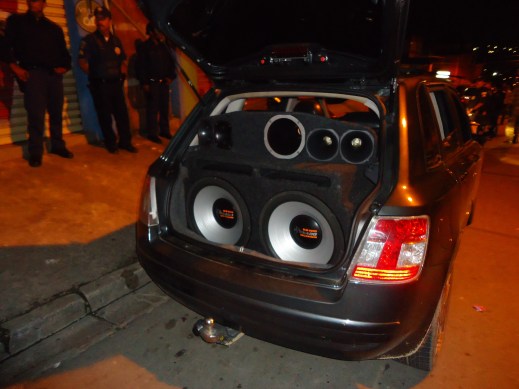
The pancadão (‘big punch’ in Portuguese) are parties that happen mostly in the peripheral neighborhoods of São Paulo, where very little leisure space is able to accommodate large numbers of people. For this reason, these parties happen on the streets and plazas, attracting thousands of youngsters that go to flirt, drink, and dance to the sound of Brazilian funk. The music comes from car speakers. Sometimes three or more cars will park a few feet from each other, blasting Brazilian funk throughout the night. Most of the lyrics contain metaphors referring to sex, but recently there has also been a wave of more extreme “ostentatious funk” (funk ostentação) coming from São Paulo. Here are two examples of popular funk ostentação songs that can be heard emanating from the pancadão, the first is MC Guime’s “Tá Patrão,” and the second, MC Rodolfinho’s “Como é Bom Ser Vida Loca.”
There has also been a link between the pancadão and drug traffic. Tellingly, there is branch of ‘forbidden’ funk that exalts drug dealers and robbery while also affronting the police. These parties persevere because everything is mobile: the music, the drinks, the drugs, and even the place for having sex – everything is supplied by the cars and can move around whenever there is a risk of conflict with the police.

An example of a pancadão car. Photo by Leonardo Cardoso.

Other things kept within a pancadão car. Photo by Leonardo Cardoso.
Presently, I am conducting research in two peripheral regions. One is the place where most funk MCs originate, and the other is where new strategies of shutting down these parties have been implemented by the police. The Operação Pancadão is an operation that gathers military and civil police, PSIU agents, and other administration officers. This task force measures sound emissions, apprehends and punishes the responsible, then impounds the cars. Once you cut the sound, partygoers disperse – often seeking another pancadão close by. One police chief reports having mapped more than 200 places of pancadão in São Paulo.
Because of this fieldwork, I believe that the field of ‘applied sound studies’ needs to be developed further, both inside and outside of the academy. It is crucial for urban planners to develop qualitative methods to understand how residents evaluate the everyday soundscape. In Europe , for example, there is a group of scholars working on new methods for assessing and improving soundscapes based on how residents perceive the environments in which they live. I also see the potential for scholars interested in sound-related nuisance to work with conflict mediation. During the weekend 60% of all calls received by the police dispatcher (equivalent to 911 in the U.S.) are from people complaining about some nuisance, usually loud sounds. Understanding urban sounds as a phenomenon which impacts several different social sectors can empower interested parties to put forward alternatives. Ideally, these alternatives will allow marginalized youth to enjoy their music without being bullied by drug dealers or assaulted by policemen. At the micro level, conflict mediation scholars could provoke a sense of dialogue between neighbors and help them to find solutions for conflicting sonic behaviors.
Please listen to the accompanying podcast, “Listening to São Paulo, Brazil,” for the opportunity to listen to the soundscape of São Paulo, as I walk you through these spaces of sonic conflict.
—
Leonardo Cardoso was born in Porto Alegre, Brazil, where he studied music composition at UFRGS (Federal University of Rio Grande do Sul). In 2005 he entered the Ethnomusicology Group at UFRGS as a research assistant. From 2005 to 2008 he participated in projects with indigenous communities in Rio Grande do Sul. In 2008 he started his Master’s in ethnomusicology at the University of Texas at Austin under Prof. Veit Erlmann’s advising. His interest in film music led him to write his thesis on the experimental field of visual music in Los Angeles. He is working in São Paulo, where he is currently conducting fieldwork on urban noise, for his PhD. Leonardo is also a photographer, composer, and sound collector. Contact: cardoso@utexas.edu
Share this:


Current Top Posts





April 2021

January 2020

November 2019

October 2019

August 2019

April 2014

November 2017

March 2015

December 2017

October 2015
 Sounding Out!
Recent Comments