
Sounding Out! Podcast #31: Game Audio Notes III: The Nature of Sound in Vessel
DOI: https://doi.org/10.59350/5vfyy-01a89
This post continues our summer Sound and Pleasure series, as the third and final podcast in a three part series by Leonard J. Paul. What is the connection between sound and enjoyment, and how are pleasing sounds designed? Pleasure is, after all, what brings y’all back to Sounding Out! weekly, is it not?
Part of the goal of this series of podcasts has been to reveal the interesting and invisible labor practices which are involved in sound design. In this final entry Leonard J. Paul breaks down his process in designing living sounds for the game Vessel. How does one design empathetic or aggressive sounds? If you need to catch up read Leonard’s last entry where he breaks down the vintage sounds of Retro City Rampage. Also, be sure to be sure to check out last week’s edition where Leonard breaks down his process in designing sound for Sim Cell. But first, listen to this! -AT, Multimedia Editor
–
CLICK HERE TO DOWNLOAD: Game Audio Notes III: The Nature of Sound in Vessel
SUBSCRIBE TO THE SERIES VIA ITUNES
ADD OUR PODCASTS TO YOUR STITCHER FAVORITES PLAYLIST
–
Game Audio Notes III: The Nature of Sound in Vessel
Strange Loop Game’s Vessel is set in an alternate world history where a servant class of liquid automatons (called fluros) has gone out of control. The player explores the world and solves puzzles in an effort to restore order. While working on Vessel, I personally recorded all of the sounds so that I could have full control over the soundscape. I recorded all of the game’s samples with a Zoom H4n portable recorder. My emphasis on real sounds was intended to focus the player’s experience of immersion in the game.
This realistic soundscape was supplemented with a variety of techniques that produced sounds that dynamically responded to the changes in the physics engine. Water and other fluids in the game were difficult to model with both the physics engine and the audio engine (FMOD Designer). Because fluids are fundamentally connected to the game’s physics engine, they takes on a variety of different dynamic forms as players interact with the fluid in different ways. In order to address this Kieran Lord, the audio coder, and I considered factors like the amount of liquid in a collision with anything, the hardness of the surface that it was colliding with, the type of liquid in motion, whether the player is experiencing an extreme form of that sound because it is colliding with their head, and, of course, how fast the liquid is travelling.
Although there was a musical score, I designed the effects to be played without music. Each element of the game, for instance a lava fluro’s (one of the game’s rebellious automatons) footsteps, entailed required layers of sound. The footsteps were composed of water sizzling on a hot pan, a gloopy slap of oatmeal and a wet rag hitting the ground. Finding the correct emotional balance to support the game’s story was fundamental to my work as a sound designer. The game’s sound effects were constantly competing with the adaptive music (which is also contingent on player action) that plays throughout the game, so it was important to provide an informative quality to them. The sound effects inform you about the environment while the music sets the emotional underscore of the gameplay and helps guide you in the puzzles.
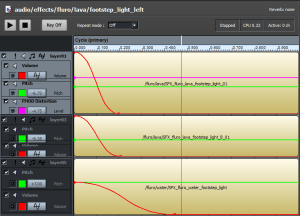
Defining the character of the fluros was difficult because I wanted players to have empathy for them. This was important to me because there is often no way to avoid destroying them when solving the game’s puzzles. While recording sounds in the back of an antique shop, I came across a vintage Dick Tracey gun that made a fantastic clanking sound when making a siren sound. Since the gun allowed me to control how quickly the siren rose and fell, it was a great way to produce vocalizations for the fluros. I simply recorded the gun’s siren sound, chopped the recording into smaller pieces, and then played back different segments randomly. The metal clanking gave a mechanical feel and the siren’s tone gave a vocal quality to the resulting sound that was perfect for the fluros. I could make the fluros sound excited by choosing a higher pitch range from the sample grains and inform the player when they approached their goal.
I wanted a fluid-based scream to announce a fluro’s death. I tried screaming underwater, screaming into a glass of water, and a few other things, but nothing worked. Eventually, when recording a rubber ear syringe, I found squeezing the water out quickly lent a real shriek while it spit out the last of the water. Not only did this sound really cut through the din of the gears clanking in the mix, but it also bonded a watery yell with the sense of being crushed and running out of breath.
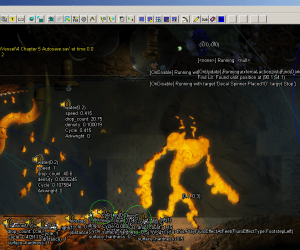
For the final boss, I tried many combinations of glurpy sounds to signify its lava form. Eventually I recorded a nail in a board being dragged across a large rusty metal sheet. Though it was quite excruciating to listen to, I pitched down the recording and combined it with a pitched down and granulated recording of myself growling into a cup of water. This sound perfectly captured the emotion I wanted to feel when encountering a final boss. Although it can take a long time to arrive at the “obvious” sound, simplicity is often the key.
Anticipation is fundamental to a player’s sense of immersion. It carves a larger space for tension to build, for instance a small crescendo of a creaking sound can develop a tension that builds to a sudden and large impact. A whoosh before a punch lands adds extra weight to the force of the punch. These cues are often naturally present in real-world sounds, such as a rush of air sweeping in before a door slams. A small pause might be included just for added suspense and helps to intensify the effect of the door slamming. Dreading the impact is half of the emotion of a large hit .
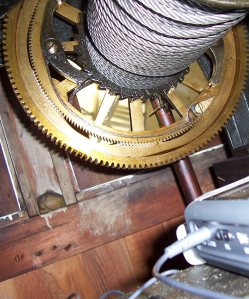
Recording all of the sounds for Vessel was a large undertaking but since I viewed each recording as a performance, I was able to make the feeling of the world very cohesive. Each sound was designed to immerse the player in the soundscape, but also to allow players enough time to solve puzzles without becoming annoyed with the audio. All sounds have a life of their own and a resonance of memory and time that stays with the them during each playthrough of a game. In Retro City Rampage I left a sonic space for the player to wax nostalgic. In Sim Cell, I worked to breathe life into a set of sterile and synthesized sounds. Each recorded sound in Vessel is alive in comparison, telling stories of time, place and recording with them, that are all their own.
The common theme of my audio work on Retro City Rampage, Sim Cell and Vessel, is that I enjoy putting constraints on myself to inspire my creativity. I focus on what works and removing non-essential elements. Exploring the limits of constraints often provokes interesting and unpredictable results. I like “sculpting” sounds and will often proceed from a rough sketch, polishing and reducing elements until I like what I hear. Typically I remove layers that don’t add an emotive aspect to the sound design. In games there are often many sounds that can play at once, so clarity and focus are necessary when preventing sounds from getting lost in a sonic goo.
In this post I have shown how play and experimentation are fundamental to my creative process. For an aspiring sound artist, spending time with Pure Data, FMOD Studio or Wwise and a personal recorder is a great way to improve their skill with game audio. This series of articles has aimed to reveal the tacit decisions behind the production of game audio that get obscured by the fun of the creative process. Plus, I hope they offer a bit of inspiration to those creating their own sounds in the future.
Additional Resources:
- My GDC 2012 talk – My site includes an MP3 recording of the talk and the full powerpoint presentation. A full video of the talk is in the GDC Vault but requires membership
- See the Jon Hopkins Soundtrack in the Video Game Vessel video game soundtrack video by me on YouTube – shows use of Lua with music in the custom level editor : https://www.youtube.com/watch?v=KOyjMPPvaY4
–
Leonard J. Paul attained his Honours degree in Computer Science at Simon Fraser University in BC, Canada with an Extended Minor in Music concentrating in Electroacoustics. He began his work in video games on the Sega Genesis and Super Nintendo Entertainment System and has a twenty year history in composing, sound design and coding for games. He has worked on over twenty major game titles totalling over 6.4 million units sold since 1994, including award-winning AAA titles such as EA’s NBA Jam 2010, NHL11, Need for Speed: Hot Pursuit 2, NBA Live ’95 as well as the indie award-winning title Retro City Rampage.
He is the co-founder of the School of Video Game Audio and has taught game audio students from over thirty different countries online since 2012. His new media works has been exhibited in cities including Surrey, Banff, Victoria, São Paulo, Zürich and San Jose. As a documentary film composer, he had the good fortune of scoring the original music for multi-awarding winning documentary The Corporation which remains the highest-grossing Canadian documentary in history to date. He has performed live electronic music in cities such as Osaka, Berlin, San Francisco, Brooklyn and Amsterdam under the name Freaky DNA.
He is an internationally renowned speaker on the topic of video game audio and has been invited to speak in Vancouver, Lyon, Berlin, Bogotá, London, Banff, San Francisco, San Jose, Porto, Angoulême and other locations around the world.
His writings and presentations are available at http://VideoGameAudio.com
—
Featured image: Courtesy of Vblank Entertainment (c)2014 – Artwork by Maxime Trépanier.
—

REWIND! . . .If you liked this post, you may also dig:
Sounding Out! Podcast #30: Game Audio Notes I: Growing Sounds for Sim Cell- Leonard J. Paul
Sounding Out! Podcast #31: Hand Made Music in Retro City Rampage– Leonard J. Paul
Papa Sangre and the Construction of Immersion in Audio Games- Enongo Lumumba-Kasongo
—
Share this:

Revising the Future of Music Technology
DOI: https://doi.org/10.59350/x3rgk-6je62
This is the opening salvo in Sounding Out!‘s April Forum on “Sound and Technology.” Every Monday this month, you’ll be hearing new insights on this age-old pairing from the likes of Sounding Out! veterano Primus Luta, along with new voices Andrew Salvati and Owen Marshall. These fast-forward folks will share their thinking about everything from Auto-tune to productivity algorithms. So, program your presets for Sounding Out! and enjoy today’s exhilarating opening think piece from SO! Multimedia Editor Aaron Trammell. —JS, Editor-in-Chief
—
We drafted a manifesto.
Microsoft Research’s New England Division, a collective of top researchers working in and around new media, hosted a one-day symposium on music technology. Organizers Nancy Baym and Jonathan Sterne invited top scholars from a plethora of interdisciplinary fields to discuss the value, affordances, problems, joys, curiosities, pasts, presents, and futures of Music Technology. It was a formal debrief of the weekend’s Music Tech Fest, a celebration of innovative technology in music. Our hosts christened the day, “What’s Music Tech For?” and told us to make bold, brave statements. A kaleidoscope of kinetic energy and ideas followed. And, at 6PM we crumpled into exhausted chatter over sangria, cocktails, and imported beer at a local tapas restaurant.
The day began with Annette Markham, our timekeeper, offering us some tips on how to best think through what a manifesto is. She went down the list: manifestos are primal, they terminate the past, create new worlds, trigger communities, define us, antagonize others, inspire being, provoke action, crave presence. In short, manifestos are a sort of intellectual world building. They provide a road map toward an imagined future, but in doing so they also work to produce this very future. Annette’s list made manifestos seem to be a very focused thing, and perhaps they usually are. But, having now worked through the process of creating a manifesto with a collective, I would add one more point – manifestos are sloppy.
Our draft manifesto is a collective vision about what the blind-spots of music technology are, at present, and what we want the future of music technology to look like. And although there is general synergy around all of the points within it, that synergy is somewhat addled by the polyphonic nature of the contributors. There were a number of discussions over the course of the day that were squelched by the incommensurable perspectives of one or two of the participants. For instance, two scholars argued about whether or not technical platforms have politics. These moments of disagreement, however, only added a brilliant contour to our group jam. Like the distortion cooked into a Replacements single, it only serves to highlight how superb the moments of harmony and agreement are in contrast. This brilliant and ambivalent fuzziness speaks perfectly to the value of radical interdisciplinarity.
http://www.youtube.com/watch?v=fl9KQ1Mub6Q
These disagreements were exactly the point. Why else would twenty academics from a variety of interdisciplinary fields have been invited to participate? Like a political summit, there were delegates from Biology, Anthropology, Computer Science, Musicology, Science and Technology Studies, and more. Rotating through the room, we did our introductions (see the complete list of participants at the bottom of this paper). Our interests were genuine and stated with earnestness. Nancy Baym declared emphatically that music is, “a productive site for radical interdisciplinarity,” while Andrew Dubber, the director of Music Tech Fest, noted the centrality of culture to the dialogue. Both music and technology are culture, he argued. The precarity of musical occupations, the gender divide, and the relationship between algorithm and consumer, all had to take a central role in our conversation, an inspired Georgina Born demanded. Bryan Pardo, a computer scientist, announced that he was listening with an open mind for tips on how to best design the platforms of tomorrow. Though collegial, our introductory remarks were all political, loaded with our ambitions and biases.
The day was an amazing, free-form, brainstorm. An hour and a half long each, the sessions challenged us to answer a big question – first, what are the problems of music technology, then what are some actions and possibilities for its future. Every fifteen or twenty minutes an alarm would ring and tables would exchange members, the new member sharing ideas from the table they came from. At one point I came to a new table telling stories about how music had the power to sculpt social relations, and was immediately confronted with a dialogue about problems of integration in the STEM fields.
In short, the brainstorms were a hodgepodge of ideas. Some spoke about the centrality of music to many cultural practices. Noting the ways in which humans respond to their environments through music, they questioned if tonal schema were ultimately a rationalization of the world. Though music was theorized as a means of social control many questions remained about whether it could or should be operationalized as such. Others considered different conversations entirely. Jocking sustainability and transduction as key factors in an ideal interdisciplinarity and shunning models that either tried to put one discipline in service of another, or simply tried to stack and combine ideas.
Some of the most productive debates centered around the nature of “open” technology. Engineers were challenged on their claim that “open source technology” was an unproblematic good, by Cultural Studies scholars who argued that the barriers to access were still fraught by the invisible lines of race, class, and gender. If open source technology is to be the future of music technology, they argued, much work must still be done to foster a dialogue where many voices can take part in that space.
We also did our best to think up actionable solutions to these problems, but for many it was difficult to dream big when their means were small in comparison. One group wrote, “we demand money,” on a whiteboard in capital letters and blue marker. Funding is a recurrent and difficult problem for many scholars in the United States and other, similar, locations, where funding for the arts is particularly scarce. On points like this, we all agreed.
We even considered what new spaces of interactivity should look like. Fostering spaces of interaction with public works of art, music, performance and more, could go a long way in convincing policy makers that these fields are, in fact, worthy of greater funding. Could a university be designed so as to prioritize this public mode of performance and interactivity? Would it have to abandon the cloistered office systems, which often prohibit the serendipitous occasion of interdisciplinary discussion around the arts?

There are still many problems with the dream of our manifesto. To start, although we shared many ideas, the vision of the manifesto is, if anything, disheveled and uneven. And though the radical interdisciplinarity we epitomized as a group led to a million excellent conversations, it is difficult, still, to get a sense of who “we” really are. If anything, our manifesto will be the embodiment of a collective that existed only for a moment and then disbursed, complete with jagged edges and inconsistencies. This gumbo of ideas, for me, is beautiful. Each and every voice included adds a little extra to the overall idea.
Ultimately, “What’s Music Tech For?” really got me thinking. Although I remain skeptical about the United States seeing funding for the arts as a worthy endeavor anytime soon, I left the event with a number of provocative questions. Am I, as a scholar, too critical about the value of technology, and blind to the ways it does often function to provoke a social good? How can technological development be set apart from the demands of the market, and then used to kindle social progress? How is music itself a technology, and when is it used as a tool of social coercion? And finally, what should a radical mode of listening be? And how can future listeners be empowered to see themselves in new and exciting ways?
What do you think?
Our team, by order of introduction:
Mary Gray (Microsoft Research), Blake Durham (University of Oxford), Mack Hagood (Miami University), Nick Seaver (University of California – Irvine), Tarleton Gillespie (Cornell University), Trevor Pinch (Cornell University), Jeremy Morris (University of Wisconsin-Madison), Diedre Loughridge (University of California – Berkley), Georgina Born (Oxford University), Aaron Trammell (Rutgers University), Jessa Lingel (Microsoft Research), Victoria Simon (McGill University), Aram Sinnreich (Rutgers University), Andrew Dubber (Birmingham City University), Norbert Schnell (IRCAM – Centre Pompidou), Bryan Pardo (Northwestern University), Josh McDermitt (MIT), Jonathan Sterne (McGill University), Matt Stahl (Western University), Nancy Baym (Microsoft Research), Annette Markham (Aarhus University), and Michela Magas (Music Tech Fest Founder).
—
Read the Manifesto here and sign on if you dig it. . . http://www.musictechifesto.org/
—
Aaron Trammell is co-founder and Multimedia Editor of Sounding Out! He is also a Media Studies PhD candidate at Rutgers University. His dissertation explores the fanzines and politics of underground wargame communities in Cold War America. You can learn more about his work at aarontrammell.com.
—
REWIND! . . .If you liked this post, you may also dig:
Listening to Tinnitus: Roles of Media when Hearing Breaks Down— Mack Hagood
Sounding Out! Podcast #15: Listening to the Tuned City of Brussels, The First Night— Felicity Ford and Valeria Merlini
“I’m on my New York s**t”: Jean Grae’s Sonic Claims on the City— Liana Silva
—
Share this:




Current Top Posts





April 2021

January 2020

November 2019

October 2019

August 2019

April 2014

November 2017

March 2015

December 2017

October 2015


Recent Comments