
Sonic Borders Virtual Panel: Theo Cateforis’s “No Control, or: How I Learned to Start Worrying about Sound” from IASPM-US
DOI: https://doi.org/10.59350/nc75e-gd545
In high school I was that guy. The one who spent every spare penny at the local record stores. The one who would make you a mixtape or tape a whole album to cassette for you. The one who would host listening parties around the stereo in his parents’ living room. Listening to music was a social activity, but it was also, I now recognize, a form of control. It was important, for instance, that I held those listening parties at my house because I was familiar with my records and stereo system, and I knew exactly how the music would sound. There would be no surprises. Likewise, to make a mixtape meant not only arranging a selection of songs, but ensuring that the recording levels and overall sound flowed from one song to the next. A good mixtape revealed not only an intimate knowledge of one’s record collection, but also the mastery of one’s tape deck.
My days of making mixtapes are long behind me, but I do construct course syllabi with a generous heap of listening assignments that function more or less the same way. And while I no longer host listening parties at my house, I do get to gather with my students every week in the classroom to listen closely to recordings. I guess the main difference is that I never gave my high school friends an exam testing them on what they had heard.
I am unsure if I gravitated toward musicology, and eventually popular music studies, as a way of validating or justifying my record collecting, but whatever the case may be recordings are central to the work that I do in my profession. I would like to think that the control that I wield over my collection is not as extreme as this memorable figure from Alan Zweig’s seminal documentary Vinyl, but if it is, I hope someone will tell me before I end up in an episode of Academic Hoarders (no, there is no such show, which is a true missed opportunity).
There are many ways that we exhibit our command of recordings in popular music studies. When we do musical analysis, for example, we control the recording through our use of descriptive language (as Barry Shank does with his wonderful break down of PSY’s “Gangnam Style” http://iaspm-us.net/sonic-borders-virtual-panel-barry-shank-on-popular-music-studies/ in the previous entry on this panel), we make transcriptions to cement soundwaves into notation, and we explain the significance of harmonic progressions and kick drum beats. Such analyses can seem especially authoritative when they focus on the music’s quantitative properties: its pitch and rhythmic structures. When we invoke sound, however, we generally do so in a more qualitative sense. It is the domain of timbre, texture, or in Barthes’s famous formulation “the grain of the voice,” for which there exists no sufficiently systematic explanation.
To be sure, pitches and rhythms are sounds, but in the vernacular or common parlance of popular music (the context I will take from this point on), sound generally refers to something else. Sound is the instrumental tone, performance style, or as Albin Zak deftly illustrates in I Don’t Sound like Nobody [link], the arrangements and production techniques that distinguish artists and their recordings from one another. Phil Spector’s Wall of Sound is, of course, a classic example. Sound in Spector’s recordings emerges from a blurry thickness of instrumental and vocal layerings, the ambient room space of Gold Star Studios and the reverberations of its echo chamber. Spector obsessively fought to control that sound, and that obsession is inseparable from his recordings’ sonic identity.
Producers are far from the only ones who anxiously fret over sound. As the past two decades have witnessed a deluge of CD reissues and remasters and a tendency toward increasingly louder recordings, music fans and recording engineers alike have increasingly voiced their concerns about the compromised quality of sound recordings. The “Loudness War,” as it has come to be called, is an impassioned rebuttal against the music industry’s attempts to define and control popular music’s sound. There are hundreds of clips on YouTube, such as this one (http://www.youtube.com/watch?v=3Gmex_4hreQ), that use audio samples to illustrate the terms of this contested terrain. And anytime a classic album reappears in a new deluxe form, fans are sure to weigh in on the sound quality (see, for example, the angry customer reviews accompanying Geffen’s “screwed up” 20th Anniversary release of Nirvana’s Nevermind http://www.amazon.com/Nevermind-2-CD-Deluxe-Nirvana/dp/B0057GYOA4/ref=sr_1_1?s=music&ie=UTF8&qid=1360492077&sr=1-1&keywords=nirvana+nevermind+deluxe).
I keep a keen eye on these debates, and not just as a music fan but as an educator who wants to select the most appropriate and representative recordings to load onto my Blackboard course page. The sound of these recordings is crucial, certainly for aesthetic reasons, but also because it is interwoven with the larger points, stories, and themes that I wish to communicate in the classroom. There have been times, however, when the sound and my stories refuse to synchronize, when I find myself in the middle of a lecture with a recording that throws a wrench into my carefully constructed lesson plan. Such moments can reveal just how relative sound is to what we expect or want to hear in the recording.
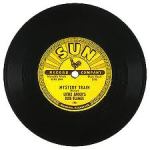
Consider Elvis Presley’s 1955 recording of “Mystery Train” for Sun Records, a song that I periodically teach in my History of Rock survey. The sound of “Mystery Train” is essential to the song’s significance. Producer Sam Phillips’ legendary “slapback echo” (aided by guitarist Scotty Moore’s newly acquired Echosonic amplifier) adds a spacious textural delay that converts the trio of musicians into a ghostly chugging train. Phillips’ innovative recording technique not only lends a poetic resonance to Presley’s vocals, it also serves a specific purpose within the narrative that I weave in my rock history class. It represents a moment of DIY recording studio ingenuity—a hallmark of small labels like Sun—and thus serves to distinguish the indies from the major labels whose domination they were beginning to threaten. It matters greatly that RCA tried to replicate that sound with Presley’s debut single “Heartbreak Hotel,” and failed.
When I taught “Mystery Train” in class a couple weeks back, I began by giving the students the background of Presley’s indie years and explaining the importance of the slapback echo. They were primed to listen for it. I decided to play them the version on the course website (the one they could access when listening on their own). But something did not sound right. One of the recording’s most alluring sonic properties is the patterns of propulsive rhythmic clicks that mysteriously emerge from the echoic aftershocks of the strumming string trio. On this particular day, those clicks did not sound at all mysterious. Rather they sounded like someone banging together two drumsticks. I always come to class equipped with a CD copy in case of some computer malfunction, and so I quickly apologized to the students and promised them a better realization of the slapback echo as I cued up the Sunrise Presley anthology. But the CD was just as bad, even worse actually. The clicks—now suffocatingly dry and wooden—sounded completely separated from the rest of the instrumental texture; I was struggling to explain how one could locate those clicks as part of the song’s recording process I had prompted the students to listen for just moments ago. I had a sinking feeling, like a used car salesman after a poor pitch, realizing a potential customer is about to leave the lot.
So, where did I go wrong? How did I manage to lose control? The answer occurred to me later that day. I recalled that when I was prepping for my class, I had been on the computer browsing YouTube and had decided to pull up a recording clip of “Mystery Train” from there just to get the song in my ear. The video that I chose was one where some fan had made a digital transfer from a “near mint” copy of the 1955 Sun 78 release (http://www.youtube.com/watch?v=XA5HErVE9oI). Listening to the clip a second time, I now heard how the rhythmic clicks were enmeshed in the texture, part of an all-consuming glorious wash of sound. When I had casually listened to the clip the first time around, I had unknowingly created a specific context for how I imagined and wanted slapback echo to sound, one that I could not reproduce in the classroom.
My point in sharing this anecdote is not to suggest that I have finally located the authentic “Mystery Train” sound. Rather, it is to acknowledge that in popular music studies, the main objects of our study, recorded songs, exist in liminal spaces, floating between different media, re-imaginations, and varying channels of communication. In my class I attempted to deploy the sound of “Mystery Train” as part of a strategic argument within the history of rock; I needed it to sound a certain way, but the song eluded my control. For those of us who interpret, analyze, and seek meaning in popular music, we constantly seek to control its sound. We often assume that our experience of popular music’s sound is a shared one, but sound can be more slippery than that. We can suggest and argue for ways of hearing, but those propositions come with no guarantees.
–Theo Cateforis–

Sonic Borders Schedule
1/21 – Liana Silva, Sounding Out! – “I’m on My New York Sh*t”: Jean Grae’s Sonic Claims on the City
1/28 – Regina Bradley, Sounding Out! – I Like the Way You Rhyme, Boy: Hip Hop Sensibility and Racial Trauma in Django Unchained
2/4 – Marcus Boon, Sounding Out! – One Nation Under a Groove?: Music, Sonic Borders, and the Politics of Vibration
2/6 – Barry Shank, IASPM-US – “On Popular Music Studies”
2/11 – Tavia Nyong’o, Sounding Out! – “Freedom Back: Sounding Black Feminist History, Courtesy the Artists”
2/13 – Theo Cateforis, IASPM-US – “No Control, or: How I Learned to Start Worrying About Sound”
2/18 – Tara Betts, Sounding Out!
2/20 – Shana L. Redmond, IASPM-US
2/25 – Art Jones, Sounding Out!
2/27 – Devon Powers, IASPM-US
—
Share this:

Freedom Back: Sounding Black Feminist History, Courtesy the Artists
Welcome to week four of our February Forum on “Sonic Borders,” a collaboration with the IASPM-US blog in connection with this year’s IASPM-US conference on Liminality and Borderlands, held in Austin, Texas from February 28 to March 3, 2013. The “Sonic Borders” forum is a Virtual Roundtable cross-blog entity that will feature six Sounding Out! writers posting on Mondays through February 25, and four writers from IASPM-US, posting on Wednesdays starting February 6th and ending February 27th. For an encore of weeks one through three of the forum, click here. And now, Tavia Nyong’o reviews Courtesy the Artist’s The Meeting, courtesy of Sounding Out! –JS
—
DOI: https://doi.org/10.59350/w8ynz-63m95
Last October 2012, in tandem with the New York launch of the retrospective art show Now Dig This! Art and Black Los Angeles 1960-1980, curated by Kellie Jones and running through March 11, 2013, MoMA PS 1 invited the sounds and images of Black Power into their courtyard Performance Dome for a Sunday afternoon collaborative arts project called The Meeting curated by Courtesy the Artists. Courtesy the Artists is the collaboration of Malik Gaines and Alexandro Segade: two-thirds of the core members of the L.A.-based performance art collective My Barbarian (the third is Jade Gordon). For The Meeting, recently transplanted New Yorkers Gaines and Seagade opted to curate a gathering of local artists, dancers and musicians they wanted to get to know better, such as LaTasha Diggs, niv Acosta, and Samita Sinha.

Curation as collaboration was the ethos behind The Meeting in PS1; Gaines and Segade were much more than masters of ceremony, but performed alongside the artists and musicians they invited. At times The Meeting felt more like a jam session than anything else, following the improvisatory and ensemblic ethos of experimental jazz. Performance piece as musician’s jam was indeed a fitting form, given that the afternoon was built around Seize the Time, a 1969 album of agit-prop cabaret recorded by activist, musician, and erstwhile Black Panther leader, Elaine Brown.
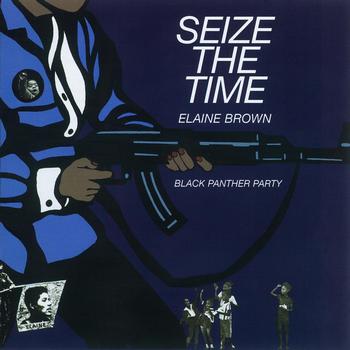
Each participant in The Meeting was invited to respond, in their chosen art form to a song from Brown’s album or another aspect of her legacy that moved them. And move them it did. If music held the event together — from Charles Gaines on the piano and drums to Matana Roberts on a haunting saxophone solo to Geo Wyeth closing down the evening with an astonishing version of “Seize the Time” intermixed with “Age of Aquarius” from the musical Hair — poetry, polemic, video, and dance sent it spinning off into a dozen scintillating tangents.
What those intersecting and diverging responses to Brown’s album shared was a concern with how the past resonates in the present, how a historical call might not always be muted over time, but sometimes amplified by its repetition across time. Given the predominance of the visual in contemporary culture — nowhere more glaring, perhaps, than in institutions devoted to visual art — what do we make of the role of the aural as a medium through which to register the reverberations of a past? The Meeting was held in a temporary structure, literally vestibular to the permanent edifice of the museum. Is the ear a similar vestibule to the institutions of culture, and, if it is, then wherein might the power of that vestibular flesh, as Hortense Spillers once named it, lie?

On Seize the Time, the mercurial Brown transposed the black revolutionary urgency of the 1960s into a musical idiom that sounded remarkable even in its day. It is slightly bemusing to settle into the jazzy opening of the title track “Seize the Time” with the knowledge that Marvin Gaye’s What’s Going On and Curtis Mayfield’s Super Fly were just around the corner. Certainly, despite their shared sonic defiance of American racism, Brown’s didactic sprechegesang would never be mistaken for Nina Simone’s soulful alto. Closer to the sonic mark would be singer-songwriters like Carole King, Janis Ian and Joni Mitchell, artists who broke the mold for women in pop in the late 1960s and early 1970s. Consider the rhetorical and musical twists and turns of the first verse of “The End of Silence,” a song that manages equal parts women’s liberation and black nationalism without ever teetering into blaxploitation supervixen territory:
Have you ever stood
In the darkness of night
Screaming silently you’re a man?
Have you ever hoped
That the time would come
When your voice could be heard
In the noonday sun?
Have you waited so long
Till your unheard song
Has stripped away your very soul?
Then believe it my friend
That the silence can end
We’ll just have to get guns and be men.
If The Meeting was a response to the call of that final line, it was one in which the shift from a single voice with backing band to a range of voices and positions was always audible. Some might call this postmodern fragmentation: dance choreographed to a repeating sample of Brown singing “freedom back,” a version of the album edited down to just the sequential instances of her singing the word “man,” played to projected images of every gun in the Panther arsenal she lists in her book. But these interventions arguably only expand our audition of the original album’s possibilities. More than 30 years on, The Meeting took advantage of Seize The Time’s musico-political incongruity to prise open new lines of affiliation between the past and our revanchist present. The question continuously hung in the air: How do we occupy our radical black and feminist legacies, especially given the fact that we cannot simply repeat those struggles in identical terms? How do we get freedom back?

The declamatory cadences of black rhetoric were as central to the way The Meeting sounded as was its music. LaTasha Diggs’s barnburning performances stopped the show to inform us that revolutionary pussy was out of stock. With Charles Gaines on drums and Matana Roberts on sax, Malik Gaines scatted excerpts from President Obama’s “race speech” while excerpts from speeches Elaine Brown had given to the Panthers were read. Since the context of Obama’s speech had been his own attempt to surrogate the justified anger of the Black Power generation with a message of reconciliation, re-mixing it in this context meant it no longer had the privilege of temporal succession over Brown, but black feminist rhetoric and the improvisatory sax could invaginate his rhetoric with an eternal recurrence of radical insurgence.
It is important to note the predominantly queer and trans performance modalities through which the Meeting posed–if not fully answered–its questions regarding freedom in a contemporary context. Brown’s refrain “we’ll just have to get guns and be men” took on a new connotation when juxtaposed against the queer and trans bodies and voices in performance.
Here history revealed itself as palimpsest: images and icons were superimposed one upon the other to create dense, freighted symbols of masculinity and femininity. In a refrain originally meant to rally radical black women towards the community leadership roles tendentiously claimed by men, the gun was much more than a ‘phallic symbol.’ As Kara Keeling recounts in The Witch’s Flight (an important book containing a shrewd analysis of Seize the Time):
The appearance of the [Black Panther Party] allowed for the recognition of the black man in the Black. But this need not be understood as precluding black “females” from appearing in blacks with guns, nor does it necessarily indicate an inherent connection between “men” and “males.” What is perhaps most innovative about the BPP’s cinematic appearance is that it threw into doubt the validity of the common sense that linked “man” with “male” with “masculine” (85).
For Keeling, the innovative disruption of white supremacist racist sense — congealed in stereotypical images of black men and black women — set the stage, formed the backing track, for the historical emergence of queer and transmasculinities.

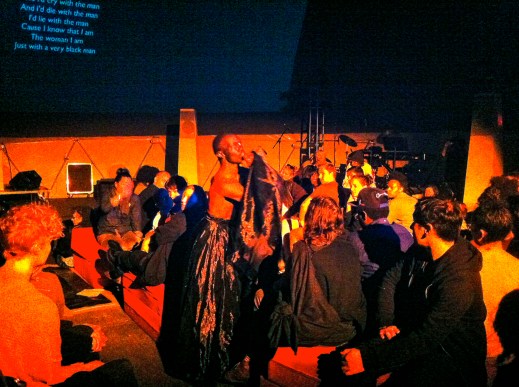
Transgender dancer and choreographer niv Acosta rhythmically ran his body against the cushioned seating of the performance dome, to the rhythmic sampling of “freedom back.” The phrase was curiously ambiguous: what actual historical freedom could Brown have possibly exhorted the panthers to claim? What imagined freedom do we think we can reclaim via our remixing of Black Power? The power of Acosta’s performance was to embody that question as a lived and livable improvisation.

The degree to which a musical legacy such as Brown’s can or should be appropriated beyond a black context was also pointedly staged that afternoon, perhaps most self-consciously by Alex Segade’s rendition of “The Meeting” — which Brown once called the Party’s anthem — in Spanish. Segade’s version captured the melodrama and romantic longing, staging the historical interconnections between black and brown power in California as a hall of mirrors and fleeting glances.
Geo Wyeth brought the house down with a funky final number that had the audience on the edge of their seats, perhaps awaiting the promised nudity a sign at the entrance warned the performance would contain. Wyeth’s onstage costume changes were anything but a striptease, however, as he instead fused the militancy of Seize the Time with the sexual revolution of Hair in an incompossible auditory portrait of the legacy of “the Sixties.” His performance left the audience with the emphatic reminder that it is less his generation’s challenge to prove adequate to the past than it is to retrieve from history’s shroud the pulsating star of their own desires.
—
[The Meeting included Simone Leigh, Samita Sinha, Matana Roberts, Charles Gaines, Malik Gaines, Adam Pendleton, niv Acosta, LaTasha Diggs, Xaviera Simmons, Jarrod Kentrell, Alex Segade, and Geo Wyeth].
—
Featured Image of Jarrod Kentrell performing to Elaine Brown’s “Very Black Man” at The Meeting, Courtesy of the author
—
Tavia Nyong’o is Associate Professor of Performance Studies at New York University, where he writes, researches and teaches critical black studies, queer studies, cultural theory, and cultural history. His first book, The Amalgamation Waltz: Race, Performance, and the Ruses of Memory (Minnesota, 2009), won the Errol Hill Award for best book in African American theatre and performance studies. Nyong’o has published articles on punk, disco, viral media, the African diaspora, film, and performance art in venues such as Radical History Review, Criticism, TDR: The Journal of Performance Studies, Women & Performance: A Journal of Feminist Theory, Women Studies Quarterly, The Nation, and n+1. He is co-editor of the journal Social Text.
—
Share this:




Current Top Posts





April 2021

January 2020

November 2019

October 2019

August 2019

April 2014

November 2017

March 2015

December 2017

October 2015
 Sounding Out!
Recent Comments