
Listening to and as Contemporaries: W.E.B. Du Bois & Sigmund Freud


DOI: https://doi.org/10.59350/mnc7c-p7c45
Inspired by the recent Black Perspectives “W.E.B. Du Bois @ 150” Online Forum, SO!’s “W.E.B. Du Bois at 150” amplifies the commemoration of the occasion of the 150th anniversary of Du Bois’s birth in 2018 by examining his all-too-often and all-too-long unacknowledged role in developing, furthering, challenging, and shaping what we now know as “sound studies.”
It has been an abundant decade-plus (!!!) since Alexander Weheliye’s Phonographies “link[ed] the formal structure of W.E.B. Du Bois’s The Souls of Black Folk to the contemporary mixing practices of DJs” (13) and we want to know how folks have thought about and listened with Du Bois in their work in the intervening years. How does Du Bois as DJ remix both the historiography and the contemporary praxis of sound studies? How does attention to Du Bois’s theories of race and sound encourage us to challenge the ways in which white supremacy has historically shaped American institutions, sensory orientations, and fields of study? What new futures emerge when we listen to Du Bois as a thinker and agent of sound?
Over the next two months, we will be sharing work that reimagines sound studies with Du Bois at the center. Pieces by Phillip Luke Sinitiere, Kristin Moriah, Aaron Carter-Ényì, Austin Richey, Julie Beth Napolin, and Vanessa Valdés, move us toward a decolonized understanding and history of sound studies, showing us how has Du Bois been urging us to attune ourselves to it. To start the series from the beginning, click here.
Readers, today’s post (the first of an interwoven trilogy of essays) by Julie Beth Napolin explores Du Bois and Freud as lived contemporaries exploring entangled notions of melancholic listening across the Veil.
–Jennifer Lynn Stoever and Liana Silva, Eds.
When W.E.B. Du Bois began the first essay of The Souls of Black Folk (1903) with a bar of melody from “Nobody Knows the Trouble I See,” he paired it with an epigraph taken from a poem by Arthur Symons, “The Crying of Water”:
O water, voice of my heart, crying in the sand,
All night long crying with a mournful cry,
As I lie and listen, and cannot understand
The voice of my heart in my side or the voice of the sea,
O water, crying for rest, is it I, is it I?
All night long the water is crying to me.
A listener, the poem’s speaker can’t be sure of the source of the sound, whether it is inward or outward. Something of its sound is exiled and resonates with Symons’ biographical position as a Welshman writing in English, an imperial tongue. At the heart of the poem is a meditation on language, communication, and listening. Personified, the water longs to be understood and sounds out the listener’s own interiority that struggles to be communicated. The poem’s speaker hears himself in the water, but he is nonetheless divided from it. If he could understand the source of the sound in a suppressed or otherwise unavailable memory, the speaker might be put back together. But listening all night long, that understanding does not come.

Together, the poem and song serve as a circuitous opening to Du Bois’ “Of Our Spiritual Strivings,” an essay that grounds itself in Du Bois’ training as a sociologist to detail “the color line,” which Du Bois takes to be the defining problem of 20th century America. The color line is not simply a social and economic problem of the failed projects of Emancipation and Reconstruction, but a psychological problem playing out in what Du Bois is quick to name “consciousness.” As the first African American to receive a PhD from Harvard in 1895, Du Bois had studied with psychologist William James, famous for coining the phrase “the stream of thought” in his modernist opus, The Principles of Psychology (1890). In her study of pragmatism and politics in Du Bois, Mary Zamberlin describes how James encouraged his students to listen to lectures in the way that one “receives a song” (qtd. 81). In his techniques of writing, Du Bois adopts and reinforces the paramount place of intuition and receptivity in James’ thought to conjoin otherwise opposed concepts. Demonstrated by the opening epigraphs themselves, Du Bois’ techniques often trade in a lyricism that stimulates the reader’s multiple senses.
I argue that Du Bois surpasses James by thinking through listening consciousness in its relationship to what we now call trauma. While I will remark upon the specific place of the melody in Du Bois’ propositions, I want to focus on the more generalized opening of his book in the sounds of suffering, crying, and what Jeff T. Johnson might call “trouble.” The contemporary understanding of trauma, as a belated series of memories attached to experiences that could not be fully grasped in their first instance, comes to us not from the scientific discipline of psychology, but rather psychoanalysis.
Among the field’s first progenitors, Sigmund Freud, was a contemporary of Du Bois. Though trained as a medical doctor, Freud sought to free the concept of the psyche from its anatomical moorings, focusing in particular on what in the human subject is irrational, unconscious, and least available to intellectual mastery. His thinking of trauma became most pronounced in the years following WWI, when he observed the consequences of shell-shock. Freud discovered a more generalizable tendency in the subject to go over and repeat painful experiences in nightmares. Traumatic repetition, he noted, is a subject struggling to remember and to understand something incredibly difficult to put into words. At the heart of Freud’s methods, of course, was listening and the observations it afforded, grounding his famous notion of the “talking cure.” Because trauma is so often without clear expression, Freud listened to language beyond meaning, beyond what can be offered up for scientific understanding.

The beginning of Souls, along with its final chapter on “sorrow songs,” slave song or spirituals, tells us that Du Bois’ project shared that same auditory core. Du Bois was listening to consciousness, that is, developing a theory of a listening (to) consciousness in an attempt to understand the trauma of racism and the long, drawn-out historical repercussions of slavery. Importantly, however, Du Bois’ meditation on trauma precedes Freud’s. But Du Bois’ thinking also surpasses Freud in beginning from the premise that trauma is the sine qua non of theorizing racism, which makes itself felt not only outwardly in social and economic structures, but inwardly in consciousness and memory.
Du Bois claimed that he hadn’t been sufficiently Freudian in diagnosing white racism as a problem of irrationality. He didn’t mean by this that Freud himself made such a diagnosis, but rather that Freud was correct in refusing to underestimate what is least understandable about people. Freud’s thinking, however, remained mired in racist thinking of Africa. Though he claimed to discover a universal subject in the structure of the psyche—no one is free from the unconscious—racist thinking provided the language for the so-called “primitive” part of the human being in drives. This primitivism shaped Freud’s myopic thinking of female sexuality, famously remarking that female sexuality is the “Dark Continent,” i.e. unavailable to theory. Freud drew the phrase from the imperialist travelogues of Henry Morton Stanley in the same moment that Du Bois was turning to Africa to find what he called, both with and against Hegel, a “world-historical people.” As I argue, Du Bois found in the music descended from the slave trade not only a “gift” and “message” to the world, but the ur-site for theorizing trauma.
Ranjana Khanna has shown how colonial thinking was the precondition for Freudian psychoanalysis. Anti-colonial psychiatrist Frantz Fanon, for example, both took up and resisted Freud when he elaborated the effects of racism as the origin of black psychopathology, i.e. feelings of being split or divided. Du Bois, like Fanon after him, was hearing trauma politically as a structural event. The complex intellectual biography of Du Bois, which includes a time of studying (in German) at Berlin’s Humboldt University, mandated that he took from European philosophical interlocutors what he needed, creating a hybrid yet decidedly new theory of listening consciousness. That hybridity is exemplified by the opening of his book, an antiphony between two disparate sources bound to each other across the Atlantic through what I will call hearing without understanding. In this post, I ask what Du Bois can tell us about psychoanalytic listening and its ongoing potential for sound studies and why Freud had difficultly listening for race.
***

“Psychoanalysis . . . , more than any twentieth-century movement,” writes Eli Zaretsky in Political Freud, “placed memory at the center of all human strivings toward freedom” (41). He continues, “By memory I mean no so much objective knowledge of the past or history but rather the subjective process of mastering the past so that it becomes part of one’s identity.” In 1919, Freud gave a name to the experience resounding for Du Bois in Symons’ poem “The Crying of Water:” “melancholia.” Unlike mourning after the death of a loved one, whose aching and cries pass with time, melancholia is an ongoing, integral part of subjects who have lost more inchoate things, such as nation or an ideal. This loss, Freud contended, could in fact be constitutive of identity, or the “ego,” Latin for “I” (“is it I? Is it I?” Symons asks). In mourning, one knows what has been lost; in melancholia, one can’t totally circumscribe its contours.
Zaretsky details the way that Freudianism, particularly after its rapid expansion in the US after WWI, became a resource for the transformation of African American political and cultural consciousness, playing a pronounced role in the Harlem Renaissance, the Popular Front, and anti-imperialist struggles. Zaretsky rightly positions Du Bois and his 1903 text as the beginning of a political and cultural transformation, but it is an anachronism to suggest that Freudianism contributed to Du Bois’ early work. Not only does Du Bois’ analysis of “The Crying of Water” predate Freud’s “Mourning and Melancholia” by nearly two decades, the two thinkers were contemporaries. In the years that Freud was writing his letters to Wilhelm Fliess, which became the body of his first book, The Interpretation of Dreams (1900), Du Bois was compiling his previous publications for The Souls of Black Folk, along with writing a new essay to conclude it, “The Sorrow Songs,” a sustained reflection on melancholia and its cultural reverberations in song. 1903 is the year of Souls compilation, not composition.
Du Bois’ thinking of a racialized listening consciousness is not only contemporary to Freud, but also fulfills and outstrips him. To approach Du Bois and Freud as contemporaries involves positioning them as listeners on different, but not opposing sides of what Du Bois calls the “Veil.” It is the psychological barrier traumatically instantiated by racialization, which Du Bois famously describes in the first chapter of Souls. The Veil, Jennifer Stoever describes, is both a visual and auditory figure, the barrier through which one both sees and hears others.
To better define the Veil, Du Bois—like Frederick Douglass before him—returns to a painful childhood scene that inscribed in his memory the violence of racial difference and social hierarchy. Early works of African American literature often turn to memoir, writing their elided subjectivity into history. But we miss something if we don’t recognize there a proto-psychoanalytic gesture. In the middle of a sociological, political essay, Du Bois writes of the painful memory of a little white girl rejecting his card, a gift. In this, we can recognize the essential psychoanalytic gesture of returning to the traumatic past of the individual as a forge for self-actualization in the present.
As Paul Gilroy has described, Du Bois’ absorption of Hegel’s thought while at Humboldt cannot be underestimated, particularly in terms of the famous master-slave dialectic. In this dialectic, the slave-consciousness emerges as victorious because the master depends on him for his own identity, a struggle that Hegel described as taking place within consciousness. Like Hegel, Zaretsky notes, Du Bois understood outward political struggle to be bound to “internal struggle against . . . psychic masters” (39). I would state this point differently to note that Du Bois’ traumatic experience as a raced being had already taught him the Hegelian maxim: the smallest unit of being is not one, but two. For Hegel, the slave knows something the master doesn’t: I am only complete to the extent that I recognize the other in myself and that the other recognizes me in herself. That is the essential lesson that an adult Du Bois gleans from the memory of the little girl who will not listen to him. He recognizes that she, too, is incomplete.
The essential difference between psychoanalysis and the Hegelian thrust of Du Bois’ essay, however, is that while a traditional analysand seeks individual re-making of the past—not only childhood, but a historical past that shapes an ongoing political present– Du Bois emphasizes the collective and in ways that cannot be reduced to what Freud later calls the “group ego.” If we restore the place of Du Bois at the beginnings of psychoanalysis and its ways of listening to ego formation, then we find that race, rather than being an addendum to its project, is at its core.
We can begin by turning to a paradigmatic scene for psychoanalytic listening, the one that has most often been taken up by sound studies: the so-called “primal scene.” In among the most famous dreams analyzed by Freud, Sergei Pankejeff (a.k.a. the “Wolf Man”) recalls once dreaming that he was lying in bed at night near a window that slowly opened to reveal a tree of white wolves. Silent and staring, they sat with ears “pricked” (aufgestellt). Pricked towards what? The young boy couldn’t hear, but he sensed the wolves must have been responding to some sound in the distance, perhaps a cry.
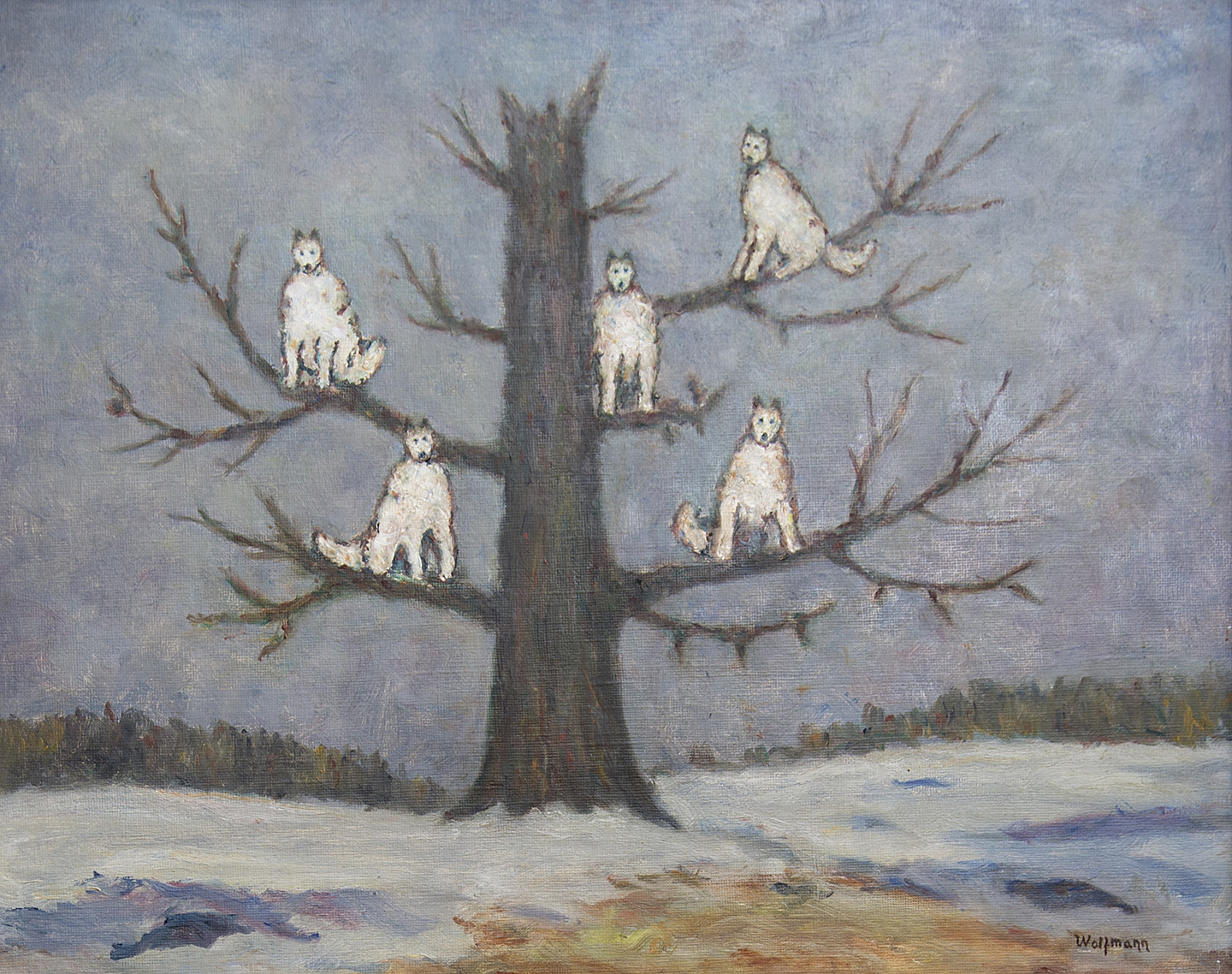
In “The Dream and the Primal Scene” section of “From the History of An Infantile Neurosis” (1914/1918), Freud concluded that the dream was grounded in the young boy’s traumatic experience of witnessing his parents having sex. Calling this the “primal scene,” Freud conjectured that there must have been an event of overhearing sounds the young boy could not understand. In the letters he exchanged with Fliess, Freud had begun to attend to the strange things heard in childhood as the basis for fantasy life and with it, sexuality.
The primal scene is therefore crucial for Mladen Dolar’s theory in A Voice and Nothing More when he pursues the implications of an unclosed gap between hearing and understanding. In the Wolf Man’s case, it is impossible, Freud writes, for “a deferred revision of the impressions…to penetrate the understanding.” In Dolar’s estimation, the deferred relation between hearing and understanding defines sexuality and is the origin of all fantasy life. This gap in impressions cannot be closed or healed, and, for Jacques Lacan it also orients the failure of the symbolic order to bring the imaginary order to language. From this moment forward, psychoanalytic theory argues the subject is “split,” listening in a dual posture for the threat of danger and the promise of pleasure. Following Lacan, Dolar, Michel Chion, and Slavoj Žižek return to the domain of infantile listening—listening that occurs before a person has fully entered into speech and language—to explain the effects of the “acousmatic,” or hearing without seeing.
After Freud, the phrase “primal scene” has taken on larger significance as a traumatic event that, while difficult to compass, nonetheless originates a new subject position that makes itself available to a collective identity and identification. The original meaning of hearing sexual and libidinal signals without understanding them, I would suggest, holds sway. Psychoanalytic modes of listening, particularly if restored to its political origins in racism, offer resources for what it means to listen beyond understanding, but such thinking of race immediately folds into intersectional thinking of gender and sexuality. Consider the place of the traumatic memory of the little girl who rejects the card. In The Sovereignty of Quiet, Kevin Quashie returns to Du Bois’ primal scene to note how the scene takes place in silence, for she rejects it, in Du Bois’ terms, “with a glance.” I want to expand upon this point to note that where there is silence, there is nonetheless listening. Du Bois is listening for someone who will not speak to him; he desires to be listened to and the card—a calling card—figures a kind of address.
It has gone largely unnoticed that, to the extent that the scene is structured by the master-slave dialectic, it is also structured by desire. This scene of trauma is shattering for both boy and girl. The desire coursing through the scene is suppressed in Du Bois’ adult memory in favor of its meaning for him as a political subject. What would it mean to recollect, on both sides, the trace of sexual (and interracial) desire? In “Resounding Souls: Du Bois and the African American Literary Tradition,” Cheryl Wall notes the scant place for black women in the political imaginary of this text. This suppression, I would argue, already begins in the memory of the girl who appears under the sign of the feminine more generally. The fact that she is white, however, casts a greater taboo over the scene and therefore allows more for a suppression of sexuality in his memory. Du Bois emerges as a political agent disentangled from black women—with one notable exception, the maternal, and this exception demands that we listen with ears pricked to “The Sorrow Songs,” as Du Bois’ early contribution to the psychoanalytic theory of melancholia.
Next week, part two will further explore The Souls of Black Folk as a “displaced beginning of psychoanalytic modes of listening,” emphasizing the African melodies once sung by his grandfather’s grandmother that Du Bois’s hears as a child, as “a partial memory and a mode of overhearing.”
—
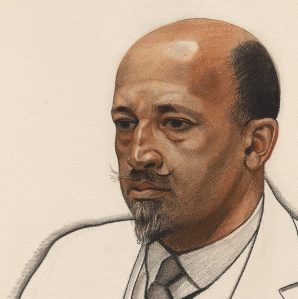
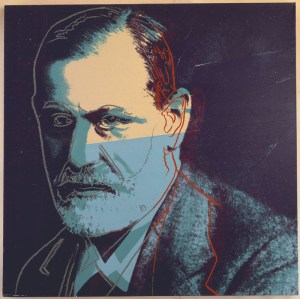
Featured Images: “Nobody Knowns the Trouble I See” from The Souls of Black Folk, Chapter 1, “W.E.B. Du Bois” by Winold Reiss (1925), “Sigmund Freud” by Andy Warhol (1962)
—
Julie Beth Napolin is Assistant Professor of Literary Studies at The New School, a musician, and radio producer. She received a PhD in Rhetoric from the University of California, Berkeley. Her work participates in the fields of sound studies, literary modernism and aesthetic philosophy, asking what practices and philosophies of listening can tell us about the novel as form. She served as Associate Editor of Digital Yoknapatawpha and is writing a book manuscript on listening, race, and memory in the works of Conrad, Du Bois, and Faulkner titled The Fact of Resonance. Her work has appeared in qui parle, Fifty Years After Faulkner (ed. Jay Watson and Ann Abadie), and Vibratory Modernism (ed. Shelley Trower and Anthony Enns).
—

REWIND! . . .If you liked this post, you may also dig:
“A Sinister Resonance”: Joseph Conrad’s Malay Ear and Auditory Cultural Studies–Julie Beth Napolin
“Scenes of Subjection: Women’s Voices Narrating Black Death“–Julie Beth Napolin
Unsettled Listening: Integrating Film and Place — Randolph Jordan
—
Share this:

Episode II: The Greatest Sound in the Galaxy: Sound and Star Wars

DOI: https://doi.org/10.59350/9pk8v-22t21
In this galaxy, two weeks ago, Leslie McMurtry published Episode I, a discussion of sound in the Star Wars films. Binge read it here! In today’s post, she listens to the farther reaches of the Star Wars galaxy–its multi-media forms including radio and cartoons–as well as the newest installment, Solo!
—
Yeah, I speak it a little.
For the first time in the onscreen history of Star Wars, a human speaks Wookiee and needs subtitles to do so. There is more significance to this moment in Solo (2018) than might first seem apparent. To understand why, we need to think back to the Ewoks, the small furry creatures from Return of the Jedi. They have polarized fans, and their language feeds into potential ethical sonic/linguistic dilemmas in Star Wars. As Ben Burtt explains,
With a new language, the most important goal is to create emotional clarity. People spend all of their lives learning to identify voices. You became an expert at that, and somewhat impossible to electronically process the human characteristic, and retain the necessary emotion. To fool the audience into believing this is a real character as the basis of the sound, although you may sprinkle other things in there. It varies from character to character.
The language of the Ewoks, however, was “rendered almost entirely from Tibetan.” As Stephen Davis argues, Tibetan and other non-European languages used in Star Wars “were sometimes distorted” and “not used to convey meaningful content.” This, says Davis, seemingly suggests “that these languages were never meant to be intelligible to moviegoers; rather, they were used to create social distance between strange characters and the anticipated audience.”
The process actually took a reversal when Star Wars was translated into Diné (Navajo) for its premiere in 2013 at Window Rock, Arizona, in front of an audience of hundreds. In Star Wars, a plethora of languages have been spoken by a variety of species, but it has been rare for human characters to speak in these languages. The potential distancing at work somehow becomes much less during this moment in Solo.
The first part of this article has mainly focused on the “original trilogy.” The next section will detail Star Wars in the digital era and in other media. Envisioned since 1978 as a cycle of nine films, A New Hope, Empire Strikes Back, and Return of the Jedi were given “Special Edition” makeovers in 1997 as Star Wars entered the digital era. These re-issues were committed to the soundworld of the original, Ben Burtt leaving “virtually untouched” such key elements as the sounds of Darth Vader, Artoo, Threepio, and the TIE fighters, while the Special Edition required the creation of Huttese dialogue for Jabba the Hutt and sound effects for his movement in A New Hope.
Kinda handy to have a storyteller who makes his own sound effects
As a child, Ben Burtt loved listening to his grandfather’s radio, tuning between stations to hear the sounds in between, the beeps, whistles, and static. “There’s something about that I find opens my mind,” he said. While the radio links to George Lucas and Star Wars have already been comprehensively explored, what about Star Wars on the radio?
Since at least 1925, when the BBC began its long-standing series of adaptations, The Classic Serial, adaptations from media like books and stage plays have been a mainstay of radio content. Despite the one-time frequent proliferation of film-to-radio adaptation, the practice has become much more uncommon. In 1981, with organised public radio manifestations like NPR (National Public Radio) still in their infancy in the US, drama had played a much smaller part on the airwaves than public service broadcasting’s equivalent in the UK, the BBC—indeed, drama was more likely to be found on nostalgic commercial throwbacks like The CBS Radio Mystery Theater. Nevertheless, when approached by Richard Toscan of USC, John Houseman, and Frank Mankiewicz, Lucasfilm quickly sold the adaptation rights to NPR for $1, including, crucially, use of music and special effects. The BBC also agreed to co-produce.
Why did George Lucas sell the radio rights to Star Wars for $1 a pop? Clearly the involvement of his alma mater USC was a factor; nevertheless, as previously argued, Lucas was invested in radio culture, not just of the 1930s serial type that was mirrored in action-adventure-science fiction films of that era, but also the free-wheeling intimacy of radio hosts such as Wolfman Jack and Bob “The Emperor” Hudson, a Burbank DJ and subject of one of Lucas’ films. The dramatization’s length (six-and-a-half hours) de-compressed A New Hope’s story, “meaning that the characters could be treated in more depth and the story told in more detail,” as noted by Frederica Kushner, creating character-developing moments in transmedia long before the digital age (including completely new sequences for Luke and Leia in episodes 1 & 2 of A New Hope and a scene in which Luke constructs a new light saber as a prologue to Return of the Jedi). NPR’s listening audience doubled during the broadcast of the first adaptation in 1981.
In the era of classic radio serials, rural listeners often used film-to-radio adaptations as a way of keeping up with movie culture; as Malcolm Usrey of the Texas Panhandle recalled, “[o]nly a serious emergency kept us from hearing The Lux Radio Theater.” In 1981, there was no way for viewers who wanted to re-watch Star Wars to do so, as it was long gone from cinemas. The radio adaptations would have offered the next best thing, while a more “fill-in” approach was beginning to manifest by 1996, when Return of the Jedi was finally adapted (in a much compressed form), by which point the original trilogy were all available on VHS.
The radio adaptations, nevertheless, remain a fascinating meditation on Star Wars’ transmedia and its use of sound. The response to sound in Star Wars functions perhaps similarly to Dermot Rattigan’s “macro-micro scale” in radio, the intimacy created when broadcasters address an audience of millions but seem to speak individually to YOU.
Sir, my audio sensors no longer . . .
As celebrated movie critic Gene Siskel wrote in his review of Return of the Jedi, “I can’t think of another recent picture whose sound I enjoyed so much. [. . .] it’s almost flawless. [ . . .] Three is not enough.” Indeed, three was not enough, and in 1999, Burtt became the sound editor on The Phantom Menace, the most expensive independent film in history, the first of a new trilogy. The Phantom Menace made full use (perhaps, some would suggest, over-use) of digital animation technologies and brought voices in the shape of Brian Blessed and Andy Secombe to alien creatures.
Williams’ leitmotifs proceeded to weave retrospectively into this trilogy as well as the introduction of new themes, for example “Across the Stars,” “a love theme that swells with the fervent romance shared by Anakin and Padmé, and which subsequently plays over the end credits” (and is only heard in Attack of the Clones and Revenge of the Sith). To return to Bribitzer-Stull’s catalogue of Williams’ use of leitmotifs, thematic irony is prominent in Revenge of the Sith when Padmé says she is pregnant:
Bribitzer-Stull presents this as “a clear case of romantic irony, since the audience knows what horrible fate lies in store for the two characters, though the characters themselves do not.” Another new composition was “Duel of the Fates” with three iterations of its leitmotif heard throughout The Phantom Menace, Attack of the Clones, and Revenge of the Sith.
Echoes of “Duel of the Fates” are heard in Solo, and those who have seen the film will understand why.
Civilized words can be our greatest weapon!
Long before Disney acquired Lucasfilm, Star Wars’ transmedia success was profound. On television, Star Wars lived on the 1980s in Ewoks the animated series (1985-6) and Droids (1985). Droids were the further adventures of R2-D2 and C-3PO, set before A New Hope. With voice talent lent (again) by Anthony Daniels as Threepio and Artoo “as himself,” the short-lived animated series featured an opening theme tune by The Police’s Stewart Copeland. The final episode, an hour-long special, “The Great Heep” was based on a screenplay by Ben Burtt.
The music, composed and performed by Patricia Cullen (who scored Ewoks and The Care Bears), flirts with “fantasy”/ “medieval” music as well as imitating John Williams’ late-Romantic idiom. The story features humanoid characters speaking non-English languages and creatures that sound like tauntauns. Artoo and Threepio also interact with other droids in scenes that lay the foundation for later Burtt robot project Wall-E (2008).
As Daniels remarked, “That was my favorite episode. Ben has a particular affection for me as C-3P0 and has a natural empathy toward R2-D2.” (Ewoks and Droids were followed on the small screen by Clone Wars (Cartoon Network, 2008-15) and Rebels (Disney Channel, 2014-18), whose sound worlds may be investigated in future installments.)
Elsewhere, sound was particularly important to Star Wars in video game format. According to Felan Parker, since the release of Star Wars: The Empire Strikes Back for Atari, video games have had prominence within the Star Wars storyworld; as Jason Scott puts it, “Star Wars has been repurposed for each new technology, frequently as a flagship title to help sell hardware.” In the games, the Force becomes visualized and sonified. In Star Wars: Return of the Jedi (1994), it has, in Parker’s words, a “tinkling sound” while in The Force Unleashed (2008), it sounds like “gushing wind.” As Christopher Coleman puts it, the Star Wars video games were perhaps more adventurous than the films and other forms of media to break away from the John Williams score and musically innovate.
Coleman argues that the zenith of this innovation was The Force Unleashed (for Xbox 360, Playstation, Nintendo Wii, or DS), set between Revenge of the Sith and A New Hope, centered around Darth Vader’s secret apprentice, Starkiller. This gave players the opportunity to be “visually stunned” but also musically impressed, creating a reactive musical environment that bridged the “significant stylistic gap between the two Star Wars trilogies.”
In 2012, Disney acquired Lucasfilm for $4 billion, starting a new trilogy cycle. Furthermore, Disney would begin making the Anthology films, “churning out” a new film “every two or three years indefinitely, providing the anchor for brand extensions worldwide,” of which Solo is the second (with Rogue One, 2016, being the first). “The cultural box-office explosion” from Black Panther has reportedly carried into Solo, with “fascinating” African-American actor Donald Glover as Lando Calrissian inheriting the cape from Billy Dee Williams.
However, Star Wars has never been able to escape, in Andrew Howe’s words, “the gravitational pull of contemporary racial politics”; the original trilogy has suffered from a notable absence of human racial minorities. Howe argues, for example, that Lucas withholds from the Tusken Raiders any forms of humanizing speech, in turn suggesting that human desert races like the Bedouins share the Tusken Raiders’ brutishness. “Perhaps,” Howe posits, “Lucas is suggesting that it is only in areas of lax governmental control that racial minorities can exist unmodified by race-based expectations.”
More infamous, perhaps, is Ahmed Best’s performance in The Phantom Menace as Jar-Jar Binks. Patricia Williams wrote scathingly of Jar-Jar’s “mush of West African, Caribbean, and African-American linguistic styles” in The Nation. The perception is that “Jar Jar was depicted in broad, stereotypical terms as the lazy Jamaican,” if not more pejoratively. Silas Carson played Nute Gunray (The Phantom Menace, Attack of the Clones) as a Transylvanian, though audiences interpreted the Neimoidians as having East Asian accents which, combined with the qualities of sadism, power, and cowardice, caused some concern over stereotyped portrayals. However, as Howe points out, the main villains in the prequels are largely coded as white.
Howe argues that Lucas (and Lucasfilm, and by extension, Disney) were made exceedingly aware of Star Wars’ potentially unsatisfying track record as regards race and ethnicity, which he believes has been addressed, with varying degrees of success, in the prequels. Perhaps more successful was the casting of Mexican actor Diego Luna, playing the heroic rebel Cassian Andor in Rogue One, with a pronounced accent, which Samantha Schmidt puts this way, “There was no particular reason Cassian was Mexican, or why he shouldn’t be. He just was. [ . . .] It was a rare example of a time when a Latino actor has been cast in a blockbuster film not simply as a token Latino character but as a leading role with no obvious ties to Latino culture,” though arguably the same had occurred 14 years earlier with the casting of Jimmy Smits as Bail Organa (Smits is half Puerto Rican).
Star Wars in the digital era also revisited the divide between Standard North American and Standard Neutral English, particularly in the characters of Rey and Finn. Rey, the hero whose journey across The Force Awakens, The Last Jedi, and Episode IX has mirrored Luke Skywalker’s, is played by British actor Daisy Ridley, who has maintained a Standard Neutral English throughout her performance. Finn, former stormtrooper FN-2187, Rey’s friend and potential love interest, is also played by a British actor, John Boyega, who has swapped his accent for a Standard North American one. Boyega’s claims that director Rian Johnson felt Boyega’s accent just didn’t work are ironic, considering that Lucas originally preferred an American accent for Threepio (voiced by Anthony Daniels in a Standard English Neutral accent). American-ness and Britishness were clearly a major component of the latest grouping of Star Wars films:
Among other things, this resulted in rampant speculation about Rey’s parentage, her “Core Worlds”/Coruscanti accent making it clear that she wasn’t the long-lost daughter of Han Solo and Princess Leia. By contrast, Kylo Ren, Han and Leia’s actual son (and Rey’s antagonist/potential love interest), played by Adam Driver, does not emulate his code-swapping grandfather Anakin Skywalker/Darth Vader and speaks Standard North American (though with the same bass baritone as James Earl Jones).
Finn’s accent and role feeds into a long-standing argument regarding the role of the stormtrooper, who spoke in the original trilogy with a Standard North American accent (likely because these characters were dubbed by Americans, like Bill Wookey) whereas, as previously discussed, the management structure of the Empire emulated its namesake Emperor and spoke Standard English Neutral. In the prequels, Jango Fett, the prototype for the stormtrooper clone army, spoke with a New Zealand accent, predicated on the Maori ancestry of actor Temuera Morrison, a convention carried through during Clone Wars, which is set between Attack of the Clones and Revenge of the Sith.
To return to Ridley and Boyega, though, while both were born in London, the “suitability” of their respective accents says a lot about the endurance of class distinctions in British culture. Ridley’s suitably “noble-sounding” accent, closely matching Standard English Neutral, differs greatly from Boyega’s Peckham accent. You can take the stormtrooper out of the Empire, but you can’t take the American-ness out of the stormtrooper, it seems.
Ridley, with a background in music performance, is a mezzo-soprano, and her speaking voice is somewhat low in pitch, in contrast to the stereotypical feminine voice, higher-pitched and lilting. This vocal quality has not garnered the attention that Carrie Fisher’s voice has in her last role, in The Last Jedi, in which she was pilloried by some elements of fandom:
her voice is kerazy! It has that “I’ve been through some serious drugs and alcohol” tone, which, unless she can really play it down, would be pretty distracting for a “Queen”. It doesn’t sound like an easy voice to get away from….throaty, broken and borderline insane.
As Ros Jennings and Eva Krainitzki note, ageism is part of contemporary society. They further argue that a binary is usually established in screen media between “ageing as decline” or “successful ageing.” If an older woman on screen does not conform as either a “graceful” ager or “sexy oldie,” she is effectively erased and made invisible, clearly not the case with a visible and powerful General Leia Organa in The Force Awakens or The Last Jedi. Nor has Fisher’s voice been erased. The comments made by (usually male) critics regarding Fisher’s “kerazy” voice as evidenced above clearly situates her in, as Melanie Williams puts it, “the middle of both misogyny and gerontophobia.” On the dichotomy between “ageing well” and “letting oneself go,” Fisher’s voice is perceived as the latter and therefore not evidence of a “queenly” persona.
To break through this binary, it might be more instructive to look at the example of Vanessa Redgrave, who, like British compatriots Dame Helen Mirren and Dame Judi Dench, are examples of (in Williams’ words) female “post-middle-age life [being] as equally dynamic and fulfilling as the years before.” Redgrave’s distinctive “husky” voice (“powerful” despite her life-long smoking) more closely resembles Fisher’s, also deepened in register (though whether her self-admitted addictions to cocaine and prescription drugs have had any bearing on the timbre, intensity, and pitch of her voice is of, arguably, less relevance). While, as Williams would argue, Mirren and Dench in their public personas have attempted to “transcend age by ignoring it,” Fisher as Leia in The Last Jedi seems to adhere more to a model Jennings and Krainitzki have applied to Redgrave in Call the Midwife (BBC, 2012-), where her voice is of paramount importance—a holistic understanding of female ageing, neither hypersexualized nor invisible.
Fisher’s death before the release of The Last Jedi predicated a good deal of work cutting together Leia’s dialogue in order to finish the film. Star Wars is no stranger to such digital wizardry, having already digitally inserted Fisher’s face onto actress Ingvild Deila in 2016 for a scene in Rogue One and having resurrected Peter Cushing in the same film. Viewers were seemingly so struck with the visual spectacle of Cushing, portrayed on set by another actor, Guy Henry, with FACS (facial action coding system) superimposed, there was little comment on the non-Cushing vocal performance—though a number of fans felt they could tell the difference. Manuel Nogueira argued,
The only thing that put me off a little was the voice – the way the words were pronounced was perfect, but the tone was not. Peter Cushing had a beautifull [sic] unique voice and I suppose it’s difficult for someone to imitate it exactly.
While commentators argued about the ethics of these uncanny resurrections, the voices for these hybrid creations seemed to fly under the radar. Fisher’s voice was original, having been edited together from her dialogue in previous Star Wars films.
I’m such a happy Chewbacca!!
John Williams has continued to be involved in scoring the newest Star Wars films, to greater and lesser degrees. Composer Michael Giacchino had only four weeks to complete the score to Rogue One as he was brought in at the last minute. Giacchino, as the first person to compose for a Star Wars film other than John Williams, faced the difficulty of fitting his musical style within the existing Williams leitmotif structure while contributing something new. Broxton notes that within Giacchino’s score are allusions to the Battle of Hoth music from The Empire Strikes Back throughout the sequence “AT-ACT Assault” in Rogue One, including the use of xylophones and pianos, while the rhythm from the “Rebel Blockade Runner” sequence of A New Hope is heard in one of the new themes Giacchino composed, “Hope”:
Williams himself was back for The Force Awakens (2015), about which he noted, “It would be like writing an opera, and then writing six more based on the same kind of material and the same story . . . over the course of 40 years.” Similarly to previous movies in the series, the ratio of music to scenes in The Force Awakens is high, with little reference to previous leitmotifs (only seven minutes). The Last Jedi works differently, introducing, as Broxton points out, only two significant new leitmotifs. Nevertheless, Broxton argues, “As a result, The Last Jedi manages to be warmly nostalgic, emotionally powerful, and daring and thrilling, all at the same time, and often in the same cue.” For example, “Battle of the Heroes” returns in The Last Jedi, though it was last heard in Revenge of the Sith.
Although Solo makes sparing use of Williams’ leitmotifs (for example, “Rebel Fanfare” in an exhilarating sequence), John Powell’s score has seemingly more shading of mentor Hans Zimmer or Howard Shore. Bributzer-Stull considered Shore’s leitmotif structure for The Lord of the Rings films the most complex in film history. Also in Solo we have the first (to my knowledge) onscreen diegetic use of Williams’ themes, the Imperial March, which is used as part of a recruitment video on Corellia, in which a voice in Standard English Neutral tells potential applicants to join up and see the universe.
However, quite a different diegetic Williams music moment has already been heard, in Ep. 1 – “A Wind to Shake the Stars” of the 1981 Star Wars radio dramatization. Curiously enough, it was also part of a recruitment video, though, this time, the music was “Main/Luke A.” The first non-music and non-narration sounds heard in the radio adaptation are, in fact, Luke humming along to this Imperial Space Academy theme tune which he is playing repeatedly in the techdome before interrupted by his frenemies Windy and Deke. (For an idea of what it might have looked like, and indeed, a notion of how integral the score of Star Wars is to the story—and how odd it feels when it’s absent—take a look at one of the deleted scenes from A New Hope:
Beyond musical motifs, sound design in the newest films builds heavily on previously established conventions. Solo, the first Star Wars film not to feature Artoo and Threepio, gives us our first female-voiced droid, L-3 (voiced by Phoebe Waller-Bridge). L-3 speaks with a Standard English Neutral accent, which would lend credence to our “Core Worlds”/Coruscanti accent hypothesis. However, in all other respects, the film seems to muddy the waters considerably regarding consistency of accents. For example, soldier-of-fortune Val (Thandie Newton) speaks Standard English Neutral, though she could have easily been raised in the Core Worlds and fallen from grace. However, characters like Qi’ra (Emilia Clarke), who grew up a street orphan in Corellia, speak Standard English Neutral, which hardly fits the hypothesis that it denotes the supposed Core Worlds linguistic training that the Empire (and the First Order) value. Surely Beckett’s (Woody Harrelson) disguise among the Imperials should have fooled no one, given he is the only officer there with an American accent. Some characters don’t really seem to know what accent to put on, such as Paul Bettany’s Dryden Vos, who appears to be speaking Standard North American with some difficulty.
***
In writing this article, I have realized the emotional impact of sound in Star Wars not just generally, but upon myself. The most intimate sonic moment for me is the Force/Obi-Wan/All-Purpose leitmotif, also known by the visual scene in which it first appears (or, in Bribitzer-Stull’s terms, the “prototypic statement”), Binary Sunset in A New Hope [However, if you watch the films in chronological rather than release order, you will not fail to recognize it in The Phantom Menace onwards]. At this moment, according to Bribitzer-Stull, “we have no idea of what this musical signifier actually signifies, but we know it means something important.” “Rey A/Primary” (from The Force Awakens) is linked via chords to “Binary Sunset.” I would argue the frequent use of “Binary Sunset” titillates the film-goer in scenes like the one in The Last Jedi in which—apparently astrally linked across space by Grand Leader Snoke—Rey and Kylo touch hands. By invoking “Binary Sunset,” does such a moment argue that the two will bring long-desired balance to the Force, given this leitmotif’s frequent and long-standing association with the Force? Or does it have another meaning? There is another musical echo when Rey and Kylo work together rather than against each other in that movie—a short reference to “Duel of the Fates” from The Phantom Menace:
However, Broxton best describes the emotional power of “Binary Sunset” in The Last Jedi by linking it cyclically with the title of the film:
as Luke watches Ahch-To’s twin suns rise in his final moments before he becomes one with the Force, [this] is a heartbreaking mirror of the legendary ‘Binary Sunset’ scene from 40 years ago, and allows us to reflect on the life of that young farm boy from Tatooine, dreaming of a life of adventure.
Interviewed in 2018, Ben Burtt noted that, “despite the digital age, I still emphasise field recording real, physical objects.” As has been previously argued, Burtt’s commitment to creative sound design which is still rooted in the experience of the physical world helped locate the fantastical elements of Star Wars. Coupled with George Lucas’ keen sound awareness and vision (or sonic vision), Star Wars’ sound has come to be an integral part of its ontology, whether in audiovisual media or its countless other incarnations (ahead of the release of Solo, children could clamour for a Nerf Blaster, Lightsaber, and Millennium Falcon Playset, complete with appropriate sound effects). No longer is it necessary to create one’s own sound effects during play, and one can roleplay as Chewbacca just as easily as Han Solo. According to Alexis C. Madrigal of The Atlantic, “Humans being humans, once Chewbacca’s voice had been manufactured by Burtt, people began to imitate it with their own vocal chords.” And while “Chewbacca Mask Lady” (Candace Payne) seems to revel as much in her appearance as Chewie as in the Wookiee sounds her mask makes, it’s surely through the sound of her exuberant, irrepressible laughter that we enjoy the YouTube video that has currently received more than six million views.
May the Force (and all its accompanying sounds) be with you.
—
Featured Image made here: Enjoy!
—
Leslie McMurtry has a PhD in English (radio drama) and an MA in Creative and Media Writing from Swansea University. Her work on audio drama has been published in The Journal of Popular Culture, The Journal of American Studies in Turkey, and Rádio-Leituras. Her radio drama The Mesmerist was produced by Camino Real Productions in 2010, and she writes about audio drama at It’s Great to Be a Radio Maniac.
—

REWIND!…If you liked this post, you may also dig:
The Magical Post-Horn: A Trip to the BBC Archive Centre in Perivale–Leslie McMurtry
Speaking American–Leslie McMurtry
Out of Sync: Gendered Location Sound Work in Bollywood–Priya Jaikumar ‘
—
Share this:




Current Top Posts





April 2021

January 2020

November 2019

October 2019

August 2019

April 2014

November 2017

March 2015

December 2017

October 2015


Recent Comments