
Lokananta: Sounds of Crisis and Recovery from Indonesia’s National Record Company
DOI: https://doi.org/10.59350/9vkr2-1p088
Entering from the front, Lokananta seems quiet. An art-deco façade gives way to a sleepy courtyard with a central fountain—the sound of splashing water mixes with stately gamelan music from a wall-mounted speaker—but there are signs of activity here in Indonesia’s oldest record company. Head right into the duplication room and you hear the hiss-snap of an old tape-splicing machine at work, plus occasional bursts of guitar as a worker in a blue collared shirt tests out punk cassettes. Across the low campus of pastel yellow buildings, an engineer in the company’s cavernous studio listens back to an upbeat shuffle from a recent session.
These sounds take on a special significance at Lokananta, because it is the nation’s state-owned record company—the “Sound of Indonesia”—which after a brush with bankruptcy in the early 2000s, is now making a tentative comeback driven largely by renewed interest in analog music technology. It makes for an interesting scene: tattooed indie rockers and young tape sellers partnering with a company that for decades was part of the authoritarian government’s Department of Information. Crisis and transition have a way of forging unusual partnerships, and Lokananta’s current business configuration is a product of economic crisis.
I learned of Lokananta’s winding path to recovery while doing ethnographic fieldwork in May 2015, when I visited the company, interviewed many of its employees, and met with some of the young musicians and entrepreneurs that are helping to keep it afloat. They helped me piece together this story of Lokananta’s long history and uncertain future, a story that reflects many of the larger social changes unfolding across Indonesia during the company’s sixty years of operation. From the ‘golden years’ to the ‘vacuum,’ crisis to recovery, I found that Lokananta continues to fulfill its mission of disseminating the sounds of the nation, but those sounds are different than before. More specifically, I argue that the fiscal crisis forced Lokananta to open itself to the new sounds and scenes that have emerged in contemporary Indonesia.
An Instrument that Plays Itself
Lokananta takes its name from a mythical gamelan ensemble that according to legend sounded without being struck (perhaps an echo of the long-running association between recorded sound and the supernatural?). When established in the city of Surakarta in 1956, Lokananta’s mandate from the Sukarno government was to establish a national culture through sound, and at the same time mitigate the influence of the international music then dominating the airwaves. In Lokananta’s early years, this meant manufacturing vinyl discs of recordings made throughout the archipelago, and then distributing those records back to the country’s radio stations for broadcasting. Soon enough listeners began asking to buy records themselves, and in 1959 the state-owned company began selling to the general public. Besides recordings of regional songs, or lagu daerah, much of the music bearing Lokananta’s seal was in the classical gamelan tradition of central Java and a style of sentimental song known as kroncong.


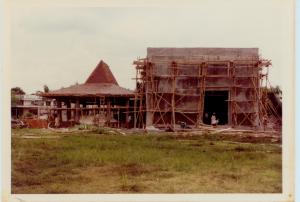

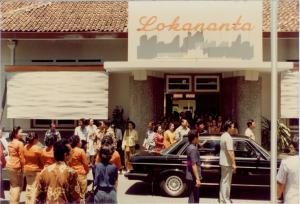
The company’s output during those golden years—basically the 60s-80s—is well documented in a discography compiled by ethnomusicologist Philip Yampolsky; I’m more interested in what has happened since then. By the 1990s, recorded music was neither mysterious nor scarce. Anyone with a tape deck could copy a cassette and pirated music was ubiquitous. Studios were downsizing and going digital, and Lokananta, with its large facility and staff, was struggling to remain viable even with government support. Then came the Asian Financial Crisis and the fall of the ‘New Order’ regime in 1998.
The Department of Information was liquidated during the political transition, meaning Lokananta lost all government funding. Most of the technical staff were shifted to the national radio broadcaster, RRI, while Lokananta shrank to a skeleton crew and for several years stopped almost all production. Employees who were there refer to this time as the “vacuum.” The piano was sold, microphones disappeared, and for a time the record storage shed was rented out for indoor soccer. Lokananta went silent.
With the loss of public support and the traditional music market in decline, Indonesia’s oldest record company needed new sources of revenue. Increasingly, that revenue has come from recording and duplicating albums by indie and underground artists, scenes that have actually blossomed in the aftermath of the repressive New Order regime.
Lokananta Riot
Just days before I arrived at Lokananta, a Balinese Rockabilly band called The Hydrant wrapped up a session there for their new album. The band’s very presence at the studio says a lot about Lokananta’s changing image in the Indonesian music world. When I later met with Adi, The Hydrant’s bass player, he told me that until this year he’d never heard of Lokananta. Even as a lover of vintage recordings, he had no idea that his country boasted an old wood-paneled studio that is reportedly modeled on the famous Abbey Road in London. When he heard about that room from a friend in Jogjakarta, Adi and his band realized it was the perfect place to record an album ‘live in the studio’ just like their idols from the 50s and 60s (some of those idols were even released on the Lokananta label). According to Adi, the studio manager at Lokananta told him that The Hydrant was the first “riot and roll band” to record there, so the album became “Lokananta Riot.”
This trend of young bands recording live at Lokananta got its start in 2012, when Indonesian R&B singer Glenn Fredly and the indie pop group White Shoes and the Couples Company both completed projects there. For these artists, recording in the company’s vintage studio served to emphasize their connection with Indonesia’s national music history, and also to draw attention to Lokananta’s important role in that history. In fact, the album that White Shoes recorded, Menyanyikan Lagu2 Daerah, was entirely based on the style of regional folk songs (lagu daerah) that Lokananta distributed in its early years.
But the big name acts that are drawn to Lokananta’s studio don’t necessarily manufacture their albums there, even though Lokananta was originally and primarily a record factory, not a studio. The 7” vinyl records of Menyanyikan Lagu2 Daerah, for example, had to be pressed overseas because Lokananta’s record fabricating machines—the country’s first—were sold for scrap metal in the 1980s. Cassette production, however, has not stopped, even if it is down from the days when the company could pump out tens of thousands of tapes a month. In those days, neighborhood kids would fly kites with the discarded magnetic tape. And like the recording end of business, Lokananta’s duplication services are now reaching a whole new clientele.
Rather than churn out playful kroncong tapes, today Lokananta acts as more of a boutique producer, specializing in small runs of indie releases by bands with names like Deluded, Homicide, and Working Class Symphony. These bands are not drawn to Lokananta so much by its history and legacy, but for very practical reasons that again can be traced back to the company’s near collapse in the early 2000s.
Many of the new cassettes produced at Lokananta pass through the hands of two local entrepreneurs: Rochmad Indrianto and Tamtomo Widhiandono. Indtrianto, who goes by Anto, is only 25. Over the whir of tape duplicators, he explained to me that unless you want them copied one by one on a home tape deck, Lokanata is the only place to do a short run of cassettes—as few as 20-50 copies. The quality is good, and because Lokananta is right there in Surakarta, the turnaround is fast and the prices low. When Anto and Tamtomo started working with Lokananta in 2014, the company’s only output was re-releases of old recordings. The two young entrepreneurs, and the cassette revival they were part of, could not have come at a better time. That year they placed several duplication orders for their label and online store Alpha Omega Merchandise, and also helped to organize a Record Store Day event at Lokananta with vendors, speakers, and live performances in the studio:

Once word got around the local scene, more tape orders started coming in. Lokananta was not easy to work with directly—it had no online order form or Instagram account—so Anto and Tamtomo became the middlemen. They told me that this year they are handling at least eight to ten orders a month. Thanks to that business, for the first time ever Lokananta now generates more than half of its revenue from tape duplication services. This turn of events feels appropriate in a way: the very independent music scene that both contributed to and benefited from the end of the New Order regime is now helping to prop up an institution left stranded by that government’s collapse.

The Sound of Indonesia
Many people and projects have claimed to capture the sound of a nation. No doubt Lokananta comes up as short as the rest. Yet, I’m struck by the way this one state-owned recording company and its meandering story do reflect so much of the tumult of Indonesia’s last sixty years. Lokananta has always been what the moment called for: a pressing plant for regional folk records, a studio for mass-produced gamelan recordings, an archive, and an indie cassette workshop. In each adaptation you can hear the political, cultural, and technological changes at work. You can sense the shifts in government censorship, which limited the import and reproduction of foreign sounds, and the sounds of critique and dissent that followed. You can see the shift from vinyl—which most Indonesians could only access via radio broadcasts—to the cassette, the medium that finally made recorded music readily available to the general public. And since Lokananta’s crisis at the turn of the millennium, you can hear the sounds of an industry in transition: a growing and uncensored independent music scene, and a renewed search for a national identity in the sounds and technologies of the past.
The ‘Sound of Indonesia’ that Lokananta offers in its current output must be understood as part of the institution’s response to crisis—brought on by both a changing music market and the sudden loss of government support. In this state, Lokananta’s sound cannot be curated by producers or culture ministers; it is dictated by necessity, and in that struggle to survive the company has had to open itself up in new ways. Looking through old photos in Lokananta’s archive, I saw a lot of official state pageantry and choreographed presentations—administrators in suits and workers with ID badges. Right now, however, Lokananta is a place where someone can walk in off the street with a home-recorded cassette and get it duplicated, where an up-and-coming band can book a recording session, where an avant-garde composer can put on a noise concert, or where a few motivated entrepreneurs can find a willing partner. It is a place of nostalgia but also experimentation and DIY networking—all of which are now publicly visible on the company’s facebook page.

Lokananta’s new director has plans to convert the main building into a museum and is already applying for national cultural heritage status. There is also talk of restoring and updating the studio equipment—no word on any new vinyl pressing machines. But whatever it becomes in the future, the present is clearly a special moment in Lokananta’s history. And while many of the company’s employees may consider this to be a rough patch in that history, when I see the words “The Sound of Indonesia” emblazoned on their uniforms, I can’t help but think that they are living up to that motto in ways that their predecessors in the New Order period would have never imagined. They are producing records and finding community partners that previously might have never made it through the company’s pastel-yellow entryway. The political transition, fiscal crisis, and recovery forced that change, and luckily for Lokananta, Indonesia’s burgeoning independent music scene has embraced it.
—
Ian Coss is a graduate student in Ethnomusicology at Boston University, where his work is focused on the uses of radio and recording technologies. Ian has released several albums of original music that draw on everything from gamelan to dub, and continues to perform around New England. He has also worked as a freelance radio producer for Afropop Worldwide and The World. Follow all his projects at iancoss.com.
—
All images are used with permission by the author.
—

REWIND! . . .If you liked this post, you may also dig:
That Infernal Racket: Sound, Anxiety, and the IBM Computer in AMC’s Mad Men — Andrew Salvati
Brasil Ao Vivo!: The Sonic Pleasures of Liveness in Brazilian Popular Culture — Kariann Goldschmitt
Sounding Out! Podcast Episode #6: Spaces of Listening / The Record Shop — Aaron Trammell
—
Share this:

“A Sinister Resonance”: Joseph Conrad’s Malay Ear and Auditory Cultural Studies

DOI: https://doi.org/10.59350/5txv7-8g743
Welcome to the first part of Sonic Shadows, a new SO! series featuring essays drawn from a recent symposium on the question “what does it mean to have a voice” held last April at The New School, and featuring organizers Dominic Pettman, Pooja Rangan and Julie Beth Napolin, as well as invitees Mara Mills (NYU), Gustavus Stadler (Haverford), Rey Chow (Duke), and James Steintrager (UC Irvine). I am happy to serve as Guest Editor, bringing some work developed for, during and after that event, beginning with my own article below.
Participants in “Sonic Shadows” focused on the voice’s shadowy or coded qualities as it stands on the border of the animal, human, and machine. Our motivating question was one shared by literary studies (authorship, the voice of writing, narration), technology studies (recording, storing, and transmitting voices), and media studies, particularly documentary studies (giving voice and objectivity). This question of having a voice, among the oldest questions of philosophy and literature, is also at the intersection of musicality, ontology, epistemology, phenomenology, psychoanalysis and history. Our discussions aimed to carve out a new trajectory for voice studies today, and in this series for Sounding Out! our authors will begin to lay out where that trajectory might lead.
— Guest Editor Julie Beth Napolin
—
As readers of this blog are well aware, historically, sound has been the “other” to more ensconced objects of music and voice. Brian Kane’s Sound Unseen has recently urged for an auditory cultural studies that might move us away from a reified category of sound: “Although it seems a truism to even say it, music studies is a species of sound studies and auditory culture” (226). By this same token, “voice” does not merely become “sound” at its limit, when words fray or dissolve, but rather begins that way. More importantly, auditory cultural studies would (and does) revolve around modes of listening, which are necessarily grounded in questions—and the always open question—of difference and the social. With that in mind, this article argues for the central role of the novel—and the voice in and of the novel—in an auditory cultural studies.
Poetry has enjoyed a longstanding dialogue around sonorousness, while the novel seems more immune to questions of the auditory. In “The Storyteller,” Walter Benjamin called the novel “the birthplace of the solitary individual,” meaning that writing and reading happen in silence, without a listening other. We don’t “listen” to the novel in the same way we might listen to poetry, which often demands that we read it aloud. But if the novel is, in its most basic sense, a combination of description and dialogue, then the human speaking voice—and how to represent it—is central to its definition, as well as how to represent sounds in the world. William Faulkner describes “the Chuck. Chuck. Chuck.” of an adze in As I Lay Dying, and novelists like Zora Neale Hurston wrote in an “eye-dialect” that would try to approximate for the eye the sounds of African American vernacular voice, as did Charles Dickens with English vernacular—each of these practices tell us about the unstable relationship between writing and listening. The novel has always been haunted by this gap, and it tells us important things about what we think it means to communicate across distance.
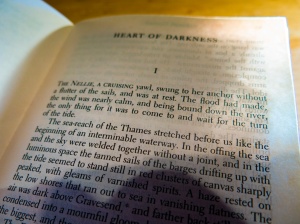
The modernist novel in particular is a fecund territory for modes of listening, and such works as Mark Goble’s Beautiful Circuits have shown to what extent auditory practices shaped by technology had conditioned writing practices and its imaginary in the long 20th century. But the question of “having a voice,” still lingers, even after Friedrich Kittler has shown to what extent the writer felt robbed of and haunted by voice in the wake of the invention of the gramophone in the late 19th century. Was the experience of voice in “modernity” only its disembodiment? And doesn’t the emphasis upon disembodiment obscure the place of the body in the signifying social practices of auditory culture? Is reading a wholly disembodied or silent experience?
In a recent essay on Joseph Conrad, I addressed these questions, pointing out that the history of the novel, as a “silent” genre, feels quite different if we begin with Conrad’s physical voice as mediated by his vexed relationship to the English language. He had spent his childhood in exile in Russia and his adult life as a merchant marine, steeped in colonial locations. Conrad would only ever write fiction in English, his third language after Polish and French, and he learned English by overhearing it aboard ships, never shedding a foreign accent he once described as “gibberish.” His sentiment in a letter to confidant, “l’ Anglais m’est toujours une langue etrangère,” registers a double displacement from a home in written and spoken language.
Conrad once wrote that the “power of sound has always been greater than the power of sense.” Often in his novels, characters hear when they cannot see, and “action,” is reduced to characters’ listening to distant sounds—like the drumming that comes from the jungle in Heart of Darkness. Dialogue is rarely a simple matter of transcribing words on the page. He tried to represent the fact that people often mishear each other or stutter and shout in the midst of noise—those representations changed what was possible for “dialogue” in the process. I’m reminded here of how in several of Jean Luc Godard’s films, viewers can’t hear what characters are saying because the noise in a café is too loud, or a train passes by at a crucial moment. These issues of communication in the novel are especially important for auditory cultural studies to ponder—the inner voice of writing and reading, the voice that is supposed to make the most immediate sense to a person, is suddenly hijacked by sounds.
Conrad would never speak English without a sense of shame, his own wife often couldn’t understand him, and his prose is marked by oddities that reveal thinking in one language while writing in another. In The Secret Agent, Steven G. Kellman briefly notes, Conrad writes the phrase “pulled up violently the venetian blind,” an error in word order that carries what Kellman calls “the traces of incomplete translingualism” (11). I’m also thinking of the unidiomatic word “moonshine” in the opening paragraphs of Heart of Darkness. Moments like this are important because they betray the extent to which Conrad was “passing” in his voice as an English writer.
Heart of Darkness is nothing if not a series of voices and sounds. It begins with an English merchant ship waiting for the turn of the tide and to dock in London. To pass the time, Marlow, a sailor aboard ship, tells an extended story of a previous journey along the Congo River (as reported by Marlow’s anonymous listener in the present). This story is rife with misheard voices and distant sounds. Chinua Achebe seminally attacked Conrad’s racism in his representation of African people as being without voice, as only making noise and speaking broken English. But this reading is complicated by Conrad’s own struggle with English. We have to hear “behind” or “through” his claim to speaking as an Englishman via the voice of Marlow. Conrad also crafted scenes were Englishmen have to confront being baffled by difference—they have to sit and listen, and confess they don’t understand the meanings of sounds.
The development of Marlow, Conrad’s recurring English avatar, was tied up in the desire for an idealized English voice. His relationship to English continually mediated his ambivalent feelings about the act of writing, his place in English literary society, and what it meant to speak—physically and symbolically—as a naturalized citizen. These ambivalences, I describe, all collide in the moment of Conrad’s first encounter with the x-ray and the phonograph in 1898 when he will discover that “all matter” is simply waves and vibrations. Though Conrad is most remembered for writing that the task of the novel is “to make you see”, auditory cultural studies would do well to remember that with Heart of Darkness, Conrad felt he had struck upon a novel with “a sinister resonance, a tonality of its own, a continued vibration that, I hoped, would hang in the air and dwell on the ear long after the last note had been struck.”

Heart of Darkness is preoccupied with what I call the “vibrational monad,” as a theory of the continuity of all things and actions. Vibration—as action at a distance—allowed Conrad to imagine the novel as a material force overcoming of national and linguistic difference. As a sound-effect that reached others without speech, vibration for Conrad dissolved the difficulties of embodied communication. The drumming of the Congo is one such resonance, but so are moments like “moonshine.” These resonances remain “sinister,” though, because communication is not absolute or guaranteed. Conrad also wanted his readers to experience an emotional pall of the horrors of colonialism, communicated best not in words or “sense” but by the way obscure sounds and nonsense linger and haunt the reader’s inner ear after putting down the novel.
In my essay, I do not distinguish greatly between vibration and resonance in their material differences. In Conrad’s imaginary these forces are intertwined, and that intertwining—in the nature of the literary in its turn of phrases—marks a place for literature in auditory cultural studies. It is difficult to distinguish these tropes in his writing partly because they pose an emotional and physical tie; both link body to body. Historically, electronic technologies of vibration involve a colonizing impulse to conquer space and time. But in Conrad, vibration remains uncertain and ambiguous in that it often reverses its course to become its opposite and separate bodies as a means of distance and difference.
In his early fictions, vibration and resonance register translingual fault lines, reminding us that Conrad’s acquisition of voice was an embodied process, an uneven and ongoing one. Conrad begins his first novel Almayer’s Folly with a vocal fragment, a shout in two languages, neither of them English. These two words would have appeared strange and completely unfamiliar to his readers in England: “Kaspar, makan!” As we only later learn, this unidentified shout to Kaspar Almayer, a Dutch trader, has been issued by his Sulu wife who calls him to dinner.

What does Conrad’s Malay voice mean for the definition of Anglophone modernism (from James Joyce to Jean Rhys) and what “other” voices and sounds define it from within? It is significant that Conrad’s 1895 romance does not begin with any description of characters or even the world. In this Victorian moment, a reader would expect fiction to begin with some sort of utterance in close proximity to authorial speech, as a voice-over (in the first or third person) that overlays the world of the novel. This voice tells us who we are about to meet and where, grants access. This shout is a puzzling beginning for a writer who would worry so much about reaching his readers. We—readers in English—don’t know what this voice is saying. No reader knows where this voice is coming from, who is shouting, and where. It won’t be translated for several pages, and then only indirectly. Again, Conrad hijacks the inner voice of reading to trouble English self-certainty.
That reminds me of the critique of voice-over and translation in the writings and films of Trinh T. Minh-ha, who often forces her viewers to confront languages they cannot understand and to sit with that non-understanding. Conrad gives up that authorial impulse; he drops its armature to become another voice—of a woman and colonized subject captured and brokered—as the opening gesture of his fiction. He speaks in her voice—rather than for her—and lets it take over what should be the first, authorial utterance. The shout carries an unspoken agony of colonization. She was, we later learn, kidnapped by Captain Lingard in the seizure of her village, and while he will call her “daughter,” she must endure his nightly visits, only to be passed to Almayer along with the failed promise of material wealth. His “folly” is inherent to the colonial rage for identity. This first authorial utterance is marred by the audible specter of sexual violence in colonialism.
What does this specter mean for the place of the novel in auditory cultural studies? Conrad destabilizes the white reader’s claim to “encountering” a world at a distance through the inner voice, a voice that is supposedly spontaneous, close and natural. The novel is also a technology of voices, but in this case, rather than bringing the other close, these vocal fragments mark an important place for distance. Conrad wrote Almayer’s Folly during his last journey as a merchant marine. Remarkably, one of few drafts of a letter home from that trip in Polish survives on a verso page of the manuscript. That material manuscript is too a space of difference—voices within voices, languages within languages, voices recorded but also obscured. The “sinister resonance” is one name for this founding disparity in the novel as an act of communication.
—
Julie Beth Napolin is Assistant Professor of Literary Studies at The New School, a musician, and radio producer. She received a PhD in Rhetoric from the University of California, Berkeley. Her work participates in the fields of sound studies, literary modernism and aesthetic philosophy, asking what practices and philosophies of listening can tell us about the novel as form. She served as Associate Editor of Digital Yoknapatawpha and is writing a book manuscript on listening, race, and memory in the works of Conrad, Du Bois, and Faulkner titled The Fact of Resonance. Her work has appeared in qui parle, Fifty Years After Faulkner (ed. Jay Watson and Ann Abadie), and Vibratory Modernism (ed. Shelley Trower and Anthony Enns).
—
Featured image: “Joseph Conrad” by Flickr user Phoca2004, CC BY-NC-ND 2.0
—

REWIND! . . .If you liked this post, you may also dig:
Hello, Americans: Orson Welles, Latin America, and the Sounds of the “Good Neighbor” — Tom McEnaney
This Is How You Listen: Reading Critically Junot Díaz’s Audiobook — Liana M. Silva
How Svengali Lost His Jewish Accent — Gayle Wald
—
Share this:




Current Top Posts





April 2021

January 2020

November 2019

October 2019

August 2019

April 2014

November 2017

March 2015

December 2017

October 2015


Recent Comments