Episode I: The Greatest Sound in the Galaxy: Sound and Star Wars
DOI: https://doi.org/10.59350/c7s43-n7429
Ever tried listening to a Star Wars movie without the sound? –IGN, 1999
Sound is 50 percent of the motion-picture experience. –George Lucas
In the radio dramatization of Return of the Jedi (1996), a hibernation sickness-blinded Han Solo can tell bounty hunter Boba Fett is in the same room with him just by smelling him. Later this month, Solo: A Star Wars Story (part of the Anthology films, and as you might expect from the title, a prequel to Han Solo’s first appearance in Star Wars: A New Hope) may be able to shed some light on how Han developed this particular skill.
Later in that dramatization, we have to presume Han is able to accurately shoot a blaster blind by hearing alone. Appropriately, then, sound is integral to Star Wars. For every iconic image in the franchise—from R2D2 to Chewbacca to Darth Vader to X-Wing and TIE-fighters to the Millennium Falcon and the light sabers—there is a correspondingly iconic sound. In musical terms, too, the franchise is exemplary. John Williams, Star Wars’ composer, won the most awards of his career for his Star Wars (1977) score, including an Oscar, a Golden Globe, a BAFTA, and three Grammys. Not to mention Star Wars’ equally iconic diegetic music, such as the Mos Eisley Cantina band (officially known as Figrin D’an and the Modal Nodes).
Without sound, there would be no Star Wars. How else could Charles Ross’ One Man Star Wars Trilogy function? In One Man Star Wars, Ross performs all the voices, music, and sound effects himself. He needs no quick costume changes; indeed, in his rapid-fire, verbatim treatment, it is sound (along with a few gestures) that he uses to distinguish between characters. His one-man show, in fact, echoes C-3PO’s performance of Star Wars to the Ewoks in Return of the Jedi, a story told in narration and sound effects far more than in any visuals. “Translate the words, tell the story,” says Luke in the radio dramatization of this scene. That is what sound does in Star Wars.
I believe that the general viewing public is aware on a subconscious level of Star Wars’ impressive sound achievements, even if this is not always articulated as such. As Rick Altman noted in 1992 in his four and a half film fallacies, the ontological fallacy of film—while not unchallenged—began life with André Bazin’s “The Ontology of the Photographic Image,” (1960) which argues that film cannot exist without image. Challenging such an argument not only elevates silent film but also the discipline of film sound generally, so often regarded as an afterthought. “In virtually all film schools,” Randy Thom wrote in 1999, “sound is taught as if it were simply a tedious and mystifying series of technical operations, a necessary evil on the way to doing the fun stuff.”
Film critic Pauline Kael wrote about Star Wars on original release in what Gianlucca Sergi terms a “harmful generalization” that its defining characteristic was its “loudness.” Loud sound does not necessarily equal good sound in the movies, which audiences themselves can sometimes confuse. “High fidelity recordings of gunshots and explosions, and well fabricated alien creature vocalizations” do not equal good sound design alone, as Thom has argued. On the contrary, Star Wars’ achievements, Sergi posited, married technological invention with overall sound concept and refined if not defined the work of sound technicians and sound-conscious directors.
The reason why Star Wars is so successful aurally is because its creator, George Lucas, was invested in sound holistically and cohesively, a commitment that has carried through nearly every iteration of the franchise, and because his original sound designer, Ben Burtt, understood there was an art as well as a science to highly original, aurally “sticky” sounds. Ontologically, then, Star Wars is a sound-based story, as reflected in the existence of the radio dramatizations (more on them later). This article traces the historical development of sound in not only the Star Wars films (four decades of them!) but also in other associated media, such as television and video games as well as examining aspects of Star Wars’ holistic sound design in detail.
A long time ago, in a galaxy far, far away . . .
As Chris Taylor points out, George Lucas “loved cool sounds and sweeping music and the babble of dialogue more than he cared for dialogue itself.” In 1974, Lucas was working on The Radioland Murders, a screwball comedy thriller set in the fictional 1930s radio station WKGL. Radio, indeed, had already made a strong impression on Lucas, such that legendary “Border blaster” DJ Wolfman Jack played an integral part in Lucas’ film American Graffiti (1973). As Marcus Hearn picks up the story, Lucas soon realized that The Radioland Murders were going nowhere (the film would eventually be made in 1994). Lucas then turned his sound-conscious sensibilities in a different direction, in “The Star Wars” project upon which he had been ruminating since his film school days at the University of Southern California. Retaining creative control, and a holistic interest in a defined soundworld, were two aspects Lucas insisted upon during the development of the project that would become Star Wars. Lucas had worked with his contemporary at USC, sound designer and recordist Walter Murch, on THX 1138 (1971) and American Graffiti, and Murch would go on to provide legendary sound work for The Conversation (1974), The Godfather Part II (1974), and Apocalypse Now (1979). Murch was unavailable for the new project, so Lucas then asked producer Gary Kurtz to visit USC to evaluate emerging talent.
Pursuing a Masters degree in Film Production at USC was Ben Burtt, whose BA was in physics. In Burtt, Lucas found a truly innovative approach to film sound which was the genesis of Star Wars’ sonic invention, providing, in Sergi’s words, “audiences with a new array of aural pleasures.” Sound is embodied in the narrative of Star Wars. Not only was Burtt innovative in his meticulous attention to “found sounds” (whereas sound composition for science fiction films has previously relied on electronic sounds), he applied his meticulousness in character terms. Burtt said that Lucas and Kurtz, “just gave me a Nagra recorder and I worked out of my apartment near USC for a year, just going out and collecting sound that might be useful.”

Inherent in this was Burtt’s relationship with sound, in the way he was able to construct a sound of an imaginary object from a visual reference, such as the light saber, described in Lucas’ script and also in concept illustrations by Ralph McQuarrie. “I could kind of hear the sound in my head of the lightsabers even though it was just a painting of a lightsaber,” he said. “I could really just sort of hear the sound maybe somewhere in my subconscious I had seen a lightsaber before.” Burtt also shared with Lucas a sonic memory of sound from the Golden Age of Radio: “I said, `All my life I’ve wanted to see, let alone work on, a film like this.’ I loved Flash Gordon and other serials, and westerns. I immediately saw the potential of what they wanted to do.”
But sir, nobody worries about upsetting a droid
Burtt has described the story of A New Hope as being told from the point of view of the droids (the robots). While Lucas was inspired by Kurosawa’s The Hidden Fortress (1958) to create the characters of droids R2-D2 (“Artoo”) and C-3PO (“Threepio”), the robots are patently non-human characters. Yet, it was essential to imbue them with personalities. There have been cinematic robots since Maria, but Burtt uniquely used sound to convey not only these two robots’ personalities, but many others as well. As Jeanne Cavelos argues, “Hearing plays a critical role in the functioning of both Threepio and Artoo. They must understand the orders of their human owners.” Previous robots had less personality in their voices; for example, Douglas Rain, the voice of HAL in 2001: A Space Odyssey, spoke each word crisply with pauses. Threepio is a communications expert, with a human-like voice, provided by British actor (and BBC Radio Drama Repertory Company graduate) Anthony Daniels. According to Hearn, Burtt felt Daniels should use his own voice, but Lucas was unsure, wanting an American used car salesman voice. Burtt prevailed, creating in Threepio, vocally, “a highly strung, rather neurotic character,” in Daniels’ words, “so I decided to speak in a higher register, at the top of the lungs.” (Indeed, in the Diné translation of Star Wars [see below], Threepio was voiced by a woman, Geri Hongeva-Camarillo, something that the audience seemed to find hilarious.)
Artoo was altogether a more challenging proposition. As Cavelos puts it, “Artoo, even without the ability to speak English, manages to convey a clear personality himself, and to express a range of emotions.” Artoo’s non-speech sounds still convey emotional content. We know when Artoo is frightened;
when he is curious and friendly;
and when he is being insulting.
(And although subtitled scenes of Artoo are amusing, they are not in the least necessary.) Artoo’s language was composed and performed by Burtt, derived from the communication of babies:
we started making little vocal sounds between each other to get a feeling for it. And it dawned on us that the sounds we were making were not actually so bad. Out of that discussion came the idea that the sounds a baby makes as it learns to walk would be a direction to go; a baby doesn’t form any words, but it can communicate with sounds.
The approach to Artoo’s aural communications became emblematic of all of the sounds made by machines in Star Wars, creating a non-verbal language, as Kris Jacobs calls it, the “exclusive province” of the Star Wars universe.
Powers of observation lie with the mind, Luke, not the eyes
According to Gianlucca Sergi, the film soundtrack is composed of sound effects, music, dialogue, and silence, all of which work together with great precision in Star Wars, to a highly memorable degree. Hayden Christensen, who played Anakin Skywalker in Attack of the Clones (2002) and Revenge of the Sith (2005), noted that when filming light saber battles with Ewan McGregor (Obi-Wan Kenobi), he could not resist vocally making the sound effects associated with these weapons.
This a good illustration of how iconic the sound effects of Star Wars have become. As Burtt noted above, he was stimulated by visuals to create the sound effects of the light sabers, though he was also inspired by the motor on a projector in the Department of Cinema at USC. As Todd Longwell pointed out in Variety, the projector hum was combined with a microphone passed in front of an old TV to create the sound. (It’s worth noting that the sounds of weapons were some of the first sound effects created in aural media, as in the case with Wallenstein, the first drama on German radio, in 1924, which featured clanging swords.)
If Burtt gave personality to robots through their aural communications, he created an innovative sound palette for far more than the light sabers in Star Wars. In modifying and layering found sounds to create sounds corresponding to every aspect of the film world—from laser blasts (the sound of a hammer on an antenna tower guy wire) to the Imperial Walkers from Empire Strikes Back (modifying the sound of a machinist’s punch press combined with the sounds of bicycle chains being dropped on concrete)—he worked as meticulously as a (visual) designer to establish cohesion and impact.
Sergi argues that the sound effects in Star Wars can give subtle clues about the objects with which they are associated. The sound of Imperial TIE fighters, which “roar” as they hurtle through space, was made from elephant bellows, and the deep and rumbling sound made by the Death Star is achieved through active use of sub-frequencies. Meanwhile, “the rebel X-wing and Y-wing fighters attacking the Death Star, though small, emit a wider range of frequencies, ranging from the high to the low (piloted as they are by men of different ages and experience).” One could argue that even here, Burtt has matched personality to machine. The varied sounds of the Millennium Falcon (jumping into hyperspace, hyperdrive malfunction), created by Burtt by processing sounds made by existing airplanes (along with some groaning water pipes and a dentist’s drill), give it, in the words of Sergi, a much more “grown-up” sound than Luke’s X-Wing fighter or Princess Leia’s ship, the Tantive IV. Given that, like its pilot Han Solo, the Falcon is weathered and experienced, and Luke and Leia are comparatively young and ingenuous, this sonic shorthand makes sense.
Millions of voices
Michel Chion argues that film has tended to be verbocentric, that is, that film soundtracks are produced around the assumption that dialogue, and indeed the sense of the dialogue rather than the sound, should be paramount and most easily heard by viewers. Star Wars contradicts this convention in many ways, beginning with the way it uses non-English communication forms, not only the droid languages discussed above but also its plethora of languages for various denizens of the galaxy. For example, Cavelos points out that Wookiees “have rather inexpressive faces yet reveal emotion through voice and body language.”
While the 1978 Star Wars Holiday Special may have many sins laid at its door, among them must surely be that the only Wookiee who actually sounds like a Wookiee is Chewbacca. His putative family sound more like tauntauns. Such a small detail can be quite jarring in a universe as sonically invested as Star Wars.
While many of the lines in Star Wars are eminently quotable, the vocal performances have perhaps received less attention than they deserve. As Starr A. Marcello notes, vocal performance can be extremely powerful, capitalizing on the “unique timbre and materiality that belong to a particular voice.” For example, while Lucas originally wanted Japanese actor Toshiro Mifune to play Obi-Wan, Alec Guinness’ patrician Standard English Neutral accent clearly became an important part of the character. For example, when (Scottish) actor Ewan McGregor was cast to play the younger version of Obi-Wan, he began voice lessons to reproduce Guinness’ voice. Ian McDiarmid (also Scottish), a primarily a Shakespearean stage actor, was cast as arch-enemy the Emperor in Return of the Jedi, presumably on the quality of his vocal performance, and as such has portrayed the character in everything from Revenge of the Sith to Angry Birds Star Wars II.
Sergi argues that Harrison Ford as Han Solo performs in a lower pitch but an unstable meter, a characterization explored in the radio dramatizations of A New Hope, Empire Strikes Back, and Return of the Jedi, when Perry King stands in for Ford. By contrast, Mark Hamill voices Luke in two of the radio dramatizations, refining and intensifying his film performances. Sergi argues that Hamill’s voice emphasizes youth: staccato, interrupting/interrupted, high pitch.
And affectionately parodied here:
I would add warmth of tone to this list, perhaps illustrated nowhere better than in Hamill’s performance in episode 1 – “A Wind to Shake the Stars” of the radio dramatization, which depicts much of Luke’s story that never made it onscreen, from Luke’s interaction with his friends in Beggar’s Canyon to a zany remark to a droid (“I know you don’t know, you maniac!”). It will come as no surprise to the listeners of the radio dramatization that Hamill would find acclaim in voice work (receiving multiple nominations and awards). In the cinematic version, Hamill’s performance is perhaps most gripping during the climactic scene in Empire Strikes Back when Darth Vader tells him:
According to Hamill, “what he was hearing from Vader that day were the words, ‘You don’t know the truth: Obi-Wan killed your father.’ Vader’s real dialogue would be recorded in postproduction under conditions easier to control.” More on that (and Vader) shortly.
It has been noted that Carrie Fisher (who was only nineteen when A New Hope was filmed) uses an accent that wavers between Standard North American and Standard Neutral English. Fisher has explained this as her emulating experienced British star of stage and screen Peter Cushing (playing Grand Moff Tarkin).
However, the accents of Star Wars have remained a contentious if little commented upon topic, with most (if not all) Imperial staff from A New Hope onwards speaking Standard Neutral English (see the exception, stormtroopers, further on). In production terms, naturally, this has a simple explanation. In story terms, however, fans have advanced theories regarding the galactic center of the universe, with an allegorical impetus in the form of the American Revolution. George Lucas, after all, is an American, so the heroic Rebels here have echoes with American colonists throwing off British rule in the 18th century, inspired in part because of their geographical remove from centers of Imperial rule like London. Therefore, goes this argument, in Star Wars, worlds like Coruscant are peopled by those speaking Standard Neutral English, while those in the Outer Rim (the majority of our heroes) speak varieties of Standard North American. Star Wars thus both advances and reinforces the stereotype that the Brits are evil.
It is perhaps appropriate, then, that James Earl Jones’ performance as Darth Vader has been noted for sounding more British than American, though Sergi emphasizes musicality rather than accent, the vocal quality over verbocentricity:
The end product is a fascinating mixture of two opposite aspects: an extremely captivating, operatic quality (especially the melodic meter with which he delivers the lines) and an evil and cold means of destruction (achieved mainly through echoing and distancing the voice).
It is worth noting that Lucas originally wanted Orson Welles, perhaps the most famous radio voice of all time, to portray Vader, yet feared that Welles would be too recognizable. That a different voice needed to emanate from behind Vader’s mask than the actor playing his body was evident from British bodybuilder David Prowse’s “thick West Country brogue.” The effect is parodied in the substitution of a Cockney accent from Snatch (2000) for Jones’ majestic tones:
A Newsweek review of Jones in the 1967 play A Great White Hope argued that Jones had honed his craft through “Fourteen years of good hard acting work, including more Shakespeare than most British actors attempt.” Sergi has characterized Jones’ voice as the most famous in Hollywood, in part because in addition to his prolific theatre back catalogue, Jones took bit parts and voiced commercials—“commercials can be very exciting,” he noted. The two competing forces combined to create a memorable performance, though as others have noted, Jones is the African-American voice to the white actors who portrayed Anakin Skywalker (Clive Revill and Hayden Christensen), one British, one American.
Brock Peters, also African American and known for his deep voice, played Vader in the radio dramatizations. Jennifer Stoever notes that in America, the sonic color line “historically contoured, identified, and marked mismatches between ‘sounding white’ and ‘looking black’” (231) whereas the Vader performances “sound black” and “look white.” Andrew Howe in his chapter “Star Wars in Black and White” notes the “tension between black outer visage and white interior identity [ . . ] Blackness is thus constructed as a mask of evil that can be both acquired and discarded.”
Like many of the most important aspects of Star Wars, Vader’s sonic presence is multi-layered, consisting in part of Jones’ voices manipulated by Burtt, as well as the sonic indicator of his presence: his mechanized breathing”
The concept for the sound of Darth Vader came about from the first film, and the script described him as some kind of a strange dark being who is in some kind of life support system. That he was breathing strange, that maybe you heard the sounds of mechanics or motors, he might be part robot, he might be part human, we really didn’t know. [ . . .] He was almost like some robot in some sense and he made so much noise that we had to sort of cut back on that concept.
On radio, a character cannot be said to exist unless we hear from him or her; whether listening to the radio dramatizations or watching Star Wars with our eyes closed, we can always sense the presence of Vader by the sound of his breathing. As Kevin L. Ferguson points out, “Is it accidental, then, that cinematic villains, troubling in their behaviour, are also often troubled in their breathing?” As Kris Jacobs notes, “Darth Vader’s mechanized breathing can’t be written down”—it exists purely in a sonic state.
Your eyes can deceive you; don’t trust them
Music is the final element of Sergi’s list of what makes up the soundtrack, and John Williams’ enduring musical score is the most obvious of Star Wars’ sonic elements. Unlike “classical era” Hollywood film composers like Max Steiner or Erich Korngold who, according to Kathryn Kalinak, “entered the studio ranks with a fair amount of prestige and its attendant power, Williams entered as a contract musician working with ‘the then giants of the film industry,’” moving into a “late-romantic idiom” that has come to characterize his work. This coincided with what Lucas envisioned for Star Wars, influenced as it was by 1930s radio serial culture.
Williams’ emotionally-pitched music has many elements that Kalinak argues link him with the classical score model: unity, the use of music in the creation of mood and character; the privileging of music in moments of spectacle, the way music and dialogue are carefully mixed. This effect is exemplified in the opening of A New Hope, the “Main Title” or, as Dr Lehman has it (see below), “Main/Luke A.” As Sergi notes, “the musical score does not simply fade out to allow the effects in; it is, rather literally, blasted away by an explosion (the only sound clearly indicated in the screenplay).”
As Kalinak points out, it was common in the era of Steiner and Korngold to score music for roughly three-quarters of a film, whereas by the 1970s, it was more likely to be one-quarter. “Empire runs 127 minutes, and Williams initially marked 117 minutes of it for musical accompaniment”; while he used three themes from A New Hope, “the vast majority of music in The Empire Strikes Back was scored specifically for the film.”
Perhaps Williams’ most effective technique is the use of leitmotifs, derived from the work of Richard Wagner, and more complex than a simple repetition of themes. Within leitmotifs, we hear the blending of denotative and connotative associations, as Matthew Bribitzer-Stull notes, “not just a musical labelling of people and things” but also, as Thomas S. Grey puts it, “a matter of musical memory, of recalling things dimly remembered and seeing what sense we can make of them in a new context.” Bribitzer-Stull also notes the complexity of Williams’ leitmotif use, given that tonal music is given for both protagonists and antagonists, resisting the then-cliché of using atonal music for antagonists. In Williams’ score, atonal music is used for accompanying exotic landscapes and fight or action scenes. As Jonathan Broxton explains,
That’s how it works. It’s how the films maintain musical consistency, it’s how characters’ musical identities are established, and it offers the composer an opportunity to create interesting contrapuntal variations on existing ideas, when they are placed in new situations, or face off against new opponents.
Within the leitmotifs, Williams provides various variations and disruptions, such as the harmonic corruption when “the melody remains largely the same, but its harmonization becomes dissonant.” One of the most haunting ways in which Williams alters and reworks his leitmotifs is what Bribitzer-Stull calls “change of texture.”
Frank Lehman of Harvard has examined Williams’ leitmotifs in detail, cataloguing them based on a variety of meticulous criteria. He has noted, for example, that some leitmotifs are used often, like “Rebel Fanfare” which has been used in Revenge of the Sith, A New Hope, The Empire Strikes Back, The Force Awakens, The Last Jedi, and Rogue One. Lehman particularly admires Williams’ skill and restraint, though, in reserving particular leitmotifs for very special occasions. For example, “Luke & Leia,” first heard in Return of the Jedi (both film and radio dramatization) and not again until The Last Jedi:
While Williams’ use of leitmotifs is successful and evocative, not all of Star Wars’ music consists of leitmotifs, as Lehman points out; single, memorable pieces of music not heard elsewhere are still startlingly effective.
In the upcoming Solo, John Williams will contribute a new leitmotif for Han Solo, while all other material will be written and adapted by John Powell. Williams has said in interview that “I don’t make a particular distinction between ‘high art’ and ‘low art.’ Music is there for everybody. It’s a river we can all put our cups into, and drink it, and be sustained by it.” The sounds of Star Wars have sustained it—and us—and perfectly illustrate George Lucas’ investment in the equal power of sound to vision in the cinematic experience. I, for one, am looking forward to what new sonic gems may be unleashed as the saga continues.
On the first week of June, Leslie McMurtry will return with Episode II, focusing on shifts in sound in the newer films and multi-media forms of Star Wars, including radio and cartoons–and, if we are lucky, her take on Solo!
—
Featured Image made here: Enjoy!
—
Leslie McMurtry has a PhD in English (radio drama) and an MA in Creative and Media Writing from Swansea University. Her work on audio drama has been published in The Journal of Popular Culture, The Journal of American Studies in Turkey, and Rádio-Leituras. Her radio drama The Mesmerist was produced by Camino Real Productions in 2010, and she writes about audio drama at It’s Great to Be a Radio Maniac.
—

REWIND!…If you liked this post, you may also dig:
The Magical Post-Horn: A Trip to the BBC Archive Centre in Perivale–Leslie McMurtry
Speaking American–Leslie McMurtry
Out of Sync: Gendered Location Sound Work in Bollywood–Priya Jaikumar
—
Share this:

Scenes of Subjection: Women’s Voices Narrating Black Death

DOI: https://doi.org/10.59350/w6s6n-xsc96
This past summer 2016, U.S. President Barack Obama arrived in Warsaw and delivered an unplanned statement on the brutal police shooting deaths of two black men that had just occurred within one day of each other, Philando Castile in Minnesota and Alton Sterling in Louisiana. Obama was speaking from afar on the structural relationship between two events that should trouble “all of us Americans.” Obama spoke pointedly to the fact of “racial disparity” in police shootings and in the justice system more broadly.
Since November 2016, it has felt as though a space of sanctioned public discourse—still in the making since Reconstruction—has once again become smaller and, in a manner of speaking, unhearing. Quite simply, Obama’s statement meant that identification could not compass the ground of an imagined community. A white listener could not say, as with gun violence in general, “he speaks of someone who could have been me, therefore I am troubled.” Again, identification with white experience asserts itself as the ground of “we.”
The death of Sterling had been captured on cellphone video that showed the police holding him down before shooting him. The video was taken by a store owner who was friendly with Sterling. The ground of a white viewer’s identification is here easily acceded. That viewer might say to him or herself, “I too could know someone who I don’t believe is violent or dangerous; I too might wish to protest or prevent his or her unjust murder.”
The shooting of Castile by police officer Jeronimo Yanez was not captured on video; there is no visual evidence of the event made by a bystander. Instead, Castile’s dying moments were captured on live video stream by his girlfriend, a black woman, Diamond Reynolds, who orally narrated the immediate aftermath of the event while it was happening. There was no rescue that could have been attempted by Reynolds. Even though Castile was alive and Reynolds’s daughter sat in the back seat, the effort immediately—and of necessity—turned to testimony. The camera—but also narration, putting into words the event that was still unfolding—afforded Reynolds and her daughter some measure of protection against the officer’s gun still aimed in the car. Reynolds no doubt imagined the recording would be used as evidence in a court of law. If she herself did not survive the event, the recording would have already been seen by a public and archived by live stream; her voice would still testify within it.
What does it mean, on an ethical level, for a black woman to narrate the spectacle of a black death? What does it mean for me, a white woman, to listen to that narrative or read a transcription, knowing that I will never be called upon to narrate the death of my loved one while it is happening, and then to write of it, to narrate it to you?
To feel emotionally impacted by an image of another person, Kaja Silverman argues, is to imaginatively project oneself into the visual field. This identification for Silverman can be fractured, multiplied and redirected in ways that richly expand the parameters of ethical life; but at base, one must be able to project oneself into the image.

In contrast, testimony is to assert that some juridical order has been perverted for an individual and to seek adjudication. But it is also to critique the boundaries of public life: it is to insist that to listen to or receive a narrative is to recognize an another who is not—and could never be—you. To recognize another is to affirm the singularity of the other’s life, a life that has been or can be lost or brutalized. Identification cannot be the sole ground of political action around unjust death: one must be able to say to oneself, “that was not me; that could not have been me; someone singular has been lost; I am troubled nonetheless.”
In Scenes of Subjection, Saidiya Hartman shows how 19th century white abolitionist sentiment was first organized by the spectacle of the black body in pain. White abolitionists often recounted the feeling of “what if that were me?” or “what if that were my family?” Hartman shows how the black body in American life takes on what she calls “fungible” form. If as a commodity, that body must be exchanged, then as spectacle, that body must also be a projective screen for identification where the white viewer emplaces him or herself in order to feel sympathy or outrage. Such sentiment, Hartman insists, is merely feeling for oneself.
Much of the recent discourse surrounding viral videos of black death has concerned looking or “not looking,” or what Alexandra Juhasz calls in a recent essay on her decision not to watch Reynolds’s video, “surfeit images.” But these are not simply images—they are narratives and testimonies. Later in this post, I return to what it means to speak of a “voices” in this context—some of them written and some of them mediated by retelling.
***

A long history of black women’s acts of testimony is occluded in the emphasis on the newness of the new media event and the “convergence” it affords. As Juhasz notes, new media scholar Henry Jenkins describes convergence as the spreading of media events across mediums and formats. Juhasz felt “compelled to join the fray of discourse that surrounds, reproduces and amplifies the video I have not yet seen.” She describes the sense of “knowing” the video without watching because of its convergence across platforms as well as its historical repetition. But convergence is, in the term long afforded by literary discourse, a narrative. Reynolds told the story in real time; one person may have watched the video, in full or in fragments, and told the story of the event in a status update, in conversation, or in a text message. The convergence relates Reynolds’s live stream to a long history of testimony, testifyin’(g), and unofficial or counter-history that has long been held by both oral and print culture across the black diaspora. It is how one “knows” in advance that Castile’s death is “like” so many others before him.
But this advance sense of “knowing” overleaps the singular voice that mediated the video of a singular death. To feel oneself to know in advance is to have internalized, but then occluded, the other. I say this because convergence is premised upon fungibility. Reynolds’s narrating voice is “like” many voices before hers; she occupies a place in a long historical field. At the same time, the singular always interrupts fungibility as an untenable ground of ethical life. Quite simply, the choice is as follows: you can avert your gaze and still participate in public outrage, but you’re missing something important if you don’t listen or attend to narrative, if you don’t amplify its particular domain.
When Reynolds narrated what was happening in the car at that moment—when that narrative is again repeated by people who watched or read of it, as I am now—an alternate and urgent relation is demanded by the narrating voice: neither projection nor identification, but recognition. In this post, I want to explore how this is the case. I will bring to the discussion my understanding of what has long been a concern in American literary studies, one that corresponds to the entry of black women into American literature and public discourse: testimony. Under what conditions have black women been called upon to testify and how does this kind of testimony get mediated?
***
On September 24, 2016, the New York Times released a cellphone video of the death of Keith Lamont Scott in Charlotte, North Carolina. Police shot Lamont outside of his car. The police claimed–and continue to claim–that he was holding a gun. Several videos from different vantage points have emerged since Lamont’s death. The presentation of videos mainly confirms a contemporary epistemic and ethical relationship to the visual, a new twist on an old sensory formation that continues to organize American social and political life. Repeatedly, people express a hope, or the belief, that some angle or some vantage correctly adjoined to another angle alone will answer the questions of “what happened?”
President Obama has called for more body cams for police, the underlying logic being that, if recorded, police brutality will become more preventable as it becomes more officially visible. However, the issue remains that the relationship to visual evidence always-already concerns the racist optic that organizes the black male body for a white gaze in advance as “threat.” Judith Butler, writing in 1993 of the Rodney King trial in the essay “Endangered/Endangering: Schematic Racism and White Paranoia” in the Reading Rodney King/Reading Urban Uprising anthology, reminds us that “The visual field is not neutral to the question of race; it is itself a racial formation, an episteme” (17).
This post does not focus on the urgent question of how white supremacy has historically marshaled the black male body within the racialized regime of the visible. Ta-Nehisi Coates and Jackie Wang are among those who have provided recent and pivotal accounts that orient me as I write.
Instead, I want to shift our contemporary conversation about white supremacy, racist policing, and black life and death by addressing the ethical place of black women’s voices as they narrate the spectacle of black death. The question is not, can black death be seen within a white optic? I think the answer is no, it cannot. Time and again, the amassment of images insists that no amount of video footage can or will change the optic. Race is no doubt a visible artifact.
Can hearing differently augment and change its regime?
Jennifer Stoever has recently asked after “the sonic color line” as a rejoinder to W.E.B. Du Bois’s 1903 insistence in The Souls of Black Folk that the “problem of the 20th century is the problem of the color line” (3). The problem of a line or threshold suggests the possibility of crossing and, with it, amalgamation. For Du Bois, the need and demand for crossing moves in one direction: the white consciousness should experience, not what it is to live as a black consciousness, but that her own consciousness, indeed very life, is inextricably bound to the other it repudiates. For Du Bois, this transformation–even in the act of writing—was intimately linked to song and narrative. Stoever reminds us that, though writing, he implored his reader to “hear” him.
As I sifted through the news in the weeks following Scott’s death, I kept returning to this question: what does it mean for the voices of black women to become politically audible and intelligible as narrators in a society that still insists on identification as the only ground for ethical life? At the same time, what does it mean for a black woman to become a voice for another, to survive a death and tell the story where another cannot?
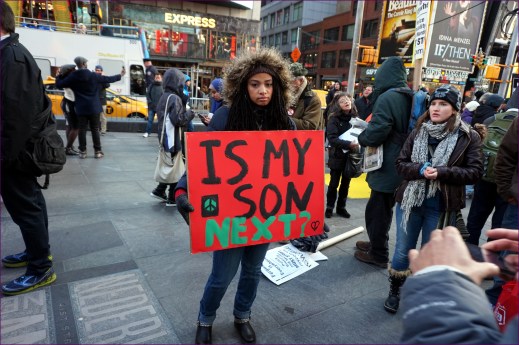
The majority of the police brutality that has received widespread public scrutiny is the visible violence against black males. As the #sayhername hashtag was meant to illustrate, black women are more invisible as subjects of racist violence. When Castile was bleeding out in silence, Reynolds took the camera and became his voice for him. The ground was suddenly shifted away from the visibility, toward audibility. I include within its matrix the significance of Sandra Bland who, using her phone’s video camera, orally narrated her own arrest in her own voice.
In the U.S., white supremacy has attempted to make black voices historically inaudible as historical agents: slaves (not being citizens) were not originally allowed to testify in court, and even after Emancipation, black litigants could not testify against whites in some states. The demand for extra-juridical testimony has remained constant since slavery and Emancipation and it was the first point of entry for black writers into American literature. But the task of testimony—and making it “heard” in a manner of speaking—has long fallen disproportionally on black women, but this task brings to black women, as I will describe, an important power and ethical charge.
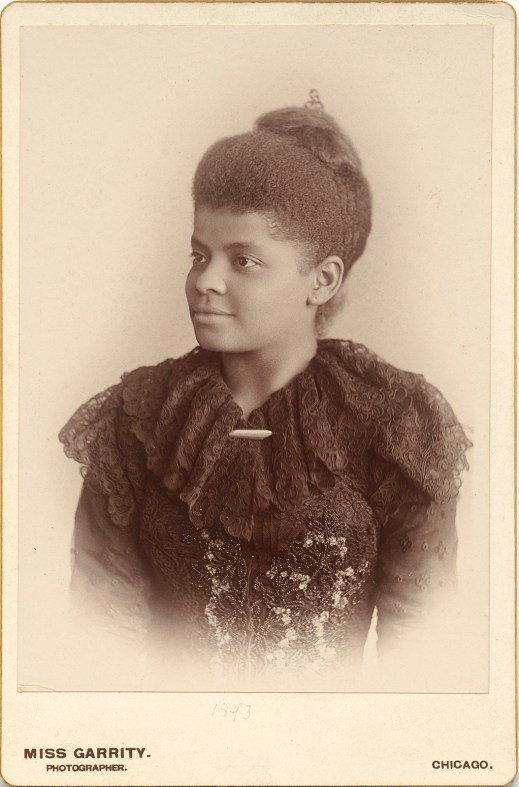
In 1895, Ida B. Wells wrote A Red Record: Tabulated Statistics and Alleged Causes of Lynching in the United States. The pamphlet provides statistics (the number of lynchings listed under year and purported crimes), but also narratives of specific events. In the Preface by Frederick Douglass, he writes, “I have spoken, but my word is feeble in comparison. You give us what you know and testify from actual knowledge.” She tells one story of a lynch mob coming to a house where a black man accused of a crime was being held while still with his family. As you read, I want to ask “where” Wells is as a speaker is and by what authority:
…that night, about 8 o’clock, a party of perhaps twelve or fifteen men, a number of whom were known to the guards, came to the house and told the Negro guards they would take care of the prisoners now, and for them to leave; as they did not obey at once they were persuaded to leave with words that did not admit of delay.
The woman began to cry and said, “You intend to kill us to get our money.” They told her to hush (she was heavy with child and had a child at her breast) as they intended to give her a nice present. The guards heard no more, but hastened to a Negro church near by and urged the preacher to go up and stop the mob. A few minutes after, the shooting began, perhaps about forty shots being fired. The white men then left rapidly and the Negroes went to the house. Hamp Biscoe and his wife were killed, the baby had a slight wound across the upper lip; the boy was still alive and lived until after midnight, talking rationally and telling who did the shooting.
He said when they came in and shot his father, he attempted to run out of doors and a young man shot him in the bowels and that he fell. He saw another man shoot his mother and a taller young man, whom he did not know, shoot his father. After they had killed them, the young man who had shot his mother pulled off her stockings and took $220 in currency that she had hid there. The men then came to the door where the boy was lying and one of them turned him over and put his pistol to his breast and shot him again. This is the story the dying boy told as near as I can get it.
Here, testimony is not to tell what happened to Wells herself, but to tell the story where the young boy cannot.
Is this narrative’s ethical stance premised upon identification and fungibility? No, I think not. But it is premised upon self-absencing. Using the strategies of direct discourse and shifts in narrative voice (or the subject of the verb’s mode of action), she absents herself as an “I” or first-person to mediate the story—until the very end: “This is the story the dying boy told as near as I can get to it.” Her written tactics are vivid, and a reader perhaps imagines a scene. But the culmination of the image insistently returns to a voice: the dying boy’s. It is only at the end of the synthetic narrative that she attributes the narrative to him as its witness. She writes in the third-person of an event she did not witness: she has allowed her voice to move around in space – from the site where the warrant was made, to the threshold of the family’s cabin door, on the other side of the door, to the anonymous spaces of rumor, then away from the scene to the church, and back.
I’m reminded of a recently audio performance, The Numbers Station [Red Record], where sound artists Mendi + Keith Obadike sonifed Wells’s statistics, using them as numbers to generate audio frequencies (some of the numbers being below 20 hz, the lowest threshold of human hearing).
In a measured and restrained, yet breathy and resonant tone of voice, Mendi Obadike reads the statistics as Keith Obadike generates and oscillates corresponding tones. It is a study in repetition, as is Wells’s pamphlet (racist crime, Douglass writes, “has power to reproduce itself”). And yet, both the pamphlet and the Obadikes’ performance are a study in the singular: one female voice carries each of the numbers in their signification.
Numbers Station is depleted or exhausted narrative space that asks that no images be conjured. The vocal style is impersonal, to be sure—the performer does not passionately react to the numbers. And yet, it is style that moves the voice into that region of the throat where Roland Barthes found the “grain,” where timbre most resonates. It burrows in the human capacity for timbre as the singularity of every voice that says, “here I am.”
When Roland Barthes asked the famous question, “who speaks?” in “The Death of the Author,” he delighted in the impersonal domain of the literary, wherein writing becomes “an oblique space” no longer tied to the physical voice of the body writing. We can say that a physical guarantee of white life, its freedom of continuation underwrites the death of the author. In other words, one can die into text, relinquish the tie that binds the first-person to the body writing, and survive those deaths. It was not important for Barthes to ask, “who may die?,” as in who might have the freedom of impersonality, and “who hears?”, as in who has the right to determine the meaning of the utterances. I want to address these questions.
***
Video technology means that one can record sound and image simultaneously–video having built in mics–yet cell technology makes video, as sound and image, even more accessible and disseminable. Often, the voices of those holding the cell phone at a distance are also captured, remarking upon what they are witnessing or trying to cognize, or they are simply breathing; these voices become a part of the narrative scene. Cell phone technology enables a new mode of witnessing, one connected to older antecedent technologies: the written word as a form of “voice” for black writers. Yet, there is something even more importantly material that gets lost when one focuses on the image of brutality rather than the narrative agency that can be harnessed by the act of recording. In the case of Reynolds’s video, this narrating is explicit. She puts into words what she is seeing. But this narrating can also be more implicit.
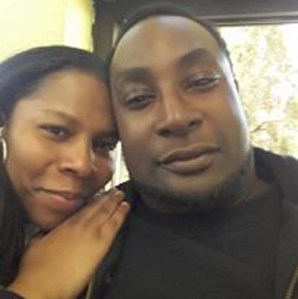
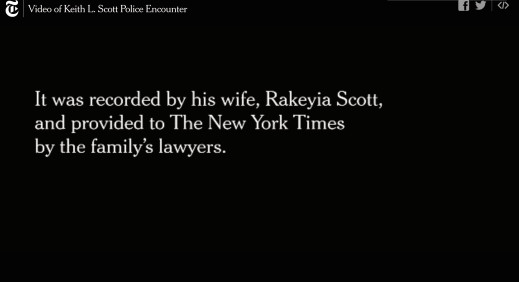
The video released by the New York Times of the police shooting of Keith Lamont Scott included the subtitle, as an introductory slide, that “It was recorded by his wife, Rakeyia Scott.” I pressed pause and, like Juhasz, felt myself unable to watch, stopped in my tracks by this matter-of-fact annotation. Scott had had to videotape the murder of her husband. It took some time before I could return to the video itself, but immediately my thoughts return to Reynolds—again, a black woman had been thrust into the position of narrating black death at the hands of a white police officer, while it was unfolding. But I want to insist that the fungible quality is ethically augmented by narrating itself.
In what follows, New York Times reporters Richard Fausset and Yamiche Alcindor transcribe Scott’s audio and summarize the visuals of the video rather than calling upon readers to view or re-view the video itself. I am choosing to provide the summary report—a narrative—in order to underscore the types of social and sensory positions that get taken up when one tells a story (in this case, it is a narrative of a narrative, since Rakeyia Scott is already positioned in the video as its participant-narrator). This account is not “what happened”—it is a narrative that tries to synthesize audio-visual information into a narrative form. If I also choose to repeat the narrative, rather than the video, it is in alignment with Hartman’s ethical insistence that to repeat the spectacle of death is to reify it, as when she choose not to quote Douglass’ narrative of witnessing the beating of his Aunt Hester in the introduction to Scenes of Subjection. Fred Moten, in In the Break, rightly suggests in response that to turn away from an image is still to be caught up in its imaginary reproduction.
I want the reader to focus on how the Times’s narrative conjures the scene while also involving certain decisions about what sensory data to include as internal to the logical order of events, harnessing adjectives, adverbs, and certain sensorial details. It is one platform of convergence:
Immediately, Ms. Scott said, “Don’t shoot him,” and began walking closer to the officers and Mr. Scott’s vehicle. “Don’t shoot him. He has no weapon. He has no weapon. Don’t shoot him.”
An officer can then be heard yelling: “Gun. Gun. Drop the gun.” A police S.U.V. with lights flashing arrived, partly obscuring Ms. Scott’s view, and a uniformed officer got out. From that point, there are five officers, most of whom appeared to be wearing body armor over plain clothes, around Mr. Scott.
“Don’t shoot him, don’t shoot him,” Ms. Scott pleaded, her voice becoming louder and more anxious. “He didn’t do anything.”
Officers continued to yell “drop the gun” or some variation of it — at least 12 times in 38 seconds.
“He doesn’t have a gun,” Ms. Scott said. “He has a T.B.I.” — an abbreviation for a traumatic brain injury the lawyers said Mr. Scott sustained in a motorcycle accident in November. “He’s not going to do anything to you guys. He just took his medicine.”
“Drop the gun,” an officer screamed again as Ms. Scott tried to explain her husband’s condition. The officer then said he needed to get a baton.
“Keith don’t let them break the windows. Come on out the car,” Ms. Scott said, as the video showed an officer approaching Mr. Scott’s vehicle.
“Drop the gun,” an officer shouted again.
Ms. Scott yelled several times for her husband to “get out the car,” but on the video, he cannot be seen through the window of the S.U.V.

The above summary reproduces on the page how Scott’s speaking voice suddenly thrust her into a position of addressing several auditors. In listening to the video, I can hear that she modifies her tone of voice to communicate to each addressee, speaking alternately in an imitate imploring tone to her husband and with sharper emphasis to the police. The tone of voice is also linguistic—the diction changes as the addressee changes (“Come on out the car” is so intimate and familiar to my ear somehow, a private grammar and tone suddenly thrown into the public space). She calls the police, “you guys,” which strikes me as an attempt to tone them down, as it were, to bring them back into a human sphere from which they’d removed themselves. “Ms. Scott tried to explain her husband’s condition”—I add this emphasis, because I think the journalist is channeling here the ways in which Rakeyia Scott is not being heard.
In narrating the scene of her husband’s death, Rakeyia Scott becomes the absolute tie between that past of the image and the present of watching; I use the present tense, because it happens again, with each telling. Scott speaks, more silently and spectrally, to the audiences that will later watch and listen to the video she is recording, or read the transcript as synthesized by journalists or other viewers. In holding the camera, she imputes to herself a third voice as narrator, as did Wells in narrating the scene in A Red Record. This third voice, I am suggesting, is inaudible. It hovers next to her words with new force because, in the act of recording itself, she is testifying, offering a synthetic view as to reality. She creates a hearing space even though it is being foreclosed around her.
She is the only party in the scene who speaks to all addressees at once: her husband, the police, and “us.” The police do not respond to her directly, as if she not there. Indeed, she is standing somewhere outside of the scene as would a narrator. Because Rakeyia Scott holds a camera–outside of the frame–while also speaking, something of testimony gets activated. She has one foot outside of the event in the future after the video. She courageously separates herself from what is unfolding in order to constitute a narrative of the event; she mediates the scene. She not only puts into words facts that are not visible to the police, she issues pleas, commands, and words that carry the explanatory force of narrative, but also testimonial force because she holds the recording device.
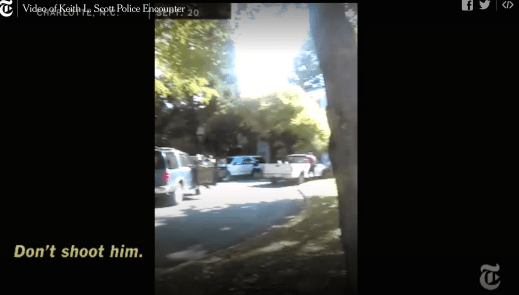
By holding a camera, Scott directs her words not only to police, but toward a yet-to-be constituted audience. The recording device also activates the presence of a juridical gaze. She anticipates having to bring this event, not yet fully unfolded, before a court of law. But at the same time, her use of the recording device reveals the juridical sensorium as white. The device’s presence indicates that, were Scott to remember and tell the story later in a court of law, her words on their own would not be enough to guarantee their explanatory power. The spectacle of black death cannot, on its own, announce its own truth within a racist optic. She says what the police (and a spectral jurist) refuse to see. She is forced to narrate because her voice is negated by the police, but also for those unknown viewers who will see this later.

There is hope, no doubt, that sometime after this scene has come to end, the video will find a place in the civic as a force of enacting law and justice, and above all, change.
At the turn of the last century, Du Bois wrote of “double consciousness” in The Souls of Black Folk, or the split incumbent upon black American consciousness to see oneself and then, to see oneself as the other sees you, “measuring one’s soul by the tape of a world that looks on in amused contempt and pity.” However, in narrating her husband’s death at the hands of American police in 2016, Rakeyia Scott was split in ways that are not fully compassed by double consciousness. This split into three (or more) not only marks the mediating place of black women in the spectacle of black death, but marks another ethical horizon where at issue is not only seeing differently, but hearing differently. As I’ve tried to describe, these ways of hearing are not an identification with (like me), but a recognition of (you are singular).
This is not yet to speak to the collapse of Scott’s voice after her husband’s murder. Continually occupying this position of testifying, Scott bravely maintains her hold on the camera, even when it means capturing her own screams when Charlotte police begin to shoot. She is both forms. Even then, in screaming, her voice retains its narrative power. Horrifyingly, she cannot change the sequence of events. But her voice continues to exist in belated relation to the scene and to the political afterlife of the murder as image.
With the digital, it becomes possible to reduce the space and time of testimony. With Reynolds, many watched on Facebook Live an event they were powerless to change in its unfolding. With Scott, the police gun shots had not yet taken place. I think the question is, were Rakeyia Scott white, would her words have been pro-active testimony of a not-yet determined event? Her words would have been lent a different power, a power to change events in their unfolding. In America, white testimony and black testimony bear fundamentally different ontological weight.
In repeatedly trying to answer the question whose recurrence haunts me–What does it mean for Scott to have narrated the murder and death of her loved one as it was taking place?–I am thrust up against the sense that we are in a new ethical moment and relation to history when it becomes possible—and necessary—for black women to narrate death to an unknown public as it is unfolding. This includes the moments before their own deaths, such as Korryn Gaines, who was killed by the Baltimore County Police Department in August 2016, in her own apartment while holding her five year old son, who watched and himself suffered a gunshot wound. Like Reynolds, she broadcast her recordings via Facebook live.
Testimony is usually reserved for some time after the scene, and its hallmark is that it is belated. It must reconstitute a scene we can no longer see. The burden is on the narrating voice to conjure, with persuasion and conviction, the truth of the missing image, so that the story can in fact stand in place of the scene, merging with it on an ontological level. The live streamed video fundamentally reduces that distance in time, where the narrative now overlays the image, not from outside of it, but within it. They refuse the false juridical narratives that will, in the future, attempt to reframe the image in the name of “fact.”
In the differentiation of the senses, there is the order of the visible and the order of narrating voice that accompanies the image to give it sense, to retell its meaning somehow after. Scott insists on being there to narrate. That is not to suggest that somehow, because Scott speaks, she is more “present.” While the video is meant as future evidence, it also lends a voice of recognition in this ethical sense I have been trying to describe. Scott’s voice is split by the camera. Even if she herself were not to have survived the event, in narrating and taping, she becomes the medium for history (the persistent and unchanging fact of unjust black death). And yet, she is the vehicle for this death that matters in its singularity. She speaks as both, as history and particularity.
In watching and listening, I finally understand something of Hannah Arendt’s argument in The Human Condition that speech and action form a fundamental unit. For Arendt, great deeds cannot happen in silence: they must be narrated and accompanied by speech. And yet the scenes Arendt describes couldn’t be more different. This raises the issue of the conditions of narration: it is one thing to be speaking to your fellow citizens in a sanctioned forum. It is another to hold a camera as an officer holds a gun that might very well shoot you too.
What I’d like to preserve about Arendt’s analytic is the union of speech and action. It is related to the role of the right to speak in the ancient polis, where one had to take responsibility for the possibility that one’s speech might lead to the deeds of the community. But speech, for Arendt, is the function of action that makes it for others, that commits that action to the memories of others who can narrate it. In Arendt’s view, the story does not end there. The fact is, one might not survive one’s greatest deed. If one does survive, it would be in highly transformed terms. It is for others to tell the story.
In part, the ethical bond means our lives are in each other’s hands, that the other is responsible for narrating where you cannot. We are always-already ethically bound as “witnesses and participants,” as Frederick Douglass once described himself in his 1851 Narrative. He remembers himself as a six year old child not only watching, but listening to the scene of brutality against his Aunt Hester that he later recalls and transmutes into a narrative.
My hope is that this power of narrative is in the midst of opening another political horizon. It refutes identification as the untenable ground of ethics and action. We must act—or hold on to a sense of acting, even if its meaning and parameters remain unclear. As I reach the end of this essay, I can’t shake the sense that that it is not enough to have provided an analytic for understanding these videos and their voices in their long resonance with history. Nor does it feel right to say that these videos “do” something for us– they, and their narrators, demand that we do something for them. This mode of action begins in the attitude of hearing. Hearing testimony, Jill Stauffer describes in Ethical Loneliness: The Injustice of Not Being Heard, means allowing the unchangeable past to resound in the present. Only then can one “author conditions where repair is possible” (4).
It might be, then, that hearing itself is a mode of action, even if that action be much delayed. Hearing becomes action when formal power structures have denied its event as a source of repair. As listeners to the present and the past, we are neither projecting ourselves in the images nor imagining ourselves uninvolved in their scenes of subjection. We were all already there. And yet, to be “there” means to allow oneself to be exposed to another’s singular experience, rather than favor a collectively conditioned idea of what is known in advance. Who and where will we be afterward, is what remains. These videos and their not-yet determined afterlives become louder than the optic, if not in the word than in the sounds.
—
I’d like to thank Jennifer Stoever, Erica Levin, Jay Bernstein, and Ben Williams for their thoughtful voices and contributions that resound throughout this essay.
—
Julie Beth Napolin is Assistant Professor of Literary Studies at The New School, a musician, and radio producer. She received a PhD in Rhetoric from the University of California, Berkeley. Her work participates in the fields of sound studies, literary modernism and aesthetic philosophy, asking what practices and philosophies of listening can tell us about the novel as form. She served as Associate Editor of Digital Yoknapatawpha and is writing a book manuscript on listening, race, and memory in the works of Conrad, Du Bois, and Faulkner titled The Fact of Resonance. Her work has appeared in qui parle, Fifty Years After Faulkner (ed. Jay Watson and Ann Abadie), and Vibratory Modernism (ed. Shelley Trower and Anthony Enns).
—

REWIND! . . .If you liked this post, you may also dig:
“A Sinister Resonance”: Joseph Conrad’s Malay Ear and Auditory Cultural Studies–Julie Beth Napolin
SANDRA BLAND: #SayHerName Loud or Not at All–Regina Bradley
On Whiteness and Sound Studies–Gus Stadler
Spaces of Sounds: The Peoples of the African Diaspora and Protest in the United States–Vanessa K. Valdés
—
Share this:




Current Top Posts


April 2021
January 2020

November 2019

October 2019

August 2019

April 2014

November 2017
March 2015
December 2017

October 2015


Recent Comments