
Animal Renderings: The Library of Natural Sounds

 Today we bring you the latest post in SO!’s spring series, Live from the SHC, which follows the new research from the 2011-2012 Fellows of Cornell’s Society for the Humanities, who have gathered in the A.D. White House to study “Sound: Culture, Theory, Practice, Politics.” For the full series, click here. Today poet, scholar, and ecocritic Jonathan Skinner brings us all a treat for spring, so throw open your windows and take a deep listen. –Editor in Chief, JSA
—
This planet is singing 24/7 but are we listening to it? Take out your earbuds, turn down the music and the air conditioning, walk away from the fridge, shut off your engine, open the windows, and tell me what you hear. If you are in the humid parts of the temperate regions, chances are you’ll hear right now, amidst the myriad human sounds, and depending on the time of day, the spring peepers going, the woodcocks peenting and displaying, a grouse drumming, the whistling of cardinals and robins, chickadees countersinging, blackbirds trilling, cawing of crows, blue jays scolding, honking of geese, hooting of an owl or two, woodpeckers drumming, house sparrows chirping (in this case, to a Satie carillon), perhaps some coyotes yapping it up after midnight. Not to speak of wind in branches and leaves, water, thunder and lightning. These are just some of sounds I can pick up, with a bit of careful listening, in and around the relatively urban environment of Ithaca, New York. If you put your ear to the grass, you might hear this astonishing Treehopper communication.
Or maybe you heard these sounds in some music you were listening to, in a movie soundtrack or videogame? Just as we pervade their worlds, animals pervade our environments, and their sounds are used to “render” these environments within the relatively flat dimensions of our media—the way three dimensions of spatial information get “crunched” to the two dimensions of a video game’s display (see 4:00 – 5:20 for a demonstration of Aiden Fry’s “generative birdsong” program below, developed through the analysis and sampling of birdsong as a solution to repetitive sound effects that can diminish the immersive quality of the game). Even the most sophisticated “surround sound” audio must “render” figuratively the environed experience of hearing.
.
The next time you watch a movie, listen to some “ambient” music or play a videogame that renders an outdoors environment, imagine subtracting the animal sounds (either literal or evoked) from these media scapes and consider how incompletely rendered the experience would be. A reversal of the effect, as in Gus Van Sant’s use of Hildegard Westerkamp’s “Beneath the Forest Floor” soundscape, to track and underscore the anomie of certain characters through Elephant, his thinly veiled recreation of the Columbine High School tragedy, also proves the rule (note especially the soundtrack from 3:10 – 3:40).
.
Greg Budney and Mike Webster explain their dedication to compiling the world’s largest and best quality archive of animal recordings (now in video as well as audio), the Macaulay Library of Natural Sounds at Cornell University, as a responsibility to future acoustic biologists, who may bring tools and concepts to the data we have not remotely conceived. Their mission is first and foremost a scientific one. However, conservation is also high on their list: Budney, an expert recordist, points out how high quality recordings—as of lekking Greater Prairie-Chickens—can be played back into the environment, to promote nesting of endangered populations.

Cornell's Bioacousticians Performing FIeld Recording for the Macaulay Library of Natural Sounds
These bioacousticians agree that high quality sound recordings can be a powerful way to interest laypeople in the sounds of the robin in their backyard, and, by extension, in broader issues of conservation. Sounds in the Macaulay Library also are available to the entertainment industry, so that, indeed, myriad animal vocalizations contribute to the renderings of its various media. Licensing fees in turn contribute to the conservation mission of the Library.
Rendering is not so much a matter of reproduction—accurately representing a “real” environment—as of recreating, through a consistency that “completes” the aesthetic experience, the feelings associated with an environment. (Think of the difference in quality between the “finished” HD, surround-sound movie and the behind-the-scenes “special features” on a DVD.) In Audio-Vision: Sound on Screen, media theorist Michel Chion identifies an important feature of rendering in “materializing sound indices,” noises that help render, in sound and image, a particular “clump of sensations” (112-116).
For instance, spatial depth, in outdoor scenes, is often rendered through the presence of bird song or dogs barking, etc. Or consider the cooing of pigeons that often accompanies the opening of a garret window in a movie set in Paris. Or that ubiquitous red-tailed hawk’s cry indexing a “wild” landscape. The absence or thinness of these indices can be just as helpful to rendering, as when the landscape includes “ethereal, abstract, and fluid” entities: “out of touch” characters in Jacques Tati films or the drawn characters in Who Framed Roger Rabbit, where hollow, lightweight, plastic sounds help us believe that we are indeed seeing (or, as Chion reminds us, “hear-seeing”) cartoon characters (watch from 1:19 – 1:33 for the famous “clang” the drawn Jessica Rabbit makes as she collides with the live action Eddie Valiant).
.
Cormac McCarthy’s The Road, both the book and the film version, deploy effectively the total absence of animal sounds to convey the uncanny complex of feelings bound up in environmental apocalypse—the “silent spring” invoked by Rachel Carson a half century ago in her indictment of the toxic legacy of the chemical industry.
In his study of environmental aesthetics, Ecology Without Nature, ecocritic Timothy Morton faults rendering for perpetuating an “ecomimetic illusion of immediacy,” an “ambient” art that ultimately comes in between us and the life it is supposed to bring us close to (36). Rendering lures us into the “relaxing ambient sounds of ecomimesis,” precisely when we need to hear “the screeching of the emergency brake” (as Morton puts it: “whistling in the dark, insisting that we’re part of Gaia” 187, 196). However, Chion notes that “the disjunctive and autonomist impulse [à la Godard] that predominates in intellectual discourse on the question (‘wouldn’t it be better if sound and image were independent?’) arises entirely from a unitary illusion” that there is “a true unity existing elsewhere” (Audio-Vision 97-98). Such unity is in fact elusive: for instance, it can be difficult to identify the sources of sounds in “nature” (consider the bewildering variety of blue jay calls), while the notion that a sound can on its own invoke more abstract characteristics of its source, especially when it is produced by a nonhuman species, betrays a kind of magical thinking. (Forms of non-western magical thinking actually acknowledge the disjunctive quality of natural sounds by referring, for instance, to “voices in the forest.”) Also, sound is so context dependent, and our listening is so strongly influenced by the conventions of our media, that “sound in itself”can be a very slippery object. Chion notes that we need something like an “auditory analogy of the visual camera obscura” —i.e. the monitoring and recording of soundscapes—to help us listen to “sounds for themselves and to focus on their acoustical qualities” (108).
In a time of mass extinction, how are we to approach the rendering of animal sounds in our mediated environments? Do these sounds have agency? Does listening to and “capturing” animal sounds bring us closer to them, or only lure us, with an illusion of immersion and unity, away from realizing the dark nature of our ecology, and the urgent reforms needed, if we are actually to help animals (does our rendering and consumption of whale song—pace what Songs of the Humpback Whale has done for whale conservation—end up perpetuating the same extractive process that “renders” whale blubber)?
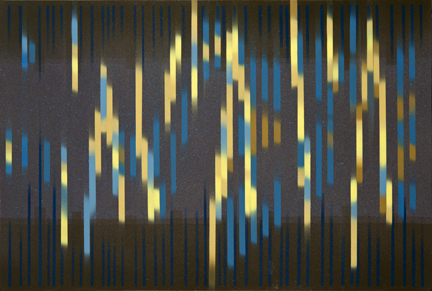
Connecticut Warbler by Carol Hanna, Songs of the Birds
I would say that, so long as we approach these sounds neither as a substitute for, nor as an experience “less than,” the daily practice of listening to our environments, a resource like the Macaulay Library can add immeasurably to our awareness of the diversity, and the vulnerability, of life on Earth. (Another resource worth exploring is the British Library’s Environment & nature sounds archive, especially the collection of early wildlife recordings.) Careful attention to renderings of animal sounds in our media can make us aware of the extent to which we “render” the landscape around us, through selective habits of listening, and open us to the disjunctive, noisy, reverberant, distorted sounds such renderings obscure. (R. Murray Schafer made this point long ago, in his book The Soundscape urging us to listen to noise if we want to defeat it.) Clips posted here, of media using birdsong to render scenes of human violence, state the complexity of our pastoral aesthetics in an exaggerated way, but every day our listening has access to a range of sonic collisions.
Consider the famous recordings of nightingales in Beatrice Harrison’s backyard, to the accompaniment of her cello, as well as to RAF bombers—on Minnesota Public Radio’s Music & Nature. Part of what we will hear when we listen with open ears is our own domination of the soundscape, one that can have concrete implications for the survival of other species (Chris Clark, head of Bioacoustics Research at Cornell, has imaged the way the noise of shipping lanes impacts the acoustic habitat of endangered Right Whales.) How might the infrasonic or ultrasonic vocal communications—of blue whales, elephants, mice and bats, for instance—that operate beyond the range of the naked human ear (but not of our instruments) impact our media environments? The “materializing sound indices” of recordings can be used to return us to the embodied, imperfect natures of these other beings, whose vulnerability, philosopher Jacques Derrida suggests in The Animal That Therefore I Am, it is our own nature to follow.

A Gaggle of Grackles by Flickr User Dan Machold
The more we listen to the environment acousmatically, the better critics we become of our media environments’ often crassly commercial renderings. Many of these sounds (see also some of the recordings collected on the Earth Ear label’s Dreams of Gaia) are simply beautiful, or astonishing—conveying an aesthetic dimension alluded to in veteran nature recordist Bernie Krause’s new book, The Great Animal Orchestra: Finding the Origins of Music in the World’s Wild Places. (My concern with a focus on the exotic is that privileging “wild places” might have the effect of devaluing the “not wild,” i.e. where most people live—places nonetheless full of wild creatures—and where we might best develop our listening.) Finally, the more we find ways to render these sounds meaningfully in our own lives, outside patterns of consumption, the better chances are we’ll begin to develop (politically, ethically) meaningful relationships with these other species, species with whom we must collaborate if we want to tend the web of life that so desperately needs our care.
**Featured Image Credit: Digital Collage Bird Art by Flickr User Peregrine Blue
—
Jonathan Skinner founded and edits the journal ecopoetics, which features creative-critical intersections between writing and ecology. Skinner also writes ecocriticism on contemporary poetry and poetics: he has published essays on the poets Mei-mei Berssenbrugge, Ronald Johnson, Bernadette Mayer, Lorine Niedecker, and Charles Olson; on Poetries of the Third Landscape, Documentary Poetics, and Poetry Animals; and an ethnographic study of the Tohono O’odham Mockingbird Speech. Skinner’s poetry collections include Birds of Tifft (BlazeVox, 2011), Warblers (Albion Books, 2010), With Naked Foot (Little Scratch Pad Press, 2009), and Political Cactus Poems (Palm Press, 2005). Skinner’s latest creative project is a book on the urban landscape designs of Frederick Law Olmsted.
Share this:

Quiet on the Set? : The Artist and the Sound of a Silent Resurgence
On a recent episode of Law and Order: SVU Mariska Hargitay’s Olivia Benson takes her new paramour, David Haden (played by Harry Connick Jr.) to see Michel Hazanavicius’s The Artist. When Benson asks him what he thought of the film, he replies with notable disdain: “I think maybe there’s a reason they don’t make silent films anymore.” When Benson responds nervously to his subsequent display of affection, presumably fearing that someone from work might see them, Haden pronounces, “Don’t worry. Nobody we work with could sit through two hours of black-and-white, no talking.”
Haden’s response might seem surprising given the box-office and critical success of the film, with The Artist grossing more than $120 million worldwide and receiving five of the Academy’s most coveted Oscars, including Best Picture, Best Direction, and Best Actor in a Leading Role. In fact, with both The Artist and Martin Scorsese’s Hugo walking away with a preponderance of Academy Awards, many critics, including the editors of Cineaste, began to wonder if we were finally seeing a long-overdue challenge to “long-entrenched cultural prejudices against silent cinema.” There seems to be a renewed optimism that, with The Artist’s critical and commercial success, the popular stereotypes about silent film—heavy-handed acting, artless cinematography, mundane plots—may finally begin to break down.
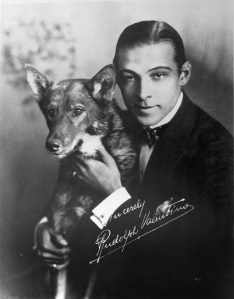
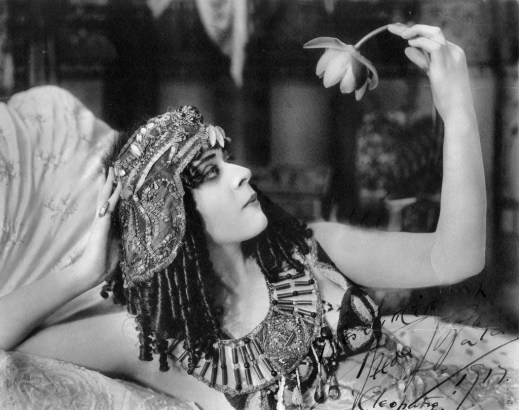
Rudolph Valentino and his Dog, this and featured photo of Theda Bara as Cleopatra (1917) courtesy of the Orange County Archives
As a film studies professor who specializes in the pre-sound era and frequently asks even my freshman students to engage with at least one silent film, I am both buoyed and dubious about this supposed sea change in public attitudes toward silent cinema. While some of my students sound a lot like David Haden after I ask them to watch even the most accessible silent slapstick comedies, many of my upper-level students now count works like F. W. Murnau’s Sunrise among their favorite films. And I’ve discussed the merits of The Artist with many of those same students, who easily recognized the film’s many references to other silent-era works, and appreciated its ability to mimic a very particular brand of silent film. I honestly believe there is some truth to the claim that films like The Artist and Hugo have encouraged spectators to engage with other silent films, including the recently restored color version of Trip to the Moon that is showcased in Scorsese’s film. In fact, in recent weeks there has been considerable buzz about skyrocketing demand for silent films via streaming services and even Cinemark’s XD-equipped theaters will be screening the 1927 film Wings as part of its “Reel Classics” series in late May. Rumor has it that Broadway will soon be hawking a production about Charlie Chaplin’s life and 2012 will see the life of silent film star Rudolph Valentino represented in Silent Life.
Michel Hazanavicius explains in the production notes to The Artist that his desire to make a silent film had been brewing for years: “From the beginning of my career, I fantasized about making a silent film.” But he also viewed the dream as far-fetched, one that would be unlikely to draw support in contemporary film production circles: “I call it a fantasy because whenever I mentioned it, I’d only get an amused reaction—no one took this seriously.” Despite this resistance, Hazanavicius refused to let go of the idea and continued to imagine how he might capitalize on the unique artistic potential of the silent medium: “As a director, a silent film makes you face your responsibilities. . . .Everything is in the image, in the organization of the signals you’re sending to the audience. And it’s an emotional cinema, it’s sensorial; the fact that there is no text brings you back to a basic way of telling a story that only works on the feelings you have created. I thought it would be a magnificent challenge and that if I could manage it, it would be very rewarding.”
Despite the initial skepticism Hazanavicius faced, The Artist’s unexpected international success has revealed consumers’ (perhaps temporary) appetite for silent film. Parody trailers of upcoming Hollywood blockbusters like The Avengers have aped silent film form and The Artistifier allows users to transform any Youtube video into a silent film.
.
Even hipster clothiers, Shabby Apple, have taped into silent film’s newfound cultural cache by launching a “Silent Era” collection of swimsuits with names like the “Bara swim mini” and the “Karloff swim top.” Despite this recent upsurge in references to and imitations of the silent film medium, advertisers, filmmakers, artists, and musicians have expressed a nostalgic reverence for silent film for decades. Between 2007 and 2010, Janelle Monáe released her Metropolis and ArchAndroid Suites, which refashioned Fritz Lang’s iconic 1927 film, Metropolis.
.
Mimicking both the film’s visual style and political message, Monáe also refashioned herself as Metropolis’s iconic android and adopted her trademark tuxedo attire after seeing photos of Marlene Dietrich, the silent and sound film star who helped mainstreamed this androgynous look in the 1920s (and also as a tribute to the working class uniforms of her parents). From AFLAC’s 2006 satirizing of the medium’s stereotyped damsel in distress, to IBM’s 1986 series of ads featuring Charlie Chaplin, marketers have frequently banked on silent films’ ability to attract the public eye.
.
What do we make of this renewed interest in silence? We must first remember that, as I tell my students, silent films were never designed for silent viewing at all given that most were screened with musical accompaniment that ranged from a single organist to a 40-piece orchestra. Even the composition of The Artist reveals the lie behind silent film “silence,” with composer Ludivic Bource employing 80 musicians from the Flanders Philharmonic Orchestra in developing the score for the film. Despite the fact that live orchestral accompaniments of silent film have become staples of film festivals around the world, most of today’s viewers’ experiences with silent film are limited to watching DVD transfers of varying quality, with canned music that is sometimes recycled from one DVD release to another, regardless of film title or subject matter. Few viewers, including those who have attended screenings of The Artist, have truly experienced the “silent” medium as it was intended, with sound and image working in tandem via a combination of “live” music and projected celluloid. Two years ago, I saw the transformative effect of recreating a more authentic silent film viewing experience when I arranged a screening of Sunrise at the University of Northern Colorado with the Mont Alto Chamber Orchestra providing live musical accompaniment. Many of my students still speak of that experience with tremendous reverence, explaining that they finally understood what it meant to truly experience a “silent film.”
While popular audiences tend to neglect how integral sound was to silent film, Rick Altman has argued in Silent Film Sound that sound has thus far failed to establish its own “autonomous measure of worth,” with scholars arguing that because film’s historical roots are bound up in silence “cinema is thus essentially a visual art” (6). Yet, this bias seems to be belied by the reaction to The Artist, with even the Oscars ceremony choosing to use the film’s only synchronized sound scene when introducing it as a the Best Picture nomination. It seems that even an acclaimed twenty-first century silent film must flaunt its, albeit brief, reliance on synchronized sound. Certainly, the many viewers who demanded refunds from their local cineplexes reflect the prevailing opinion that film must include sound if it hopes to maintain their interest and earn their cinema-going dollars.

Silent Film Festival Winter event at the Castro by Flickr User Steve Rhodes
So, what is the appeal then of these “silent” films in which, though accompanied by music and sound effects, dialogue is not spoken but read via soundless lips or intertitles? For me, the attraction comes from both understanding the aesthetic and technological roots of an art form that I admire and the fact that they require the development of character and narrative in purely visual terms. I am also attracted to its higher degree of abstraction, its ability to create a kind of poetry while also defying the very essence of language itself. And I see in the absence of sound a refreshing denunciation of contemporary demands for ever-increasing realism. Silent film is the antithesis of today’s fetishizing of 3-D.

Projector, Chaplin by Flickr User Stephen Coates
While I acknowledge this statement may seem naïve given that Scorsese’s aforementioned film manages to combine that “new” technology with a tremendous reverence for silent film’s seemingly “primitive” techniques, I firmly believe that the aesthetics of “silence” have an important resonance for contemporary viewers raised on Dolby. After hearing my frequent complaints about the current impetus toward 3-D, one of my students has taken to calling me Charlie Chaplin, seeing in my resistance a mirroring of the great comedian and director’s opposition to sound technology. Like Chaplin’s Tramp in Modern Times who cannot keep up with the machine-age and its insistence on productivity, I often find myself longing for something simpler from film, something more retrained and abstracted, less motivated by the demand for “progress” and, at least on the surface, The Artist’s return to silence seems to fulfill that admittedly nostalgic desire. While it is an imperfect, and perhaps misleading, example of the silent medium, even the modernized form of silent cinema that we see in The Artist demands that viewers consider the relationship between history and memory, between film’s relatively youthful heritage and its contingent representations of the past, between sound and silence.
—
April Miller is an Assistant Professor and Director of Film Studies at the University of Northern Colorado. Her research focuses primarily on the intersections between literature, film and socio-scientific concerns such as criminality and mental illness. She is currently completing a book manuscript, Offending Women: Modernism, Crime, and Creative Production, which investigates the female criminal and her often-overlapping sites of representation in literature, journalism, and silent film.
Share this:


Current Top Posts





April 2021

January 2020

November 2019

October 2019

August 2019

April 2014

November 2017

March 2015

December 2017

October 2015
 Sounding Out!
Recent Comments