
Beyond the Grave: The “Dies Irae” in Video Game Music
For those familiar with modern media, there are a number of short musical phrases that immediately trigger a particular emotional response. Think, for example, of the two-note theme that denotes the shark in Jaws, and see if you become just a little more tense or nervous. So too with the stabbing shriek of the violins from Psycho, or even the whirling four-note theme from The Twilight Zone. In each of these cases, the musical theme is short, memorable, and unalterably linked to one specific feeling: fear.
The first few notes of the “Dies Irae” chant, perhaps as recognizable as any of the other themes I mentioned already, are often used to provoke that same emotion.
Often, but not always. The “Dies Irae” has been associated with death since its creation in the thirteenth century, due to its use in the Requiem Mass for the dead until the Second Vatican Council (1962–65). Its text describes the Last Judgment, when all humanity will be sent to heaven or hell. But from the Renaissance to today, the “Dies Irae” has also come to symbolize everything from the medieval church and Catholic ritual to the sinister, superstitious, or supernatural, even violence and battle—and any combination of the above.
Because of its unique history not only within its original liturgical context but also within later musical genres, this chant has become largely divorced from its original purposes, at least in modern popular imagination. Instead, it now holds a multiplicity of meanings; composers manipulate these meanings by utilizing this chant in a new setting, and thus in turn continue to reinforce those meanings within modern media. Since its use within the Mass, concert music, and films has already been well documented, this blog post explores its presence in an as yet unexamined medium: video games.

By Willem Vrelant (Flemish, died 1481, active 1454 – 1481) 1481 – illuminator (Flemish) Details of artist on Google Art Project [Public domain], via Wikimedia Commons
Beginning in the late eighteenth century, the text was set in Requiems for the secular stage by composers such as Mozart, Verdi, and Britten. But due to both its evocative text and its memorable melody (often just the first sixteen, eight, or even four notes), the “Dies Irae” chant soon was incorporated into secular instrumental works, where it signified the past, the supernatural, the oppressive, the demonic, and death. No work is more responsible for this than Hector Berlioz’s Symphonie Fantastique, where the chant symbolizes the composer’s own death and the depravity of the demons and witches who dance at his funeral.
The history of this chant, together with its use in film, has been explored by scholars such as Linda Schubert and John Haines. Because the “Dies Irae” was already a well-known symbol of the aforementioned characteristics, and because early silent film musicians borrowed musical ideas from previously composed works, the chant segued quickly into early film, where its symbolic possibilities were reinforced. Thus, even in newly composed soundtracks, composers utilized this chant as an aural shortcut to a host of emotional and psychological reactions, especially (as James Deaville and others discuss) within horror films. It appears in scenes depicting inner anguish, fear, the occult, evil, and imminent death in films from It’s a Wonderful Life, The Seventh Seal, and The Shining to Disney’s The Lion King and Star Wars, in musicals like Sweeney Todd, and in literary works such as Gaston Leroux’s The Phantom of the Opera, but it also symbolizes power and even heroism, such as in this Nike shoe commercial.
The “Dies Irae” appears analogously in video game soundtracks, where it communicates the same symbolic meanings that it does in film scores and concert music. Its recognizability also lends itself to parody, as it did in Monty Python and the Holy Grail. Yet, unlike in film music, the evolution of its use in game music speaks also to the evolution of game music technology.
In the earlier years of video games, technology could not create continuous soundtracks. The first such was in Space Invaders (1978), although it consisted only of four descending notes looped indefinitely. Additionally, while voice synthesis was used in game soundtracks as early as 1982, reproduction of musical voices was limited even into the 1990s. William Gibbons describes how early systems had a limited number of channels (40); as a result, Baroque-style counterpoint worked well texturally, and reproducing music from earlier composers such as Bach was not only permissible by copyright but also demonstrated the capabilities of their systems (201–204). As such, earlier games were less interested in a monophonic chant, although several (such as Fatal Fury) did use Mozart’s setting of the “Dies Irae.”
The “Dies Irae” chant is first used in game music in the late 1980s and early 1990s, by which point most systems had five or more channels, allowing for improved timbres and sound synthesis. The opening theme song to F-19 Stealth Fighter (1988–92, DOS/PC/Amiga/Atari) subtly references the first phrase of the chant. Composer Ken Lagace sets the first eight pitches evenly in the lower voice before moving them to a higher, rhythmicized register. The chant is accompanied by a consistent percussive element and several higher, chordal voices, which splinter off into fast arpeggios before restating the opening. There is as yet no action, nor is the plot either spiritual or supernatural, so the chant here actually works in a somewhat anomalous way. It heightens the player’s tension through its aural connotations of fear and death, thus setting the stage for the battles still to come in the game itself.
Indiana Jones and the Fate of Atlantis (1992, PC) is another early instance of the “Dies Irae,” which appears at the end, when Indiana and his companion Sophia confront the malevolent Doctor. The chant again increases tension but also indicates the presence of evil. Musically, the first two phrases of the chant appear in long, low tones, accompanied by several high, sustained, dissonant pitches. New voices enter, reminiscent of the opening phrase, before the chant returns in full in all registers. The system’s capability for thicker textures allowed the composers to stack the monophonic “Dies Irae” against itself, further emphasizing the threat of imminent danger in this final encounter.
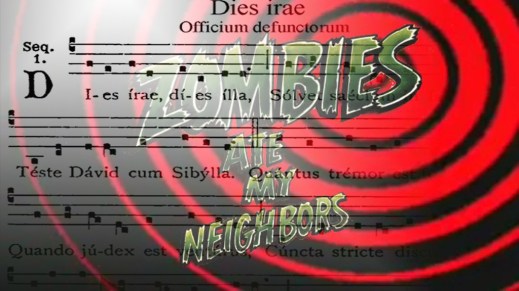
The last of the early case studies is Zombies Ate My Neighbors (1993, SNES/Genesis). These systems featured multiple channels capable of emulating a variety of acoustical settings. The game is a parody of 1950s horror films; the protagonists race through standard horror settings such as malls and castles to rescue their neighbors from demonic babies, vampires, zombies, and other stock creatures. The soundtrack also mimics the musical tropes in such films: chant itself, especially the “Dies Irae,” but also timbres such as tremolo, stingers, extreme ranges, and dissonance. The track “Curse of the Tongue,” which plays upon encountering the final boss, Dr. Tongue’s Giant Head, emulates a Gothic pipe organ. The low organ drone sustains underneath the first sixteen notes of the chant, which sound in a shrieking, vibrato-heavy register. The voices then move in parallel fifths as in medieval polyphony. The “Dies Irae” here brings to mind an entire film genre while also overtly characterizing the final battle against the otherworldly, sinister, evil Head. In this case, the chant works literally to signify the current battle and threat of death, but also parodically to indicate the absurdity of the situation.
The development of video game audio technology allowed first for voice emulation, then voice reproduction. Vocal samples were used as early as the 1980s, but were often confined to theme songs. Yet even after voices were reproduced within soundtracks, it is the “Dies Irae” melody alone that is most frequently sampled, strikingly paralleling its earlier use in film and concert music. When the “Dies Irae” text is used, it is set to newly composed music or borrowed from the Mozart or Verdi Requiems. Moreover, as in earlier media, all that is needed as an aural mnemonic is the first phrase, even just the first four notes, of the chant melody.
For example, two games released for PC in 1999—Heroes of Might & Magic III and Gabriel Knight 3: Blood of the Sacred, Blood of the Damned—both use just the first portion of the “Dies Irae.” In “Burying the Manuscript” from Gabriel Knight, pizzicato violins first allude to the first four or five notes of the chant (1:25); the full first phrase is then presented in parallel motion in the brass. The remainder of this theme alludes to the first few notes, making the “Dies Irae” a constant presence here and underscoring the secrecy, even the occult nature, of the manuscript in this scene.
Heroes III uses even less melodic material. In the Necropolis, composer Paul Romero uses the first four notes of the “Dies Irae” to underpin the entire theme. The bass plays the first four notes in a low register before seguing into newly composed material, but the contour of that phrase returns throughout the theme. The full chant phrases do not appear until the very end. The chant hints constantly at the overwhelming metaphor of death in this area, as well as to the presence of supernatural creatures such as vampires, zombies, and wraiths.
Unusual for many reasons, then, is the last case study: the game Dante’s Inferno (2010, PS3/Xbox360). It is the sole example here to use voices, but the text appears to be newly composed. As John Haines noted, the presence of Latin or pseudo-Latin is in and of itself a trope of the diabolical or demonic, which adds further nuance to this scene (129). The familiar melody is presented by a choir of mixed voices, accompanied by a roar of low brass, ambient noise, and a descant voice singing on open vowels, all signifiers of horror or the medieval. Moreover, the “Dies Irae” is not reserved for a final battle, as in previous examples, nor does it characterize supernatural creatures. Rather, it is the first theme heard in the game, reinforcing not only the medieval setting and the constant presence of death but also the ultimate trajectory of Dante, and the gamer, into Hell.
While the “Dies Irae” has been well studied as an aural signifier within film and concert music, its use in video games has, before now, been largely ignored. As in earlier musical genres, this chant brings to games a host of culturally accepted, musically mediated meanings that allow composers to immediately flesh out a character or scene. In so doing, game composers acknowledge that sound is not just sound, but rather it is (to borrow a phrase from Elizabeth Randell Upton) “a complex interaction of experiences and expectations on the part of the audience.” These experiences are continuously shaped by new compositions, scores, and soundtracks, which in turn continuously shape the audience’s expectations for future works.
As such, game soundtracks, along with other kinds of media, continue to transform the “Dies Irae” out of its original context and into an ever-growing set of pop culture symbols. The chant now signifies everything from the medieval to the present day, from judgment, battle, and death to demons, witches, and the occult. Within games in particular, though, it acts as a “memento mori,” a reminder of the mortality that game characters, and thus game players, seek to avoid through play. As such, it may instill fear in a player, but also suspicion, alertness, tension, even excitement, spurring the player to react in whichever manner suits the individual game.
The iconic status of the opening phrases of the “Dies Irae” chant marks it as a particularly useful polyvalent symbol for composers. Yet the utilization of this well-known trope is not without its problems. As I discuss in a forthcoming article, this chant, and indeed all plainchant, originates in a particular sacred, liturgical tradition. When a chant such as “Dies Irae” is used as a signifier of a general sense of spirituality, or of the medieval, or even of horror, then by default those characteristics are reified, if subtly, as Christian. Moreover, linking a chant such as the “Dies Irae” to the supernatural or the occult serves to perpetuate early modern stereotypes of Catholicism as nothing more than superstitious magic; see, for example, the purported origins of the phrase “hocus pocus.” Such anachronistic uses further obfuscate chant’s continuous role within Catholic (and other) liturgy; it is both a historic and a very modern practice.
Given that the “Dies Irae” is certainly not the only musical means to the aforementioned symbolic ends, perhaps these concerns are not pressing. Still, as Anita Sarkeesian points out, we can enjoy modern media while simultaneously critiquing facets that are problematic. There is no clear-cut way, at this point, to overturn hundreds of years of accumulated symbolic meaning for a musical icon such as the “Dies Irae,” but it behooves us as participants in auditory culture to become better aware of the multiple, and occasionally challenging, meanings within what we hear.
[Other games that also use the “Dies Irae” chant include Gauntlet Legends (1999, N64/PS/Dreamcast), Final Fantasy IX (2000, PS), EverQuest II (2004, MMORPG), Heroes of Might and Magic V (2006, PC), Sam & Max: Season 2 (2007–8, Wii/PC/PS3/Xbox 360), Ace Combat: Assault Horizon (2011, PS3/Xbox 360), and Diablo 3 (2012–4, PC/PS3/Xbox/PS4). My thanks go to VGMdb and Overclocked Remix for bringing several of these games to my attention, and to Ryan Thompson and Dana Plank for comments.]
–
Featured Image: A mashup of the first lines of the Dies Irae and the Zombies Ate My Neighbors title screen. Remixed for purposes of critique.
–
Dr. Karen Cook specializes in medieval and Renaissance music theory, history, and performance. She is currently working on a monograph on the development of rhythmic notation in the fourteenth and early fifteenth centuries. She also maintains active research interests in popular and contemporary music, especially with regard to music and identity in television, film, and video games. She frequently links her areas of specialization together through a focus on medievalism, writ broadly, in contemporary culture. As such, some of her recent and forthcoming publications include articles on fourteenth-century theoretical treatises, biographies of lesser-known late medieval theorists, and the use of plainchant in video games, a book chapter on medievalist music in Harry Potter video games, and a forthcoming co-authored Oxford Bibliography on medievalism and music.
–
 REWIND!…If you liked this post, you may also dig:
SO! Amplifies: Mega Ran and Sammus, The Rappers With Arm Cannons Tour–Enongo Lumumba-Kasongo
Video Gaming and the Sonic Feedback of Surveillance: Bastion and the Stanley Parable–Aaron Trammell
Playing with the Past in the Imagined Middle Ages: Music and Soundscape in Video Game–James Cook
Share this:

Out of Sync: Gendered Location Sound Work in Bollywood

co-edited by Praseeda Gopinath and Monika Mehta
Our listening practices are discursively constructed. In the sonic landscape of India, in particular, the way in which we listen and what we hear are often normative, produced within hegemonic discourses of gender, class, caste, region, and sexuality. . . This forum, Gendered Soundscapes of India, offers snapshots of sound at sites of trans/national production, marketing, filmic and musical texts. Complementing these posts, the accompanying photographs offer glimpses of gendered community formation, homosociality, the pervasiveness of sound technology in India, and the discordant stratified soundscapes of the city. This series opens up for us the question of other contexts in India where sound, gender, and technology might intersect, but, more broadly, it demands that we consider how sound exists differently in Pakistan, Sri Lanka, the Maldives, Bangladesh, Bhutan, Nepal, and Afghanistan. How might we imagine a sonic framework and South Asia from these locations? —Guest Editors Praseeda Gopinath and Monika Mehta
For the full introduction to the forum, click here.
To read all of the posts in the forum, click here.
—
“Indian traffic tends to be one of the noisiest, but that is true of all third world countries…What doesn’t make sense is when you try to remove it from that context. Two people can’t be whispering to one another in the middle of a bench by the sea in Bandra. Will you hear someone sitting next to you on that bench?,” asks sound designer Dileep Subramaniam indignantly. We are discussing the Indian film industry’s norm of looping (or “dubbing”) sound and dialogue at the post-production stage, which has traditionally given India cinema’s sound track an unrealistic degree of clarity. For a loud country, Indian films have been in the habit of incorporating remarkably few ambient sounds into their sound track, until the practice of synchronized sound recording began to infiltrate Hindi film aesthetics in the late 1990s.
The break from post-synchronized sound occurred over a relatively brief period of time in India, as a majority of the commercial films moved away from MOS (motor only sound or no sync sound) to synchronized sound, which refers to the recording of sound alongside image during a film shoot. Industry professionals argue that sound technologies underwent revolutionary changes in comparison to image technologies in India between 1995 and 2002, as the introduction of digital editing platforms weaned the Bombay film industry away from its reliance on mono-tracks and primitive stereo-tracks, directly to Dolby digital multi-tracks. Hindi cinema almost entirely skipped the intermediary technological stage of stereo ultrasound, used for several years in Hollywood. Today, an amalgam of sync sound and Automated Dialogue Replacement (ADR) characterize Bollywood cinema’s soundscapes.
We have been more attuned to Hindi cinema’s soundscapes than to the production and pre-production practices of sound recording and the composition of sound crews, which follows a disciplinary habit in film studies of prioritizing film aesthetics over other aspects of film’s materiality and production. This lopsided emphasis has meant that we have missed out on the complex ways in which the story of film sound is part of a larger story of social change in India, wherein formal shifts are of a piece with new employment opportunities and a realignment of India’s middle class. These social and professional changes have impacted Indian class and gender relations in disparate ways.

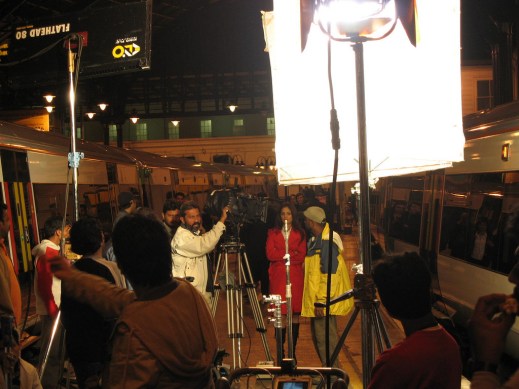
On the set of Bhagum Bhag filmed on Brighton Station, image by Flickr User Simon Pielow,(CC BY-SA 2.0)
Based on conversations that I conducted in Bombay (now Mumbai) in 2009 and 2013 with sound professionals working on Bollywood’s location shoots, I comment on sociological aspects of Bollywood’s increasing adoption of sync sound recording in location shoots, particularly with regard to its implications for class and gender relations within the film industry. My point will be two-fold. One, as the Hindi film form gravitates toward internationally recognizable codes of aural and visual realism, an expanding social range of skilled and unskilled workers are attracted to professions related to location sound recording. Two, despite the diversifying social profile of these professionals, women remain structurally excluded from all levels of the profession.
The change from non-sync to sync sound in Hindi films has created a demand for trained creative technicians and sound engineers, and equally for those who can work as bouncers and sound-security personnel on the field. Security personnel are crucial to recording location sound in a high-decibel country. According to Line Producer Raj Hate (with commercials and the location-heavy Miss Lovely to his credit, the practice of “sound lock ups” started with television commercials in India during the late 1990s before it was adopted by film shoots. “Sound lock” is a phrase used by Bollywood professionals to describe the practice of securing an area to ensure silence, in order to get the best location sound. Many of those working in this pool of unskilled labor in Bollywood today come from Mumbai’s economically depressed migrants who have traveled to the city in search of employment.
For instance, Security Provider Narendra Baruah started with security work on the film Lagaan (2001), the first big-budget film shot with sync sound, although it was preceded by the smaller scale Bombay Boys (1998), which also recorded in sync. Baruah created Active Squad Security while working on sound security for the location shoot of Veer Zaara (2004). He has provided security protection to stars (such as Madhuri Dixit Nene, Shah Rukh Khan, Aamir Khan and Preity Zinta), but his primary employment is in sync sound security. He retains a small group of men on a monthly salary with additional per diem top-ups during assignments, which may range between INR 5,000 to 10,000 to over 20,000 a day, depending on the nature of the shoot. Additionally, he hires men on a temporary basis from a pool of local Mumbaikars and immigrants seeking employment in the big city. Baruah’s company is in competition with actor Ronit Roy’s security company ACE and movie star Salman Khan’s Tiger Security. Although he lacks their star profile and their facility with English, he has made a name for himself through his entrepreneurial practice and expertise in shooting at “jhopad pattis” (slums) for films such as Slumdog Millionaire (2008) and Barah Aana (2009).

Bollywood Film Set, Image by Flickr User Rhys Tom, (CC BY-NC-ND 2.0)
Shot in Dharavi, Barah Aana required twenty men because of the high sound levels of the urban slum. As Baruah points out, jhopad pattis are the hardest places in which to secure sound for location shoots because “A pressure cooker’s whistle goes off somewhere, or a TV starts up, or a child starts crying” (“Kahien cooker ki seeti bajti hai to kabhi TV chalu hai aur bacchha rota hai.”). Open locations for films with smaller budgets also do not require ID cards for film crews, so Baruah finds that one of his greatest challenges is teaching his staff to memorize faces and manage crowds with diplomacy rather than violence. The phenomenon of Baruah and his crew working on a contract-basis with a range of films is what philosopher and sociologist Maurizzio Lazaratto discusses as the reconfigured “anthropological realities of work” in the new global work space, where “polymorphous self-employed autonomous work has emerged as the dominant form” of global labor.
The social range of Baruah’s crew reveals a disparity between Bollywood blockbusters’ onscreen transnational and cosmopolitan backgrounds, and the class diversity of those involved in producing them. As Hagen Koo argues in relation to the shrinking middle class in America and Western Europe against the expanding middle class of India and China, representations of the global middle class that narrowly refer to “the upper segments…in developing countries, whose members are affluent and globally oriented in their lifestyle and mobility pattern” are woefully inadequate (“The Global Middle Class”). Without rendering Bollywood professionals into mere representatives of their class, I can confirm based on my conversations on the field that the assorted workers enabling sync sound shoots in India today come from a range of social classes, which reveals a negotiation and redistribution of work across different classes of professionals, particularly when we consider the work of sound security personnel in conjunction with the work of sound engineers on site. On-the-ground compositions of production crews are more complex and hybrid than what is suggested by a Bollywood blockbuster’s flat image of urbane cosmopolitanism, by Mumbai’s segregated urban spaces, or by the hostile monocultures of Hindutva pushed by Shiv Sena’s divisive politics.
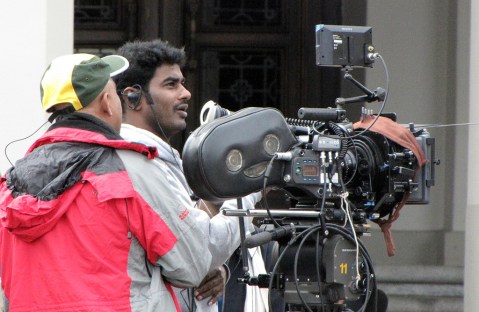
Filming of Bollywood movie “Agent Vinod” on set in Riga, Latvia, August 2010, (CC BY-SA 2.0)
At the other end of the social spectrum and hierarchy of labor among people involved in Bollywood’s revolution in sound are highly skilled sound artists and engineers. Early experimenters in sync and location sound (such as Shyam Benegal and Govind Nihlani) provided opportunities to Bollywood’s new generation of creative audio technicians, who have become key players in the industry’s innovations in sync sound recording, digital sound editing and audio mixing. Dileep Subramaniam worked in sync sound for Nihlani’s television features during the 1980s, and for BBC’s Channel 4 nature documentaries, which made it easier for him to work with transnational productions such as Merchant Ivory’s Deceivers (1988) and Shekhar Kapoor’s Bandit Queen (1995).
Location recordist, production mixer and sound designer Baylon Fonseca edited sound on the digital workstation Audio Vision from Avid for Nihlani’s Sanshodhan (1995) at a time when most Hindi film producers and directors “considered it almost witchcraft.” With Sanshodhan, he initiated methods for digital sync sound recording and mixing that are standard practice in India now. The integration of trained sound engineers into the Hindi film industry has made a palpable difference to its cinema’s sound quality, even as Hindi cinema’s increasing social legitimacy with white-collar workers allows Bollywood to seem like a valid career choice for Indians from the middle and upper middle classes. Nevertheless, high net-worth engineers have to buck traditional social norms—ranging from familial expectations to cultural notions of respectability—to consider sound work in the film industry as a valid career path.
All this is assuming that the engineers are men. Indian women face a double burden in entering such a profession: they must work against social prejudice to pursue careers in science and technology, and then apply that training to the field of media production, which does not possess the social legitimacy of most jobs in engineering. Effectively, new opportunities created by the use of sync sound in Hindi cinema does not bring much promise to women. Women are entirely omitted from the unskilled end of the location sound spectrum because of the incipient threat of violence and aggression against women in India’s public spaces. Under the strain of Hindutva’s India and Shiv Sena’s Mumbai, wherein the concept of protecting women’s honor becomes the violent pretext to restrict their freedom of movement, women are presumptively excluded from sound security work. Women are also largely absent from sound engineering because of the gendering of the hard sciences. In proportion to men, few Indian women are encouraged to enter the sciences, and fewer can choose to use it as the path into film work, so that they are structurally sidelined from high-end work in sound technologies.
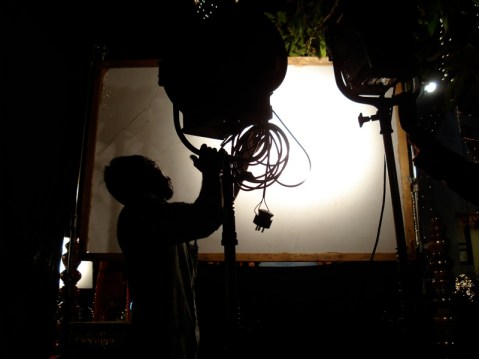
Bollywood Film Set, Image by Flickr User Dani Venn, (CC BY-NC 2.0)
Strong female characters on screen and strong female voices incorporated into the timbre of a film’s soundscape can be cause for celebration. But such inclusions rarely change the social and professional make-up of a film’s production crew. Further, merely adding women to the ranks of security personnel or sound engineers will not presumptively result in a more feminist or inclusive film text. On-screen representations do not reflect pre-production and production practices in simple ways. Despite these cautionary notes, is worth our while to invest some time and thought to how gender relations are impacted along different tiers of film production, as production practices shift in response to Hindi-cinema’s post-globalization aesthetics. Considering the gendered make up of professionals in Hindi cinema’s shift to sync sound recording on location shoots reveals several things. It demonstrates that professional opportunities, social norms and political pressures accompany formal changes in cinema. It allows us to consider what professional shifts in film sound recording in the wake of globalization look like in relation to men as opposed to women, providing an embodied perspective to abstract discussions of social change. And it chastens us against making naïve assumptions about inclusiveness.
—
Featured Image:On the set of Salaami Ish, filmed on Brighton Station,, image by Flickr User Simon Pielow, (CC BY-SA 2.0)
—
Priya Jaikumar is Associate Professor at the Department of Cinema and Media Studies at University of Southern California’s School of Cinematic Arts. She is the author of Cinema at the End of Empire, and several articles and book chapters in publications such as Screen, Cinema Journal, The Moving Image, World Literature Today, Hollywood Abroad, Transnational Feminism in Film and Media, Postcolonial Cinema Studies, Silent Cinema and the Politics of Space, The Slumdog Phenomena, Empire and Film and Routledge Companion to Cinema and Gender.
—
REWIND! . . .If you liked this post, you may also dig:
Sounding Out! Podcast #49: Sound and Sexuality in Video Games— Milena Droumeva and Aaron Trammell
As Loud As I Want To Be: Gender, Loudness, and Respectability Politics –Liana Silva
SO! Reads: Roshanak Khesti’s Modernity’s Ear–Shayna Silverstein
Share this:


Current Top Posts





April 2021

January 2020

November 2019

October 2019

August 2019

April 2014

November 2017

March 2015

December 2017

October 2015
 Sounding Out!
Recent Comments