
Playin’ Native and Other Iterations of Sonic Brownface in Hollywood Representations of Dolores Del Río
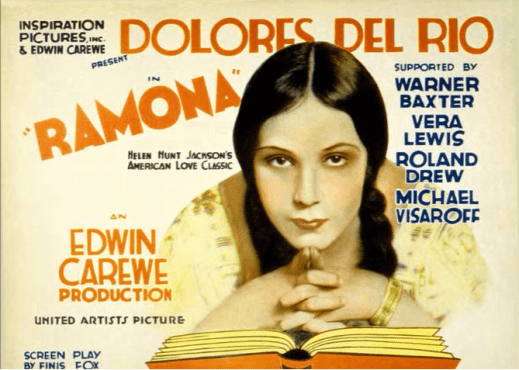
Mexican actress Dolores Del Río is admired for her ability to break ground; her dance skills allowed her to portray roles not offered to many women of color early in the 20th Century. One of her most popular roles was in the movie Ramona (1928), directed by Edwin Carewe. Her presence in the movie made me think about sonic representations of mestizaje and indigeneity through the characters portrayed by Del Río. According to Priscilla Ovalle, in Dance and the Hollywood Latina: Race, Sex and Stardom (2010), Dolores del Río was representative of Mexican nationhood while she was a rising star in Hollywood. Did her portrayals reinforce ways of hearing and viewing mestizos and First Nation people in the American imaginary? Is it sacrilegious to examine the Mexican starlet through sonic brownface? I explore these questions through two films, Ramona and Bird of Paradise (1932, directed by King Vidor), where Dolores del Río plays a mestiza and a Polynesian princess, respectively, to understand the deeper impact she had in Hollywood through expressions of sonic brownface.
Before I delve into analysis of these films and the importance of Ramona the novel and film adaptions, I wish to revisit the concept of sonic brownface I introduced here in SO! in 2013. Back then, I argued that the movie Nacho Libre and Jack Black’s characterization of “Nacho” is sonic brownface: an aural performativity of Mexicanness as imagined by non-Mexicans. Jennifer Stoever, in The Sonic Color Line (2017), postulates that how we listen to particular body(ies) are influenced by how we see them. The notion of sonic brownface facilitates a deeper examination of how ethnic and racialized bodies are not just seen but heard.
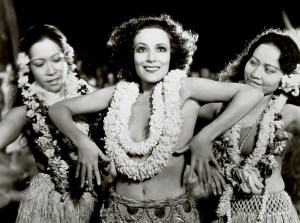
Picture of Del Rio as Luana in BIRDS OF PARADISE, available in the public domain.
Through my class lectures this past year, I realized there is more happening in the case of Dolores del Río, in that sonic brownface can also be heard in the impersonation of ethnic roles she portrayed. In the case of Dolores del Río, though Mexicana, her whiteness helps Hollywood directors to continue portraying mestizos and native people in ways that they already hear them while asserting that her portrayal helps lend authenticity due to her nationality. In the two films I discuss here, Dolores del Río helps facilitate these sonic imaginings by non-Mexicans, in this case the directors and agent who encouraged her to take on such roles. Although a case can be made that she had no choice, I imagine that she was quite astute and savvy to promote her Spanish heritage, which she credits for her alabaster skin. This also opens up other discussions about colorism prevalent within Latin America.
 First, let us focus on the appeal of Helen Hunt Jackson’s Ramona (1884), as it is here that the cohabitation of Scots, Spanish, Mestizos, and Native people are first introduced to the American public in the late 19th century. According to Evelyn I. Banning, in 1973’s Helen Hunt Jackson, the author wanted to write a novel that brought attention to the plight of Native Americans. The novel highlights the new frontier of California shortly after the Mexican American War. Though the novel was critically acclaimed, many folks were more intrigued with “… the charm of the southern California setting and the romance between a half-breed girl raised by an aristocratic Spanish family and an Indian forced off his tribal lands by white encroachers.” A year after Ramona was published, Jackson died and a variety of Ramona inspired projects that further romanticized Southern California history and its “Spanish” past surged. For example, currently in Hemet, California there is the longest running outdoor “Ramona” play performed since 1923. Hollywood was not far behind as it produced two silent-era films, starring Mary Pickford and Dolores del Río.
The charm of the novel Ramona is that it reinforces a familiar narrative of conquest with the possibility of all people co-existing together. As Philip Deloria reminds us in Playing Indian (1999), “The nineteenth-century quest for a self-identifying national literature … [spoke] the simultaneous languages of cultural fusion and violent appropriation” (5). The nation’s westward expansion and Jackson’s own life reflected the mobility and encounters settlers experienced in these territories. Though Helen Hunt Jackson had intended to bring more attention to the mistreatment of native people in the West, particularly the abuse of indigenous people by the California Missions, the fascination of the Spanish speaking people also predominated the American imaginary. To this day we still see in Southern California the preference of celebrating the regions Spanish past and subduing the native presence of the Chumash and Tongva. Underlying Jackson’s novel and other works like Maria Amparo Ruiz De Burton The Squatter and the Don (1885) is their critique of the U.S. and their involvement with the Mexican American War. An outcome of that war is that people of Mexican descent were classified as white due to the signing of Treaty of Guadalupe Hidalgo and were treated as a class apart. (See Michael Olivas’ anthology, Colored Men and Hombres Aqui from 2006 and Ignacio M. García, White but not Equal from 2008). These novels and films reflect the larger dominant narrative of whiteness and its relationship to nation building. Through Pickford’s and del Río’s portrayals of Ramona they reinforce the whiteness of mestizaje.

Screenshot from RAMONA (1910). Here, Ramona (played by Mary Pickford) finds out that she has “Indian blood.”
In 1910, Mary Pickford starred in D.W. Griffith’s short film adaptation of Ramona as the titular orphan of Spanish heritage. Henry B. Walthall played Alessandro, the Native American, in brownface to mimic physical attributes of the native Chumash of Southern California. Griffith also wanted to add authenticity by filming in Camulas, Ventura County, the land of the Chumash and where Jackson based her novel. The short is a sixteen-minute film that takes viewers through the encounter between Alessandro and Ramona and their forbidden love, as she was to be wedded to Felipe, a Californio. There is a moment in the movie when Ramona is told she has “Indian blood”. Exalted, Mary Pickford says “I’m so happy” (6:44-6:58). Their short union celebrates love of self and indigeneity that reiterates Jackson’s compassionate plea of the plight of native people. In the end, Alessandro dies fighting for his homeland, and Ramona ends up with Felipe. Alessandro, Ramona, and Felipe represent the archetypes in the Westward expansion. None had truly the power but if mestizaje is to survive best it serve whiteness.
.jpg#filelinks)
Poster of 1928’s RAMONA, under fair use
Edwin Carewe’s rendition of Ramona in 1928 was United Artists’ first film release with synchronized sound and score. Similar to the Jazz Singer in 1927, are pivotal in our understanding of sonic brownface. Through the use of synchronized scored music, Hollywood’s foray into sound allowed itself creative license to people of color and sonically match it to their imaginary of whiteness. As I mentioned in my 2013 post, the era of silent cinema allowed Mexicans in particular, to be “desirable and allowed audiences to fantasize about the man or woman on the screen because they could not hear them speak.” Ramona was also the first feature film for a 23-year-old Dolores del Río, whose beauty captivated audiences. There was much as stake for her and Carewe. Curiously, both are mestizos, and yet the Press Releases do not make mention of this, inadvertently reinforcing the whiteness of mestizaje: Del Río was lauded for her Spanish heritage (not for being Mexican), and Carewe’s Chickasaw ancestry was not highlighted. Nevertheless, the film was critically acclaimed with favorable reviews such as Mordaunt Hall’s piece in the New York Times published May 15, 1928. He writes, “This current offering is an extraordinarily beautiful production, intelligently directed and, with the exception of a few instances, splendidly acted.” The film had been lost and was found in Prague in 2005. The Library of Congress has restored it and is now celebrated as a historic film, which is celebrating its 90th anniversary on May 20th.
In Ramona, Dolores del Río shows her versatility as an actor, which garners her critical acclaim as the first Mexicana to play a starring role in Hollywood. Though Ramona is not considered a talkie, the synchronized sound comes through in the music. Carewe commissioned a song written by L. Wolfe Gillbert with music by Mabel Wayne, that was also produced as an album. The song itself was recorded as an instrumental ballad by two other musicians, topping the charts in 1928.
In the movie, Ramona sings to Allessandro. As you will read in the lyrics, it is odd that it is not her co-star Warner Baxter who sings, as the song calls out to Ramona. Del Río sounds angelic as the music creates high falsettos. The lyrics emphasize English vernacular with the use of “o’er” and “yonder” in the opening verse. There are moments in the song where it is audible that Del Río is not yet fluent speaking, let alone singing in English. This is due to the high notes, particularly in the third verse, which is repeated again after the instrumental interlude.
I dread the dawn
When I awake to find you gone
Ramona, I need you, my own
Each time she sings “Ramona” and other areas of the song where there is an “r”, she adds emphasis with a rolling “r,” as would be the case when speaking Spanish. Through the song it reinforces aspects of sonic brownface with the inaudible English words, and emphasis on the rolling “rrrr.” In some ways, the song attempts to highlight the mestiza aspects of the character. The new language of English spoken now in the region that was once a Spanish territory lends authenticity through Dolores del Río’s portrayal. Though Ramona is to be Scottish and Native, she was raised by a Spanish family named Moreno, which translates to brown or darker skin. Yes, you see the irony too.

United Artists Studio Film Still, under Fair Use
Following Del Río’s career, she plays characters from different parts of the world, usually native or Latin American. As Dolores del Río gained more popularity in Hollywood she co-starred in several movies such as Bird of Paradise (1932), directed by King Vidor, in which she plays a Polynesian Princess. Bird of Paradise focuses on the love affair between the sailor, played by Joel McCrea, and herself. The movie was controversial as it was the first time we see a kiss between a white male protagonist with a non-Anglo female, and some more skin, which caught the eye of The Motion Picture Code commission. Though I believe the writers attempted to write in Samoan, or some other language of the Polynesian islands, I find that her speech may be another articulation of sonic brownface. Beginning with the “talkies,” Hollywood continued to reiterate stereotypical representations though inaccurate music or spoken languages.
In the first encounter between the protagonists, Johnny and Luana, she greets him as if inviting him to dance. He understands her. He is so taken by her beauty that he “rescues” her to live a life together on a remote island. Though they do not speak the same language at first it does not matter because their love is enough. This begins with the first kiss. When she points to her lips emphasizing kisses, which he gives her more of. The movie follows their journey to create a life together but cannot be fully realized as she knows the sacrifice she must pay to Pele.
I do not negate the ground breaking work that Dolores del Río accomplished while in Hollywood. It led her to be an even greater star when she returned to Mexico. However, even her star role as Maria Candelaria bares some examination through sonic brownface. It is vital to examine how the media reinforces the imaginary of native people as not well spoken or inarticulate, and call out the whiteness of mestizaje as it inadvertently eliminates the presence of indigeneity and leaves us listening to sonic brownface.
—
reina alejandra prado saldivar is an art historian, curator, and adjunct lecturer in the Women, Gender and Sexuality Studies Program and Liberal Studies Department at CSULA and in the Critical Studies Program at CALArts. As a cultural activist, she focused her earlier research on Chicano cultural production and the visual arts. Prado is also a poet and performance artist known for her interactive durational work Take a Piece of my Heart as the character Santa Perversa (www.santaperversa.com) and is currently working on her first solo performance entitled Whipped!
—
Featured image: Screenshot from “Ramona (1928) – Brunswick Hour Orchestra”
—
 REWIND!…If you liked this post, you may also dig:
Afecto Caribeño / Caribbean Affect in Desi Arnaz’s “Babalú Aye” – reina alejandra prado saldivar
SO! Amplifies: Shizu Saldamando’s OUROBOROS–Jennifer Stoever
SO! Reads: Dolores Inés Casillas’s ¡Sounds of Belonging! – Monica de la Torre
Share this:

Teach Me How To Dougie Like A Mediocre White Man

In the third episode of Twin Peaks: The Return (2017), we meet Dougie Jones, a new character who is, as an otherworldly being will tell him, “manufactured.” Dougie’s sonic presence on the show is primarily marked by repetition, as the majority of his dialogue involves him parroting those around him. Though Dougie has been received as a symbol of purity or a magical conduit for others’ best selves (14:53-19:00), a close listen to his repetitions suggests that he is instead what Sarah Hagi has dubbed the “mediocre white man.”
DAILY PRAYER TO COMBAT IMPOSTOR SYNDROME: God give me the confidence of a mediocre white dude
— Sarah Hagi (@geekylonglegs) January 21, 2015
Hagi’s so-called prayer is a brilliantly concise instance of intersectional analysis that can also provide a framework for understanding Dougie Jones. In a few short words, she’s able to 1) demonstrate how white supremacist patriarchy makes her life more difficult, 2) call into question the achievements of those who hold so much power that it’s doled out to the most mediocre among them, and 3) situate the entire critique in a systemic framework. That is, though one possible reading of this tweet is that Hagi suffers from a shortcoming she is responsible to correct–a lack of confidence–the fact that she frames her critique as a prayer suggests that this confidence isn’t so much an inner belief in oneself as it is a privilege granted to some but not others. Twin Peaks: The Return offers, in the vocal interactions of Dougie, an extended meditation on the systemic mechanizations that produce the kind of mediocre white man Hagi laments.
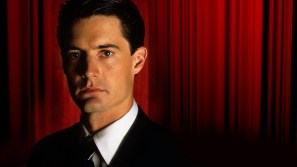
“Twin Peaks Returns to Television in 2016” by Flickr user BagoGames, CC BY 2.0.
For readers who aren’t Twin Peaks viewers, hang on: explaining the origin of Dougie Jones requires a few sentences that may read as something bordering on nonsense outside the show’s bizarre universe. Dougie is played by Kyle MacLachlan, who also plays the show’s main character, Agent Dale Cooper, as well as The Return’s Mr C, Cooper’s evil doppelganger who overcame Cooper in an extradimensional realm in the Season 2 finale and who has been living in the “real world” ever since, while Cooper is stuck in another dimension. The show implies that Mr C has only 25 years–roughly the amount of time since the show’s first run in the early 90s–before Cooper switches places with him (extradimensional bureaucracies, amiright?). As a ploy to stay in the real world, Mr C “manufactures” Dougie Jones so that when Cooper is finally released from extradimensional detention, he replaces Dougie, not Mr C. For the bulk of The Return, Mr C continues wreaking havoc across the Midwest and Western US, while Cooper, adversely affected by his transit across dimensions, is trapped in Dougie’s life, barely able to function beyond the level of a small child. Technically, then, the character called Dougie Jones is really Dale Cooper, but Cooper’s episodes-long inability to regain control of himself leads to an extended case of mistaken identity, where everyone in Dougie’s life believes Cooper to be Dougie.
Significantly, Dougie’s family and co-workers are barely phased by his ineptitude. At worst, like when he doesn’t know how to use the bathroom, people are annoyed by Dougie. But, more often than not, Dougie’s moments of silence and often erratic behavior — including befuddlement over how to feed or dress himself — are interpreted as quirky, humble, and endearing. More than that, Dougie’s boss believes him to be a courageous and principled whistle-blower whose cryptic drawings on insurance forms outs one of his co-workers for defrauding the company’s clients.

Screenshot of Twin Peaks: The Return
Dougie is beyond mediocre, yet over the course of the season, he falls into hundreds of thousands of dollars, a luxury car, a family life that seems to be fulfilling for his wife and son, and the respect and gratitude of his boss. Confidence isn’t something this mediocre white man possesses; rather, it’s a trait projected onto him by everyone around him. In riffing on the way people exist in systems of inequity, Sylvia Wynter notes in On Being Human As Praxis (2015) that we end up keeping “the reality of our own agency opaque by attributing that agency to extrahumanly mandating entities” (45). Put another way, the god who would grant us the confidence of a mediocre white man isn’t a deity but a system of patriarchal white supremacy that makes itself opaque behind the rationale that a person like, say, Dougie Jones couldn’t possibly be as successful in his life if he hadn’t earned it.
The primary marker of the mechanization of Dougie’s confidence is a sonic one: we can hear his ascendence in moments of repetition. Twin Peaks is a show comprised of overlapping aural and visual loops, recurring sounds, and doubled and tripled characters, so keying in on the sound of Dougie’s repetition fits into the series’ aesthetic. Early in Dougie’s presence in the series, when Cooper is fresh from the other dimension, his repetition is delayed, partial, and generally out of synch with regular patterns of conversation; people react to this repetition with concern. The following scene occurs in the moments just after Cooper has replaced Dougie Jones; his scene partner, Jade, was in the shower when the switch happened.
This clip is cut so that the phrase “Jade give two rides” happens back-to-back, but in the episode, there’s over a minute of a screen time between Jade saying (a grammatically correct version of) it and Dougie repeating it. Dougie’s imprecise and ill-timed repetition suggests to Jade that something may be wrong with him, and she rightly advises him to find some help. A similar interaction occurs in Episode 6, which opens with Dougie standing outside his work at night, unaware of what people do when work is over. When a police officer tries to shoo him away, Dougie is able to repeat back information he had heard several days earlier, and his delayed reaction again elicits concern from the person he’s with. A few scenes later, “Jade gives two rides” returns.
As the season progresses, however, Dougie begins to repeat back exact phrases or words that have just been spoken to him. The effect is one of understated agreement or even prescience, as if he’s repeating something he’s known for some time and has been waiting for others to realize, too. Note the way Dougie responds in the following two videos. In the first, he’s asked a question, which rises in pitch in the final syllables, and Dougie repeats the phrase with a falling pitch figure, which his conversants interpret to be confirmation. In the second, he’s given advice, and he responds by repeating the last word in uptalk, which his conversants interpret as a hilarious joke rather than the limitations of a person whose interdimensional travel has left his verbal skills lacking.
As Dougie’s repetition locks into a quicker, more immediate responsorial pattern, the people around him no longer worry about his well-being and, in fact, begin to project onto him a confidence he’s incapable of possessing. This repetition, the kind that immediately plays with or confirms what his boss or potential murderers say, suggests a couple different theoretical constructions of repetition. Butler, in describing the performativity of gender, notes that gender norms are “the stylized acts of repetition through time,” the rehearsed and rehashed ideas that we ascribe, in this case, to white men: well-timed humor on the one hand, and wise confirmation on the other (520). Sara Ahmed underscores a similar idea, noting that “compulsory heterosexuality” is “the accumulative effect of the repetition of the narrative of heterosexuality as an ideal coupling” (145). Here, Dougie’s white masculinity isn’t all that makes him the target of others’ projections of confidence and competence; his nuclear family also marks him as a productively repetitive person, a person capable of reproduction. To modify Hagi’s tweet a bit, the world projects onto Dougie the confidence of a mediocre, white, reproductive man.
Both Butler and Ahmed also gesture toward distinctly sonic phenomena present in Dougie’s repetitions. Repetition accumulating over time becomes not just distinct events happening in succession but a discrete, singular thing unto itself. When thinking in terms of systemic oppression like white supremacy or cisheteropatriarchy, the repetitive privileging of white masculinity congeals into a continuous power flow. In musical terms, we hear the accumulative, rapid retriggering of a sound as pitch rather than many distinct events. Timing matters here: if the repetition is delayed or metered just so, we can perceive instances of the same events as moving in concert either melodically or harmonically. The shift in Dougie’s repetitions over the course of The Return is the sound of institutional privilege tuning white masculinity, retriggering moments of repetition–which sounds like a rise in pitch as the repetitions move closer together, a literal ascent–until those around Dougie stop worrying about him and start believing that this mediocre white straight man must have earned the success he seemingly enjoys.
Though a perusal of Twin Peaks: The Return analyses and recaps demonstrates that viewers and critics have been far more interested in the archetypal Jekyll/Hyde duality of Dale Cooper and Mr C than they have been in the nature of Dougie Jones, Dougie’s relative lack of drive or desire offers the opportunity to hear how white male mediocrity is made. The Return checks in on Dougie regularly from his introduction in the third episode until he transforms back into Cooper, then is remanufactured and sent home to his family in the sixteenth and eighteenth episodes. What we’re privy to in that time is a different kind of manufacturing, where Dougie is constructed by his surroundings to be wise, caring, attentive, upright, and brave, though we know he’s none of those things. The slow burn of Twin Peaks: The Return means that we’re stripped of any easy excuses for Dougie’s upward momentum in the season beyond the obvious explanation that the gods of mediocre white men have gifted him with treasures out of reach for others. Dougie repeats what he hears, and what he hears is that his mediocrity is good enough.
—
Featured image: Screenshot from “‘Dougie’ Cooper – All Phrases (Twin Peaks Compilation)” by Youtube user AKA.
—
Justin Adams Burton is Assistant Professor of Music at Rider University. His research revolves around critical race and gender theory in hip hop and pop, and his book, Posthuman Rap, is available now. He is also co-editing the forthcoming (2018) Oxford Handbook of Hip Hop Music Studies. You can catch him at justindburton.com and on Twitter @j_adams_burton. His favorite rapper is one or two of the Fat Boys.
—

REWIND! . . .If you liked this post, you may also dig:
DIANE… The Personal Voice Recorder in Twin Peaks-Tom McEnaney
Malcolm Gladwell’s Bad Aesthetics–Justin Burton
Listening to Sounds in Post-Feminist Pop Music-Robin James
Share this:




Current Top Posts





April 2021

January 2020

November 2019

October 2019

August 2019

April 2014

November 2017

March 2015

December 2017

October 2015


Recent Comments