
Cauldrons of Noise: Stadium Cheers and Boos at the 2012 London Olympics

 Welcome to the extra innings of our summer series on “Sound and Sport”! In today’s bonus post, David Hendy discusses his recent Noise broadcast for BBC Radio 4 on the sounds of Olympic crowds. For an instant replay of our summer series click Kariann Goldschmitt’s “The Sounds of Selling Out?: Tom Zé, Coca-Cola, and the Soundtrack to FIFA Brazil 2014” (August), Josh Ottum‘s “Sounding Boards and Sonic Styles: The Music of the Skatepark” (July), Tara Betts‘s “Pretty, Fast, and Loud: The Audible Ali” (June), and Melissa Helquist‘s “Goalball: Sport, Silence, and Spectatorship” (May). Following Hendy’s post on Olympics past, give Andrea Medrado’s podcast a spin for a listen into its future: “The Sounds of Rio’s Favelas: Echoes of Social Inequality in an Olympic City.” And now, David Hendy. Of course, the crowd goes WILD. —J. Stoever-Ackerman, Editor-in-Chief
—
I didn’t get to go to the London 2012 Olympics or Paralympics. Alas, my number didn’t come up in the lottery for seats. So, like millions of others, my family and I watched – and heard – the sporting action on television or, occasionally, on our smart phones. A pretty good experience it was, too: the BBC for instance gave British viewers 24 live streams of high-definition coverage for the Olympics; Channel 4’s approach to the Paralympics was smaller-scale but packed a similar punch in terms of imagery. A key part of the “enhanced experience,” however, was the acoustic quality of the broadcasts. When the Olympics had last been staged in London, during the post-war austerity of 1948, television footage sounded like this:
“1948 Olympics Clip” courtesy of Peregrine Andrews and Alan Hall, Falling Tree Productions Limited
Just about the only things viewers would’ve heard were the voices of the commentators and the distant, muted sounds of the crowd.
That evocative archive recording was used in a recent radio documentary by the British sound designer Peregrine Andrews. The programme explored just how much had changed in location recording techniques by 2012. This time around, Peregrine pointed out, some 4,000 microphones were in position at the various venues: not just suspended in the air above or placed on the trackside, but bonded directly onto the beams in the gymnastic hall, say, or attached to the targets used in archery. Competitors everywhere were heard in extreme close-up – every shift of a hand or foot, every creak of wood, every grunt or groan made audible to the viewer at home.
This wasn’t just hyperbole. Newspapers quickly latched on to the phenomenon, dispatching reporters to measure decibel levels and offer their readers guides to the “best” venues for hearing the sound of the crowd. They pointed out that an airplane taking off produces about “140 decibels of noise”– and that the cheers echoing around the soaring curves and low ceilings of the Olympic Velodrome reached very nearly the same level.

Panorama of the London Olympic Velodrome, Image courtesy of Flickr User Jack999

Olympic Velodrome Image courtesy of Flickr User adambowie
“The roar was thrilling, to the point of pain,” claimed one reporter from the Toronto Globe and Mail. “If I had endured another minute, I am sure we’d all have gone deaf.” Zaha Hadid’s gloriously sweeping Aquatics Centre provided perhaps the most intense acoustics of all. Whenever the 17,500 fans inside cheered, the “guttural roar” was simply “ear-drum shattering,” declared the London Evening Standard. The main Olympic stadium was open air, of course, making the sound less intense. But even here the Globe and Mail journalist wrote of a “tsunami of noise” building in waves; another of the stadium’s “sonic boom”; yet another of how Usain Bolt’s 100 metres final produced a roar from the crowd which, measured at 107 decibels, beat that of your average pneumatic drill.

Olympic Stadium 2012, Image by Flickr User tom_bennett
Perhaps it wasn’t surprising that London 2012 was dubbed the loudest ever Olympics. For the main stadium’s designer Rod Sheard had always conceived it with acoustics firmly in mind. He’s quoted in a piece in It’s Nice That: “The athletes are so focused, it’s very easy for them not to hear the crowd. . .we’ve got to make it really loud for them to get any benefit from it.” And so the 80,000 people inside were packed as closely together as possible with the roof shaped to rebound their roar back into the heart of the space, generating maximum volume.
As my producer Matt Thompson and I discovered when making our recent BBC radio series Noise: a Human History (available on iTunes), this contemporary attempt to revel in the roar of the spectators throws up some striking – and very ancient – parallels. The most obvious is that of the Colosseum in Rome, which, some 2000 years ago, provided what Keith Hopkins and Mary Beard have described as “a brilliantly constructed and enclosed world, which packed emperor, elite and subjects together, like sardines in a tin.”
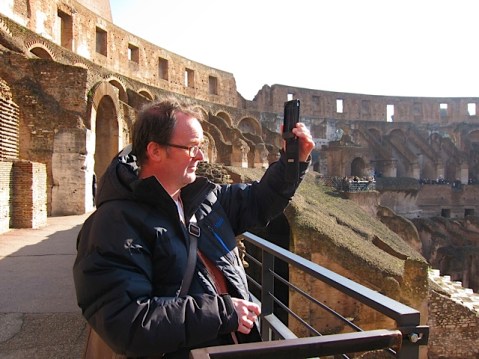
David Hendy at Colosseum, Image by MattThompson/Rockethouse Productions
The acoustic qualities of ancient amphitheaters like this – their ability to amplify the slightest sounds – is still pretty unnerving if you get the chance to witness it for yourself, as Matt and I did when recording, at the Colosseum and at the ancient Greek theatre of Epidaurus:
In these cauldrons of concentrated sound, the roar of the spectators took on a collective force of its own – a volatile quality rich with cultural and political repercussions. During plays in Greek theatres, audiences were rarely hushed and reverential. They were talkative and unruly, sometimes showing their disapproval by drumming their heels against the benches, sometimes disrupting the action by shouting and jeering. The chorus below would address spectators directly, as if facing a jury. Audience participation was as much a part of a performance as were the actors in the orchestra or on the stage. And when it came to the Roman Games later held at the Colosseum or in even larger venues such as the nearby Circus Maximus, the barrage of sound could reach intimidating levels of ferocity.

David Hendy Recording at Epidaurus, Image by Matt Thompson/Rockethouse Productions, taken on location
Roman arenas were not just sporting venues, of course. They were designed for political theatre. Vespasian had ordered the Colosseum to be built to help wipe away the memory of his predecessor Nero and his notorious private pleasure palace the Golden House. Now Roman citizens had a pleasure palace all of their own. The ruling elite had also created a place for the ostentatious display of imperial power and generosity, a bribe for the people’s continuing loyalty. Which is why, if the crowds were sometimes a little slow in showing their appreciation, paid stooges dotted about the arena would start applauding – or booing – at all the right moments, while soldiers would strike down any member of the audience who lagged in their cheering. But, as in the Greek theatres, Rome’s audiences were never entirely under the cosh; they could occasionally give voice to underlying discontentment. And when so many people were so tightly packed together, sheer proximity and the contagious quality of sound meant any turn in the mood would have been quick to make itself felt.
One startling example of this came in 55BC when Julius Caesar’s powerful rival Pompey put on a show in the Circus Maximus that featured the slaughter of elephants – something the crowd lapped up until the very moment they heard the poor creatures’ death throes. In episode 9 of Noise: a Human History, I speculated on what it might’ve been like – and recalled the unsettling outcome:
In London in 2012, we had our very own Pompey, in the form of the British Chancellor of the Exchequer, George Osborne. He’d turned up to the Paralympics to award some medals. And as his name was announced the stadium resounded with loud booing for the first time all summer:
Why did 80,000 people all suddenly decide to boo as one? Because, one commentator quipped, there were only 80,000 people in the stadium.
Politicians as a class are inevitably unwelcome in a place of entertainment, their presence too obviously betraying an attempt to siphon off a little of the goodwill. Osborne’s particular problem, though, was that he wasn’t just any old politician. He was from the ruling Conservative party, which, true to its ungenerous instincts, had just cut welfare benefits for Britain’s disabled people. In the circumstances, turning up to the Paralympics seemed an entirely predictable affront to most of those in the stadium – one that Osborne was thick-skinned and numb-skulled enough not to have predicted for himself.
All this might seem, well, unsporting. But booing is part of the civic dialogue. It brings politicians face-to-face with their electorate. It forces them to feel the scorn and anger of those they’ve let down. The moment passes, of course. Clips briefly went viral on YouTube, and were soon forgotten. Osborne himself is still in office, overseeing the ruination of the British economy through his programme of austerity. But for a delicious few seconds we were reminded of the inherently public nature of sound. We heard – we felt – the role of listening to one another, not as a passive thing but as a powerfully collective, inter-subjective, electrifying, communicative act.
—
Featured Image: Crowd: London 2012 Olympic Stadium, Image by Flickr User Flickmor
—
David Hendy is Professor of Media and Communication at the University of Sussex, England. He wrote and presented the recent 30-part BBC radio series Noise: a Human History, which remains available to download on ITunes. The accompanying book, Noise: a Human History of Sound and Listening, will be published in the US in October 2013 by Harper Collins. He’s the author of Radio in the Global Age (2000), Life on Air: a History of Radio Four (2007), and Public Service Broadcasting (2013), and contributes regularly to radio programmes.
—
 REWIND! . . .If you liked this post, you may also dig:
“We wanted to tell stories about sound”: Opening Ears Through the “Everything Sounds” Podcast–Craig Shank and George Drake Jr.
Quebec’s #casseroles: on participation, percussion and protest–Jonathan Sterne
Goalball: Sport, Silence, and Spectatorship— Melissa Helquist
Share this:

Hello, Americans: Orson Welles, Latin America, and the Sounds of the “Good Neighbor”

 And now, we interrupt this broadcast for a message from Guest Editor Neil Verma: At 9:00 pm on July 11, 1938, the Columbia Broadcasting System unfurled a plush Tchaikovsky concerto to welcome 23 year-old wunderkind Orson Welles and his Mercury Theater troupe to national airwaves for a show destined to become the most famous dramatic radio anthology ever aired.
The Mercury Theater on the Air came with hype. Welles was fresh off a streak of innovative stage adaptations of Shakespeare’s “Julius Caesar,” Shaw’s “Heartbreak House,” and Marlowe’s “Doctor Faustus,” pledging in a New York Times article to “treat radio with the intelligence and respect such a beautiful and powerful medium deserves.” A jab at his rivals? Maybe. Legends tell of 17-hour writing sessions, of rows minutes before airtime between Welles, producer John Houseman and composer Bernard Herrmann, of sound men abusing baskets, watermelons, toilets, lawnmowers to make audio. Time described Mercury’s ambition as “bounded north and south by hope, east and west by nerve.”
Welles was by then a radio veteran, the hero of The Shadow and impersonator of newsmakers from Sigmund Freud to Fiorello laGuardia on The March of Time. Hundreds of extant recordings link Welles to rousing Norman Corwin pageants, Columbia Workshop experiments, strident war shows like Ceiling Unlimited, buffoon turns on the Jack Benny and Fred Allen Shows, picaresque Harry Lime adventures, dense thrillers on Suspense, romances on Lux Radio Theater, diplomacy on Hello Americans, and on and on. Welles gave radio new forms, as radio informed his filmmaking profoundly – the sound of Citizen Kane (1941) the characters in Mr. Arkadin (1955), the vocals in Touch of Evil (1958) the theme of F is for Fake (1974). Welles invented a cinema that is, among other things, a kind of radio play you can see.
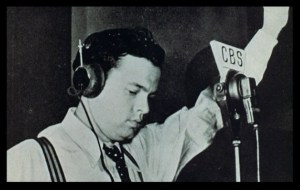
Mercury (and the Campbell Playhouse it became) undertook plays like “Dracula,” “Treasure Island,” “The 39 Steps,” “Rebecca,” “Jane Eyre,” and “The Magnificent Ambersons” and dozens of others. But none would be remembered were it not for the “War of the Worlds,” adapted from H.G. Wells’s novel by Howard Koch. In October of 1938, WOTW aired to six million listeners, hundreds of thousands of whom misheard it as news. The “Panic Broadcast” became a series of fables: listeners treated for shock in Newark; families on Boston rooftops watching the fires of New York in the distance; an Indianapolis church service interrupted by a parishioner telling congregants “you might as well go home to die;” bomb threats and a police raid on CBS headquarters. Three quarters of a century later many agree with the New York Tribune’s Dorothy Thompson, who declared the Invasion “one of the most fascinating and important events of all time,” but the meaning of that event also feels unclear, growing more ambiguous with time. Today, the alien invasion is itself increasingly alien.
To confront that issue and to open Mercury to new kinds of critical practices in sound studies, Sounding Out! is partnering with Antenna over the next six months to bring you a 12-part series entitled From Mercury to Mars: Orson Welles on Radio after 75 Years. I’m honored to serve as Sounding Out!‘s Guest Editor. We’ll be bringing you authors who engage aesthetic, historical and political aspects of Welles’ radio work with a depth and intensity unusual in Welles studies.
That’s especially true of this inaugural post by Cornell Comparative Literature Professor and SO! contributor Tom McEnaney, who has been working on a book project involving radio and the “neighborhood” of the Americas. I’m thrilled welcome Tom’s nuanced and provocative take on Welles’s adaptation of Joseph Conrad’s Heart of Darkness and his Hello, Americans program, and I hope it will encourage you to stay with us as the series unfolds.
Like Welles, we’ve got a few tricks up our sleeve. Stay tuned. — nv
—
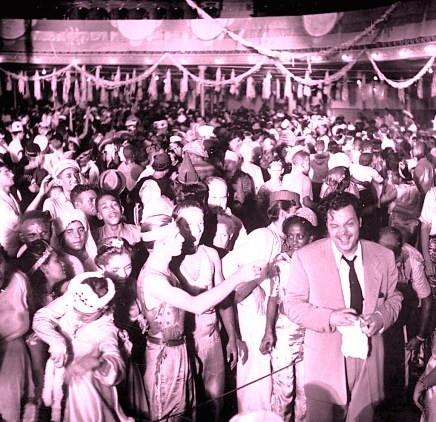
When WNYC’s Radiolab aired their live celebration of War of the Worlds five years ago, the odd laugh line was reserved for a moment at the start of the radio play when an announcer interjects “now we return to the music of Ramón Raquello and his orchestra.”
Raquello, as the Radiolab team makes clear, didn’t exist, and his “orchestra” was just an anonymous phonograph recording of the famous tango “La cumparsita.” Welles apparently chose the song for its “tedium,” hoping it would make believable the lunacy to come. That the music of the Southern Cone set up listeners in the United States for the greatest hoax in history might have been yet another of the inside jokes Welles left us to listen for.
The sounds of Ramón Raquello and the settings of some of Welles’s most famous films—The Lady From Shanghai (1947); Touch of Evil (1958)—remind us how Latin America, and its relationship to the United States, fascinated Welles in the late 30s and 40s. Five years after War of the Worlds, he began the final episode of his CBS program Hello Americans by recalling the show’s mission: “It is important for the people of this hemisphere to get better acquainted, and the Mercury [Theater] has been given the job of helping out with the introductions.”
An artful propagandist, Welles told Nelson A. Rockefeller, FDR’s head of Inter-American Affairs and Welles’s boss at RKO studios, that radio and film were the best way “to sell South America to North America.” Between 1938 and 1943 his technical innovations in film and radio, in addition to a 1942 stint as a “good will ambassador” to Latin America, created for him by Rockefeller, were meant to convince U.S. audiences of FDR’s claim in his first inaugural that the United States should follow the policy of the “Good Neighbor.” Whether listening, watching, or reading his work during World War II, Welles’s U.S. audiences were constantly reminded that they were residents of the Americas, rather than an exceptional and isolated America.
To assess the aesthetics and politics of Welles’s engagement with Latin America, it’s worth returning to the October 30, 1938 broadcast of War of the Worlds. Presented as a live news report of an alien invasion on the East Coast of the United States, War of the Worlds sent its mass audience into hysterics, proving to Marshal McLuhan that radio was “a tribal drum,” capable of calling forth the “archaic forces” of “the resonating Africa within” (301). The primitivist and racist logic in McLuhan’s Understanding Media (1964) sought to explain away the irrationality he (and his Frankfurt School forebears) identified as the enlightenment’s dialectical twin by exiling it to Africa. In this, he might have merely followed Welles’s Mercury Theater, which aired a production of Joseph Conrad’s Heart of Darkness a week after War of the Worlds, thus linking an allegory about fascism (and radio’s dangerous complicity with irrational politics) to a Conrad adaptation that critic Michael Denning calls “a fascist parable” exalting “power for power’s sake” (376).
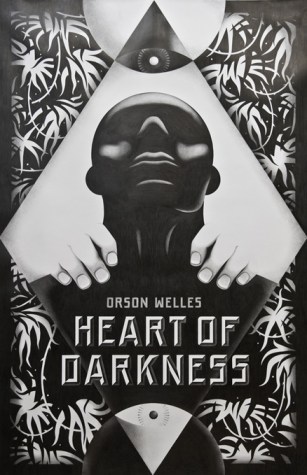
Yet these radio works concern themselves with fascism from very different narrative and social positions. While War of the Worlds depicts an alien invasion, his Heart of Darkness describes a journey towards the alien racial Other, presenting listeners with what had become by 1938 the more mundane miracle of radio—to bring them close enough to hear Kurtz’s haunting repetition: “the horror, the horror.”
Welles, who plays both Kurtz and Marlow in the conversation that leads up to these climactic lines, depicts here the seductive power of his own voice, able to encapsulate the story’s most important characters, and, as Kurtz, to impress even himself, as Marlow.
“Mr. Kurtz,” Marlow / Welles says with awe, “is a remarkable man.” Repeating a line heard throughout the play, Marlow’s words are slyly deflated when they are echoed, with a tone of critical distance, in the voice of one of the ivory company’s employees, a voice that stands in for the listening audience, and encourages their own distrust of Marlow’s naïve faith in Kurtz’s lust for power.
Meanwhile, the play tells a complimentary story of proximity and distance: as the boat moves back down the river, the music shifts from tribal drums to spiritual laments to a meandering jazz saxophone, tracing, in basic and exoticist fashion, a capsule history of African diasporic music.
One year later, Welles also attempted to adapt Heart of Darkness as his cinematic directorial debut for RKO, shifting the frame narrative to New York City, while planning to shoot on location in Panama, where expansion had begun that year on the Panama Canal to allow for the transportation of US warships. For this project, Welles planned a first-person camera technique, mimicking his radio work with first person address. The Mercury Theater’s program, originally named “First Person Singular,” placed listeners on the scene. In film the technique became even more immersive, plunging the audience into uneasy, inescapable identification with Marlow’s point of view.
 The first person in Welles’s screenplay combines Heart of Darkness’ journey into alien territory with War of the Worlds’ alien invasion—the sense that the audience was under attack. Forced to look out through the eyes of the imperialist adventurer Marlow, the audience surprisingly became the object that everyone in the film watches. The technique could prove threatening to the predominantly white and male movie audiences in the United States of 1940, as Welles planned to enlist 3,000 African American actors to play the so-called natives on the shores of the river—2500 more black extras than worked in Hollywood at the time. When the audience fell under the black gaze in the Canal Zone, where African American men increasingly worked as part of the defense industries, the story’s imperialist theme would have pointed back to the United States’ own racist working conditions, revealing the nation’s complicity and subordination to the imperialist pursuit whose destiny is the primitivist conditions it creates.
RKO rejected Welles’s screenplay, as they did his later documentary project, It’s All True, which sought to transform his 1942 trip throughout Latin America into a tale that fused “the story of samba” with “the story of jazz” to situate African American and Afro-Brazilian musical cultures at the heart of Pan-American culture. Welles soon repurposed the material from It’s All True for a radio program entitled “Hello Americans” that attempted to complete the shift in representation towards a more lateral and dialogic notion of adjacency, positioning U.S. and Latin American culture on the same plane. The means to make these introductions included interviews with and recordings by musicians from Cuba, Brazil, and Mexico, historical tales about Montezuma, Toussaint L’Ouverture, Benito Juárez, Atahualpa and others.
In the show’s most experimental section, Welles simultaneously reinforces and mocks the idea that radio’s ability to collapse distances and transcend borders makes it the medium to communicate the idea of neighborliness.
 Transporting his audience to “a clay hut somewhere in South America,” Welles introduces a small family in which the son, Juan, builds radios at a new factory, and his father, José, listens to the device. Once the broadcast begins, the listening audience within the frame—Juan, José and his mother—share the same space as the audience listening to “Hello Americans.” All listen together as a broadcast voice introduces Roosevelt’s inaugural address, then Roosevelt’s recorded voice announces his policy of the Good Neighbor, and finally static interrupts Roosevelt’s voice, and a German accented voice takes over to complain about “the republic of the Jew Franklin Roosevelt.” When José comments that the broadcast seems strange, his son Juan answers, “Oh no, they’re all like that. Señor Schmidt at the factory told us it’s uh, it’s because we’re closer to Germany.” Then, a musical curtain falls and Welles returns to reassure his audience that “Juan has learned. Today he works in another factory and he’s a member of the Latin American Confederation of Workers.”
The passage distinguishes between voices—José, Juan, the US broadcaster, Roosevelt, and the German propagandist—and reflects the imagined proximity implicit in Roosevelt’s idea of the Good Neighbor. But the technique also reveals how “Señor Schmidt” and his countrymen take advantage of the geographical confusion made possible by radio’s transcendence of borders to imply that Germany is actually more of a “neighbor” than the United States. These types of confusion between imagination and reality had once launched listeners into panic, but now Welles steps in to calmly and condescendingly reassure the audience that Juan “has learned.” Learned, that is, to join the left leaning Confederation: an untenable statement on US radio less than a decade later.
And yet, the unnamed obstacle impeding both foreign transmissions is language itself. Because everything filters through English, with accents marking the space between Spanish and German, Hello Americans imagines Pan-Americanism through one language alone. Radio’s monolingualism highlights one of the medium’s limitations. Whereas It’s All True could employ subtitles, and allow audiences to listen to a subject’s voice while reading what they said, radio faltered on its most medium-specific component – words.
 Furthermore, while Welles imagines a “neighborhood” for all Americans, listeners lose the more radical racial politics he had once placed at the center of his Haitian Macbeth (1936), Heart of Darkness (1938), his theatrical production of Richard Wright’s Native Son (1941) and It’s All True (1942). Together these works place the African diaspora at the center of U.S., Pan-American, and world culture. They insist that the attack on fascism abroad must include a change in race relations at home. More ambivalently, they reveal Welles participating in acts of love and theft – a New Deal Kurtz, he draws the power to criticize fascist power from exoticized images of Afro-Caribbean, Afro-Brazilian, and African American cultures, supporting and appropriating the art and struggles of the African diaspora to bill himself as the cultural leader of, not just the ambassador for, Pan-Americanism.

Orson Welles as Othello (1952)
—
Tom McEnaney is an Assistant Professor of Comparative Literature at Cornell University. His work focuses on the connections between the novel and various sound recording and transmission technologies in Argentina, Cuba, and the United States. He is currently at work on a manuscript tentatively titled “Acoustic Properties: Radio, Narrative, and the New Neighborhood of the Americas.”
—

REWIND! . . .If you liked this post, you may also dig:
DIANE… The Personal Voice Recorder in Twin Peaks—Tom McEnaney
On the Lower Frequencies: Norman Corwin, Colorblindness, and the “Golden Age” of U.S. Radio–J. Stoever-Ackerman
The Sound of Radiolab: Exploring the “Corwinesque” in 21st Century Public Radio— Alex Russo
Share this:


Current Top Posts





April 2021

January 2020

November 2019

October 2019

August 2019

April 2014

November 2017

March 2015

December 2017

October 2015
 Sounding Out!
Recent Comments