
Listening to Interiors, Silo #5
 Early in Jonathan Sterne’s (2003) book The Audible Past he writes, “hearing is concerned with interiors, vision is concerned with surfaces” (p. 15). This binary is in many ways gospel in sound studies. Martin Jay (1993) has established in his work, Downcast Eyes, a similar division between observations, the ocular, and listening, the speculative (p. 85). Most other literature takes a similar perspective – the sonic interior is a main methodological praxis of sound studies. When deciphering the speculative, listening is still the first, best tool, for interpreting an interior. I wonder, what it means to extend this metaphor into space. What does it mean, interpretively, for a sound wave to ricochet through a reverb spring, to yell in a claustrophobic hallway, or to listen with headphones instead of speakers. What is the culture of the interior, and how is it heard?
One place to look is the fantastic but infrequently publicized (although it has gotten some notable press) Silophone. An abandoned grain silo in Montréal, Silophone has been wired to serve as a medium of anonymous communication, and reverberation since November 2000. It’s easy to reach too, just call 514-844-5555. After the second ring, you are patched in to Silo #5, where your words are broadcast to ricochet around the abandoned building. Contributing to a participatory soundscape where several voices contribute to an ever changing, echoing interior. Silophone is definitely art, it is intrinsically technological, certainly audible, and it is almost social.
One striking question about Silophone is what exactly it means, what are the cultural stakes of an anonymous and collective interior? Can it be read as a critique of the ambiguity of network society, the futility of translation in an increasingly global culture? As the sounds refract against the walls of the silo and compete against one another, it is hard to decipher a clear signal, let alone consider a dialect or source. Conversely, Silophone also represents the possibilities of a network commons. Even though one sound rarely emerges as dominant, this relates to the counter-hegemonic aspects of the interior. Inside, hearing privileges proximity, and quiet. The less participants, and the closer your receiver is to a speaker, the more likely you are to hear a sound. Though this is a similar to the listening politics of everyday life, it should be noted that the silo is an experiment of space; the dynamics of its audible space emulates a virtualization of voices unprecedented in non-abstract spaces.

Listening to an interior is an important way to consider the politics of specific objects and architectural configurations. It is a way to render and think through the spatial configurations of space-less phenomenon: sounds, ideology, opinions and ephemera all belong to the interior, and it is important to develop tools for discussing them in a way which is not degraded to mere speculation. Silo #5, once a hub of cacophonous conversation, is now silent, somewhat forgotten and out of vogue. Does this reflect a social shift away from telephone-mediated relations, a societal shift in the practice of hearing? Although the interior of the silo models an anonymous and semi-random collective, other interiors may model other things. What do the interiors of computers, subways or classrooms model? Further, with listening as a method, can we begin proximate our interior selves?
AT


Share this:

Y2K, Collective Ritual, and Sound in the New Millennium
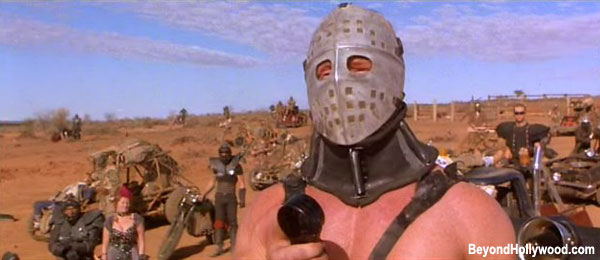 The recent New Year brought back some slightly embarrassing memories of past ball-droppings, 1999 in particular. That was the year, you’ll remember, when the world as we know it was to end due to all the clocks in all computers reading 0000 instead of 2000 – nuclear plants were to implode, bank accounts would be scrambled and a month later, the world would resemble some scene from The Road Warrior. I’ll fess up. I bought into the Y2K hype hook-line-and-sinker. I hunkered down in my living room with some old friends playing Risk that New Year’s Eve, I awaited an event of cataclysmic proportions. As the countdown droned on TV, it seemed every dice roll took me one step closer to the end . . . 10, 9, 8, 7, 6, 5, 4, 3, 2, 1. Upon zero, nothing changed and anxiety slowly began to leak from my body. Sting appeared on TV and introduced the new millennium with his jazzy “Brand New Day.” With lyrics about time and second chances, I grew to associate the song with a sense of profound relief. No matter how hokey Stings lyrics were (he uses the term “fuddy-duddy” at one point), “Brand New Day” will forever remind me of second-chances and possibility. Part of a clever advertising coup designed to reinvigorate Sting’s flagging career, the gospel tropes used in “Brand New Day” fit as a discursive response to the apocryphal (and apocalyptic) conversations circulating about Y2K at the time.
The history of technology is filled with utopian and dystopian visions of the future. Famously depicted in Apple’s “1984” commercial, the technocratic American narrative (Think Reaganomics) goes something like this: While developments in technology can allow for an increased sense of autonomy and individuality, they are unerringly used for evil. This evil strongly resembles a stereotypical Soviet culture where individuality is sacrificed for the good of the collective whole. Therefore, good technology promotes the individual while evil technology supports the collective.
 If this seems a little heavy handed, it should be noted that the whole endeavor of mass computing has its roots in American Cold War history. After the atomic catastrophes of Hiroshima and Nagasaki, Vannevar Bush, then Director of the Office of Scientific Research and Development, predicted the Internet with the “memex machine” in his article to The Atlantic, “As We May Think.” Written to an unassuming audience, Bush suggests the destructive potential of atomic weaponry heralded a concrete limit to traditional methods of warfare, because of this the next battlefronts would be informatic. Y2K is a dystopic variation on this theme, atomic blow up by-way-of nuclear power had even become incorporated into some of its myths. These myths were a fantasy, to be sure, but they were rooted in the collective fears of a confused and dysphoric America, an America which had recently overcome Communism and lauded its rapidly developing technological sector as a new source of economic capital on the world stage. Y2K was scary because it played on a cultural fear of technology, which was paradoxically one of America’s key exports at the time.
It is an interesting contrast between the cultural environment of post-Cold War America and the loose backup calls of “brand new day,” with its rhythmic pleas to “stand up!” increasing in frequency and intensity as the song continues. Though the song has nothing to do with Y2K, or even technology, its position as a televised event after the ball dropped December 31, 1999, had solidified it forever in my imagination as a spiritual reaction to the technological paranoia of the time. Sting conveys a baptism narrative; as a country we had mysteriously been absolved of our technocratic sins. I was (and am) a believer. As I sit writing this on my iMac, I consider the many marketing strategies Apple has used in the last decade to convince me of the ways their software and hardware could define me as an individual. Sting redeems the pursuit of individuality through the use of gospel tropes. Instead of an almighty passing the judgement of heaven or hell, a technocratic neoliberal economy threatened the wrath of Y2K to nonbelievers at the turn of the millennium. As the proverbial gates to a new era of prosperity opened, Sting climbed higher in falsetto, “Stand up and be counted every boy and girl/Stand up all you lovers in the world/We’re starting up a brand new day.”
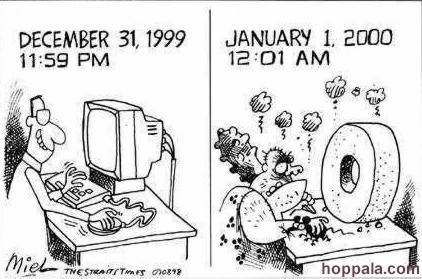
This year, as I watched a web steam of the ball drop January 31, 2010, I was able to later navigate to the MTV website and enjoy a Flaming Lips concert in Oklahoma City live from my computer. In this transition, something struck me. The potentials of computing, particularly video and sound editing (iMovie, Garageband and their disseminatory middle-man YouTube) still rely on an earlier Cold-War rhetoric of individualism and creative innovation to express the potential strengths of technology. Meanwhile any sense of collective ritual is set to the whim of a mouse-click, from New York to Oklahoma in a heartbeat. These new rituals compete with the old in a new context of hyper-individuality; ironically “Brand New Day” has become stuck once more in my head, as it has been routinely on New Years for the past 10 years. From these changes in collective ritual, what will it mean to celebrate the new year in 2011?


Share this:


Current Top Posts





April 2021

January 2020

November 2019

October 2019

August 2019

April 2014

November 2017

March 2015

December 2017

October 2015
 Sounding Out!
Recent Comments