
Fear of a Black (In The) Suburb

 Editor’s Note: This month Sounding Out! is thrilled to bring you a collection of posts that will change the way you hear cities. The Sounds of the City series will prompt readers to think through ideas about urban space and sound. Are cities as noisy as we think they are? Why are cities described as “loud”? Who makes these decisions about nomenclature and why?
We kicked things off two weeks ago with my critical reading of sound in Lorraine Hansberry’s A Raisin in the Sun, a play about African Americans in Chicago that still rings/stings true today. Guest writer Linda O’ Keeffe took readers last week on a soundwalk of Smithfield Square in Dublin, Ireland and specifically of the Smithfield Horse Fair, in order to illustrate how urban renewal disrupts city soundscapes and how sound reclaims those spaces. Next week CFP winner Lilian Radovac will share with us a photoessay on the sound installation Megaphóne in Montreal.
Today’s post comes from regular writer Regina Bradley whose post reminds us of the recent verdict of the Michael Dunn case, the “loud music case” when he shot 17-year-old Jordan Davis at a gas station. She discusses the dichotomy of urban and suburban in the context of sound (noisy versus quiet) and hip hop.
Edited on Feb 17, 2014 at 9:35 am EST: the first published version of this post did not acknowledge Nina Sun Eidsheim as the coiner of the phrase “sonic blackness.” We have added a reference in the post to recognize the work Eidsheim has done in theorizing this concept.–Managing Editor Liana M. Silva-Ford
***
In a recent Chase credit card commercial a white woman pulls up to a gas station and pumps gas into her minivan while blasting loud music. Her windows rattle and the toys of her children vibrate to the beat. After pumping gas, the woman hops into her car, puts on a pair of shades, and bounces to the beat like a “cool mom.” In the context of the commercial, the white suburban mother is not threatening. The commercial reminds me that Jordan Davis’ life ended at a gas station in Jacksonville, Florida. His loud hip hop music was not cool; in fact, he and the music are perceived to be threatening.
The woman in the Chase commercial borrows what is instantly recognizable as sonic black (masculine) cool. Nina Sun Eidsheim, in her article “Marian Anderson and ‘Sonic Blackness’ in American Opera”, theorizes sonic blackness as the racialization of sounds that listeners perceive to be coming from a black body. Borrowing from her concept, I extend sonic blackness as the sound that are perceived as black that enter spaces where physical blackness could be readily refused. Of particular interest for this essay is the connection between black mobility, urban space, and sound. I focus particularly on hip hop as a mobile form of sonic blackness whose origins are based in the city. Hip hop reinforces conceptualizations of contemporary blackness as urban. In this context, sonic blackness collapses the absolute binaries in which blacks are frequently forced to exist, i.e. urban and rural, working class and middle class, silence and noise. Yet when it is situated in hip hop, sonic blackness can also be considered a disruption of suburbia, a dominant trope of white privilege at the end of the 20th century. Using examples from the contemporary cartoon show The Boondocks, I posit that the show’s use of hip hop underscores how the white suburban soundscape is constructed in contrast to black urban sounds.

Screen Shot Leave It to Beaver ending credits
America’s popular imagination portrays the suburbs as white, middle class, and quiet. Constructions of the suburbs in recent history have not strayed far from the idealistic neighborhoods of the 1950s and 1960s portrayed in shows like Leave It to Beaver. Take for example the inclusion of gated communities as the upper echelon of suburbs and white privilege seen in The Real Housewives of Orange County (which opens with the viewer ‘walking through’ opened gates into the Orange County community). I’d like to emphasize the connection between whiteness and quiet, as privilege in these types of spaces is present but often not visible or audible. Suburbs are the result of urban industrialism, anxiety of close association with an increasing minority community, and the need to sustain a romantic ideal of the American dream. A suburb’s physical parameter is a middle-class manifestation of manicured lawns, gates, and homeowner associations. At the level of sound, the suburbs’ class privilege is represented as the hum of lawn mowers, chirping birds, and screeching breaks of school buses. As Steve Macek points out in Urban Nightmares: The Media, The Right, And The Moral Panic Over The City, suburban sensibilities cling to an idealistic notion of a physically and sonically constructed white ambivalence to racial and class anxieties associated with cities. Any dysfunction associated with whiteness is quietly tucked away from public view.
White suburbia sustains its desirability because it is a physically and sonically segregated space. Yet white suburbia is also the site of black Americans’ most recent migratory efforts. In ways that northern cities signified opportunity for blacks in the early 20th century, the ideals of racial progress and class in the late 20th century have shifted to U.S. suburbs. Thoughts of the middle class in the black imagination amplify the suburb as a utopic space because of its initial lack of access. The suburb becomes the mountaintop of racial access and privilege.

“A Raisin in the Sun 1959 2” in the public domain via Wikimedia Commons
Consider the premise for Lorraine Hansberry’s 1959 play A Raisin in the Sun. Hansberry examines in the play the high stakes of home ownership in a ‘good neighborhood.’ The Lee family leaves the Southside for the opportunity at a better life and more space for their growing family. As Liana Silva-Ford pointed in her discussion of A Raisin in the Sun two weeks ago, the Lee family’s decision to move into the Clybourn Park neighborhood disrupts the suburb as a space of white privilege and annotates the cusp of the emerging Civil Rights Movement. Additionally, visual demonstrations of black protest that reach suburban areas are annotated by sonic markers of struggle i.e. the sound of attacking guard dogs, police officers screaming at protestors, spraying fire hoses, and screams and moans of black bodies under attack. The audio-visual representation of the struggle of integration collapses the notions of white suburbia as a site of ‘perfect peace.’ The above referenced sonic markers also destabilize classifications of black trauma as restricted to urban spaces like the inner city, which is believed to embody blacks’ realities.

“Damen – Boondocks” by Flickr user Ian Freimuth, CC BY-NC-ND 2.0
Where Hansberry’s interrogation of space and access in Raisin in the Sun is an initial foray into constructions of white privilege vis-à-vis suburban communities, Aaron McGruder’s 21st century suburban space of The Boondocks pivots on the romanticized ideas of blacks in middle class spaces derived from the 1950s and 1960s. The show introduces viewers to patriarch Robert (Grandad Freeman) and his two grandsons, Huey and Riley Freeman, who have left the south side of Chicago for the white suburb of Woodcrest. McGruder incorporates sonic markers of race and class that collapse suburbs as white only spaces. Aside from lighthearted lounge music style piano riffs during dialogues that indicate whiteness, McGruder incorporates sonic elements of hip hop that interrupt white suburbia. Elements of sonic registers of hip hop, like heavy bass kicks and songs like “Booty Butt Cheeks” or “Thuggin’ Love,” disrupt the quiet of the Woodcrest community.
The clash of hip hop’s loudness with Woodcrest’s quiet demeanor is best demonstrated in the episodes “The Story of Thugnificent” and “The Block is Hot.” In “The Story of Thugnificent,” rapper Thugnificent decides to move to Woodcrest. His presence is heard before it is seen, a caravan of cars with bass systems playing “Booty Butt Cheeks” before he actually appears on screen. Thugnificent’s arrival is striking as he introduces hip hop as a literal and sonically disruptive element of black working class cultural expression. The disruption is celebrated, however, because of Thugnificent’s allure as a rapper. He gets a pass that Grandad Freeman questions because he sees Thugnificient as a threat to what he perceives to be as a delicate existence of his blackness in a white community.
Grandad Freeman’s vehement opposition to embrace “the homie” Thugnificent destabilizes notions of policing as a one-sided scare tactic by whites. Yet to repel Thugnificent’s physical and sonic presence, Grandad resorts to hip hop and records a diss record that demands Thugnificent to leave Woodcrest. The diss record parodies the sonic notes of a rap battle: Grandad starts the track with ramblings of “yeah” and “uh.” Where these terms are used in a rap battle to try to “catch the beat,” Grandad’s use of these words is an offset attempt to try to find something to say. The result of Grandad and Thugnificent’s rap battle on wax is a rise in physical violence against senior citizens in Woodcrest. The awkwardness of Grandad’s diss track parallels not only a generational dismissal of hip hop as an outlet of protest but the sonic awkwardness of hip hop being the voice of protest for a suburban space.

“Fight the Power” single cover, by fair use under US copyright law
In the episode “Block is Hot,” a nod to rapper Lil Wayne’s same titled track (although he nor the song are mentioned anywhere in the show), Huey Freeman blasts rap group Public Enemy’s pro-black and anti-police brutality anthem “Fight the Power” to remind his neighborhood he is a black nationalist. He is also dressed in a black hoodie and black timberland boots. Huey is undeniably hip hop in a privileged white space. Huey’s physical apparel, a nod to the Black Panther party and the hip hop fashion affinity for wearing the color black is amplified by “Fight the Power.” Huey’s posturing can also be read as a homage to Radio Raheem from Spike Lee’s 1989 film Do the Right Thing because like Radio Raheem, Huey lugs around a large boombox to play “Fight the Power.” Particularly striking is the overlap of the urban hip hop masculinity Raheem signifies with Huey’s own hip hop posturing in Woodcrest. While Raheem remains in the ‘hood, Huey doubly signifies hip hop’s migration from the city into suburban areas as well as his own migration to Woodcrest from Chicago. Huey uses hip hop as a site of social-political resistance and as a way to remain attached to his urban roots. Blasting “Fight the Power” shows how Huey remains conscious of white privilege in Woodcrest. He recognizes the need to identify black agency – even if it is only emphasized through sound – while reflecting on the “new” suburb as a racially ambiguous space.
The most jarring use of sound to reflect on the racial politics of the new suburb is the shooting of Uncle Ruckus by police officers. The ricochet of the bullets can be heard against cars and other inanimate objects but the bullets miss their target, Ruckus. The gun shots mark an interruption of the suburban soundscape. Gun shots, sonic signifiers of power, death, and trauma, are also markers of black violence as an urban phenomenon. However, negotiations of power shift to speak to reclamation of white privilege in sonic and physical spaces . The gun shots inflicted upon black bodies in suburban spaces could also be read as a subversion of gun shots heard in hip hop. While the sound of a firing gun in the hip hop imagination is expected and acceptable, gun shots in white suburbia are disruptive and displaced because they contest its appearance as a quiet and respectable space. Further, the sonic significance of the bullets riddling everything around Ruckus is the messiness of the hit-or-miss surveillance of black bodies, particularly black men, as necessary in privileged white spaces.

“Jacksonville Florida Sheriff’s Office Impala” by Flickr user Dfirecop, CC BY-NC-ND 2.0
The policing of black bodies in suburban spaces, especially over the past two years, begs the question of how suburban soundscapes serve as backdrops of 21st century racial anxieties and whiteness. The centrality of sound in the deaths of Trayvon Martin, Renisha McBride, Jordan Davis, and Jonathan Ferrell,– i.e. 911 tapes and banging on house doors – is critical in identifying race and space. Sonic markers of racial anxiety in their deaths devastatingly reemphasize the connection of race and sound in white privilege spaces. For example, Davis’ killer Michael Dunn stated to his girlfriend that he “hate[d] that thug music.” Unlike the suburban mom in the Chase commercial, Dunn is threatened by the sonic blackness and hypermasculinity associated with loud [hip hop] music. The negative connotations of hip hop as “thug music” and Davis’ mere presence as a young black man trigger a devastating response to the disruption of white privileged space.
As I work through my visceral response to Michael Dunn’s not guilty verdict for the actual slaughter of Jordan Davis, I think about the frivolity of the suburban mom in the Chase commercial and her enjoyment of loud music. The overlap of her whiteness, gender, and status as a suburbanite protect her from any inclinations of being a menace. She uses loud music as a sense of liberation – a premise for the Chase Freedom card being promoted in the commercial. Unlike Chase’s suburban mom, Jordan Davis’ use of loud music is not freeing – it contextualizes him in a rigid space of hypermasculinity and pathology that is all too often associated with hip hop culture. As I discuss previously, the traumas associated with black bodies that cannot be literally articulated take place in nonliteral spaces like sound. Utilizing sound is particularly useful in situating blackness in privileged white spaces like suburbs that displace their agency and significance because of racial anxieties associated with space and class.
—
Regina Bradley recently completed her PhD at Florida State University in African American Literature. Her dissertation is titled “Race to Post: White Hegemonic Capitalism and Black Empowerment in 21st Century Black Popular Culture and Literature.” She is a regular writer for Sounding Out!
—
Featured image: “Dead End in the Burbs” by Flickr user Vox Efx, CC BY 2.0
—
 REWIND!…If you liked this post, you may also dig:
“Death Wish Mixtape: Sounding Trayvon Martin’s Death”-Regina Bradley
“From Illegitimate to Illmatic: On Tiger Mothers, Ethnoburbs, and Playing the Violin While Dreaming of Nas”-Christie Zwahlen
“Sound Off! // Comment Klatsch #7: #RachelJeantel asks: Are you Listening?”
Share this:

Making Music at Studio X: The Identity Politics of Community Studios

What are the social obligations of what I term “community studios”— spaces that exist to provide “at-risk” youth access to free or low-cost music recording equipment, services, and education? This essay reflects the findings of a four month ethnomethodological project, in which I explored the institutional and social affordances of Studio X, a community studio located in a rural college town in upstate New York. Using information from interviews and several hours of observation in the studio, I argue that community studios are subject to unique institutional pressures that emerge from their framing as both professional studios (private enterprises with no restrictions on creative expression) and community centers (shared spaces, which, in this context, are designed to provide oversight and the proper socialization of youth through rules and activities). While tapping into private and philanthropic revenue streams has resulted in the development of some exceptional studio projects, it has also led to a problematic situation where the studio has trouble establishing an independent identity for itself. This essay hopes to offer a critical perspective and, in doing so, offer some suggestions to help community studios deal with these challenges.
Community studios offer a different studio model than the standard professional or DIY models typically discussed in academic literature. While recent work by Eliot Bates and Susan Schmidt Horning has done an excellent job of framing the sociohistorical contexts of commercial music studios, neither adequately addresses the politics of community studios. These politics, however, cannot be taken for granted as they challenge Bates’ contention that studios “isolate studio workers from the outside world, and the world from studio work, while possessing a visual and audible difference from other work environments.” Contentiously, community studios represent a unique set of stakeholders including parents, donors, youth, and community center administrators, amongst others. The community studio is far from isolated, however, and its identity, therefore, is in constant flux.
Studio X was developed in 2006 with funds from a $65,000 grant from the New York State Music Fund, a board created by the Rockefeller Philanthropy Advisors to dispense over $35 million in settlement money from music businesses that profited from “payola” practices. It was conceived as a space where predominantly low-income African American youth would have access to professional recording equipment and training. According to the grant proposal, technical expertise was to be supplemented with classes that contextualized the music within “the socio-political, and social justice significance and origins of hip-hop, reggae, and other forms” in addition to making connections with “jazz, African percussion, and contemporary world music.”

A picture of Andrew Carnagie’s philanthropy. Borrowed from Wikimedia Commons.
Many of Studio X’s goals had been met. On my first day there, I encountered a local singer who spoke with me for over an hour, praising the studio for giving him the opportunity to use a voice he claims to have wasted in jail. Another respondent explained that the studio helped to shed positive light on an area that is often categorized in negative and judgmental terms. He remarked: “More people should know about [the studio]. Show more appreciation. They should come down and see what we’re about down here. It’s not all negative. Good things happen at [Studio X].”
Not all was well with Studio X, however, as I learned when I encountered an administration struggling to negotiate the studio’s joint identity as both a community center and a professional studio. At the helm was Eric, an audio engineer by training, and the full-time director of Studio X. Since accepting the position in 2012, he had been crafting the space in the likeness of a professional studio. Free music production and engineering classes ceased and he even began offering private sessions with better equipment at the rate of $25 an hour. Eric justified this decision by explaining that the fee helped to ensure that people actually kept their appointments, and the better equipment yielded superior recordings. He also insisted that a large percentage of the funds these sessions earned ultimately supported the community center and studio.
Community response was mixed. Many respondents noted that they trusted Eric, with a few even suggesting that he should charge more. One respondent, a local producer, felt Eric’s pay sessions were a reflection of greater economic trends in cloud music sites, like Soundcloud and Reverbnation, that allow artists to tailor their investment through incrementally priced packages.
A number of community members, however, were deeply disturbed by this change. One local rapper claimed that turning Studio X into a “real studio” had never been a part of its original mission. They were fearful that the space’s shift towards a professional studio in structure implied the troubling imposition of capitalist hierarchies. This contention is echoed by scholars like Louis Meintjes and Tricia Rose, who state that studios and other technologies of musical (re)production are always deeply representative and constitutive of the greater institutional structure of the music industry.
The studio also furthered a number of questionable social policies. Upon the studio entrance was a sign that detailed rules for proper conduct. Not only did the studio maintain a dress code, but it also censored lyrical content. The sign displayed six rules:
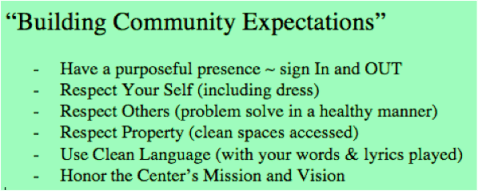
This sign was taped to the door at Studio X.
When I asked Eric about these rules he indicated that he’d written these rules to avoid running into trouble with parents and with the Executive Director: “I just don’t want to be known as the guy who lets 14 and 15 year olds come and say whatever they want…Usually kids that age don’t have language like that although a few times I had to tell them to use different language or I had to tell them to leave.” Thus, according to Eric, Studio X’s success as a community center meant the censoring many of its patrons. But how did Eric’s decision affect the narratives of the studio’s constituents?
This research suggests that the administrative politics of community studios has deep implications for inclusion and identity of community members. Although it’s easy to dismiss Eric’s decisions to charge for studio space and censor language as racist, the reality is that many members of the community respected his leadership and felt he was guiding Studio X towards a positive direction. Eric’s vision, in other words, worked to produce a culture of ideological support within the community itself.

A screenshot of Avid Protools 11 software.
Even though Studio X represents only one community studio, its identity struggles are certainly worth noting as similar institutions crop up around the world. How can community organizers best create a recording space that is safe, professional, and productive for members of low-income populations?
To start, organizers must recognize how the strings attached to philanthropic grants can lead to poor administrative choices. The institutional design of community studios mirrors the demands of broader grant-funding institutions, from which community studios derive their primary income. In order to provide community members with tools to produce work that is “competitive,” at least from an audio engineering perspective, community studios must invest in expensive equipment or risk coming across to both community members and potential investors as a poor alternative to daycare.
To adequately support these spaces, administrators and other stakeholders must insist on finding new and creative ways to raise clean money. Beat Making Lab, a community studio initiative that has connected educators and artists with community centers and schools across the globe since 2012, allows supporters to directly contribute and sponsor the purchase of specific equipment and development of projects. Still, it relies on its grant partnership with PBS to reach a larger audience. Similarly, Notes-for-Notes, an organization founded in 2006 toward the development of positive spaces for youth to learn about, create, and record music, receives private funding and sponsorship from celebrities and music production companies among others; it is also the recipient of funds from a number of philanthropic grant institutions.The alternative to these innovative funding tactics is to imagine, construct, and present a studio that is primarily concerned with “positively” shaping the character of young men and women in an effort to appease questionably minded philanthropists, even though this maneuver often compromises the culture, community, and content of the community which the studio itself exists to support.
—
Enongo Lumumba-Kasongo is a PhD student in the Department of Science and Technology Studies at Cornell University. Since completing a senior thesis on digital music software, tacit knowledge, and gender under the guidance of Trevor Pinch, she has become interested in pursuing research in the emergent field of sound studies. She hopes to combine her passion for music with her academic interests in technological systems, bodies, politics and practices that construct and are constructed by sound. More specifically she would like to examine the politics surrounding low-income community studios, as well as the uses of sound in (or as) electronic games. In her free time she produces hip hop beats and raps under the moniker Sammus (based on the video game character, Samus Aran, from the popular Metroid franchise).
—
 REWIND! . . .If you liked this post, you may also dig:
Papa Sangre and the Construction of Immersion in Audio Games— Enongo Lumumba-Kasongo
Yellow Rain and The Sound of Matter: Kalia Yang’s Sonorous Objection to Radiolab— Justin Eckstein
The Noise of SB 1070: or Do I Sound Illegal to You?— Jennifer Stoever-Ackerman
Share this:


Current Top Posts





April 2021

January 2020

November 2019

October 2019

August 2019

April 2014

November 2017

March 2015

December 2017

October 2015
 Sounding Out!
Recent Comments