
Sounding Out! Podcast #47: Finding the Lost Sounds of Kaibah

CLICK HERE TO DOWNLOAD: Finding the Lost Sounds of Kaibah
SUBSCRIBE TO THE SERIES VIA ITUNES
ADD OUR PODCASTS TO YOUR STITCHER FAVORITES PLAYLIST
In the early 1960s Native American women had few opportunities and rights as citizens. During this politically charged era, a young Navajo woman, Kay Bennett, or “Kaibah”, defied those restrictions by recording and releasing her own albums. Almost fifty years later, we present this conversation with Rachael Nez, a Navajo scholar and filmmaker, whose research explores “Songs from the Navajo Nation” through Kaibah’s records. Kaibah self-published her own albums until she was signed by Canyon records, wrote and published her own books, and traveled the world performing Navajo music everywhere from the Middle East to Europe. Rachael looks at how Kaibah’s music acts as a site for the circulation of Indigenous knowledge, oral history, and resistance.
In this podcast Marcella Ernest speaks with Rachael about the scarcity of materials relating to Kaibah’s history. Although there is no archive of her work, and no coherent trace of her story in one site, she explains how we can piece together a story of Kaibah based on her albums and songs. This dialogue considers the ways in which Indigenous erasure can be recuperated through sound. The project of finding the lost sounds of Kaibah is a fascinating story of how sound can be used to reconstitute indigeneous identity. What social and cultural norms conspire to obfuscate a Navajo woman of such prestige and talent? Finding the lost sounds of Kaibah is a conversation about (re)searching to find a lost sound.
–
Marcella Ernest is a Native American (Ojibwe) interdisciplinary video artist and scholar. Her work combines electronic media with sound design with film and photography in a variety of formats; using multi-media installations incorporating large-scale projections and experimental film aesthetics. Currently living in California, Marcella is completing an interdisciplinary Ph.D. in American Studies at the University of New Mexico. Drawing upon a Critical Indigenous Studies framework to explore how “Indianness” and Indigenity are represented in studies of American and Indigenous visual and popular culture, her primary research is an engagement with contemporary Native art to understand how members of colonized groups use a re-mix of experimental video and sound design as a means for cultural and political expressions of resistance.
–
Featured image is used with permission by the author.
—
 REWIND! . . .If you liked this post, you may also dig:
Sounding Out! Podcast #24: The Raitt Street Chronicles: A Survivor’s History – Sharon Sekhon and Manuel “Manny” Escamilla
Sounding Out! Podcast #20: The Sound of Rio’s Favelas: Echoes of Social Inequality in an Olympic City— Andrea Medrado
The “Tribal Drum” of Radio: Gathering Together the Archive of American Indian Radio–Josh Garrett Davis
Share this:

SO! Reads: Dolores Inés Casillas’s ¡Sounds of Belonging!

 In Sounds of Belonging: U.S. Spanish-Language Radio and Public Advocacy (NYU Press, 2014), Dolores Inés Casillas turns up the volume on the sonic and the political dynamics of the Latino immigrant experience in the United States. A theoretically rich yet accessible book, Sounds of Belonging jump-starts Spanish-language radio studies, proving that the broader field of radio and sound studies can no longer continue to ignore or silence the importance of Spanish-language radio—from its historical significance for Spanish speaking Latinos to its lucrative place in radio markets today. Spanish-language radio reveals the power of sound in shaping the lived experiences of Latina/o communities, including immigrants and those with deep roots in the United States. Casillas shows how sound acts as a platform through which Latin Americans insert themselves in the U.S. imaginary, despite the nation’s attempts to erase their presence.
Sounds of Belonging provides keen insight into the constant buzz of immigration on the airwaves. Some questions that propel this book: What sonically constitutes the Latina/o experience in the United States? Also, what immigration-related sounds are found on Spanish-language radio airways? Casillas’s emphases shows how little we know of how the Latina/o sounds.
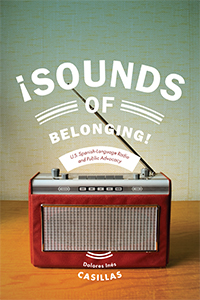 Sounds of Belonging deftly navigates the historical and contemporary domains of Spanish-language radio, theorizing them as a dynamic sonic terrain where we can listen to struggles for and against power, as well as to modalities of difference. Beginning with the traces of Spanish-language radio that emerged early in American radio’s so-called “Golden Age” in the 1930s-1940s, moving through the activist-driven bilingual Chicano community radio of the 1960s and 1970s, and then laying out the landscape of the highly profitable world of Spanish-language broadcasting today, Casillas guides readers through a historical trajectory of Spanish-language radio. She draws from Spanish-language radio broadcasting in its commercial and non-commercial iterations, while keeping tuned to the transnational connections transmitted through these frequencies.
Casillas engages with critical cultural studies, Chicana/Latina studies, and radio/media studies to explore the production of masculinity on El Cucuy’s morning radio program. Casillas studies El Cucuy as both an on-air personality and a political figure advocating for immigrants’  rights, illustrating the “complex interplay of gender, labor, and globalization” (104). While El Cucuy’s “shock-jock” style–imbued with sexual humor–often garners him comparison to Howard Stern or Rush Limbaugh, El Cucuy does more than shock and entertain his listeners. Casillas argues that sound and immigrant listening practices are integral to El Cucuy’s discursive aural constructions of a transnational working-class male audience, one that is not shamed for speaking Spanish, enjoying ranchera music, or laboring in “women’s work.” However, by highlighting how El Cucuy and his listeners reinscribe traditional gender roles that silence and marginalize Latinas, Casillas reveals the complexity of El Cucuy’s political advocacy for male workers on the one hand, and the program’s misogynistic message on the other.
Sounds of Belonging pushes scholars to think more thoroughly about the role format and genre play in the characterization of radio stations, as well as the audience constructed through these programming choices. She characterizes Spanish-language radio as both on-air dialogues and conversations between callers and radio hosts. This approach provides an intersectional analysis comparing radio listeners to those working in production. Casillas opens a line of inquiry into non-normative or non-hegemonic radio practices by positing that Latino radio listening is public and communal and not a solitary practice. Casillas shows how research that frames listeners as a market—simply audiences or consumers—polarizes our understanding of radio practices, particularly within research on Spanish-language radio.
One of Casillas’s most important interventions is her granular analysis of the role of radio in Latino communities, particularly within migrant and working class groups who may have easier access to and familiarity with radio, as opposed to other media such as the Internet. For these communities, radio becomes as an anchor, grounding the cultural ties Latinos have to the communities they migrated from—through stations’ language and music—but it also functions as a way to aurally migrate between borders, specifically when listeners-turned-callers locate themselves bi-nationally.

Casillas also argues that Spanish-language radio is an alternative site of congregation and dialogues amongst communities that are marginalized and made hyper visible by mainstream English-language media. Anti-immigrant policy and legislation—heard and seen in popular media as a narrative of “illegal aliens” invading America—is the backdrop against which Casillas explores the role of Spanish-language radio as an “acoustic ally,” a concept she explores in the chapters “Acoustic Allies: Early Latin-Themed and Spanish-Language Radio Broadcasts, 1920s-1940s,” and “Sounds of Surveillance: U.S. Spanish-Language Radio Patrols La Migra.” She explains that Texas and California were home to the debut of U.S. Spanish-language radio in the 1920s, crafted specifically for Mexican listeners. Radio announcers such as Pedro J. Gonzalez brokered airtime, typically broadcasting during the unfavorable times of late night or early morning. As a method of resistance, radio provided Spanish-language audiences with the capability of listening to “home.”

Images of Pedro J. González, who was also a musician and a founding member of Los Madrugadoras in addition to an important early Spanish language radio announcer
In the chapter “Mixed Signals: Developing Bilingual Chicano Radio, 1960s-1980s,” Casillas uncovers a major gap in research on the aurality of the Chicano Media Movement. She pivots the analytical lens of Chicano movement activism from urban to rural areas and traces the emergence of bilingual community in conjunction with farm worker activism in California and Washington. Bilingual community radio stations such as Radio KDNA in Granger, Washington, KBBF-FM in Santa Rosa, California, and Radio Bilingüe in Fresno, California—places that rely heavily on low-wage farmworker labor—showcase how the political activism of this movement era took place on emergent community airwaves. Listener-focused Chicano community radio stations “sought to broadcast independent of commercial influence, produce local programming, and, perhaps most significant, operate under the full control of Mexicans and Chicanos themselves” (52-53). While under the control of Chicano/a community radio producers, Casillas demonstrates how the funding model for community radio stations—namely, a heavy reliance on grants from the Corporation for Public Broadcasting—underscores the bureaucratic limitations for public broadcasts.
Sounds of Belonging opens the path for a new line of inquiry regarding Spanish-language radio while revealing that there is much work to do in the area of Spanish-language radio studies. Despite the chapter “Mixed Signals”’s focus on the community radio format, Casillas’s dedication to commercial radio highlights an urgent need for scholarship on non-commercial radio. Studying non-commercial stations will advance necessary conversations around content and innovation rather than economic success and failure.

Overall, Sounds of Belonging is an exciting and foundational text for scholars and readers interested in Latina/o media studies, sound, radio, cultural production, immigration and the Latina/o experiences in the United States as experienced and lived through sound and listening. Casillas’s agility in drawing from various theoretical and methodological perspectives provides a rich analysis of Spanish-language radio situated in a transnational context that reflects not just the listenership, but also the continued importance of radio for Latina/o communities living throughout the U.S. borderlands.
—
Monica De La Torre is a doctoral student in the Department of Gender, Women and Sexuality Studies at the University of Washington. Her scholarship bridges New Media and Sound Studies by analyzing the development of Chicana feminist epistemologies in radio and digital media production. A member of Soul Rebel Radio, a community radio collective based in Los Angeles, Monica is specifically interested in the ways in which radio and digital media production function as tools for community engagement. She is an active member of the UW Women of Color Collective and the Women Who Rock Collective. Monica earned a B.A. in Psychology and Chicana/o Studies from University of California, Davis and an M.A.in Chicana/o Studies from California State University, Northridge; her master’s thesis was entitled “Emerging Feminisms: El Teatro de las Chicanas and Chicana Feminist Identity Development.” Monica received a 2012 Ford Foundation Predoctoral Fellowship, which recognizes superior academic achievement, sustained engagement with communities that are underrepresented in the academy, and the potential to enhance the educational opportunities for diverse students.
—
Featured image: “Hi-Fi” by Flickr user Feans CC BY 2.0
—
REWIND! . . .If you liked this post, you may also dig:
SO! Reads: Daniela Cascella’s F.M.R.L. (Finding Materials for Remembering and Listening) — Kyle D. Stedman
The Sonic Roots of Surveillance: Intimacy, Mobility, and Radio — Kathleen Battles
Sounding Out Podcast #24: The Raitt Street Chronicles: A Survivor’s History — Sharon Sekhon and Manuel “Manny” Escamilla
Share this:


Current Top Posts





April 2021

January 2020

November 2019

October 2019

August 2019

April 2014

November 2017

March 2015

December 2017

October 2015
 Sounding Out!
Recent Comments