
Sound Bites: Vampire Media in Orson Welles’s Dracula

 Welcome back to our continuing series on Orson Welles and his career in radio, prompted by the upcoming 75th anniversary of his 1938 Invasion from Mars episode and the Mercury Theater series that produced it. To help us hear Welles’s rich radio plays in new and more complicated ways, our series brings recent sound studies thought to bear on the puzzle of Mercury‘s audiocraft.
From Mercury to Mars is a joint venture with the Antenna media blog at the University of Wisconsin, and will continue into the new year. If you missed them, check out the first installment on SO! (Tom McEnaney on Welles and Latin America) and the second on Antenna (Nora Patterson on “War of the Worlds” as residual radio).
This week, Sounding Out! sinks its teeth into Orson Welles’s “Dracula,” the first in the Mercury series, and perhaps the play that solicits more “close listening” than any other—back in 1938, Variety yawned at Welles’s attempt at “Art with a capital A” and dismissed his “Dracula” as “a confused and confusing jumble of frequently inaudible and unintelligible voices and a welter of sound effects.” Here’s the full play, listen for yourself:
It’s a good thing that our guide is University of South Carolina Associate Professor and SO! newcomer Debra Rae Cohen. Cohen is a former rock critic, an editor of the essential text on radio modernism, and has also recently written a fascinating essay on the BBC publication The Listener, among other distinguished critical works on modernism. Below you’ll find the most detailed close reading of Welles’s “Dracula” (and of Welles as himself a kind of Dracula) ever done.
Didn’t even know Welles ever played Count Dracula? That’s just the first of many surprises you’ll discover thanks to Debra Rae’s keen listening.
So (to borrow a phrase), enter freely and of your own will, dear reader, and leave something of the happiness you bring. – nv
—

Orson Welles
It’s one of the best-known anecdotes of the Mercury Theater: Orson Welles bursts into the apartment where producer John Houseman is holed up cut-and-pasting a script for Treasure Island, the planned debut production, and announces, only a week before airing, that Dracula will take its place. At a time when Lilith’s blood-drenched handmaidens on the current season of True Blood serve as an analogue for our own cultural oversaturation with vampires, it’s worth recalling why, in 1938, this substitution might have been more than merely the indulgence of Welles’s penchant for what Paul Heyer calls “gnomic unpredictability” (The Medium and the Magician, 52).
In fact, 1938 was a good year for vampire ballyhoo; Tod Browning’s 1931 Dracula film had been rereleased only a month before to a new flurry of Bela Lugosi press. Welles’s last-minute switch was a savvy one, allowing him to capitalize on the publicity generated by the continuing popularity of the film (and the popular Hamilton Deane and John Balderston stage adaptation from which it largely drew), while publicly disdaining its vulgarity in favor of what he seemed peculiarly to consider the high-culture status of Stoker’s original novel. Here he is defending the book:
But more importantly, Welles’s production reclaimed and exploited the novel’s own media-consciousness, a feature occluded in the play and film versions, and one to which the adaptation into radio adds, as it were, additional bite. Dracula introduced several of the radio innovations we’ve come to associate with the Mercury Theater (and The War of the Worlds in particular)—first-person retrospective narration, temporal coding, the strategic use of media reflexivity—but Stoker’s novel may have made such innovations both alluring and inevitable.

Stoker’s Dracula is made up of a patchwork of documents—shorthand diaries, transcribed dictation cylinders, newspaper clippings—that do not simply serve as a legitimizing frame, as in Frankenstein. Instead, they are deeply self-referential, obsessively chronicling the very processes of inscription and translation between media by which the novel is built. Confronted with the terrible threat of Dracula free to prey on London’s “teeming millions,” Mina Harker vows thus: “There may be a solemn duty, and if it come we must not shrink from it. …I shall get my typewriter this very hour and begin transcribing.” Processes of ordering information serve, as critics since Friedrich Kittler have noted (see for example here, here, and especially here), as the way to combat the symbolic threat of vampirism that, as Jennifer Wicke argues, stands in for “the uncanny procedures of modern life,” and a threat that may have already colonized intimate spaces of the text itself (“Vampiric Typewriting,” 473).
That threat, in the novel, sounds oddly like . . . radio. Seeping intangibly through the cracks of door frames, invading domestic spaces, riding through the ether “as elemental dust,” materializing abruptly in intimate settings, communicating across land and sea while rendering his receiver passively malleable, Stoker’s Dracula is terrifying by virtue of his insidious ubiquity, a kind of broadcast technology avant la lettre.

A 1931 Grosset & Dunlap edition of Dracula, with images from Browning’s film.
In adapting Dracula for radio, then, Welles could play on the deep division in the novel between the ordered forces of inscription and the Count’s occult, uncanny transmissive force in order to exploit the anxieties connected with the medium itself. Even the double role Welles plays in the production—both Dracula and the doctor Arthur Seward—functions in this regard as more than bravura.
Seward’s primary role in the drama as compère, or advocate, threads together Dracula’s multiple documentary “narration,” through what became the familiar Mercury device of retrospect-turned-enactment. As Seward, Welles performs an argumentative and editorial function that’s nowhere in Stoker’s novel, where the various documents make up a file that is explicitly uncommunicated, because unbelievable, for a case no longer necessary to make. Shuffling the various documents that make up the “case,” Seward stands outside of definite place, but also outside of time, animating “the extraordinary events of the year 1891” by directly addressing an audience of a medium that does not yet exist. Here is part of Seward’s address:
Seward is our first “First Person Singular,” and yet his persona is unsettlingly thin. Though his voice at the outset is strong and urgent, it feels bland compared with the dense goulash of “Transylvanian” effects that competes for our attention through the first ten minutes of the production—hoofbeats, thunder, wolf howls, whinnies, the sound of a coach seemingly about to clatter to bits, the singsong of prayers muttered, perhaps, in some exotic foreign tongue. The “documents” on which Seward’s claim to the trust of the audience rides are overwhelmed by the sound that saturates them. Here is the scene:
It’s not until nearly 20 minutes into the production that Seward reveals his own connection with the story—as the lover of Lucy Westenra—and from this moment forward Welles allows Seward’s authority in the “present” to be eroded by his bland inefficacy in the scenes of the “past.” By Act II, he has ceded authority by telegraph to Dr. Van Helsing (Martin Gabel, in a brilliantly crafted performance):
Without the didactic authority of Van Helsing and with small claim on audience sympathy, Seward becomes, through the second half of the production, a strangely insecure advocate, whose claim on authentic first person experience often disrupts, rather than augments, his role as presenter.
The listener does not consistently “follow” Seward either narratively or sonically—indeed, he is often displaced to the sonic periphery by Dr. Van Helsing. In the final confrontation with Dracula, Seward is explicitly shooed to the outer margins of the soundscape to pray.

Orson Welles as The Shadow in a CBS promotional photo, 1937 or 1938
Here the technical exigencies of Welles’s double role support a subtext that his unmistakable voice has already suggested: that Seward is here the “other” to Dracula (as, later, his Kurtz would be to his Marlow), waning as he waxes. As Lucy is weakened through Dracula’s occult ministrations, so too is Seward sapped of vitality, his romantic passages voiced as strangely bloodless, while Dracula’s wring from Lucy an orgasmic sonic response. Penetrating the intimate chamber Seward ineffectively desires to protect, Dracula replaces him as the production’s central sonic presence—who even when silent, possesses the sonic space.
Contrast Seward’s feeble voice during his night-time vigil here,
to Dracula’s seductive visit here,
Welles needed to distinguish his Dracula from Lugosi’s, employing, rather than an accent, a kind of sonorous unplaced otherness. But his performance shares the ponderous spacing of syllables that, in Lugosi’s case, derived from phonetic memorization of his English script; in other words, Welles is “recognizable” as Dracula without “playing” him. As an analogue to Lugosi’s glacial movement, Dracula’s voice is here surrounded by depths of silence in an otherwise effect-busy soundscape.
From the beginning, Dracula is also sonically on top of the listener, uncomfortably intimate, as in this scene of a close shave:
And although Dracula’s voice is not heard for a full thirteen minutes after Lucy’s death, it nevertheless seems to inhabit all available silences, until he quietly seeps through the door frame of Mina Harker’s bedroom:
The closely-miked phrase “blood of my blood” is reprised throughout the second half of the production—it is repeated seven times, by both Dracula and Mina (Agnes Moorhead), though it occurs only once in the novel—underscoring the ineffable aurality of Dracula’s “transmission.” The line doesn’t present as meaning, but as a tidal echo, the pulse of a carrier wave. While it signals an action unrepresentable to the ear—Dracula’s literal bite or its resonances of memory and desire—it also functions as a “signal” in the sense that Verma describes, as a repetitive element that compels listenership like an incantation (Theater of the Mind, 106). This is the power against which the “documents” are marshaled, the power of “pure” radio—ironically the very power that allows them to be shared. And the hypnotic thrum of radio rips them to shreds.

A recent CD edition of Welles’s Dracula by CSI Word
Indeed, the closing minutes of the drama present the vampire hunters, the novel’s forces of inscription, as an array of anxious noises marshaled against this lurking silence. The frenzied pacing of the final chase back to Transylvania—an element of Stoker’s novel that both plays and film sacrificed—gathers momentum through ever-shorter “diary entries” delivered, breathlessly, over the sound effects of transport:
Welles exploits the familiarity of his audience with a mechanism that Kathleen Battles calls a “radio dragnet”; the forces of order deploy the ubiquity of radio itself to shore up social cohesion, enlisting the audience within their ranks (Calling all Cars, 149). But here that very process is, simultaneously, unsettled and undermined by the identification of Dracula himself with invisible transmission. As Van Helsing repeatedly hypnotizes Mina to tap in on her communion with Dracula—radio, in a sense, deploying radio—the listener is aware of being both eavesdropper and the sharer of rapport, a position that implicates her in Mina’s enthrallment. Here is part of the sequence:
This identification intensifies in the climactic sequence, completely original to Welles’s adaptation, in which Dracula, at bay before his enemies, weakened by sunlight, calls upon the elements of his undead network:

Cover art featuring the “undead network” from a 1976 vinyl pressing of Welles’s “Dracula”
This tour-de-force moment for Welles is also the point when radio shatters the documentary frame and undermines its logic. Though Mina hears Dracula, the others do not, and as Van Helsing’s “testimony” attests, even she does not remember it. This communication can’t, then, be part of Seward’s “evidence.” Rather, it is the radio listener—Dracula’s real prey—who who has received Dracula’s transmission, who has heard across time and space what no one else present can hear: “You must speak for me, you must speak with my heart.”
Although Mina refuses this rapport by staking Dracula at the last possible second—or does she refuse it? Is this not perhaps the Count’s secret wish?—the effect of the uncanny communion persists beyond Seward’s summation, beyond Van Helsing’s subsequent account of Dracula’s end. It renders almost unnecessary Welles’s famous playful post-credits epilogue, in which he abruptly adopts Dracula’s tones to tell us that, “There are wolves. There are vampires”:
But with the hypnotic reach of radio at your disposal, who needs them?

Orson Welles in The Third Man (Reed, 1949)
—
Featured Image Adapted from Flickr User Andrew Prickett
—
Debra Rae Cohen is an Associate Professor of English at the University of South Carolina. She spent several years as a rock & roll critic before returning to academe. Her current scholarship, including her co-edited volume Broadcasting Modernism (University Press of Florida, 2009, paperback 2013) focuses on the relations between radio and modernist print cultures; she’s now working on a book entitled “Sonic Citizenship: Intermedial Poetics and the BBC.”
—
 REWIND! . . .If you liked this post, you may also dig:
“The Sound of Radiolab: Exploring the ‘Corwinesque’ in 21st Century Public Radio”–Alexander Russo
“One Nation Under a Groove?: Music, Sonic Borders, and the Politics of Vibration”–Jonathan Sterne
“Radio’s ‘Oblong Blur’: Notes on the Corwinesque“– Neil Verma
Share this:

Cauldrons of Noise: Stadium Cheers and Boos at the 2012 London Olympics
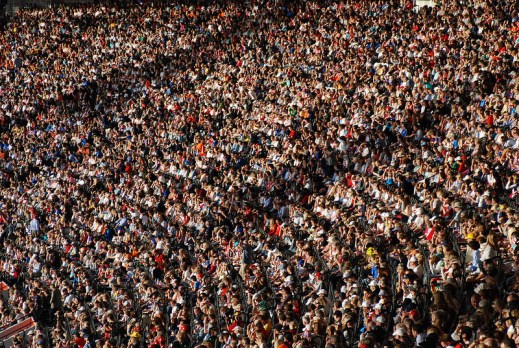
 Welcome to the extra innings of our summer series on “Sound and Sport”! In today’s bonus post, David Hendy discusses his recent Noise broadcast for BBC Radio 4 on the sounds of Olympic crowds. For an instant replay of our summer series click Kariann Goldschmitt’s “The Sounds of Selling Out?: Tom Zé, Coca-Cola, and the Soundtrack to FIFA Brazil 2014” (August), Josh Ottum‘s “Sounding Boards and Sonic Styles: The Music of the Skatepark” (July), Tara Betts‘s “Pretty, Fast, and Loud: The Audible Ali” (June), and Melissa Helquist‘s “Goalball: Sport, Silence, and Spectatorship” (May). Following Hendy’s post on Olympics past, give Andrea Medrado’s podcast a spin for a listen into its future: “The Sounds of Rio’s Favelas: Echoes of Social Inequality in an Olympic City.” And now, David Hendy. Of course, the crowd goes WILD. —J. Stoever-Ackerman, Editor-in-Chief
—
I didn’t get to go to the London 2012 Olympics or Paralympics. Alas, my number didn’t come up in the lottery for seats. So, like millions of others, my family and I watched – and heard – the sporting action on television or, occasionally, on our smart phones. A pretty good experience it was, too: the BBC for instance gave British viewers 24 live streams of high-definition coverage for the Olympics; Channel 4’s approach to the Paralympics was smaller-scale but packed a similar punch in terms of imagery. A key part of the “enhanced experience,” however, was the acoustic quality of the broadcasts. When the Olympics had last been staged in London, during the post-war austerity of 1948, television footage sounded like this:
“1948 Olympics Clip” courtesy of Peregrine Andrews and Alan Hall, Falling Tree Productions Limited
Just about the only things viewers would’ve heard were the voices of the commentators and the distant, muted sounds of the crowd.
That evocative archive recording was used in a recent radio documentary by the British sound designer Peregrine Andrews. The programme explored just how much had changed in location recording techniques by 2012. This time around, Peregrine pointed out, some 4,000 microphones were in position at the various venues: not just suspended in the air above or placed on the trackside, but bonded directly onto the beams in the gymnastic hall, say, or attached to the targets used in archery. Competitors everywhere were heard in extreme close-up – every shift of a hand or foot, every creak of wood, every grunt or groan made audible to the viewer at home.
This wasn’t just hyperbole. Newspapers quickly latched on to the phenomenon, dispatching reporters to measure decibel levels and offer their readers guides to the “best” venues for hearing the sound of the crowd. They pointed out that an airplane taking off produces about “140 decibels of noise”– and that the cheers echoing around the soaring curves and low ceilings of the Olympic Velodrome reached very nearly the same level.

Panorama of the London Olympic Velodrome, Image courtesy of Flickr User Jack999

Olympic Velodrome Image courtesy of Flickr User adambowie
“The roar was thrilling, to the point of pain,” claimed one reporter from the Toronto Globe and Mail. “If I had endured another minute, I am sure we’d all have gone deaf.” Zaha Hadid’s gloriously sweeping Aquatics Centre provided perhaps the most intense acoustics of all. Whenever the 17,500 fans inside cheered, the “guttural roar” was simply “ear-drum shattering,” declared the London Evening Standard. The main Olympic stadium was open air, of course, making the sound less intense. But even here the Globe and Mail journalist wrote of a “tsunami of noise” building in waves; another of the stadium’s “sonic boom”; yet another of how Usain Bolt’s 100 metres final produced a roar from the crowd which, measured at 107 decibels, beat that of your average pneumatic drill.

Olympic Stadium 2012, Image by Flickr User tom_bennett
Perhaps it wasn’t surprising that London 2012 was dubbed the loudest ever Olympics. For the main stadium’s designer Rod Sheard had always conceived it with acoustics firmly in mind. He’s quoted in a piece in It’s Nice That: “The athletes are so focused, it’s very easy for them not to hear the crowd. . .we’ve got to make it really loud for them to get any benefit from it.” And so the 80,000 people inside were packed as closely together as possible with the roof shaped to rebound their roar back into the heart of the space, generating maximum volume.
As my producer Matt Thompson and I discovered when making our recent BBC radio series Noise: a Human History (available on iTunes), this contemporary attempt to revel in the roar of the spectators throws up some striking – and very ancient – parallels. The most obvious is that of the Colosseum in Rome, which, some 2000 years ago, provided what Keith Hopkins and Mary Beard have described as “a brilliantly constructed and enclosed world, which packed emperor, elite and subjects together, like sardines in a tin.”
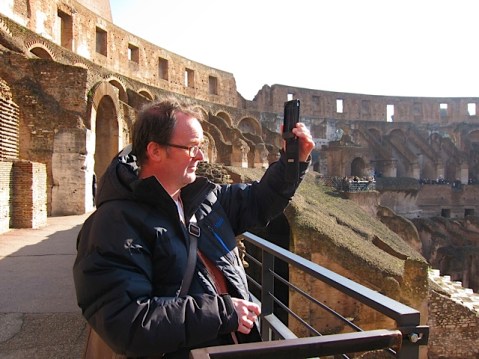
David Hendy at Colosseum, Image by MattThompson/Rockethouse Productions
The acoustic qualities of ancient amphitheaters like this – their ability to amplify the slightest sounds – is still pretty unnerving if you get the chance to witness it for yourself, as Matt and I did when recording, at the Colosseum and at the ancient Greek theatre of Epidaurus:
In these cauldrons of concentrated sound, the roar of the spectators took on a collective force of its own – a volatile quality rich with cultural and political repercussions. During plays in Greek theatres, audiences were rarely hushed and reverential. They were talkative and unruly, sometimes showing their disapproval by drumming their heels against the benches, sometimes disrupting the action by shouting and jeering. The chorus below would address spectators directly, as if facing a jury. Audience participation was as much a part of a performance as were the actors in the orchestra or on the stage. And when it came to the Roman Games later held at the Colosseum or in even larger venues such as the nearby Circus Maximus, the barrage of sound could reach intimidating levels of ferocity.

David Hendy Recording at Epidaurus, Image by Matt Thompson/Rockethouse Productions, taken on location
Roman arenas were not just sporting venues, of course. They were designed for political theatre. Vespasian had ordered the Colosseum to be built to help wipe away the memory of his predecessor Nero and his notorious private pleasure palace the Golden House. Now Roman citizens had a pleasure palace all of their own. The ruling elite had also created a place for the ostentatious display of imperial power and generosity, a bribe for the people’s continuing loyalty. Which is why, if the crowds were sometimes a little slow in showing their appreciation, paid stooges dotted about the arena would start applauding – or booing – at all the right moments, while soldiers would strike down any member of the audience who lagged in their cheering. But, as in the Greek theatres, Rome’s audiences were never entirely under the cosh; they could occasionally give voice to underlying discontentment. And when so many people were so tightly packed together, sheer proximity and the contagious quality of sound meant any turn in the mood would have been quick to make itself felt.
One startling example of this came in 55BC when Julius Caesar’s powerful rival Pompey put on a show in the Circus Maximus that featured the slaughter of elephants – something the crowd lapped up until the very moment they heard the poor creatures’ death throes. In episode 9 of Noise: a Human History, I speculated on what it might’ve been like – and recalled the unsettling outcome:
In London in 2012, we had our very own Pompey, in the form of the British Chancellor of the Exchequer, George Osborne. He’d turned up to the Paralympics to award some medals. And as his name was announced the stadium resounded with loud booing for the first time all summer:
Why did 80,000 people all suddenly decide to boo as one? Because, one commentator quipped, there were only 80,000 people in the stadium.
Politicians as a class are inevitably unwelcome in a place of entertainment, their presence too obviously betraying an attempt to siphon off a little of the goodwill. Osborne’s particular problem, though, was that he wasn’t just any old politician. He was from the ruling Conservative party, which, true to its ungenerous instincts, had just cut welfare benefits for Britain’s disabled people. In the circumstances, turning up to the Paralympics seemed an entirely predictable affront to most of those in the stadium – one that Osborne was thick-skinned and numb-skulled enough not to have predicted for himself.
All this might seem, well, unsporting. But booing is part of the civic dialogue. It brings politicians face-to-face with their electorate. It forces them to feel the scorn and anger of those they’ve let down. The moment passes, of course. Clips briefly went viral on YouTube, and were soon forgotten. Osborne himself is still in office, overseeing the ruination of the British economy through his programme of austerity. But for a delicious few seconds we were reminded of the inherently public nature of sound. We heard – we felt – the role of listening to one another, not as a passive thing but as a powerfully collective, inter-subjective, electrifying, communicative act.
—
Featured Image: Crowd: London 2012 Olympic Stadium, Image by Flickr User Flickmor
—
David Hendy is Professor of Media and Communication at the University of Sussex, England. He wrote and presented the recent 30-part BBC radio series Noise: a Human History, which remains available to download on ITunes. The accompanying book, Noise: a Human History of Sound and Listening, will be published in the US in October 2013 by Harper Collins. He’s the author of Radio in the Global Age (2000), Life on Air: a History of Radio Four (2007), and Public Service Broadcasting (2013), and contributes regularly to radio programmes.
—
REWIND! . . .If you liked this post, you may also dig:
“We wanted to tell stories about sound”: Opening Ears Through the “Everything Sounds” Podcast–Craig Shank and George Drake Jr.
Quebec’s #casseroles: on participation, percussion and protest–Jonathan Sterne
Goalball: Sport, Silence, and Spectatorship— Melissa Helquist
Share this:


Current Top Posts





April 2021

January 2020

November 2019

October 2019

August 2019

April 2014

November 2017

March 2015

December 2017

October 2015
 Sounding Out!
Recent Comments