
Making Music at Studio X: The Identity Politics of Community Studios

What are the social obligations of what I term “community studios”— spaces that exist to provide “at-risk” youth access to free or low-cost music recording equipment, services, and education? This essay reflects the findings of a four month ethnomethodological project, in which I explored the institutional and social affordances of Studio X, a community studio located in a rural college town in upstate New York. Using information from interviews and several hours of observation in the studio, I argue that community studios are subject to unique institutional pressures that emerge from their framing as both professional studios (private enterprises with no restrictions on creative expression) and community centers (shared spaces, which, in this context, are designed to provide oversight and the proper socialization of youth through rules and activities). While tapping into private and philanthropic revenue streams has resulted in the development of some exceptional studio projects, it has also led to a problematic situation where the studio has trouble establishing an independent identity for itself. This essay hopes to offer a critical perspective and, in doing so, offer some suggestions to help community studios deal with these challenges.
Community studios offer a different studio model than the standard professional or DIY models typically discussed in academic literature. While recent work by Eliot Bates and Susan Schmidt Horning has done an excellent job of framing the sociohistorical contexts of commercial music studios, neither adequately addresses the politics of community studios. These politics, however, cannot be taken for granted as they challenge Bates’ contention that studios “isolate studio workers from the outside world, and the world from studio work, while possessing a visual and audible difference from other work environments.” Contentiously, community studios represent a unique set of stakeholders including parents, donors, youth, and community center administrators, amongst others. The community studio is far from isolated, however, and its identity, therefore, is in constant flux.
Studio X was developed in 2006 with funds from a $65,000 grant from the New York State Music Fund, a board created by the Rockefeller Philanthropy Advisors to dispense over $35 million in settlement money from music businesses that profited from “payola” practices. It was conceived as a space where predominantly low-income African American youth would have access to professional recording equipment and training. According to the grant proposal, technical expertise was to be supplemented with classes that contextualized the music within “the socio-political, and social justice significance and origins of hip-hop, reggae, and other forms” in addition to making connections with “jazz, African percussion, and contemporary world music.”

A picture of Andrew Carnagie’s philanthropy. Borrowed from Wikimedia Commons.
Many of Studio X’s goals had been met. On my first day there, I encountered a local singer who spoke with me for over an hour, praising the studio for giving him the opportunity to use a voice he claims to have wasted in jail. Another respondent explained that the studio helped to shed positive light on an area that is often categorized in negative and judgmental terms. He remarked: “More people should know about [the studio]. Show more appreciation. They should come down and see what we’re about down here. It’s not all negative. Good things happen at [Studio X].”
Not all was well with Studio X, however, as I learned when I encountered an administration struggling to negotiate the studio’s joint identity as both a community center and a professional studio. At the helm was Eric, an audio engineer by training, and the full-time director of Studio X. Since accepting the position in 2012, he had been crafting the space in the likeness of a professional studio. Free music production and engineering classes ceased and he even began offering private sessions with better equipment at the rate of $25 an hour. Eric justified this decision by explaining that the fee helped to ensure that people actually kept their appointments, and the better equipment yielded superior recordings. He also insisted that a large percentage of the funds these sessions earned ultimately supported the community center and studio.
Community response was mixed. Many respondents noted that they trusted Eric, with a few even suggesting that he should charge more. One respondent, a local producer, felt Eric’s pay sessions were a reflection of greater economic trends in cloud music sites, like Soundcloud and Reverbnation, that allow artists to tailor their investment through incrementally priced packages.
A number of community members, however, were deeply disturbed by this change. One local rapper claimed that turning Studio X into a “real studio” had never been a part of its original mission. They were fearful that the space’s shift towards a professional studio in structure implied the troubling imposition of capitalist hierarchies. This contention is echoed by scholars like Louis Meintjes and Tricia Rose, who state that studios and other technologies of musical (re)production are always deeply representative and constitutive of the greater institutional structure of the music industry.
The studio also furthered a number of questionable social policies. Upon the studio entrance was a sign that detailed rules for proper conduct. Not only did the studio maintain a dress code, but it also censored lyrical content. The sign displayed six rules:
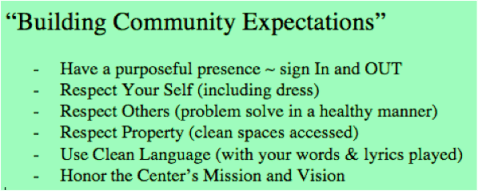
This sign was taped to the door at Studio X.
When I asked Eric about these rules he indicated that he’d written these rules to avoid running into trouble with parents and with the Executive Director: “I just don’t want to be known as the guy who lets 14 and 15 year olds come and say whatever they want…Usually kids that age don’t have language like that although a few times I had to tell them to use different language or I had to tell them to leave.” Thus, according to Eric, Studio X’s success as a community center meant the censoring many of its patrons. But how did Eric’s decision affect the narratives of the studio’s constituents?
This research suggests that the administrative politics of community studios has deep implications for inclusion and identity of community members. Although it’s easy to dismiss Eric’s decisions to charge for studio space and censor language as racist, the reality is that many members of the community respected his leadership and felt he was guiding Studio X towards a positive direction. Eric’s vision, in other words, worked to produce a culture of ideological support within the community itself.

A screenshot of Avid Protools 11 software.
Even though Studio X represents only one community studio, its identity struggles are certainly worth noting as similar institutions crop up around the world. How can community organizers best create a recording space that is safe, professional, and productive for members of low-income populations?
To start, organizers must recognize how the strings attached to philanthropic grants can lead to poor administrative choices. The institutional design of community studios mirrors the demands of broader grant-funding institutions, from which community studios derive their primary income. In order to provide community members with tools to produce work that is “competitive,” at least from an audio engineering perspective, community studios must invest in expensive equipment or risk coming across to both community members and potential investors as a poor alternative to daycare.
To adequately support these spaces, administrators and other stakeholders must insist on finding new and creative ways to raise clean money. Beat Making Lab, a community studio initiative that has connected educators and artists with community centers and schools across the globe since 2012, allows supporters to directly contribute and sponsor the purchase of specific equipment and development of projects. Still, it relies on its grant partnership with PBS to reach a larger audience. Similarly, Notes-for-Notes, an organization founded in 2006 toward the development of positive spaces for youth to learn about, create, and record music, receives private funding and sponsorship from celebrities and music production companies among others; it is also the recipient of funds from a number of philanthropic grant institutions.The alternative to these innovative funding tactics is to imagine, construct, and present a studio that is primarily concerned with “positively” shaping the character of young men and women in an effort to appease questionably minded philanthropists, even though this maneuver often compromises the culture, community, and content of the community which the studio itself exists to support.
—
Enongo Lumumba-Kasongo is a PhD student in the Department of Science and Technology Studies at Cornell University. Since completing a senior thesis on digital music software, tacit knowledge, and gender under the guidance of Trevor Pinch, she has become interested in pursuing research in the emergent field of sound studies. She hopes to combine her passion for music with her academic interests in technological systems, bodies, politics and practices that construct and are constructed by sound. More specifically she would like to examine the politics surrounding low-income community studios, as well as the uses of sound in (or as) electronic games. In her free time she produces hip hop beats and raps under the moniker Sammus (based on the video game character, Samus Aran, from the popular Metroid franchise).
—
 REWIND! . . .If you liked this post, you may also dig:
Papa Sangre and the Construction of Immersion in Audio Games— Enongo Lumumba-Kasongo
Yellow Rain and The Sound of Matter: Kalia Yang’s Sonorous Objection to Radiolab— Justin Eckstein
The Noise of SB 1070: or Do I Sound Illegal to You?— Jennifer Stoever-Ackerman
Share this:

Digital Analogies: Techniques of Sonic Play

 Editor’s Note: Welcome to Sounding Out!‘s fall forum titled “Sound and Play,” where we ask how sound studies, as a discipline, can help us to think through several canonical perspectives on play. While Johan Huizinga had once argued that play is the primeval foundation from which all culture has sprung, it is important to ask where sound fits into this construction of culture; does it too have the potential to liberate or re-entrench our social worlds? Here, Roger Moseley challenges us to rethink the philosophical discourses of both sound and play and locates the moments in which they intersect and interface. From games of Telephone to Guitar Hero, Moseley considers the ways in which sonic play can help us understand the phantasmic binaries of the analog and digital.–AT
—
Throughout the distinguished intellectual lineage of play (where it is touched on by notable philosophers such as Plato, Montaigne, Kant, Schiller, Gadamer, Derrida, and Baudrillard), little attention has been paid to the parallels that can be drawn between sound and play as both media and phenomena. The very name of today’s most prominent cultural and technological locus of play, the video game, overtly privileges the eye at the expense of the ear. As recent research and creative work by such figures as Aaron Oldenburg, Aaron Trammell, George Karalis, and Enongo Lumumba-Kasongo indicates, a surge of interest in audio games, as well as video games that emphasize the importance of sound while eschewing or minimizing visual stimuli, is acting as a salutary corrective to this oculocentrism. In what follows, I suggest that bringing sonic and musical techniques to bear on this history might afford new insights into play and its myriad configurations. Conceiving of play sonically entails thinking of sound playfully. This intersectional logic can, I argue, unpick binarisms that enforce problematic distinctions and constrict thought. To demonstrate this, I conclude by deploying the concept of play to redefine the relationship between the digital and the analog—and vice versa.
How can play be defined in a manner that encompasses its farrago of meanings and associations? For video game designers and theorists Katie Salen and Eric Zimmerman, the answer is deceptively simple: play is “free motion within a more rigid structure” (Rules of Play, 304). To illustrate the flexibility of this definition, Salen and Zimmerman allude to the phenomenon of light playing upon the ocean waves. They leave unexamined, however, the intimacy and richness of the relationship between play and sound. From a scientific perspective, the patterned oscillation of which a sequence of sound waves is constituted consists of free motion within the limits set forth by the laws of physics. When disciplined and deployed as a cultural technique–take the play of musical instruments for example–sonic play is humanized and rendered transitive. But, we might also suggest that instruments play people, citing the sensation of automation with which fingers flash over fretboard or keyboard. Moving further away from anthropocentrism, we can observe how sonic technologies render play intransitive once more. From the barrel organ to the iPod, sound plays without human aid when mechanically reproduced. This way of framing reproduction invokes and extends Roger Caillois’s playful category of mimicry, which can be construed as faithful imitation, deceptive fakery, or even a Baudrillardian attempt to simulate a phenomenon that never existed.
In order to pay due attention to both the technologies through which sonic play is mediated as well as the cultural techniques imbue it with significance, I suggest that we supplement Salen and Zimmerman’s definition by thinking of freedom, motion, and structure in both digital and analogical terms. To an extent, the adoption of this modish epistemological framework acknowledges that conceptions of play are always constrained by their prevailing intellectual context. More importantly, however, I contend that technologies of sonic generation and representation from the seventeenth to the nineteenth centuries can be understood to play with the categories of the digital and the analog avant la lettre (ou le chiffre). The two categories are not mutually exclusive and to treat them as such would be to subjugate the granularity of the analog to the binary logic of the digital. Rather, they co-exist as modes between which sounds and players freely oscillate.
The origins of digital sonic play lie within the human body. As Johan Huizinga put it, “the link between play and instrumental skill is to be sought in the nimble and orderly movements of the fingers.” In the course of musical performance, human digits perform innumerable calculations. At its crudest level, musical performance from a score can be construed as a sort of algorithmic play through which mimetic fidelity is evaluated (and wrong notes relentlessly tallied). This ludic logic is at its most visible in rhythm-action video games such as Guitar Hero in which the score is no longer a text but rather a quantitative analysis. The iconography of these games usually indexes a set of digital technologies used primarily for the recording, editing, and playback of music. On the one hand, this relationship can be traced back to Leibniz’s exposition of ars combinatoria and his “invention” of binary; on the other, it is realized by the hydraulic organ and composing machine devised and programmed by the Jesuit polymath Athanasius Kircher, both of which are depicted in his Musurgia universalis (1650). In media-archaeological terms, the combination of Leibniz’s concepts and Kircher’s mechanisms gave rise to the hardware and software of Joseph Marie Jacquard’s revolutionary loom, Charles Babbage’s prototypical Analytical Engine, the player piano, the IBM punch card, and the MIDI sequencer before resurfacing in Guitar Hero, a piece of software that, in purely algorithmic terms, enlists the player’s digits to verify checksums.

An example of Kircher and Schott’s Organum, an early example of the digitization of music.
Such digital grids may constitute the field and the rules of sonic play, but they must be supplemented by analog elements if play is to flourish. As detailed in C. P. E. Bach’s Versuch über die wahre Art das Clavier zu spielen (1753/62), the clavichord and its descendants distinguished themselves from the harpsichord and the organ by endowing the keyboard with an infinite sensitivity to touch, thereby enabling a mimetic spectrum of emotional flow with unprecedented verisimilitude. Analogicity also provides another perspective on Caillois’s concept of mimicry, according to which one object or activity playfully stands in for another via imitation, deception, or make-believe. Additionally, the curves of Ernst Chladni’s figures, which materialized sound as sand, exemplify this sonic and mimetic trajectory as they rely on both Hermann von Helmholtz’s pioneering work on acoustics and the complex history of phonography to the development of analog synthesis.
In terms of sonic play, digital and analog elements can be chiastically recombined and reconfigured. A sonic communication game such as Telephone relies on the human propensity for analogy and its corrupting influence on the integrity of information transfer, playfully inverting the conditions and functions of the “real” telephone (which was engineered to compress informational content digitally without jeopardizing meaning). In much electronic dance music, the digital latticework, simultaneously visualized and rendered audible by the sequencer’s grid, constitutes a field of play overlaid with vocals, sweeps, and other analog elements that, in turn, have been captured via digital sampling. As a kind of meta-game, a mash-up plays with sonic elements whose relations can be parsed in the digital terms of Leibnizian recombinatorial play, but equally important are the unintended associations and analogies which inevitably emerge. And while games such as Guitar Hero foreground digital techniques of sonic reproduction, they simultaneously foster diverse forms of analogical play involving the player’s manipulation of the sonic (and social) behavior of her on-screen avatar—and vice versa.

Playing telephone. Image borrowed from diamondmanga @Wikimedia.
There is no doubt that the status of sound and its mediation through and as play have too often gone unacknowledged. As well as seeking to rectify this state of affairs by stressing the importance of sound in relation to the playful operations of other media, we might also dwell on the distinguishing features that set it apart: sound and the techniques that shape it are unique in the ways they simultaneously trace and are traced by the materials, technologies, and metaphors of play.
–
Roger Moseley is an Assistant Professor in the Department of Music at Cornell University. His most recent research brings a media-archaeological perspective to bear on musical performance and improvisation. He is particularly interested in how the concept of play informs sonic practices and cultural techniques. Active as a collaborative pianist on both modern and historical instruments, he has recently published essays on digital games in the contexts of musical and visual culture. His current book project is entitled Digital Analogies: Interfaces and Techniques of Musical Play.
—
REWIND! . . .If you liked this post, you may also dig:
Papa Sangre and the Construction of Immersion in Audio Games– Enongo Lumumba-Kasongo
Playing with Bits, Pieces, and Lightning Bolts: An Interview With Sound Artist Andrea Parkins— Maile Colbert
Experiments in Aural Resistance: Nordic Role-Playing, Community, and Sound— Aaron Trammell
Share this:


Current Top Posts





April 2021

January 2020

November 2019

October 2019

August 2019

April 2014

November 2017

March 2015

December 2017

October 2015
 Sounding Out!
Recent Comments