
SO! Amplifies: Memoir Mixtapes

—
“The mashup of the two things we all love to talk about: ourselves & music”
Memoir Mixtapes is a nonprofit literary magazine that is entirely volunteer-run. Created by Samantha Lampf, the idea for the magazine came about on a commute home from Santa Monica to Koreatown in 2018. At the time, Lampf’s life was rapidly changing. After marrying, moving to Los Angeles and changing her career path, she felt as if something was still missing. When “Silver Springs,” by Fleetwood Mac, came on the radio — an artist her dad used to play constantly. Lampf was immediately transported to a specific time in her childhood where she experienced insomnia and depressive thoughts, saying “the music taunted me at all hours.” Soon after, she had the thought to write an essay about this song. She then began to think that many people had their own stories about songs, and Memoir Mixtapes was officially underway.
The first call for submissions was put out that night, and Lampf was unsure if she would receive more than five pieces. However, the first volume, titled “Origin Stories,” published 34 tracks. Since then, they have published eight volumes, with topics ranging from guilty pleasures to our personal anthems. Each volume consists of creative nonfiction submissions and a song (or two) to accompany each piece. The goal of the magazine is to use music as a natural provocation of emotion and memories, using music to connect with each other while reading about some of our most personal experiences.
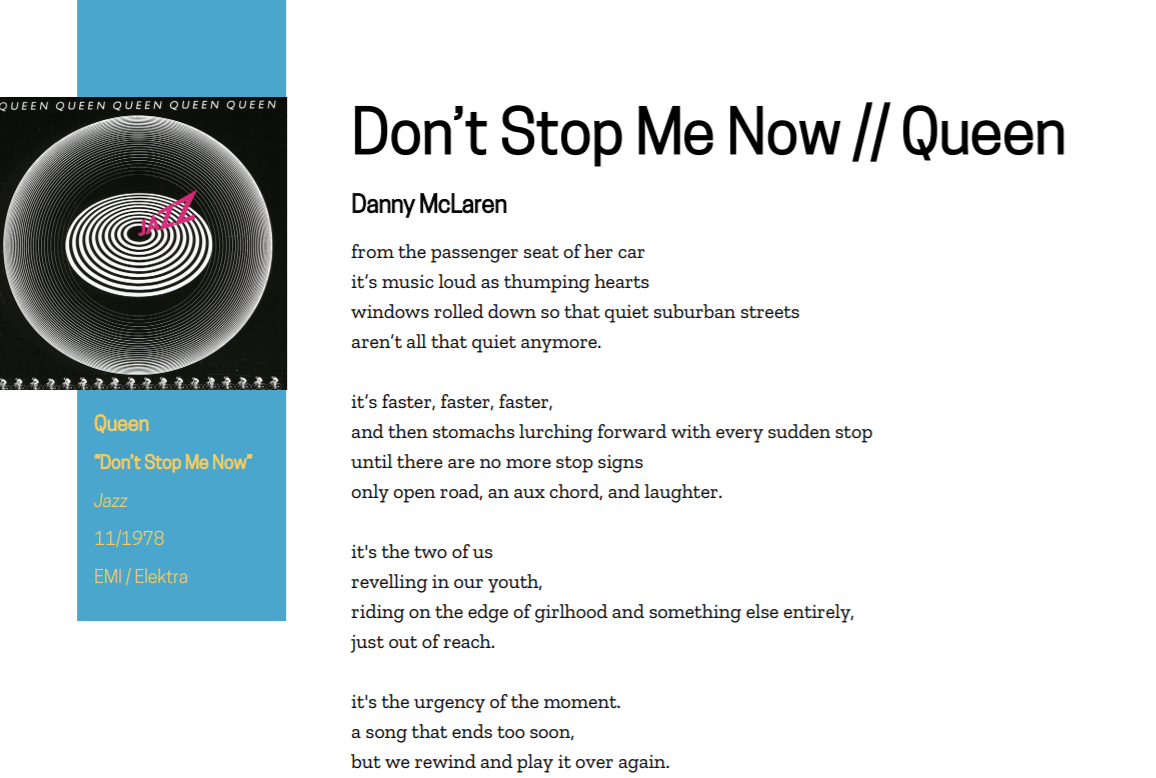
Danny McLaren’s “Don’t Stop me Now // Queen” from Vol. 4 “Anthems”
While Memoir Mixtapes’ primary focus is their full volume works, they also support other literature about music or memoir that might not fit into their main magazine topics. Deep Cuts, a section created for these pieces, features recordings, visual art, playlists and more. Not a writer, but still interested in the project? Consider sharing a song recommendation! All you have to do is create an account on Medium and follow the steps listed on the website for a chance to have your song featured either Monday, Wednesday, or Friday.
Memoir Mixtape’s 2019 Playlist
Memoir Mixtapes is special because it gives us a way to discuss the impact of music on our lives. Music is an integral part of birthdays, weddings, religion and many other cultural practices, yet we often understand music as a separate entity from identity — one that is universal in its message rather than individualized and personal. However, writers at Memoir Mixtapes are allowing us to listen to music as they experience and hear it, providing us with a new method of listening to songs we have our own histories with.
 If music and memoir sounds appealing to you, check out the Memoir Mixtapes magazine to read, listen or submit a piece of your own — they have rolling submissions, so submit anytime! For their tenth volume, Memoir Mixtapes is ready to talk about “Ballads & Breakups,” or the whimsical, disastrous search for love. As their page states, “if you felt it in your heart, we want to read it.” Calls for submissions are open now until June 30th!
_
Kaitlyn Liu is a freshman at Binghamton University majoring in English Literature with a concentration in rhetoric. Kaitlyn takes interest in writing about gender and race along with other intersectional classification systems. Kaitlyn currently writes for the opinions section for the student newspaper, Pipe Dream, as well as working as a copy editor. Outside of writing, Kaitlyn enjoys reading historical fiction and singing for Binghamton University’s oldest co-ed a cappella group, the Binghamtonics.
_
 REWIND! . . .If you liked this post, you may also dig:
SO! Amplifies: Cities and Memory–Stuart Fowkes
SO! Amplifies: Phantom Power–Jennifer Stoever
Share this:

SO! Amplifies: Phantom Power
Phantom Power is an aural exploration of the sonic arts and humanities, that launched in March 2018 with Episode 1: Dead Air (John Biguenet and Rodrigo Toscano) Hosted by poet + media artist cris cheek and sound + media scholar Mack Hagood, this podcast explores the sounds and ideas of artists, technologists, producers, composers, ethnographers, historians, cultural scholars, philosophers, and others working in sound. Because Phantom Power is about to kick off its second season on February 1, 2019, we thought we’d dig a little deeper into who they are and who they’d like to reach with their good vibrations.
Funded through a generous grant from the Miami University Humanities Center and The National Endowment for the Humanities, Phantom Power was created with the goal of bringing together three important streams of conversation in the humanities
(1) diverse and interdisciplinary scholarly pursuits, taking place under the umbrella of “sound studies,” that analyze and critique the sonic entanglements and practices of human beings;
(2) experimental aesthetic practices that use sound as a medium and inspiration to expand the boundaries of art, music, and poetry;
and (3) the nascent use of podcasting as a mode of scholarship, intra-/interdisciplinary communication, and public outreach.
The public-facing podcast draws on the extensive radio experience of co-host cris cheek, creator of Music of Madagascar, made for BBC Radio 3 in 1994, which won the SONY GOLD AWARD, Specialist Music Program of the Year. In 1998 he made crowding, a three and a half hour live-streamed webcast of largely improvised speech and sound events, commissioned as part of Torkradio from by Junction Multimedia in Cambridge. In 2004, cheek was part of the BBC series Between the Ears, on the subject of speaking in tongues, in conversation with the artist and film-director Steve McQueen, exploring the boundaries of vocal expression with actress Billie Whitelaw, and linguistics professor William Samarin. cheek appears in the first episode talking about the many contradictory experiences of “dead air” in an age of changing media technologies.
Phantom Power also alchemizes the scholarship of co-host Mack Hagood (see Hush: Media and Sonic Self-Control forthcoming in March 2019 from Duke University Press and his 2012 SO! post “Listening to Tinnitus: Roles of Media When Hearing Breaks Down”) as well as his audio production background as a musician, producer, and radio DJ—skills he has long incorporated into his scholarship and teaching. At Indiana University, for example, he and his students and won the Indiana Society of Professional Journalists’ 2012 Best Radio Use of Sound award for our documentary series “I-69: Sounds and Stories in the Path of a Superhighway.” The first episode even featured music by Hagood and by Graeme Gibson, who was touring on drums with Michael Nau and the Mighty Thread at the time. Additional sound is by Cl0v3n.
“We spend a lot of time on the production aspects of this podcast,” says Hagood, “because we want it to be a sonic and affective experience, not just an intellectual one. Many of us in sound studies have complained that we always find ourselves writing about sound. Phantom Power is our attempt to treat sound not only as an object of study, but also a means of understanding and feeling sound scholarship. This makes our show very different from most academic podcasts, which are usually lo-fi discussions between scholars about recent books. We love that kind of podcast but we build upon it by using narrative, sound design, and music to tell a compelling story that we hope will appeal to the public and sound specialists alike.”
In addition to their exploration of “dead air,” Phantom Power’s inaugural season included longform interviews with urban scholar Shannon Mattern (Episode 2, “City of Voices”), sound artist Brian House (Episode 3, “Dirty Rat”), Australia-based sound composer, media artist and curator Lawrence English (Episode 4, “On Listening In” ), and with scholar and SO! ed Jennifer Stoever (Episode 5, “Ears Racing”). The final two episodes explored what “the future will sound like” on World Listening Day (July 18th) [Episode 6: Data Streams (Leah Barclay and Teresa Barrozo) and featured Houston’s SLAB car culture [Episode 7: Screwed & Chopped (Langston Collin Wilkins)].
“I’m super excited about Season Two,” says Hagood. “Our opener stars one of my favorite sound scholars, NYU’s Mara Mills. It also uses one of my favorite formats that cris and I have developed, where one of us brings in some crazy sounds for the other to listen and react to, then we gradually develop the backstory to the sounds through our guest’s words, eventually landing on the sonic and cultural implications of it all. It’s like a fun mystery, where one co-host acts as guide and the other gets to stand in for the listener—reacting, laughing, and questioning.”
When Phantom Power returns next month, other new entries will feature cheek’s interviews with Charles Hayward of legendary experimental rock band This Heat and poet Caroline Bergvall, whose work has been commissioned by such institutions as MoMA and the Tate Modern. “I interview amazing sound scholars, but I’m a bit star struck by some of the musicians, sound artists, and poets cris interviews!” says Hagood.
You can access Phantom Power and subscribe on a plethora of outlets: itunes, android, stitcher, google podcasts, and/or by email.
REWIND!…If you liked this post, you may also dig:
SO! Amplifies: Ian Rawes and the London Sound Survey–Ian Rawes
SO! Amplifies: Cities and Memory–Stuart Fowkes
SO! Amplifies: #hearmyhome and the Soundscapes of the Everyday–Cassie J. Brownell and Jon M. Wargo
Share this:




Current Top Posts





April 2021

January 2020

November 2019

October 2019

August 2019

April 2014

November 2017

March 2015

December 2017

October 2015
 Sounding Out!
Recent Comments