
SO! Reads: Roshanak Khesti’s Modernity’s Ear

 “I drifted to another place and time,” reminisces drummer and musicologist Mickey Hart in his 2003 book about salvaging indigenous musical traditions, Songcatchers: In Search of the World’s Music. He continues, “Every day I rushed home, put on the sounds of the Pygmies [on the old RCA Victrola], and melted into their very being.” For the Grateful Dead drummer and world music producer, this experience of disorientation would eventually shape his transformation into a “songcatcher,” or one who seeks to preserve the intangible cultural heritage of indigenous music. In Modernity’s Ear: Race and Gender in World Music, author Roshanak Kheshti interrogates the “origin myth” presented by Hart, along with other collective fantasies and historical narratives that urge listening to world music. She argues that we must look beyond the political and economic exploitation of actual musicians to consider the economy of desire in which the conditions of possibility for such exploitation are formed. In contrast to a critical discourse on musical appropriation and exploitation among ethnomusicologists, one that Martin Stokes acknowledges is “marked by an anxious awareness of complexity and complicity” with world music (835), Kheshti deftly tunes into racialized and gendered yearnings for the recorded sounds of others.

Sounds in bodies
Crucial to Kheshti’s argument is her radical proposition for what occurs as, to briefly return to Hart’s aural memories, the sounds of others “melt” into our “very being.” In a crucial maneuver that focuses on how what is being heard is shaped by the embodied experience of listening, Kheshti proposes that “the object [of listening] becomes a part of the self by being taken into the body” (41). Thus when “sound, the listener’s body, escape, and affect fold into one another” (54-56) in the act of listening (a Derrida-derived encounter that Kheshti dubs “invagination”), selfhood is performatively constituted through the aural other. Moreover, the pleasure of imagining the other through listening, writes Kheshti, is not only the hegemonic form of listening within the world music industry but an experience of desire that Western media markets have historically capitalized upon.

“Whispers” by Flickr user Nicola Colella, CC BY-NC-SA 2.0
Given the ways in which listening embodies an economy of desire, Kheshti tells the history of this libidinal economy through a narrative in which modern selfhood is constructed through the racialized and gendered aural other. The Godzilla in this narrative is the World Music Culture Industry (WMCI), an entity conjured by Kheshti in reference to the historical juncture of comparative musicologists in the early twentieth century with the popular music recording industry, a coupling that she argues spawned the globalized product of modern media known as world music. As a set of hybrid musical practices designed by and large for Western media markets, world music is the key object of her inquiry (in contrast to the diversity of musical practices worldwide).
The imagined listener
 Though the book does not proceed chronologically, the first chapter seeks to interweave memory with history by opening with the early twentieth century. Stressing the pioneering role of white female sound archivists, this chapter is crucial for setting up the historical significance of the feminization of listening, a process familiar to readers of Jonathan Sterne, Louise Michele Newman, and William Howland Kenney. Kheshti puts Songcatcher (2000), a feature film about a fictional comparative musicologist who dives into Appalachian country and “discovers” Scottish and Irish ballads thought to have gone extinct, into conversation with the iconic images of Frances Densmore, an ethnologist affiliated with the Bureau of American Ethnology in the 1910s, who famously staged phonographic recordings of the Blackfoot chief, Mountain Chief (Nin-Na-Stoko). The point of convergence between these materials is the gendered and racialized politics of who was sent where to record whose sounds: white female sound archivists, spurned by their male colleagues and sent to the periphery of their respective fields to practice their craft. Once in the field, these comparative musicologists, one fictional and one real, committed acts of racial appropriation and erasure. The song catcher deracinates Appalachia by stripping the region of its Native American and African-American histories in favor of the ‘collective origin fantasy’ that links European and American genealogies, while Densmore, among others, domesticates indigenous sounds in her work for the Bureau.

Frances Densmore recording Mountain Chief. Picture by Harris & Ewing [Public domain], via Wikimedia Commons
Though the book tends to favor intensive re-readings of critical and psychoanalytic theory (from Adorno and Benjamin to Freud and Lacan) over thick ethnographic description, Kheshti touches upon key encounters in this culture industry to explain how listening to world music engenders modernity’s ear. For instance, she transcribes segments from a radio show in Northern California in which the host, a middle-aged white female, discusses what constitutes “African rhythms” with a record label executive. The two banter about this misnomered subject for some length. The host interprets what she is hearing as “African rhythms coming through.” Her visitor, an expert in world music, affirms and clarifies this attribution: “Yeah, absolutely. The rhythm on this particular song… is from a style of music called Afro-beat… that rhythm you’re hearing is definitely African, so, you don’t know nothing, you’re learning” (52). Kheshti interprets this banter as an example of how world music listeners “cherish” the experience of listening to sonic difference as a moment to live out “fantasy and imaginative play” (54), in other words, that the pleasures experienced through aurality have become definitive of twentieth-century modernity.

“world music 2” by Flickr user wayne marshall, CC BY-NC-SA 2.0
In other chapters, she details how record labels fulfill this fantasy through the production of hybrid sound media. The orchestration of these sounds in the studio not only enables the listener to feel “lost” and transcend the contingencies of the listening event, they also “pronounce and suppress presences and absences of all sorts of bodies and grains” (77). Drawing on phenomenological descriptions of her own listening experiences as well as liner notes and other commercial media, she describes how non-Western sounds are encoded as feminine, whereas the synthetic production and digital manipulation of sounds are rendered techno-logically modern and masculine. Racialized and feminized bodies are put to work in constituting the modern cosmopolitan listener. Furthermore, Kheshti argues that market mobility and aesthetic mobility are gendered male and alterity is gendered female in ways that link, for her, to miscegenation. The listening self reproduces dominant forms of heteronormativity in the consumption of modern sound media.
The listening self reproduces dominant forms of heteronormativity in the consumption of modern sound media.
Kheshti offers a radical alternative to these normative listening practices by turning to field recordings taken by Zora Neale Hurston between 1933 and 1939. Trained by Franz Boas in the traditions of nascent cultural anthropology, Hurston is kin to Densmore and those who worked for the Bureau of American Ethnology a few decades earlier. Like them, she goes to record America’s aural others, or “black folk.” But unlike her white foremothers, Hurston does not attempt to splice out the “noise” of the recordings. She “refuses fidelity” (126). Instead of staging field recordings, she made studio recordings of herself performing songs and discussing rituals. When recording her interlocutors, she interrupts, interjects, and poses directorial cues that Kheshti reads as an attempt to resist the desire to faithfully (re)produce an archive of phonographic subjects.

ca. June 1935, Eatonville, Florida, USA — Author and anthropologist Zora Neale Hurston sitting on a porch in Eatonville, Florida with two musicians, Rochelle French and Gabriel Brown. — Image from Stuff Mom Never Told You
Recommended for advanced graduate students and faculty, this virtuosic and tightly rehearsed tour through critical and psychoanalytic theory offers an ambitious and groundbreaking retake on an industry that we thought we understood, perhaps too intimately. Kheshti asks her readers to hold themselves accountable to their own forms of aural pleasure. In so doing, she offers a fresh perspective on the role of embodiment in relation to knowledge production. Rather than embracing somatic methods of inquiry as a welcome challenge to inductive reasoning, she argues that taking pleasure in listening enables the commodification of desire that sustains the world music culture industry.
Kheshti shifts the discussion of world music qua music (aesthetics, history, representation) towards issues of alterity and sound. As such, this book contributes to sound studies by holding the field accountable for difference, and, by inscribing this accountability within the history of the field itself. Indeed, Modernity’s Ear is about how the forces of desire that constitute the modern listening self are enveloped in the aural other as phonographic subject.
—
Featured image: “ear” by Flickr user Leo Reynolds, CC-BY-NC-SA 2.0
—
Shayna Silverstein is an assistant professor of Performance Studies at Northwestern University. Her research generally examines the performative processes of politics, culture, and society in relation to sound and movement in the contemporary Middle East. Her current book project examines the performance tradition of Syrian dabke as a means for the strategic contestation of social class, postcolonial difference, and gender dynamics in contemporary Syria. She has contributed to peer-reviewed journals and several anthologies including The Arab Avant-Garde: Music, Politics, and Modernity, Islam and Popular Culture, the Sublime Frequencies Companion, and Syria: From Reform to Revolt. Previously a Mellon Postdoctoral Fellow in the Penn Humanities Forum, Shayna received her PhD in Ethnomusicology from the University of Chicago and her BA in History from Yale University.
—
 REWIND!…If you liked this post, you may also dig:
SO! Reads: Daniela Cascella’s F.M.R.L. (Finding Materials for Remembering and Listening) — Kyle D. Stedman
Lokananta: Sounds of Crisis and Recovery from Indonesia’s National Record Company — Ian Coss
Saving Sound, Sounding Black, Voicing America: John Lomax and the Creation of the “American Voice” — Toniesha L. Taylor
Share this:

SO! Reads: Norma Mendoza-Denton’s Homegirls

“When I wear my eyeliner, me siento más macha (I feel more macha) I’m ready to fight” (54)
Makeup has long been an intentional part of a chola aesthetic: in particular, the skillful sign of bold black eyeliner or a carefully arched, thin, brow. The quote above by Norteña Xótchil, one of author Norma Mendoza-Denton’s interviewees, reminds us that make-up not only creates a sense of empowerment but also evokes the idea of physical strength (“feeling macha”). Norma Mendoza-Denton’s ethnographic study Homegirls: Language and Cultural Practice among Latina Youth Gangs (Wiley-Blackwell, 2008) presents a project of high ambition, and even higher execution, in its carefully crafted discussion of the linguistic and cultural practices of Latina youth gangs at Sor Juana High School in northern California. Homegirls offers much needed insight into the relationship between language style and the cultural, lived experiences of Latina youth gangs. She centers her analysis on the linguistic, the cultural, and the phonetic, and in this way she pushes students of ethnic studies and sound studies to consider how young Latinas craft and articulate their own identity through meaning-making practices that challenge tropes of deviancy that are often unfairly cast on young women of color.
Throughout the book, speaking chola – an urban, gendered variation of Chicana English – becomes an audible badge, a marker of experience rather than a punch line, a culturally appropriated costume, a music video fad, or linguistic variety in need of policing. Recently, celebrity white or non-Latina women, such as Gwen Stefani and Lana Del Rey, have adopted telltale signs of a chola aesthetic – the crisp centered hair part, baggy pants, big hoops and/or only-the-top-buttoned plaid shirt. By focusing on the language styles of cholas, Mendoza-Denton encourages readers to think beyond the stereotypical images and sounds that so often circulate in mainstream media about cholas. Homegirls offers Sound Studies and Chicana/o Studies scholars a notable addition to the growing literature on the intersections of language, race, and sound.

Image by Illusive Photography @Flickr CC BY-NC-ND
“You gotta take pride to do your clothes
you know I have to iron,
when I go out I have to iron my shirt for half an hour
or forty-five minutes, you know,
my pants, you know
they gotta be
cre::ased
you know they gotta-” (56)
 Homegirls joins conversations on Latinas and gang culture (Fregoso 2003; Miranda 2003; Ramírez 2009), which have historically been male-centered. Thelma, one of the Norteña girls, demonstrates in the quotation above her engagement with an aesthetic practice often linked with Latino gang members. Although the topic of language and linguistic identities, specifically bilingualism and translating, are emerging topics within Chicana/o Studies, Mendoza-Denton’s work joins that of a small number of scholars who take on Latina/o language practices and identities as the central focus of their work. She observes, in fact, how identity and meaning-making processes are intertwined to language, as are other social markers of identity such as race, class, gender, ethnicity, and accent. Homegirls joins recent discussions that demonstrate specifically how accents are vocal stand-ins for a person’s racialized, classed, and gendered experience. Where Fregoso and Miranda center their discussion on the cinematic representations of cholas and a historical account of pachucas respectively, Mendoza-Denton’s work is more in line with Miranda’s ethnographic approach to Latina youth gangs. Homegirls listens to the women’s voices and allows them to speak for themselves. This approach yields a work that reminds us how language identities are racialized when conflated with other racial markers, how they negotiate power relations (in/out group dynamics), and how they can also function as political forms of resistance.
“My dad dice que me miro como lesbian (says I look like a lesbian), my mom dice que qué guangajona (complains that it’s baggy). How much you wanna bet that I can go outside like this y no me dicen nada (they won’t say anything)” (151)
Maureen, a 14-year-old participant, speaks above to the code switching that many of the young women in this study practice. Mendoza-Denton re-imagines the chola as an innovator, highlighting the role of language and the body in creating new cultural practices. For example, in Chapter 5, the author heralds an exciting discussion on play and applying makeup as forms of gendered performances expanding on notions of beauty and grooming amongst Latina youth. She writes, “The symbolic and unconventional use of makeup among the girls claiming Norte and Sur at Sor Juana High School literally painted gender and ethnicity on their bodies,” marking a critical intervention in how the chola aesthetic racializes and genders bodies, yet also functions as a self-directed performance (152). In paying close attention to the symbolic meaning of makeup and its application, the ritual of carefully drawing the brow dismantles the mainstream appropriation of this often-criminalized look.
Mendoza-Denton’s close phonetic analysis demonstrates how the visual aesthetic coupled with a sonic aesthetic speaks to the political implications of embodied linguistic and cultural practices. The chola vocal aesthetic challenges traditional notions of femininity, closely associated with politics of respectability through Spanish honorifics like “usted,” within the Chicano family. This idea echoes other studies that show how pachucas, precursors to contemporary homegirls, with their extravagant attire and deviant behavior embody an adolescent rebellion against the patriarchal Chicano family and how pachuquismos forged a stylized linguistic resistance. Such stylized linguistic and embodied resistance can be seen in the excerpt below from T-Rex, one of Mendoza-Denton’s most candid participants in her study.
T-Rex: A girl could be more macha than some guys. For example me.
Norma: You think you’re more macha than guys?
T-Rex: I am more macha.
Norma: What makes you macha?
T-Rex: The way I act. The way I don’t let them step on me. (164)
In this brief excerpt, T-Rex articulates her notions of being ‘macha,’ a prime example of a discursive and material Latina youth practice that transcends the boundaries of normative gendered expressions for Latina youth. We are accustomed to seeing urban cholas with curiosity, envy, or both. Mendoza-Denton allows us to hear them and gain a deeper understanding of their social practices.
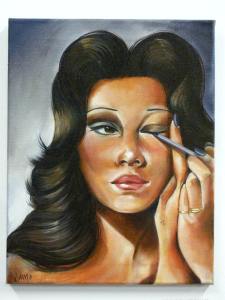
Image by Amor Eterno Arte @Flickr CC BY-NC-ND
In framing the chola aesthetic as a transgressive type of beauty, Mendoza-Denton poses that the cholas in this study act as cultural producers who assign alternative meanings to femininity through their body and speech. Recalling Xóchitl’s remarks about mascara, the eyeliner serves in one form as a tool for a racialized feminine ideal of beauty, while simultaneously a sign for “willingness to fight” for other girls (154). Eyeliner, in this example, very visibly displays the complex interactions and negotiations of gender norms and agency. In this sense, Mendoza-Denton grants the reader a primary example of how cholas participate in a type of feminine gender expression that challenges expected ways of acting, which includes speech.
From Mendoza-Denton’s conversation with T-Rex, we see that speech and accent are just as meaningful in the construction of this alternative aesthetic. T-Rex, explains how the eyeliner is a “power-based interpretation” that when correlated with a tough, or even threatening, manner of walking—the use of the body—cholas command power and respect. Here, her intervention serves not only to gain a deeper understanding of Latina youth practices but also frames the chola as an empowered, vocal (what some would consider, mouthy) woman. Too often cholas receive harsh criticism or complete disregard for their assumed subversive behavior, criminality, and social deviance. In Homegirls, Mendoza-Denton challenges those notions by finding the symbolic capital in how these young women employ discursive, material, and phonetic practices.
The final two chapters of the book focus on the specific linguistic features relevant to studies of language and sound. Mendoza-Denton highlights phonetic variation among the girls speech in how their realization of /I/ demarcates core speakers from members of the group in the periphery yet points to similar speaking characteristics for girls of both gangs. The author’s focus on the stigmatized Th-Pro set (i.e. something, nothing) in the speech of Latina girls demonstrates how it discursively positions theses young women’s interactions and group affiliation due to its frequency and saliency. These later chapters demonstrate one of the author’s most significant contributions: projecting a specific accent is often linked to the creation of an identity. As Mendoza-Denton writes, “How speakers pronounce their words says a lot not only about the identities that they wish to project, but also about the history of the language(s) that they speak” (231). These linguistic variations give readers insight on the importance of how distinctive discourse markers are vital in the creation of stylized identities for young women of color.
Norma Mendoza-Denton has produced a rich account of a community largely ignored and misinterpreted in the conversations on Latina youth culture in the United States. As she reminds readers in her conclusion, Homegirls is one of the only studies of its kind that documents gang dynamics outside of discussions regarding violence, control over territory, or drug trafficking. While this approach provides a much-needed focus on the self-making and cultural processes amongst youth of color, I wonder if some significant discussions might be left out with this approach. Although there is large need for research on this topic that deviates from traditional approaches (such as criminality, violence, drug trafficking) when working with youth, particularly women of color, in her effort to subvert these sociological mainstays Mendoza-Denton avoids certain experiences that leave out pertinent context.

Image by Joey Ortega @Flickr CC BY-ND
For example, in her discussion of the young women’s makeup practices, Mendoza Denton mentions the perceived threat they pose to teachers and police at school but does not go into more detail. These questions are not to discount the contributions of the book but rather to introduce future considerations for work surrounding Latina youth gangs. However, for Mendoza-Denton, the focus on the creativity and agency these young women embody is never lacking:
“So when you walk down the street,
you got the special walk, [begins to walk deliberately, swinging her upper body]
you walk like this,
you walk all slow,
just checking it out.
I look like a dude, ¿que no?
I walk, and then I stop.
I go like this [tilts head back – this is called looking “in”]
I always look in, I always look in,
I never look down.
It’s all about power
You never fucking smile.
Fucking never smile” (155-6)

Image by Amor Eterno Arte @Flickr CC BY-ND
Homegirls is at its finest when the reader is presented with excerpts like the quote above where T-Rex’s assertive physical and mental stance illustrates the linguistic and cultural practices that Mendoza-Denton seeks to highlight in her work. Mendoza-Denton’s contribution to this topic privileges the symbolic capital in linguistic, embodied, and cultural practices which sets up a platform for future work on Latina identities. When we read cholas in popular culture we might think of the aesthetic, the stereotypes, the big hoops, the dark lips, and the mascara. When we read Homegirls, Norma Mendoza-Denton compels us to consider the complex web of how linguistic and cultural practices (through material and vocal embodiments) speaks to the intersections of race, gender, and class amongst Latina youth gangs.
–
Featured image is of Yasmin Ferrada (the author’s sister) as photographed by King Kast. It is used with permission by the author.
–
Juan Sebastian Ferrada is a doctoral candidate in the Department of Chicana and Chicano Studies at the University of California, Santa Barbara. His work investigates the intersections of language and sexuality among LGBTQ Latina/o communities. Specifically, Sebastian explores the politics of Spanglish as a method for articulating ideas of sexuality and family acceptance within an LGBTQ Latina/o community organization. Sebastian earned a B.A. in Global Studies, in addition to a B.A. and M.A. in Chicana and Chicano Studies from the University of California, Santa Barbara.
–
 REWIND! . . .If you liked this post, you may also dig:
“Óyeme Voz: U.S. Latin@ & Immigrant Communities Re-Sound Citizenship and Belonging” – Nancy Morales
Listening to the Border: “’2487’: Giving Voice in Diaspora” and the Sound Art of Luz María Sánchez – Dolores Inés Casillas
Deaf Latin@ Performance: Listening with the Third Ear — Trevor Boffone
Share this:


Current Top Posts





April 2021

January 2020

November 2019

October 2019

August 2019

April 2014

November 2017

March 2015

December 2017

October 2015
 Sounding Out!
Recent Comments