
I Like the Way You Rhyme, Boy: Hip Hop Sensibility and Racial Trauma in Django Unchained

Welcome to week two of our February Forum on “Sonic Borders,” a collaboration with the IASPM-US blog in connection with this year’s IASPM-US conference on Liminality and Borderlands, held in Austin, Texas from February 28 to March 3, 2013. The “Sonic Borders” forum is a Virtual Roundtable cross-blog entity that will feature six Sounding Out! writers posting on Mondays through February 25, and four writers from IASPM-US, posting on Wednesdays starting February 6th and ending February 27th. For an encore of week one of the forum, click here. And now, put your hands together for Regina Bradley!–JSA
—
I’m most haunted by a scene in the film Django Unchained (2012) where a slave and former mandingo fighter is torn to bits by dogs offscreen. After seeing the dogs begin to maim the slave, the scene rapidly cuts away to former slave and bounty hunter Django’s expression (played by Jamie Foxx) while the man hollers in pain amidst the growl of dogs in the background. The scene’s grisliness was not situated within Quentin Tarantino’s signature visual violence, but in its sound. Sound better relayed the violence imposed upon the man’s body, signifying the unavailability of literal or visual discourse to speak to the racial trauma black bodies continuously face.

“Django unchained, omaggio a Quentin Tarantino alla Cineteca di Bologna” by Flickr user Il Fatto Quotidiano under a Creative Commons 2.0 Licence
Tarantino’s use of sound in this scene and the rest of the film capitalizes on an intriguing alternative to investigating racial trauma narratives in our current popular imagination. I know folks are tired of hearing about Django Unchained, but hear me out. Er, hear Quentin Tarantino out. No, I’m not talking about interviews or dribble about how he was a slave in his last life or two but rather the way he manipulates music to present a soudscape where revenge fantasies are okay. Unlike past sonic renderings of slavery like the O’Jays’ track “Ship Ahoy,” Django retraces the slave narrative in a contemporary social-cultural moment. Tarantino’s redrawing represents how postracialism provides a scapegoat for (a)historical representations of racial trauma and violence. I am most interested in the ways that the Django Unchained soundscape provides Tarantino a way to dabble in what historian and blogger Jelani Cobb calls “racial ventriloquism” by allowing him to present a sonically revisionist representation of the intersections of slave discourse, black manhood, and trauma.
If it is true that Jamie Foxx asserted that “hip hop goes hand in hand with Quentin Tarantino” then Django reflects a type of hip hop sensibility that is situated between hip hop’s commodification as the most visible form of contemporary black culture and as the most accessible form of blackness and black expression. If I had to pinpoint it, I’d suggest Tarantino’s inclusion of two rappers, Tupac Shakur and Rick Ross, within Django is no doubt a nod toward a gangsta rap sensibility that Tarantino appropriates for his slave narrative/western. Shakur’s song “Unchained” plays in the film’s trailers; Ross’s “100 Black Coffins” plays in the movie and its rolling credits. Sampling from Tupac Shakur’s music as a member of the group Outlawz reflects the vengeful, if not nihilistic, undertones of gangsta rap that run parallel to the spaghetti western aesthetic that Django is primarily framed within. Not only is Django a badass and outlaw in the sense that he is a freed slave bounty hunter roaming the South in search of his woman, but Tupac’s song contextualizes him as a gangsta badass outlaw bounty hunter who exists in the fringes of normative society. He is not the norm, but rather the exceptionally violent Negro that we as an audience root for. We want him to be violent. Violence is not only a fantasy but a privilege we want to give Django because of the violence inflicted upon him as a former slave.
“Unchained,” a mashup of James Brown’s “The Payback” and Tupac Shakur’s posthumous release “Untouchable,” sonically corresponds to these desires, using funk and the underlying association of violence in gangsta rap to provide a backdrop to cheer for Django’s violent revenge. The song utilizes sound bytes of Django and his bounty hunter partner/emancipator King Schultz (played by Christopher Waltz) interwoven with samples of “The Payback” in order to provide the context of why Django becomes unchained and displaced from the traditional impositions of violence seen in slave narratives.
A reflection of hip hop in terms of production – sampling and blending to create a unique new sound – “Unchained” also provides its listeners with a bridge between a (revisionist) slave narrative and contemporary racial violence. As the song opens, a prominent electric guitar strums to remind the listener of its western generic context but gives way to an emphatic crescendo of the horns that introduce “The Payback.” The loudness of the horns signifies the arrival of something great–Django’s arrival. The horns demand the listener’s attention. James Brown sings “sold me out, for chump change. . .told me that they, had it all arranged” sets up Django’s literal and sonic “emancipation,” correlating “sold me out” to being sold as a slave. A sound byte of King Schultz shooting Django’s overseer immediately follows Brown’s verse, bridging Brown’s verse of “time to get ready for the big payback” with Django’s freedom in the film. Django’s change in stature is sonically affirmed by an adamant and hype Shakur, rhetorically asking in loop “Am I wrong ‘cause I wanna get it on til I die?!” Shakur’s voice over the infamous horns of “Payback” and Brown’s signature scream relay the urgency of Django’s mission and past traumas, emphasizing not only black men’s capability but willingness to be violent when threatened.

“Django unchained, omaggio a Quentin Tarantino alla Cineteca di Bologna” by Flickr user Il Fatto Quotidiano under a Creative Commons 2.0 License
Another reading of this loop suggests the inherent need for black men to be violent, an essentialized (mis)conceptualization of contemporary black men within a gangsta rap aesthetic that parallels Tarantino’s (re)vengeful intentions for Django Freeman. The call and response between Shakur and the sound byte of Foxx repeating “I love the way you die boy” loosely correlates and subverts the racial trauma that often provides the foundation for slavery discourse. Foxx’s sample comes from a scene in the film where Django has just shot and killed his former overseer. The line is an inversion of when Django previously begged for mercy for his wife Broomhilda and the overseer sneered “I like the way you beg, boy.” The triumphant rendering of Brown’s horns and the loop of Shakur, when heard in conjunction with Foxx’s sound byte, signify that Django has, indeed, got the big payback. The sound bytes of Django’s voice provides a challenge to the literal slave’s voice while the music provides a backdrop for what a slave’s revenge may sound like, subverting the racial trauma inflicted on slaves.
James Brown and Tupac Shakur reflect pivotal moments of black masculinity from soul and early renderings of commodified rap, but Rick Ross reflects a more contemporary moment of black masculinity and violence within hip hop as a multicultural space. It is significant that Django includes this moment of hip hop because it similarly frames the haziness of racial politics that contextualizes the film. Ross’s “100 Black Coffins” showcases a gruff Rick Ross spitting bars about violent repercussions and avenging himself and slave women:
The track reflects a sonic representation of the American South as a site of racial trauma as seen in the American popular imagination. There is a minute and, if unaware of the film’s homage, a quickly fleeting understanding of the black coffin as representative of the original Django’s coffin that he carried around with him as a reminder of his traumatic experience and need for revenge. The sonic feel of this track is overtly masculine, consisting of Ross’s signature grunt, a lone whistle, a wailing male chorus, and hard-hitting percussion. Ross’s demands for black coffins, black pastors, and black bibles against a sonic backdrop of wails and an unsettling bell toll inflict a similarly violent Southern cultural soundscape.
Furthermore, the understanding of blackness as pathological due to the trauma blacks experience, frames Ross’s narrative as parallel to Django’s (if he were a rapper). I’m particularly struck by “100 Black Coffins” for two reasons: Rick Ross’s beat (he never picks a lame one) and Ross’ call and response with himself. Furthermore, the urgency and depth that Ross presents in his background ad libs is a haunting reflection of black (slave) men’s inability to avenge and protect their families and themselves. Ross’ solo call and response signifies a coping mechanism for the solitary existence many slaves faced when disconnected from loved ones. Ross seamlessly interchanges ahistorical images and hip hop memes against a sonic backdrop that reflects the use of sound as a usefully ahistorical space where a ‘mash-up’ of blacks’ past and present can collide. Ross talking about slinging drugs from the block extends to blacks being sold on a slave block without a question of how the two correlate. This is undoubtedly problematic but, within the context of Django as a revenge fantasy film, is acceptable because it is part of the performance of a pseudo-slave narrative.

“12.25.12 – “Django Unchained”” by Flickr user moviesinla under a Creative Commons 2.0 License
Idealistically, critically engaging Django as a sonic discourse could provide bridges to similarly violent – yet very real – representations of sonic violence in the popular imagination like Trayvon Martin’s 911 tapes and the recent murder of Jordan Davis. It is also important to point out the existence of nonmusical cues of silence and screaming presented by Kerry Washington’s character, Broomhilda, and what they suggest about the treatment of (slave) women’s narratives and agency in a sonic space, an issue that the two hip hop tracks do not broach. Overall, however, Django pushes the envelope sonically and visually in reference to sonic borders of blackness and the usefulness of the sound of racial trauma to contextualizing black masculinity, provoking a complicated question: in what ways does music blur contemporary and historical black discourses, creating a hazy representation of not only what blackness does, but what black pathology sounds like?
—
R.N. Bradley is a PhD candidate in African American Literature at Florida State University and a regular writer for Sounding Out!
Share this:

“I’m on my New York s**t”: Jean Grae’s Sonic Claims on the City
Hellooooooo, Cyberspace! Are you ready to rock??? Welcome to our February Forum on “Sonic Borders,” a collaboration with the IASPM-US blog in connection with this year’s IASPM-US conference on Liminality and Borderlands, held in Austin, Texas from February 28 to March 3, 2013. Expertly organized by Sounding Out!’s Managing Editor Liana Silva and IASPM’s Web Editor/Webmaster Justin Burton (and curated for SO! by yours truly), the “Sonic Borders” forum is a Virtual Roundtable cross-blog entity that will feature six Sounding Out! writers posting on Mondays beginning today and running through February 25, and four writers from IASPM-US, posting on Wednesdays starting February 6th and ending February 27th. We envision plenty of excitement and cross blog commenting from authors, audiences, and IASPM-US conference attendees. Consider this your ticket to the show, so please come on in and mix it up!
And what will we be talking about across our platforms? The “sonic borders” between sound studies and popular music studies. . .where their methods, objects of study, and approaches overlap, where they rub raw, where they challenge the people on either side to do do better, and where they meet to generate some of the finest scholarship in the contemporary humanities.
And who will you be hearing from over here at Sounding Out!?: Liana Silva, SO! regular Regina Bradley, Marcus Boon (York University, The Wire), Daphne Brooks (Princeton), Tavia Nyong’o (NYU), and Art Jones (film-maker, photographer, artist, mixer, raconteur, School of the Museum of Fine Arts, Boston).
And what topics do you have a front row ticket for? Some real New York shit. Django. Body-regenerating vibrations on the dance floor. Cabaret, jazz, and funk/soul, plus musical memory, dance, performance art, race, gender, sexuality, and politics. Sound gatherings in Pakistan.
Feel free to camp out and shine your cell phone lights at each day of our Forum, because we’re turning it up to 11 over here at Sounding Out! and IASPM-US!—Jennifer Stoever-Ackerman, Editor-in-Chief
***
If you had to guess whether the singers of the following lyrics were male or female, how would you fare? Click on the lyrics to hear the song and find out who’s the rap artist.
“We gon’ hold it down for Illadel for life
Came through made a name, nigga nailed it tight
An’ now we shine, been knew, shit, it was about time
Switched from streets, the beats, platinum lines
Used to struggle in the hood just to brodie the mic
Took the fame ’cause they ain’t give it us, now we excite
The biggest crowds an’ they screamin’ loud, “Philly the shit”
“They hear Brooklyn, and we up to no good
Well, here we come, so there goes your neighborhood
Timbos scuffed up, sess bein’ puffed up
Mess with the wrong one, kid, you get ruffed up”
“My city do it best, whether it’s East or West
We feelin’ good fine, love it when it’s summertime
Detroit in summertime, summer time in Detroit,
Detroit in summertime, summertime in Detroit”
Although it is somewhat unfair to judge the gender of a rapper by the lyrics of a song, it is commonly thought that if a rapper is talking about the city, they are more than likely a man. Are there borders in hip hop around the content that men or women can address?
Case in point: several years ago I wrote a paper on representations of the city in hip hop songs. It gave me the opportunity to look closely and write extensively about some of my favorite hip hop artists and songs. However, most of the songs I tackled in the paper, actually most of the songs that occurred to me, were written and sung by male rappers. When I realized this, I couldn’t believe my oversight. Surely there had to be female rappers invoking the city in their songs. Men couldn’t be the only ones claiming the city. So, over the years I have been on the hunt for songs by female emcees that talk about the city. (I recently started a Spotify playlist, but several of the songs I have come across are on mix tapes that don’t show up on Spotify. If you have any suggestions you’d like to add to this collaborative playlist, please add them or mention them in the comments!)
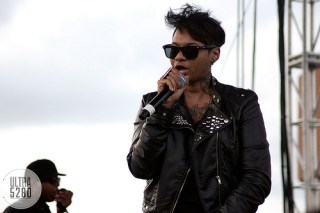
“Jean Grae” by Flickr user ultra5280 under Creative Commons 2.0 License
One of the female emcees that stands out most is Brooklyn-based Jean Grae. Born in South Africa in 1976, she moved to the United States with her parents shortly after she was born and grew up in New York City. In a 2006 interview with Robert Walsh for the academic journal Callaloo, Jean Grae reminisces about how hip hop culture was inescapable for a teen in New York City in the early nineties:
It was a thing when kids finally realized that you could put out your music yourself and you didn’t have to wait around and get signed. It was possible to learn for yourself and be able to put out music on your own or on an underground level. It was kind of unavoidable to be a part of it, I guess. (216)
After a brief stint as a DJ, she opted for rapping, as she was already writing (even if not necessarily rhyming). She took a hiatus from the hip hop scene in 2008 but later that year returned to performing and finally released a new mixtape named Cookies or Comas in 2011.
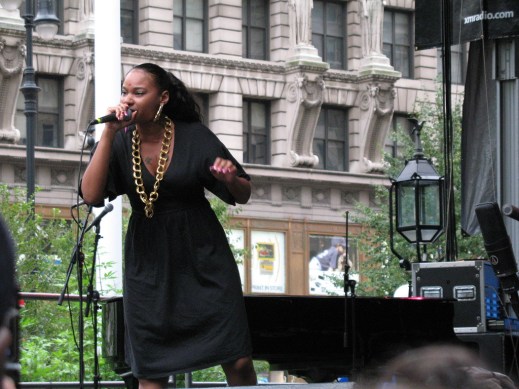
In hip hop, cities are often represented as masculine–what with the number of male rappers dropping stories about how things go down on the street–and Jean Grae complicates that representation. In Jean Grae’s version of Busta Rhymes’ “New York Shit,” she opens a door to thinking about female rappers and urban space, and her sonic intervention into Busta Rhymes’ narrative in his version of “New York Shit” illustrates how female rappers claim the city as well. I read her track as an act of urban homemaking: rapping about the city (and subverting the male voice that initially sung on the track, Busta) becomes a practice to claim the city as her home. In fact, it is not just through her lyrics but also through her voice that Jean Grae makes her presence felt.
Jean Grae’s version of “New York Shit,” a collaboration with rapper Talib Kweli, is an alternate version of Busta Rhymes’ hit track “New York Shit” from his 2006 album The Big Bang, although both songs use the same sampled loop and constantly repeat the phrase “New York Shit.”
The track that “New York Shit” samples is from the opening of a 1976 song titled “Faded Lady” from The Soul Sensation Orchestra (featuring Douglas Lucas and The Sugar Sisters, who sing together throughout the whole song). The song itself tells the story of a “faded lady” who seems to have lost her hopes, dreams, and connection to the world around her. “New York Shit,” both the Busta Rhymes and the Jean Grae/Talib Kweli version, samples approximately the first 13 seconds of the song, so that in their version the voices are erased; all that is left is the even thump thump of a drum, a bass, and a guitar, with the clash of a top hat and the bass in between, finally rising up to a climax with what sounds like a flute or clarinet until it drops back into the thump thump. The loop invokes the soundtracks of blaxploitation films, several of which were set in urban locations. The sample choice then places “New York Shit” in an urban soundscape.
Busta’s original song weaves images of New York as the birthplace of hip hop, as the location of great sports teams, and expensive taste around this soulful, smooth loop. The chorus of the song (“If you’re from New York, stand up right now, If you’re from New York, hands up right now”) calling forth New Yorkers. In the song, Busta also pays homage to some of the big names in hip hop who come from New York: Ol’ Dirty Bastard, Notorious BIG, Big Pun, Jam Master Jay, while the video includes cameos from people like Q-Tip, RZA, Slick Rick, and Big Daddy Kane. In this way, the song celebrates their contributions to hip hop, but also recreates a narrow, gendered view of who is part of that musical history.
However, the sonic picture Busta Rhymes paints is one that is devoid of women. Before the loop starts, Busta Rhymes’ voice emerges from the quiet: “DJ Scratch you’re sick for this one,” which acts as the signal for a chorus of male voices. Some of them whoop, some of them whistle, and some of them sing. Eventually they make way for Busta Rhymes to serenade listeners with his tales of New York life. His voice sounds gruff and aggressive, a contrast with the smooth vibe of “Faded Lady.” In fact, it seems as if the “faded lady” of the title is not just faded but erased–the women in the city become the faded ladies whose erasure makes possible for this problematic representation of urban space.
Enter Jean Grae.
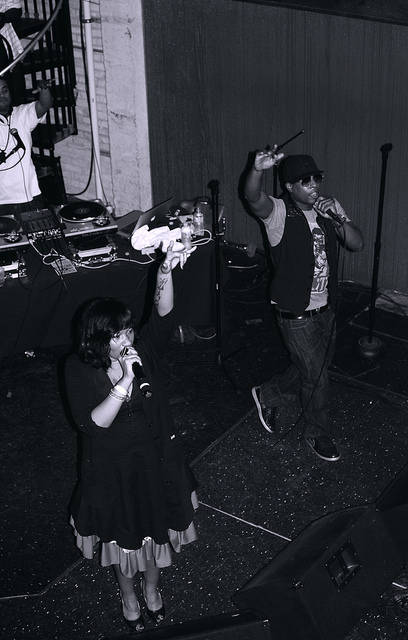
“talibjeangrae” by Flickr user HDShootsPhotos under Creative Commons License 2.0
In 2006, she and Talib Kweli released their version of “New York Shit” in a mixtape titled Hip Hop Docktrine: The Official Boondocks Mixtape which responds to Busta Rhymes’ sonic tribute to New York. (It also appeared on the mixtape Talib Kweli Presents Blacksmith the Movement.) Busta Rhymes’ song comes immediately to mind when listening to Jean Grae’s sixteen bars, especially when she starts with “Some of y’all forgot what New York is,” and in that vein it is hard not to hear Jean Grae’s track as a response to Busta Rhymes’.
Whereas Busta Rhymes’ song is ushered in by a chorus of disparate men’s voices, Talib Kweli and Jean Grae’s version starts with Talib Kweli’s introduction, followed by Jean Grae’s rapping. Talib Kweli’s introduction tricks the listener into thinking this version is just an echo of the original by Busta Rhymes (especially since the loop is virtually unchanged) until Jean Grae pops up by responding to Talib Kweli’s “I went for mine” with her “Go for yours, man.” The back-and-forth of the male and female voices, laid upon the same loop, acts as a subversion of Busta Rhymes’ male New York chorus.
But Jean Grae’s rapping is the most subversive element of the song. Jean Grae’s first line, “I’m on my New York shit,” calls forth Busta Rhymes’ song, even in her tempo. However, her verses take a swift turn from what Busta Rhymes puts forth in his song; at first listen, Busta Rhymes’ snappy, aggressive repetition of the phrase “New York [plus noun]” at the end of each verse is absent from Jean Grae’s rapping. Her voice seems to float on top of The S.S.O. loop, picking up speed when the loop reaches a climax, and dropping an octave or two (and slowing down a tad, too) when the climax of the track drops and loops back to the beginning. The resulting effect is that Jean Grae’s voice merges with the soulful flow of the song whereas Busta Rhymes’s voice is at war with it. Through her voice, Jean Grae disrupts Busta Rhymes’ sonic portrayal of a men’s-only New York. In fact, by subverting the vocal pattern Busta Rhymes sets up in the original version, Jean Grae creates a space in this New York hip hop narrative for female rappers to claim New York City as their own.
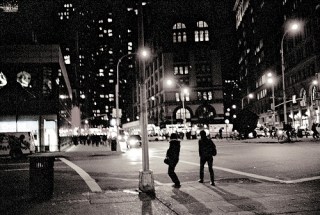
“New York City at Night” by Flickr user Alyssa L. Miller under Creative Commons License 2.0
In her verses, Jean Grae depicts a New York that is not glamorous or glitzy, like the one in Busta Rhymes’ song. Instead she talks about a “cement jungle,” and men who “struggle to their feet”; she also invokes the perils of gentrification when she talks about the Starbucks that pop up around the block (an indication of the white middle class coming to the neighborhood). But what catches my ear from this song is that Jean Grae mentions toward the end of her bars, “I just want to write and give back to the city that I’m a factor of.” Writing and rapping become a way for Jean Grae to practice her New York citizenship, an act of urban homemaking.
Even though Jean Grae busts her way into this narrative of urban masculinity, she is still a lonely female voice in the “New York Shit” repertoire. According to Wikipedia, there are several versions of the song, but Jean Grae is one of only two women to take on “New York Shit.” (Brooke Valentine has a version titled “H-Town Shit,” but I am limiting myself to the versions that look at New York City.) In that sense, Jean Grae’s female voice doesn’t necessarily fill a void in hip hop but rather points to it. On the other hand, her voice can be read/heard as highlighting a tradition of women rapping about the city. Whereas many rap songs invoke cities and urban locations, oftentimes these are portrayed as the sites of male dominance, normalizing a sonic cityscape that consists solely of men However, Jean Grae’s vocal track resists to that sonic cityscape, and that resistance too is an act of urban homemaking by virtue of claiming her space.
I continue to look for more tracks by female rappers and MCs that talk about U.S. cities, and this post has brought to mind more questions that I need to address. For example, what does it mean for a woman to rap about the city? Are there certain themes that echo throughout the songs (or throughout certain periods or subgenres)? Are there certain samples that are repeated? Do the sounds vary from city to city? These are questions that can be addressed by looking at a broader sample, but a close reading of one track can go a long way into thinking through these issues. Female rap artists like Jean Grae remind listeners that, to signify on Jay-Z, there is love in the heart of the city.
—
Featured Image of Jean Grae performing in New York City on August 26, 2006, Courtesy of Flickr User MrMoneda
—
Liana M. Silva is co-founder and Managing Editor of Sounding Out!
Share this:


Current Top Posts





April 2021

January 2020

November 2019

October 2019

August 2019

April 2014

November 2017

March 2015

December 2017

October 2015
 Sounding Out!
Recent Comments