
St Erkenwald: The Spectacle of Noise


series co-editors Dorothy Kim and Christopher Roman
Here is a distilled introduction to the latest installment of Medieval Sound, Aural Ecology, by series co-editors Dorothy Kim and Christopher Roman. To read their previous introduction, click here. To read the first run of the series in 2016, click here. To read the full introduction to “Aural Ecology” and to read last week’s post by Thomas Blake, click here.
Aural Ecology
What is considered music, noise, or harmony is historically and culturally contingent. [. . .] The essays in “Aural Ecologies” address the issue of unharmonious sounds, sounds that often mark dissonant critical identities—related to race, religion, material—that reverberate across different soundscapes/landscapes. In this way, this group of essays begins to open up the stakes of Medieval Sound in relation to what contemporary sound studies has begun to address in relation to cultural studies, architectural and environmental soundscapes, and the marking of race through the vibrations of the body. —Dorothy Kim and Christopher Roman
We don’t always listen to medieval poetry in the same way that we listen to contemporary verse, despite its many sonic features. This article addresses the central role of sound in a Middle English alliterative poem, St Erkenwald, which recounts a meruayle (158) that takes place in St Paul’s cathedral. Through listening to the aural texture of the poem, to the voices in the text listeners/ readers can interact with events as they unfurl.
Indeed John Scattergood has been argued that this work is a “conversation poem, a poem of transformations” (181), wherein things, legends are re-invented. Its central concerns are with the nature of salvation and history, how the past confronts the present and is obscured through the mists of time, with lay folk requiring the mediation of the clergy in order to comprehend its significance. The pagan judge’s discourse can be seen as representing living history, revealing what artifacts, writing, documents cannot. The poem’s highlighting of the limitations of memory, written records and commemoration, creates an enigma as P. Vance Smith phrases it, with the dead body left to recount its own place in the scheme of events (59-60, 74). It is through dialogue and sound, the poem’s sonorous fabric that the events are finally resolved, and their potential meaning extracted.
St Erkenwald opens with an account of the physical, historical and religious setting of the tale, which evolves into a description of the re-building of the cathedral. The mery (39) stone masons, whilst engaged in their work, uncover a splendid tomb, lavishly decorated. The description of the digging and carving of stone conveys jarring, bustling activity. News of the tomb with its indecipherable text spreads rapidly (58-62).
Voice File: lines 58-100
Click here to view transcript of Lines 58-100

Etching of Old St. Paul’s Cathedral, London, from Francis Bond’s Early Christian Architecture, 1913.
Apart from the explicit references to noise, the verbs are evocative of clamour and urgency. Far from proceeding calmly and in an orderly fashion to the tomb, the people highid, boghit, lepen and ronnen. A powerful sense of speed and movement is evoked, heightened by the numbers of people involved. Something extremely unusual has happened and everyone desires to see it. The event develops into a spectacle of noise, a lively social occasion, as layers of details and elements are accumulated.
Noise does not signify in itself, it has meaning only in relation to other modes of signification. Michelle R. Warren, in her analysis of “The Noise of Roland”, argues that from the “combined perspectives of acoustics, information theory, and philology” it is possible to view noise and signals or messages as interdependent and that what distinguishes something as meaningful, a signal or message, or disruptive, is “intent” (283). This is particularly evident in literature, which can be viewed as the “noise of culture,” a disturbance in the dissemination of information and thus literary texts can be viewed as “various forms of mixed signals” (304). Sound, like time and space helps to delineate boundaries between the self and other and in order for identity to be established the noisy other must be silenced.
However, there is no hint of violence, unease or alterity in all of this haste in the cathedral to see the wonder with which the pilgrims have been presented. The opening of the tomb is carefully and courteously organized by the mayor and the sacristan and skillfully enacted by the workmen. The body unearthed is as fresh as he is “sounde sodanly were slippid opon slepe”(92). There is a child-like innocence, an enthusiasm for the marvelous, the new. Even the mayor, civic and religious leaders are anxious to investigate the find. Each person questions what lies before him and endeavours to make sense of it.
To this end, they search for records and memories of this seemingly important individual (96-100). The discussion works from the materiality of the body outwards in an attempt to unravel the underlying meaning. This referral to documentation to find a rationale for what is happening proves ineffectual. The questioning of texts and modes of recording draws in the receivers of St. Erkenwald, who possess a similar level of knowledge of the events, witnessing them unfurl, just as the folk in the poem, uniting both the internal and external audiences.

Erkenwald teaching monks in a historiated initial from the Chertsey Breviary (c.1300)
News reaches Bishop Erkenwald of these happenings whilst he is visiting an abbey in Essex, and losing no time, he buskyd þiderwarde bytyme (112). Erkenwald spends the night reciting his canonical hours, beseeching God’s help to solve the mystery in order to confirm the people’s faith. His prayers prefigure the closure of the poem, functioning as an expression of desire, which through supplication is fulfilled leading to celebration as his wish and the wishes of the people are fulfilled in that the mystery of the body and divine workings are revealed.
Once he assumes control of proceedings all clamour and commotion cease, at his behest (131-2).
Voice File 2 lines 131-145
Click here to read a transcript of likes 131-145
The exquisite notes of the choir are an instance of that important element of medieval cultures, music, with every aspect of medieval life and experience and embodiment being musically significant. Lords gather, not rush to herken (134) the beautiful, intricate singing. After this carefully designed performance of sound in honour of God, the bishop processes to the tomb location. We learn of all the great, good and ordinary souls who follow the bishop as the area is unlocked with a great bundle of keys. The keys probably jangle in the echoing confines of the cloister, a naturalistic detail that draws the listener/ reader into the scene. Having negotiated the cloister the focus then narrows to a moving conversation between the bishop and the corpse. All is silence now (218-20).
Voice File 3 lines 193-220
Click here to read a transcript of lines 193-220
The crowd is as large as before, with a crush forming behind the bishop as he passes through it, yet it is becalmed through sheer amazement. The contrast between the calmness and silence of the crowd now and its previous frenetic noisy activity is quite arresting. Boisterous garrulous behavior evident amongst those attending religious worship is widely attested and, as Diana Wood notes, the church court records contain references to louts disrupting worship and bear testament to widespread chattering with warnings issued upon occasion (207).

University of Leicester Special Collections. The Shrine of Saint Erkenwald, which was in the shape of a pyramid, with an offering-table before it, and was adorned with gold, silver and precious stones. From SCT 00908, William Dugdale, The History of St. Pauls Cathedral in London : From its Foundation Untill these Times …, (London, 1818)
The dean recounts to Erkenwald all their attempts to unearth the identity of the body (159-62). Erkenwald responds by counselling the need to draw inspiration from God and to trust in their faith and to emphasize that only with divine aid can miracles be comprehended. Thereafter follows a dialogue between the bishop and the body in which we learn of the circumstances of the latter’s life and death. We are presented with performance history, the dead speaking to the living, to us, rather than information having to be gleaned from dusty monuments, texts and documents. These living words reveal God’s plan and their underlying significances are mediated by Erkenwald for the deceased judge and spectators. The poem in turn translates these events for later readers/listeners. The focus remains firmly fixed on the bishop and the corpse, with the crowd quietly observing and listening, in the same manner as those who hear/read the text.
Indeed, throughout this section the references to noise are limited to verbs and phrases which suggest sorrow. The corpse hummyd (281) and gefe a gronyng (283). One can almost hear the silence as Erkenwald pauses and looks at the tomb with flowing tears. As he warpyd the words of baptism wete (321) drips from his eyes and trillyd adoun (322). A drop falls on the judge’s face, facilitating his having a vision of paradise. His sadde soun (324) sounds out in that place for the last time for a final time as he describes what he sees and “wyt this cessyd his sowne, sayd he no more” (341). The judge is miraculously received into heaven and his body instantaneously decomposes, in the midst of great tranquility.
The climax of the poem is a crescendo of sound, as the crowd rejoices at the happy fate of the judge, but it is a happiness inevitably tinged with sadness in the face of death (350-2).
Voice File 4 lines 309-352
Click here to read a transcript of lines 309-352

A sermon at Paul’s Cross
(from the Society of Antiquaries of London)
All are involved in the procession with bells ringing out throughout the town. The bells call not only the folk of Erkenwald’s London to participate in this joyful spectacle; they invite later audiences to join the celebration. Thus childlike innocence and enthusiasm combined with the direction of the church in tangible situations are deemed beneficial. This is paralleled in the positivity of silence and the three correct usages of human speech as explicated in a fifteenth-century sermon by an Oxford student monk on the gospel reading for the third Sunday in Lent, Luke II:14-28. An individual, especially a cleric, must be silent and meditate before he can graciously address the Lord. Quiet study is necessary prior to exhorting people to leave their sinful ways, with the final purpose of rightful speech being confession, which should only be exercised after the silent acquiring of wisdom (41-51).
The poem’s narrative voice adds that physicality is merely vainglorious, and what is fundamental is the soul’s achieving of bliss through the expression of love for Our Lord who makes this feasible. Such explicit comments are comparatively rare in St. Erkenwald with the role of the church and lay folk, and their obligations performed, expressed, rather than stated. The poem provides a model of the religious culture of a cathedral with the roles of clergy and laity carefully delineated. Through a spectacle of sound, ordered and disordered, of human and divine orchestration, pastoral care and guidance is enacted for the audience in and of the poem.
—
Featured Image: Image from the Crusader Bible, Morgan Library M.638, fol. 3r.
—
Bonnie Millar, Ph.D., Researcher at the University of Nottingham holds degrees from Trinity College Dublin, and the University of Nottingham. She has authored a critical study of the Siege of Jerusalem, and also publishes regularly on alliterative poetry, medieval romances, gender theory and myths. Publications include a paper entitled “Hero or Jester: Gawain in Middle English Romances and Ballads” in Le Personnage de Gauvain dans la literature européenne du Moyen Âge ed. Marie-Françoise Alamichel, a chapter on “Key Critics, Concepts & Topics” in the Continuum Handbook of Medieval British Literature, “A Measure of Courtliness: Sir Gawain and the Carl of Carlisle” in Cultures Courtoises en Mouvement: Proceedings of the Thirteenth Congress of the International Society of Courtly Literature and contributions to the Facts on File Companion to Pre-1600 British Poetry. Current projects include a full length study of the figure of Gawain entitled Gawain: From Hero to Anti-Hero in late Middle English and Early Modern Romances and Ballads.
—
REWIND!…If you liked this post, you may also dig:
The Amplification of Muted Voices: Notes on a Recitation of the Adhan–David Font-Navarette
Wayback Sound Machine: Sound Through Time, Space, and Place–Maile Colbert
“Playing the Medieval Lyric”: Remixing, Sampling and Remediating “Head Like a Hole” and “Call Me Maybe”–Dorothy Kim
Share this:

Sounding Visibility in Anglo-Latin Prose
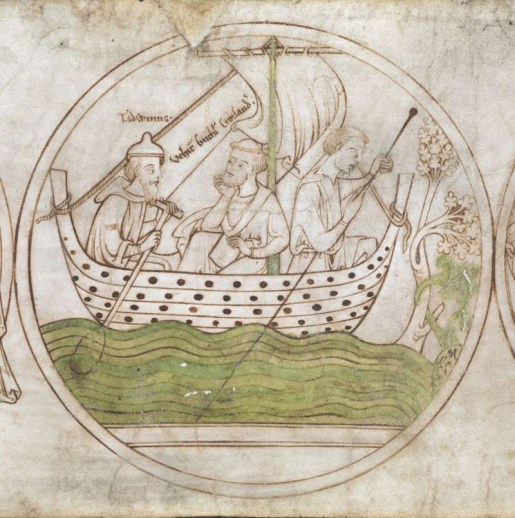
series co-editors Dorothy Kim and Christopher Roman
Here is a distilled introduction to the latest installment of Medieval Sound, Aural Ecology, by series co-editors Dorothy Kim and Christopher Roman. To read their previous introduction, click here. To read the first run of the series in 2016, click here. To read the full introduction to “Aural Ecology” and to read last week’s post by Thomas Blake, click here.
Aural Ecology
What is considered music, noise, or harmony is historically and culturally contingent. [. . .] The essays in “Aural Ecologies” address the issue of unharmonious sounds, sounds that often mark dissonant critical identities—related to race, religion, material—that reverberate across different soundscapes/landscapes. In this way, this group of essays begins to open up the stakes of Medieval Sound in relation to what contemporary sound studies has begun to address in relation to cultural studies, architectural and environmental soundscapes, and the marking of race through the vibrations of the body. —Dorothy Kim and Christopher Roman
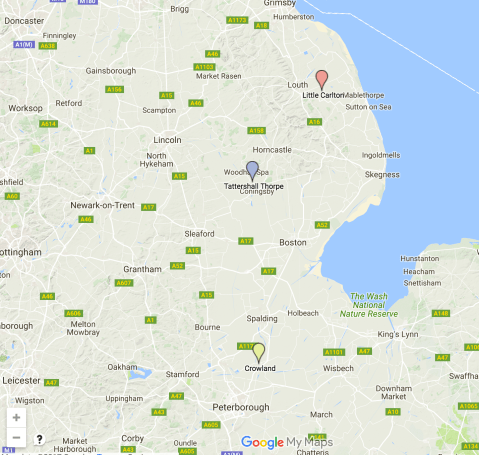
While the raucous rancor of last year’s Super Tuesday was dominating network news and social networks—which, sadly, seems so long ago now—a quieter news story emerged from the tranquil fields of Lincolnshire: an Anglo-Saxon island has been discovered. Its artifacts are some of the most remarkable to have been found in recent decades; among these finds are writing utensils, game pieces, butchered animal bones, and other indicators of a sustained trading community.
The Guardian reported that surveys and software enabled the archaeologists to model the island in its contemporary landscape and seascape, revealing that it had once rested “between a basin and a ditch.”
This placement, the lead archaeologist continued, suggests that the site “was a focal point in the Lincolnshire area, connected to the outside world through water courses.” So if these reimagined waterways can show us how people saw the site, can they tell us how people heard it, as well?
I think so, especially because of the recent work on ancient acoustics in early churches. In February, The Atlantic published an article on the recent scholarly collaboration among an art historian-archaeologist, a music producer-engineer, and the founder of the USC Immersive Audio Laboratory (yes, it’s a real thing). This super-interdisciplinary team was able to “map the acoustic fingerprint of several [Byzantine] churches,” which were shown to have been deliberately “designed to shift a person’s sensory experience.” Now, the USC member explains, they can record a chant, “process it … and all of the sudden we have performances happening in medieval structures.” They can actually rebuild the sounds of our ancient past. [By the way, Allison Meier of hyperallergic reported on this story as well; her article provides links to the Escape Velocity podcast on Acoustic Museums, which is well worth a listen].
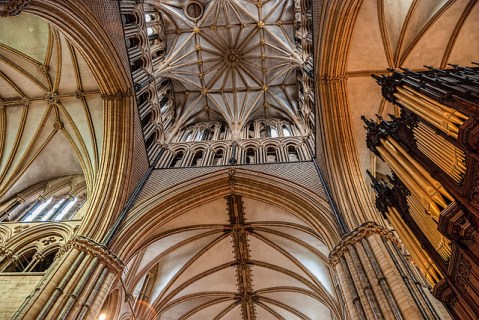
Interior of Lincoln Cathedral, Image by Flickr User Gary Ullah, (CC BY 2.0)
If they can recreate the lost sounds of ancient structures, and archaeologists can recreate early medieval topographies, then it stands to reason that the recreation of past landscapes, and even seascapes, might not be far behind.
But was sound different across the cooler, wetter climate of the early Middle Ages? Were the hearers’ auditory contexts drastically different in a pre-modern world? To what effect?
To me, what’s tantalizing about the Lincolnshire island is that it was on the border of the early medieval fenland—an area described by the 8th-century monk Felix as dense and undulating, “now consisting of marshes, now of bogs, sometimes of black waters overhung by fog, sometimes studded with wooded islands and traversed by the windings of tortuous streams” (Ch XXIV, trans Colgrave p 87). In such an aqueous environment, sound would have travelled well, staying close to the cool, dense air hovering over the waters.

Dark skies over fenlands, near Spilsby, Lincolnshire. Taken by Lutmans on Flickr, (CC BY 2.0).
In his prose hagiography, the Life of St Guthlac, Felix enshrines certain sounds in the wetland ecology of Guthlac’s surroundings. He does so most explicitly at the landing-place, where visitors must “sound a signal” to alert the hermit that they’ve arrived. But what was this signal, and why would Felix bother to emphasize such a mundane practice of alerting your host when you’ve arrived?
In monastic communities bells were used to sound the Daily Office to calling each member together in prayer. As moderns, we should remember that these bells—frequent, sonic interventions of everyday life—were rung on the shore, or in a church, or on monastic grounds rather than from the larger towers of later belfries (an exception to this is the early Irish Round Tower). These small hand-held bells “of hammered sheets or cast metal” which “would presumably have clanged or tinkled, rather than tolled sonorously across a distance” (Resounding Community, 103).

Bell-shrine; bronze and silver parcel-gilt; made for the bell of St Conall Cael.
Bells were spiritual and supernatural; they could cleanse or curse, and were kept by clerics and lay people alike. They were sometimes sworn on, as if they were relics. Sometimes, they were made into relics. For more about early Irish bell traditions, click here and or/ here.
In Northwest Europe in the Early Middle Ages, Christopher Loveluck describes David Hinton’s work on a seventh-century smith found buried alone, “next to the marshland and waterways to the sea, with his tools, a bell, a fine seax and a silk-wrapped amulet” and therefore “emblematic of the transition from such ‘outsider’ itinerant artisan/merchants to the vibrant artisan and trading communities of the emporia ports.” Still, the“[p]erception of threat from itinerant ‘outsiders’ is emphasized in the late seventh-century Anglo-Saxon law code of Wihtred, by the obligation on non-local travellers and foreigners to announce themselves with bells or horns, prior to leaving principal roads or trackways to approach settlements.”
For seventh-and eighth century people, then, bells sounded time, community, and stillness as well as place, strangeness, and travel. In either instance, the aural intrusion always betokened a human presence. And of course, these were some of the only sounds that weren’t naturally occurring; this might have been as close as they got to manmade sound pollution.
For Guthlac, sound was especially important because he could not see far from his earthen hermitage. Not having any need for a bell to sound the Daily Office, he nevertheless depended on some kind of signal for approaching visitors.
In one episode, distraught parents bring their once-possessed, now very ill son to Crowland in the hope that he might be cured. This is quite different from an earlier visitation from Wilfrid and Æthelbald, whom Guthlac knew personally, and with whom he might have traded correspondence. To me, this is the real test of Guthlac’s grace: will he help the neediest? The stranger? The tired, desperate parents? Does the bell, or whatever the signal is, proclaim their sameness or difference?
We can sense the tension in the passage, during their sounding of the signal and speaking to Guthlac:
Then when the sun rose in its splendour, they approached the landing place of this said island, and having struck the signal they begged for a talk with the great man. But he, as was his custom, burning with the flame of most excellent charity, presented himself before them…[and after hearing their story] immediately seized the hand of the tormented boy and led him into his oratory, and there prayed on bended knees, fasting continually for three days…(XLI, Colgrave 131).
The parents had expected to wait; they expected to plead on their son’s behalf. They expected a struggle to be heard. But—and I do think that’s a rather crucial autem in the Latin—Guthlac is eager to listen; the sound on the shore was enough.
What’s more, his cure is a series of utterances. He prays (aloud) for three days straight, without pausing to eat. And after ritually rinsing and breathing the “breath of healing” on the boy, the child, “like one who is brought into port out of the billows and the boiling waves, heaved some deep sighs from the depth of his bosom and realized that he had been restored to health”(XLI, Colgrave 131).
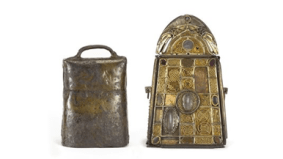
Image from National Museum of Ireland
I’m a mom to an asthmatic toddler, so I find myself quite moved by this scene. I can imagine ringing the bell—the thing I might have heard in church, or had in my home; the signal by which monks were called to prayer and children inside for curfew—to make a sound for myself. I can imagine traveling with my husband to a strange place far from home, not knowing what would happen. I can imagine using something everyday for something extraordinary, and having the sound of my arrival echo with anticipation. If I were this mother, I would hear it bounce off the marshes and off the low-lying islands. The dawn would be warming the air above us, amplifying our sound. And I would be standing there, with my child wrapped in my arms, hoping to see someone emerge from a barrow; a man of God whose isolation and entrenchment was supposed to be part of his holiness.
The sound travels outwards to the hermitage and back with the hermit—the echo of her hope, meeting them at the shore. This is a soundscape and a landscape in which time seems still on the shore, but sped through in the oratory. Felix joins both sites, and both temporalities, with the simile of the boy as one rescued from shipwreck catching his breath as he washes ashore. The image recalls the sound of their arrival, and that first bell still seems to ring through this narrative of hope against all odds.
Wouldn’t it be great to hear that again?
—
Featured Image: Guthlac sailing to Crowland with Tatwin. © British Library, Harley Roll, Y 6, roundel 4, from Medieval Histories.com
—
Rebecca Shores is a Ph.D. candidate in English Literature at the University of North Carolina at Chapel Hill. Her Dissertation is entitled “Bringing Saints to the Sea: Ships in Old English and Anglo-Latin Hagiography.”
—
REWIND!…If you liked this post, you may also dig:
(Sound)Walking Through Smithfield Square in Dublin–Linda O’Keeffe
Wayback Sound Machine: Sound Through Time, Space, and Place–Maile Colbert
Audiotactility & the Medieval Soundscape of Parchment–Michelle M. Sauer
Share this:


Current Top Posts





April 2021

January 2020

November 2019

October 2019

August 2019

April 2014

November 2017

March 2015

December 2017

October 2015
 Sounding Out!
Recent Comments