
Remix the Libraries / Collaborative Listening

DOI: https://doi.org/10.59350/fb9fr-hpg35
We’re all familiar with the stereotype. Inside the library, deep in study, you stumble upon something funny, a pun, a quip or even a reference to one of the meme-like librarians do-Gaga sing along. Whatever it is, its funny. . . hilarious even. At first you try to bottle it in, but what starts as a snigger eventually manifests itself as boisterous laughter. You’re making noise, then: SHHHHHHHHHHHH! Libraries, for better or worse, are quiet spaces, but they are also important third-spaces, social forums and purveyors of an all-ages educational opportunity. Even though we imagine libraries to be quiet, they often distribute music. This blog entry suggests a musical intervention of sorts, a reconstitution of the library as a space of noise. A site of collaboration in the public imaginary where conversations can take place over a splice of Iggy Pop and Tchaikovsky fading from one century to the next. This is no pipe dream, it is a radical rethinking of what tomorrow’s library could be within the parameters of virtual space.
This idea is nothing new, Library Information Science scholars like Brenda Dervin have been arguing since the seventies that libraries should be configured as sites of community and activity, not as tombs of information. There is a fundamental tension still; libraries are a space of study, and most users are more comfortable reading in a quiet space. Virtual spaces offer a way out of this problematic by allowing for a second acoustic space for users to listen in, a space which can be conveniently tethered to social networking software, like Facebook. I am arguing, along with my friend Nathan Graham, that libraries are the ideal setting through which to stage a new social platform of participatory and collaborative listening. Using emergent tools from social media platforms, users can cobble lists for shared virtual listening (complete with edited audio clips) and discuss them in a virtual forum. Because of the library’s institutional history as an educational space, these locally hosted forums can stage a strong argument for collaborative listening as fair use, an integral part of the 21st century library.
Right now this idea is just a seed: we are thinking of the platform, its potentials and its restrictions. Notably, in a not so discreet attempt to get feedback from the Sounding Out! reader base, I want to further entertain the idea of collaborative listening. Collaborative listening is a more interactive form of collective listening – it implies that a conversation between listeners is taking place. Some physical spaces of collaborative listening could be the living room while a record spins on a turntable, the classroom where a group of students discuss a song, a subway train where two people share MP3 earbuds, a car in a parking lot surrounded by kids all listening to its stereo, or even Youtube and Last.fm where people often leave comments about songs in the forum below. It is important to consider open spaces which can push against the impending corporate monetization of music sharing and cloud computing as Patrik Wikstrom establishes in his 2010 book, The Music Industry. Bringing this conversation to libraries helps to smash our prejudice of the library as a tomb of knowledge, it opens up the space and facilitates conversation between a greater breadth of citizens. Hopefully, this platform will help transform the library into a open source hub of conversation and collaboration.

So let us listen silently with earbuds in, to the libraries who might channel noise through the internet, a fantasy/testimony to the hopeful sounds of tomorrow.
Aaron Trammell
—
Share this:

Singing to my Imagined Listener
DOI: https://doi.org/10.59350/5jdf8-5jy70
Three hours a week, I speak to a group of ninety-nine people and explain how to make choices. I talk loudly, to the back of the room, then I lower my voice to engage them more intimately. I pause and let the room grow silent. Near the end of the twice-weekly performance, I review my main points. Like a bell, this signals to my audience that they will leave soon; they begin to rustle in their chairs. I say, “Hey, I’m not done! You can’t go yet!” And they laugh. And they stay.

I am an economist and a musician. In both of my chosen fields, performance is a necessary component. As an economist, I teach and I present papers; as a musician, I put on shows. Performance is the willful construction of a series of events using the body—hands, voice, gesture—and the instruments the body can manipulate to create a particular mental state for the witnesses. In the days leading up to my next show on October 16th at The Beef in Binghamton, NY, I have pondered the intimate ways in which listening structures the corporeal nature of performance. As an economist, I understand that performance is strategic, in that I imagine a listener for my music and choose my actions to influence that listener. As a musician, I recall moments that I listened.
“Audience as available instrument in performance”
The audience is one of the instruments available to the performer. I plan to use this to my advantage at my upcoming show. When I envision my fingers first passing across my guitar, the audience will not be engaged with me: they will be talking to each other, getting a drink, finding a seat. I will play a song at a normal volume; given the other noise, it will be background, not a centerpiece. Most people will hear it, but not many will notice it. The climax of the song will involve me holding a loud, high vocal note until all other noise dies. Each person there will have a moment in which they hear that note and wonder what it is and they will grow silent. By the end of the note, every person in the room will realize that the performance has started and that this sustained note is part of a song they have been hearing but not listening to for several minutes. As the note draws to a close, they will feel compelled to shout, to clap, to exclaim. Their part in this performance—the noise, the silence, then the noise—will be one they will play without knowing, beforehand, that they were included.
I imagine this moment like the opening to Belle And Sebastian‘s “I Don’t Love Anyone:” ‘I don’t love anyone/ You’re not listening/ … I don’t love anyone/You’re not listening even now.’ As a listener, you realize as he says ‘even now,’ that he’s right: you weren’t listening. It was a transcendent moment that shocks me as a listener: the author of the song had climbed inside my head without me knowing, and then was able to name exactly the listening experience I was having.
“Rhythm to Organize Silence”
In Chronicles, Bob Dylan describes a listening experience built around a singer who constructs her own way to view the rhythm of a song. “I’d seen [Martha Reeves] in New York … where she’d been playing with the Motown Revue. Her band couldn’t keep up with her, had no idea what she was doing and just plodded along. She beat a tambourine in triplet form, up close to her ear and she phrased the song as if the tambourine was her entire band” (160). This phrasing that is out-of-phase with the band (or the audience) reminds me of Odetta.
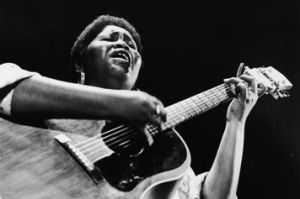
Odetta might be best known for her performance of “I’ve been driving on Bald Mountain/Water Boy.” She rebuilt those two traditional 4/4 folk songs swung onto a three-beat triplet, so what emerges is a swinging triplet where beats two and three are rushed in after a lethargic one: ONE… two three; ONE… two three; ONE… two three. After several times though the verses, she stops the guitar entirely and carries a long vocal note, setting up a moment of unnaturally long silence. The guitar and grunt that end the silence seem arrhythmic to my ear, but Odetta can sing by her own time that swings in and out of phase with the rest of us. We’re not meant to know when resolution comes, and it’s that uncertainty that Odetta wants us to experience.
I once saw Jeff Tweedy use a controlled complete silence with Wilco‘s performance of “Misunderstood” from Being There in 2001. Tweedy doesn’t use uncertainty as Odetta does; his use of silence is more akin to methodically turning on and off a bedroom light in the middle of the night. In particular, the band performs an extended outro which involves two beats of sound and two beats of silence: “NOTHING – -.” On “NAH” and “THING” the whole band is together on two identical, stinging staccato notes.
On the off beats, the entire theater is silent. When I was in the audience, it was so quiet you could have heard the audience breathe. . .if anyone had been taking a breath. On some level, I was in a state of shock, or at least, a state of being constantly startled; everyone must have been, because the silences were complete. On another level, I felt at peace. I calmly looked from face to face in the audience behind me, and everyone had the same startled, smiling expression I’m sure I had. I looked around the room–just looked, without an agenda, just idle curiosity–for the first time in what felt like years.
Seeking to recreate a combination of those listening experiences in my audience, I wrote “Something This Easy,” a song about confusing interactions with an ex. The song is forty percent silence: nineteen beats of melody followed by thirteen beats of silence. I don’t tap my foot or keep time during the silence, save for holding my breath, and I bring back the sound when I (have to) exhale. I try to keep the audience slightly and repeatedly startled by resisting any precise expectation of sound that they may hold. After a beat, the audience will break the silence when I make them laugh with the line: “I know your body like a Swedish furniture map.” With the eruption of laughter in an otherwise silent room, my audience becomes the instrument creating the music that they are listening to at that moment. That is, they are the only instrument I’m playing.
As a musician, this is the listening experience I designed: the laughter rings after I’ve triggered it like a overtone ring on a string long after having been plucked and left. As an economist, I see how I used the imagined listener successfully: I forecasted how these real listeners would react, and was able to use that forecast to design not only this moment, but potentially many others as well.
Downloadable Pape Mix of Wilco, Odetta, and his own “Something this Easy”:
Rhythm to Organize Silence (Misunderstood_Tweedy_ Bald Mtn_Odetta_ SmthThisEasy_Pape)
View Andreas Duus Pape’s latest album The Big Hit here
—
Andreas Duus Pape
—
Share this:




Current Top Posts





April 2021

January 2020

November 2019

October 2019

August 2019

April 2014

November 2017

March 2015

December 2017

October 2015


Recent Comments