
Look Away and Listen: The Audiovisual Litany in Philosophy

This is an excerpt from a paper I delivered at the 2017 meeting of the Society for Phenomenology and Existential Philosophy.
—

“Compressed and rarefied air particles of sound waves” from Popular Science Monthly, Volume 13. In the public domain, via Wikimedia Commons.
According to sound studies scholar Jonathan Sterne in The Audible Past, many philosophers practice an “audiovisual litany,” which is a conceptual gesture that favorably opposes sound and sonic phenomena to a supposedly occularcentric status quo. He states, “the audiovisual litany…idealizes hearing (and, by extension, speech) as manifesting a kind of pure interiority. It alternately denigrates and elevates vision: as a fallen sense, vision takes us out of the world. But it also bathes us in the clear light of reason” (15). In other words, Western culture is occularcentric, but the gaze is bad, so luckily sound and listening fix all that’s bad about it. It can seem like the audiovisual litany is everywhere these days: from Adriana Cavarero’s politics of vocal resonance, to Karen Barad’s diffraction, to, well, a ton of Deleuze-inspired scholarship from thinkers as diverse as Elizabeth Grosz and Steve Goodman, philosophers use some variation on the idea of acoustic resonance (as in, oscillatory patterns of variable pressure that interact via phase relationships) to mark their departure from European philosophy’s traditional models of abstraction, which are visual and verbal, and to overcome the skeptical melancholy that results from them. The field of philosophy seems to argue that we need to replace traditional models of philosophical abstraction, which are usually based on words or images, with sound-based models, but this argument reproduces hegemonic ideas about sight and sound.
 For Sterne, the audiovisual litany is traditionally part of the “metaphysics of presence” that we get from Plato and Christianity: sound and speech offer the fullness and immediacy that vision and words deny. However, contemporary versions of the litany appeal to a different metaphysics. For example, Cavarero in For More Than One Voice argues that the privileging of vision over sound is the foundation of the metaphysics of presence. “The visual metaphor,” she argues, “is not simply an illustration; rather, it constitutes the entire metaphysical system” (38). The problem with this videocentric metaphysics is that it “legitimates the reduction of whatever is seen to an object” (Cavarero 176) and it cannot “anticipate” or “confirm the uniqueness” of each individual (4). In other words, it objectifies and abstracts, and that’s bad. If vision is the foundation of the metaphysics of presence, one way to fix its problems is to replace the foundation with something else. Cavarero thinks vocal resonance avoids the objectifying and abstracting tendencies that images and text supposedly lend to philosophy.
Similarly, in the same way that the traditional audiovisual litany “assume[s] that sound draws us into the world while vision separates us from it” (Sterne 18), Barad’s argument for agential realism in Meeting the Universe Halfway assumes that diffraction draws theorists into actual contact with matter while “reflection still holds the world at a distance” (87). Agential realism looks is the view that even the most basic units of reality, like the basic particles of matter, exercise agency as they interact to form more complex units; diffraction is Barad’s theory about how these particles interact. This litany of distance-versus-relationality and external objectivity versus immersive materiality structures Barad’s counterpoint between reflection and diffraction. For example, she contrasts traditional investment in reflective surfaces—“the belief that words, concepts, ideas, and the like accurately reflect or mirror the things to which they refer-makes a finely polished surface of this whole affair” (86)–with diffractive interiorities, which get down to “the real consequences, interventions, creative possibilities, and responsibilities of intra-acting within and as part of the world” (37). But how do we know Barad is appealing to an audiovisual litany? We know because her fundamental concept–diffraction–describes the behavior of waveforms as they encounter other things, and 21st century Western scientists and music scholars think sound is a waveform. When two or more waves interact, they produce “alternating pattern[s] of wave intensity” or “increasing and decreasing intensities” (Barad 77), like ripples in water or alternating light frequencies.

“diffracted hydrogen” by Flickr user candace, CC BY 2.0
Barad appeals to notions of consonance and dissonance to explain how these patterns interact. For example, when diffracting light waves around a razor blade, “bright spots appear in places where the waves enhance one another-that is, where there is ‘constructive interference’-and dark spots appear where the waves cancel one another-that is, where there is ‘destructive interference’” (Barad 77). This “constructive” and “destructive” interference is like audio amplification and masking: when frequencies are perfectly in sync (peaks align with peaks, valleys with valleys), they amplify; when frequencies are perfectly out of sync (peaks align with valleys), they cancel each other out (this is how noise-cancelling headphones work). Constructive interference is consonance: the synced patterns amplify one another; destructive interference is dissonance: the out-of-sync patterns mask each other. Both types of interference are varieties of resonance, a rational or irrational phase relationship among frequencies. Rational phase relationships are ones where the shorter phases or periods of higher frequencies are evenly divisible into the longer phases/periods; irrational phase relationships happen when the shorter phases can’t be evenly divided into the longer wavelengths. Abstracting from waveforms to philosophical analysis, Barad often uses resonance as a metaphor to translate wave behavior into materialist philosophical methods. However, even though most of Barad’s examples throughout Meeting the Universe Halfway are visual, she’s describing what scientists call acoustic relationships.
For example, Barad argues that “diffractively read[ing]” philosophical texts means processing “insights through one another for the patterns of resonance and dissonance they coproduce” (195; emphasis mine). Similarly, she advises her readers to tune into the “dissonant and harmonic resonances” (43) that emerge when they try “diffracting these insights [from an early chapter in her book] through the grating of the entire set of book chapters” (30). As patterns of higher and lower intensity that interact via ir/rational phase relationships, diffraction patterns are a type of acoustic resonance. Appealing to acoustics against representationalism, Barad practices a version of the audiovisual litany. And she’s not the only new materialist to do so—Jane Bennett’s concept of vibration and Elizabeth Grosz’s notion of “music” also ontologize a similar idea of resonance and claim it overcomes the distancing and skeptical melancholy produced by traditional methods of philosophical abstraction.

“Painter” by Flickr user Flood G., CC BY-NC-ND 2.0
There are also instances of the audiovisual litany in phenomenology. For example, Alia Al-Saji develops in the article “A Phenomenology of Critical-Ethical Vision” a notion of “critical-ethical vision” against “objectifying vision,” and, via a reading of Merleau-Ponty, grounds the former, better notion of sight (and thought) in his analogy between painting and listening. According to Al-Saji, “objectifying vision” is the model of sight that has dominated much of European philosophy since the Enlightenment. “Objectifying vision” takes seeing as “merely a matter of re-cognition, the objectivation and categorization of the visible into clear-cut solids, into objects with definite contours and uses” (375). Because it operates in a two-dimensional metaphysical plane it can only see in binary terms (same/other): “Objectifying vision is thus reductive of lateral difference as relationality” (390). According to Al-Saji, Merleau-Ponty’s theory of painting develops an account of vision that is “non-objectifying” (388) and relational. We cannot see paintings as already-constituted objects, but as visualizations, the emergence of vision from a particular set of conditions. Such seeing allows us “to glimpse the intercorporeal, social and historical institution of my own vision, to remember my affective dependence on an alterity whose invisibility my [objectifying] vision takes for granted” (Al-Saji 391). Al-Saji turns to sonic language to describe such relational seeing: “more than mere looking, this is seeing that listens (391; emphasis mine).
This Merleau-Pontian vision not only departs from traditional European Enlightenment accounts of vision, it gestures toward traditional European accounts of hearing. Similarly, Fred Evans, in The Multivoiced Body uses voice as a metaphor for the Deleuzo-Guattarian metaphysics that he calls “chaosmos” or “composed chaos” (86); he then contrasts chaosmos to “homophonic” (67) Enlightenment metaphysics. According to Evans, if “‘voices,’ not individuals, the State, or social structures, are the primary participants in society” (256), then “reciprocity” and “mutual intersection” (59) appear as fundamental social values (rather than, say, autonomy). This analysis exemplifies what is at the crux of the audiovisual litany: voices put us back in touch with what European modernity and postmodernity abstract away.

“Image from page 401 of “Surgical anatomy : a treatise on human anatomy in its application to the practice of medicine and surgery” (1901)” by Flickr user Internet Archive Book Images
The audiovisual litany is hot right now: as I’ve just shown, it’s commonly marshaled in the various attempts to move past or go beyond stale old Western modernist and postmodernist philosophy, with all their anthropocentrism and correlationism and classical liberalism. To play with Marie Thompson’s words a bit, just as there is an “ontological turn in sound studies,” there’s a “sound turn in ontological studies.” But why? What does sound DO for this specific philosophical project? And what kind of sound are we appealing to anyway?
The audiovisual litany naturalizes hegemonic concepts of sound and sight and uses these as metaphors for philosophical positions. This lets philosophical assumptions pass by unnoticed because they appear as “natural” features of various sensory modalities. Though he doesn’t use this term, Sterne’s analysis implies that the audiovisual litany is what Mary Beth Mader calls a sleight. “Sleights” are, according to Mader in Sleights of Reason,“conceptual collaborations that function as switches or ruses important to the continuing centrality and pertinence of the social category of a political system like “sex” (3). Sleights, in other words, are conceptual slippages that render underlying hegemonic structures like cisheteropatriarchy coherent. More specifically, sleights are “conceptual jacquemarts” (Mader 5). Jacquemarts are effectively the Milli Vanilli of clocks: sounds appear to come from one overtly visible, aesthetically appealing source action (figures ringing a bell) but they actually come from a hidden, less aesthetically appealing source action (hammers hitting gongs). The clock is constructed in a way to “misdirect or misindicate” (Mader 8) both who is making the sound and how they are making it. A sound exists, but its source is misattributed. This is exactly what happens in the uses of the audiovisual litany I discuss above: philosophers misdirect or misindicate the source of the distinction they use the audiovisual litany to mark. The litany doesn’t track the difference between sensory media or perceptual faculties, but between two different methods of abstraction.

Screenshot from Milli Vanilli’s video “Don’t Forget My Number”
This slippage between perceptual medium and philosophical method facilitates the continued centrality of Philosophy-capital-P: philosophy appears to reform its methods and fix its problems, while actually re-investing in its traditional boundaries, values, and commitments. For example, both new materialists and sound studies scholars have been widely critiqued for actively ignoring work on sound and resonance in black studies (e.g., by Zakiyyah Jackson, Diana Leong, Maire Thompson). As Zakiyyah Jackson argues in “Outer Worlds: The Persistence of Race in Movement “Beyond the Human,” new materialism’s “gestures toward the ‘post’ or the ‘beyond’ effectively ignore praxes of humanity and critiques produced by black people” (215), and in so doing ironically reinstitute the very thing new materialism claims to supercede. Stratifying theory into “new” and not-new, new materialist “appeals to move ‘beyond’…may actually reintroduce the Eurocentric transcendentalism this movement purports to disrupt” (Jackson 215) by exclusively focusing on European philosophers’ accounts of sound and sight. Similarly, these uses of the litany often appeal only to other philosophers’ accounts of sound or music, not actual works or practices or performances. They don’t even attend to the sonic dimensions of literary texts, a method that scholars such as Jennifer Lynn Stoever and Alexander Weheliye develop in their work. Philosophers use the audiovisual litany to disguise philosophy’s ugly politics—white supremacy and Eurocentrism—behind an outwardly pleasing conceptual gesture: the turn from sight or text to sound. With this variation of the audiovisual litany, Philosophy appears to cross beyond its conventional boundaries while actually doubling-down on them.
—
Featured image: “soundwaves” from Flickr user istolethetv
—
Robin James is Associate Professor of Philosophy at UNC Charlotte. She is author of two books: Resilience & Melancholy: pop music, feminism, and neoliberalism, published by Zer0 books last year, and The Conjectural Body: gender, race and the philosophy of music was published by Lexington Books in 2010. Her work on feminism, race, contemporary continental philosophy, pop music, and sound studies has appeared in The New Inquiry, Hypatia, differences, Contemporary Aesthetics, and the Journal of Popular Music Studies. She is also a digital sound artist and musician. She blogs at its-her-factory.com and is a regular contributor to Cyborgology.
—
 REWIND! . . .If you liked this post, you may also dig:
From “listening” to “filling in”: where “La Soeur Écoute” Teaches Us to Listen-Emmanuelle Sontag
The Listening Body in Death –Denise Gill
Re-orienting Sound Studies’ Aural Fixation: Christine Sun Kim’s “Subjective Loudness”-Sarah Mayberry Scott
Share this:

Teach Me How To Dougie Like A Mediocre White Man

In the third episode of Twin Peaks: The Return (2017), we meet Dougie Jones, a new character who is, as an otherworldly being will tell him, “manufactured.” Dougie’s sonic presence on the show is primarily marked by repetition, as the majority of his dialogue involves him parroting those around him. Though Dougie has been received as a symbol of purity or a magical conduit for others’ best selves (14:53-19:00), a close listen to his repetitions suggests that he is instead what Sarah Hagi has dubbed the “mediocre white man.”
DAILY PRAYER TO COMBAT IMPOSTOR SYNDROME: God give me the confidence of a mediocre white dude
— Sarah Hagi (@geekylonglegs) January 21, 2015
Hagi’s so-called prayer is a brilliantly concise instance of intersectional analysis that can also provide a framework for understanding Dougie Jones. In a few short words, she’s able to 1) demonstrate how white supremacist patriarchy makes her life more difficult, 2) call into question the achievements of those who hold so much power that it’s doled out to the most mediocre among them, and 3) situate the entire critique in a systemic framework. That is, though one possible reading of this tweet is that Hagi suffers from a shortcoming she is responsible to correct–a lack of confidence–the fact that she frames her critique as a prayer suggests that this confidence isn’t so much an inner belief in oneself as it is a privilege granted to some but not others. Twin Peaks: The Return offers, in the vocal interactions of Dougie, an extended meditation on the systemic mechanizations that produce the kind of mediocre white man Hagi laments.
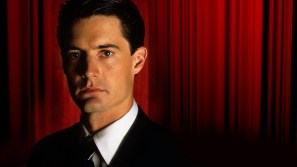
“Twin Peaks Returns to Television in 2016” by Flickr user BagoGames, CC BY 2.0.
For readers who aren’t Twin Peaks viewers, hang on: explaining the origin of Dougie Jones requires a few sentences that may read as something bordering on nonsense outside the show’s bizarre universe. Dougie is played by Kyle MacLachlan, who also plays the show’s main character, Agent Dale Cooper, as well as The Return’s Mr C, Cooper’s evil doppelganger who overcame Cooper in an extradimensional realm in the Season 2 finale and who has been living in the “real world” ever since, while Cooper is stuck in another dimension. The show implies that Mr C has only 25 years–roughly the amount of time since the show’s first run in the early 90s–before Cooper switches places with him (extradimensional bureaucracies, amiright?). As a ploy to stay in the real world, Mr C “manufactures” Dougie Jones so that when Cooper is finally released from extradimensional detention, he replaces Dougie, not Mr C. For the bulk of The Return, Mr C continues wreaking havoc across the Midwest and Western US, while Cooper, adversely affected by his transit across dimensions, is trapped in Dougie’s life, barely able to function beyond the level of a small child. Technically, then, the character called Dougie Jones is really Dale Cooper, but Cooper’s episodes-long inability to regain control of himself leads to an extended case of mistaken identity, where everyone in Dougie’s life believes Cooper to be Dougie.
Significantly, Dougie’s family and co-workers are barely phased by his ineptitude. At worst, like when he doesn’t know how to use the bathroom, people are annoyed by Dougie. But, more often than not, Dougie’s moments of silence and often erratic behavior — including befuddlement over how to feed or dress himself — are interpreted as quirky, humble, and endearing. More than that, Dougie’s boss believes him to be a courageous and principled whistle-blower whose cryptic drawings on insurance forms outs one of his co-workers for defrauding the company’s clients.

Screenshot of Twin Peaks: The Return
Dougie is beyond mediocre, yet over the course of the season, he falls into hundreds of thousands of dollars, a luxury car, a family life that seems to be fulfilling for his wife and son, and the respect and gratitude of his boss. Confidence isn’t something this mediocre white man possesses; rather, it’s a trait projected onto him by everyone around him. In riffing on the way people exist in systems of inequity, Sylvia Wynter notes in On Being Human As Praxis (2015) that we end up keeping “the reality of our own agency opaque by attributing that agency to extrahumanly mandating entities” (45). Put another way, the god who would grant us the confidence of a mediocre white man isn’t a deity but a system of patriarchal white supremacy that makes itself opaque behind the rationale that a person like, say, Dougie Jones couldn’t possibly be as successful in his life if he hadn’t earned it.
The primary marker of the mechanization of Dougie’s confidence is a sonic one: we can hear his ascendence in moments of repetition. Twin Peaks is a show comprised of overlapping aural and visual loops, recurring sounds, and doubled and tripled characters, so keying in on the sound of Dougie’s repetition fits into the series’ aesthetic. Early in Dougie’s presence in the series, when Cooper is fresh from the other dimension, his repetition is delayed, partial, and generally out of synch with regular patterns of conversation; people react to this repetition with concern. The following scene occurs in the moments just after Cooper has replaced Dougie Jones; his scene partner, Jade, was in the shower when the switch happened.
This clip is cut so that the phrase “Jade give two rides” happens back-to-back, but in the episode, there’s over a minute of a screen time between Jade saying (a grammatically correct version of) it and Dougie repeating it. Dougie’s imprecise and ill-timed repetition suggests to Jade that something may be wrong with him, and she rightly advises him to find some help. A similar interaction occurs in Episode 6, which opens with Dougie standing outside his work at night, unaware of what people do when work is over. When a police officer tries to shoo him away, Dougie is able to repeat back information he had heard several days earlier, and his delayed reaction again elicits concern from the person he’s with. A few scenes later, “Jade gives two rides” returns.
As the season progresses, however, Dougie begins to repeat back exact phrases or words that have just been spoken to him. The effect is one of understated agreement or even prescience, as if he’s repeating something he’s known for some time and has been waiting for others to realize, too. Note the way Dougie responds in the following two videos. In the first, he’s asked a question, which rises in pitch in the final syllables, and Dougie repeats the phrase with a falling pitch figure, which his conversants interpret to be confirmation. In the second, he’s given advice, and he responds by repeating the last word in uptalk, which his conversants interpret as a hilarious joke rather than the limitations of a person whose interdimensional travel has left his verbal skills lacking.
As Dougie’s repetition locks into a quicker, more immediate responsorial pattern, the people around him no longer worry about his well-being and, in fact, begin to project onto him a confidence he’s incapable of possessing. This repetition, the kind that immediately plays with or confirms what his boss or potential murderers say, suggests a couple different theoretical constructions of repetition. Butler, in describing the performativity of gender, notes that gender norms are “the stylized acts of repetition through time,” the rehearsed and rehashed ideas that we ascribe, in this case, to white men: well-timed humor on the one hand, and wise confirmation on the other (520). Sara Ahmed underscores a similar idea, noting that “compulsory heterosexuality” is “the accumulative effect of the repetition of the narrative of heterosexuality as an ideal coupling” (145). Here, Dougie’s white masculinity isn’t all that makes him the target of others’ projections of confidence and competence; his nuclear family also marks him as a productively repetitive person, a person capable of reproduction. To modify Hagi’s tweet a bit, the world projects onto Dougie the confidence of a mediocre, white, reproductive man.
Both Butler and Ahmed also gesture toward distinctly sonic phenomena present in Dougie’s repetitions. Repetition accumulating over time becomes not just distinct events happening in succession but a discrete, singular thing unto itself. When thinking in terms of systemic oppression like white supremacy or cisheteropatriarchy, the repetitive privileging of white masculinity congeals into a continuous power flow. In musical terms, we hear the accumulative, rapid retriggering of a sound as pitch rather than many distinct events. Timing matters here: if the repetition is delayed or metered just so, we can perceive instances of the same events as moving in concert either melodically or harmonically. The shift in Dougie’s repetitions over the course of The Return is the sound of institutional privilege tuning white masculinity, retriggering moments of repetition–which sounds like a rise in pitch as the repetitions move closer together, a literal ascent–until those around Dougie stop worrying about him and start believing that this mediocre white straight man must have earned the success he seemingly enjoys.
Though a perusal of Twin Peaks: The Return analyses and recaps demonstrates that viewers and critics have been far more interested in the archetypal Jekyll/Hyde duality of Dale Cooper and Mr C than they have been in the nature of Dougie Jones, Dougie’s relative lack of drive or desire offers the opportunity to hear how white male mediocrity is made. The Return checks in on Dougie regularly from his introduction in the third episode until he transforms back into Cooper, then is remanufactured and sent home to his family in the sixteenth and eighteenth episodes. What we’re privy to in that time is a different kind of manufacturing, where Dougie is constructed by his surroundings to be wise, caring, attentive, upright, and brave, though we know he’s none of those things. The slow burn of Twin Peaks: The Return means that we’re stripped of any easy excuses for Dougie’s upward momentum in the season beyond the obvious explanation that the gods of mediocre white men have gifted him with treasures out of reach for others. Dougie repeats what he hears, and what he hears is that his mediocrity is good enough.
—
Featured image: Screenshot from “‘Dougie’ Cooper – All Phrases (Twin Peaks Compilation)” by Youtube user AKA.
—
Justin Adams Burton is Assistant Professor of Music at Rider University. His research revolves around critical race and gender theory in hip hop and pop, and his book, Posthuman Rap, is available now. He is also co-editing the forthcoming (2018) Oxford Handbook of Hip Hop Music Studies. You can catch him at justindburton.com and on Twitter @j_adams_burton. His favorite rapper is one or two of the Fat Boys.
—

REWIND! . . .If you liked this post, you may also dig:
DIANE… The Personal Voice Recorder in Twin Peaks-Tom McEnaney
Malcolm Gladwell’s Bad Aesthetics–Justin Burton
Listening to Sounds in Post-Feminist Pop Music-Robin James
Share this:




Current Top Posts





April 2021

January 2020

November 2019

October 2019

August 2019

April 2014

November 2017

March 2015

December 2017

October 2015
 Sounding Out!
Recent Comments