
DIANE… The Personal Voice Recorder in Twin Peaks

READERS. 9:00 a.m. April 2nd. Entering the next installment of SO!’s spring series, Live from the SHC, where we bring you the latest from the 2011-2012 Fellows of Cornell’s Society for the Humanities, who are ensconced in the Twin Peaks-esque A.D. White House to study “Sound: Culture, Theory, Practice, Politics.” Enjoy today’s offering from Tom McEnaney, and look for more from the Fellows throughout the spring. For the full series, click here. For cherry pie and coffee, you’re unfortunately on your own. –JSA, Editor in Chief
“I hear things. People call me a director, but I really think of myself as a sound-man.”
—David Lynch
From March 6-April 14 of this year, David Lynch is presenting a series of recent paintings, photographs, sculpture, and film at the Tilton Gallery in New York City. The event marks an epochal moment: the last time Lynch exhibited work in the city was in 1989, just before the first season of his collaboration with Mark Frost on the ABC television series Twin Peaks. At least one painting from the exhibit, Bob’s Second Dream, harkens back to that program’s infamous evil spirit, BOB, and continues Lynch’s ongoing re-imagination of the Twin Peaks world, a project whose most well known product has been the still controversial and polarizing prequel film Twin Peaks: Fire Walk With Me.
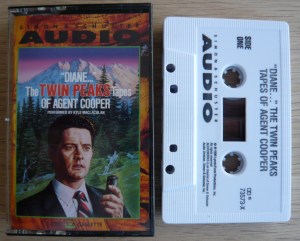
photo by Flickr user svennevenn
These forays into the extra-televisual possibilities of Twin Peaks began with the audiobook Diane…The Twin Peaks Tapes of Agent Cooper (1990). An example of what the new media scholar Henry Jenkins and others have labeled “transmedia storytelling,” the Diane tape provided marketers with another way to cash in on the Twin Peaks craze, and fans of the show a means to feed their appetite for FBI Special Agent Dale Cooper, aka Kyle Maclachlan’s Grammy nominated voice praising the virtues of the Double R Diner’s cherry pie.
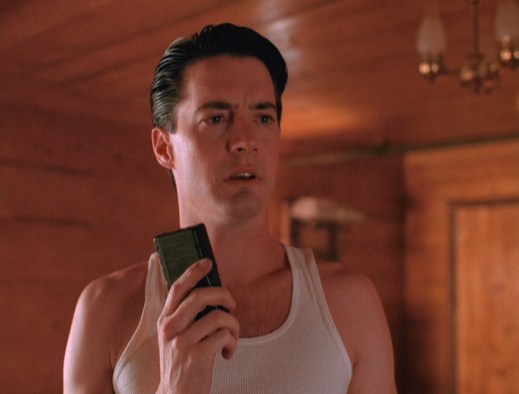
Based on the reminders Cooper recorded into his “Micro-Mac pocket tape recorder” on the show, the cassette tape featured 38 reports of various lengths that warned listeners about the fishy taste of coffee and wondered “what really went on between Marilyn Monroe and the Kennedys.” As on the program, each audio note was addressed to Diane, whose off-screen and silent identity remained ambiguous. For the film and audio critic Michel Chion, Diane is an abstraction, or the Roman goddess of the moon. Others claim “Diane” is Cooper’s pet name for his recorder. The producers delivered their official line in the 1991 book The Autobiography of Special Agent Dale Cooper: My Life, My Tapes, “as heard by Scott Frost,” (the brother of Lynch’s co-creator), where Cooper says, “I have been assigned a secretary. Her name is Diane. I believe her experience will be of great help.”
Whatever her identity, on the show Diane became the motive for Cooper’s voice recordings, and these scenes laid the groundwork for the audiobook. However, unlike the traditional audiobook, which reads a written text in its entirety, Cooper’s audio diary cuts away parts of the story, and includes additional notes and sounds not heard on the show.
The result is something like a voiceover version of Twin Peaks. And without the camera following the lives of the other characters, listeners can only experience the world of Twin Peaks as Diane would: through the recordings alone. Strangely, the inability to hear anything more than Cooper’s recordings opens up a new dimension: even as eavesdroppers we come closer to understanding Diane’s point of audition, the point towards which Cooper speaks in the first place.
Back on the show, Cooper’s notes to Diane track his movements as he tries to solve the mystery of who killed the Twin Peak’s prom queen Laura Palmer. Strangely—and not much isn’t strange in Lynch’s work— in some sense this mystery has already been solved by the show’s second episode, where Laura whispers the name of her killer to Cooper in a dream.
.
.
However, Laura’s whisper remains inaudible to the audience, and Cooper forgets what she said when he wakes up in the next episode. Much of the remainder of the program, full of Cooper’s reports to Diane, was spent trying to hear Laura’s voice. Thus, Diane, the off-screen and silent listener, became the narrative opposite to Laura, whose prom queen photograph closed each episode, and whose voice became the show’s central fetish object. Moreover, this silent relationship changes how the audience hears Cooper’s voice. Rather than a chance to relish in its sound, Cooper makes his recordings because of Laura’s voice from the grave, and directs them to Diane’s ears alone. In other words, Cooper and his recordings become a conduit to Laura/Diane rather than a solipsistic memoir about his time in Twin Peaks.

This triangulation becomes more obvious, if no less complicated in a typically labyrinthine Lynchian plot twist. As I mentioned, the Diane tape makes Cooper’s reports into a kind of voiceover. Critics have interpreted them as a parody of film noir, a genre whose history Ted Martin argues in his dissertation is defined by the relationship between voiceover and death: “Noir’s speaking voice moves from being on the verge of death to being in denial of death to emanating immediately, as it were, from the world of the dead itself.” Fascinated by this history, Lynch tweaks it through the introduction of a mina bird, famed for its capacity to mimic human voices. Discovered in a cabin at the end of episode 7, season 1, the police find the bird’s name—Waldo—in the records of the Twin Peaks veterinarian, Lydecker. The combined names—Waldo Lydecker—happen to identify the attempted murderer of Laura Hunter responsible for the voiceover in Otto Preminger’s classic noir film Laura (1944). On Twin Peaks, Cooper’s voice-activated dictaphone records Waldo the bird’s imitation of Laura Palmer’s last known words, which also happen to be Waldo’s last words, as he is shot by one of the suspects in Laura’s death.
If we follow this convoluted path of listening, we can trace a mediated circuit—from Laura to Waldo to Cooper’s voice recorder—which locates the voice of the (doubled) dead in the Dictaphone, thereby returning that voice to its noir origins in another classic of the genre: Double Indemnity (1944) (see SO! Editor’s J. Stoever-Ackerman’s take on the Dictaphone in this film here). More than a mere game of allusions, this scene substitutes Cooper’s voice with the imitation of Laura’s voice, inverting the noir tradition by putting the victim’s testimony on tape. And yet, while Waldo tantalizes the audience with an imitation of the sound of Laura’s voice, it ultimately only reminds the listener of the silent voice: Laura’s voice in Cooper’s dream.
The longer this voice remained out of range of the audience’s ears, the more it produced other voices—from Cooper’s recordings to Waldo to the dwarf in the Red Room.
Eventually, however, the trail of tape and sound it left behind ended with the amplification of Laura’s whisper, which became as much the “voice of the people” as Laura’s voice. After all, ABC instructed Lynch and Frost to answer the show’s instrumental mystery (“Who killed Laura Palmer?”) because of worries about the program’s declining ratings 14 episodes after Laura’s first inaudible whisper. The audience’s entrance into the show through the mediation of marketers mimicked the idea behind the Dianetape, but with a crucial difference: now the audience tuned in to hear their own collective voice, rather than to hear what and how Diane heard. Laura’s audible voice was audience feedback. It was the voice they called for through the Nielsen ratings. The image of her voice, on the other hand, was an invitation to listen. And Cooper’s voice-activated recorder, left on his bedside, placed in front of Waldo, or spoken into throughout the show remained an open ear, a gateway to an inaudible world called Diane. Although critics and Lynch himself have compared the elusive director to Cooper, perhaps its Diane who comes closest to representing Lynch as a “sound-man.”

David Lynch, August 10, 2008 by Flickr User titi
—
Tom McEnaney is an Assistant Professor of Comparative Literature at Cornell University. His work focuses on the connections between the novel and various sound recording and transmission technologies in Argentina, Cuba, and the United States. He is currently at work on a manuscript tentatively titled “Acoustic Properties: Radio, Narrative, and the New Neighborhood of the Americas.”
Share this:

Pushing Record: Labors of Love, and the iTunes Playlist

Borrowed from allwomentalk.com
Last month as my sister and I drove to the store, she started to joke with me. “You’re crazy,” she began, “you’re so high-tech, with your computers, and XBOX. You love music. But, you’ve got a cassette player in your car.” I shot her a look. “So what? I like it.” I said, hoping that she would back off. “So what!” she proclaimed in response, “don’t you want a CD player? Or a jack for your iPod?” I responded, “But how will I play my tapes?” She stared at me. “Who cares? They sound like crud. You’re crazy.”
Here at Sounding Out! we’ve featured a number of articles about analog tape. It persists in popular culture (Jennifer Stoever-Ackerman’s Play it Again (and Again), Sam: Part 1, Part 2, and Part 3), underground communities (Matt Laferty’s On Hand Made Music), and even our personal histories (Gus Stadler’s Pushing Play). Even though tape is generally understood to be obsolete, niche, and just plain noisy – I will insist that, despite my sister’s concerns, there is something special (even forgotten) about the medium itself. I had tried to articulate this in last year’s article What Mixtapes Can Teach Us About Noise. But, when I re-read it, I can’t help but think that I somehow missed the point. Let me try again with a new question: What is the difference between a mix on cassette tape and an iTunes playlist?
Care is the difference. The material limitations of the cassette recorder demand that care is taken during the act of inscription. In other words, cassette mixes cannot be automated like an iTunes playlist. The practice of recording a mix on cassette requires, at minimum, that some attention is paid to the moment a song begins (as record is pushed), and the moment a song ends (as stop is pressed). The cassette must be tended, as it were, during the encoding process. It is impossible to program a cassette mix otherwise.

Borrowed from velvetron.com
After tracks have been chosen and messages encoded, frequently cassette mixes are shared, or gifted. If the receiver chooses to listen to the cassette, they must locate, first, a cassette player. This was not a problem in 1990 when cassette players were a more or less ubiquitous technology. But, in the present day, they are notably rare. Furthermore, even if some care has been taken to locate a listening platform, the tape is far more treacherous than the CD to navigate. Awkward transitions governed by the fast-forward and rewind buttons, encouraged listeners to listen through all but the most wretched sequences of a cassette mix. And, let us not forget, how leaving a cassette in the wrong player could result in a mangle of 1/8″ tape. Or, how speakers, magnets, and poor weather all eventually erode at the contents of poorly stored tape. Care had to be taken in maintaining and storing a good cassette mix; tapes are a fragile technology and that, for me at least, serves to valorize the labor at stake in their creation.
Am I giving the playlist enough credit? Even though the platform may not limit its listeners, and producers, in the same ways that cassette recorders have, who is to say that any less care is taken when producing a playlist? To this point, I must bring up a question of labor. While, the receiver of a cassette mix knows that at least an hour (as cassettes are generally 60 minutes or more) of work has been put into its construction, the receiver of a mix CD, or playlist, cannot be as certain. iTunes playlists can be constructed in five minutes or less. Implicated within this labor divide is both an emerging and ephemeral culture of listening.
As Sterne (2006) has argued in his paper, The MP3 as Cultural Artifact, our bodies respond to MP3s in a way that is fundamentally different than listening to a tape, or record. “[The MP3] represents a liberation of just-in-time sound production, where systems give listeners less and ask their bodies to do more of the work” (p.838). If the very compression algorithms that constitute MP3s make demands on the brains and bodies of listeners, it is interesting to think of the iTunes playlist in parallel. The iTunes playlist makes comparatively few demands on the body of the producer. This, paradoxically, results in a culture that does not valorize the labor of its constituent producers. Most apparent in the nebulous legal credibility of Mashups, the mix exists predominantly within an economy of care. Unfortunately, the digital turn toward playlisting conspires to render the labor of care, in this context, invisible.

Borrowed from downloadatoz.com
Is there hope for iTunes? Can we trust our playlists to be received with the love that was put into them? Some theorists like Hardt (1999) see an upside to caring labor. As he points out in his essay, Affective Labor, “Caring labor is certainly entirely immersed in the corporeal, the somatic, but the affects it produces are nonetheless immaterial. What affective labor produces are social networks, forms of community, biopower” (p. 96). Sharing is caring, the accessibility and ease of production that playlisting provides, is, at least, a way to foster community. I am not so optimistic. For caring labor is not adequately valued, at least not in the context of building a playlist. Playlists rely on an audience to value them, they provide no guarantees. The labor at stake in their construction may only become visible to those who listen. The cassette mix, on the other hand, has care inscribed into its magnetic tape. The listener knows that some work has been put into making the mix, even before play is pressed.
Although cassette tapes may have all but disappeared as a way to share music, the caring labor involved in their production might be salvaged in other forms. Taking a page from Andreas Duus Pape’s recent, Building Intimate Performance Venue’s on the Internet, podcasts (produced on platforms like Garageband or Audacity), provide a viable alternative. Like cassettes, they subject their listeners to a linear play style. And, there is a certain degree of care taken by the producer when splicing, cross-fading, arranging, and sequencing a set of tracks. It is implicit in the construction of a Podcast that some degree of care was taken during its development. Of course, I will keep the cassette player in my car. I have a special tape adaptor, which lets it play music from my iPod.
–
Aaron Trammell is co-founder and multimedia editor of Sounding Out! He is also a Media Studies PhD student at Rutgers University.
Share this:


Current Top Posts





April 2021

January 2020

November 2019

October 2019

August 2019

April 2014

November 2017

March 2015

December 2017

October 2015
 Sounding Out!
Recent Comments