
I Hear You, I See You
(The title of this post comes from an episode from Season Two of NBC’s Parenthood; Zeke, the patriarch, learns in marriage counseling that he must listen to his wife and let her know he is listening.)
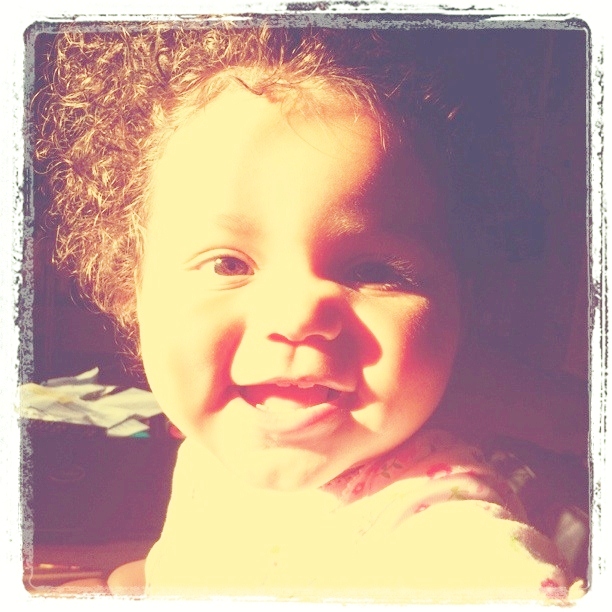 Since she was in the womb I’ve recorded Miss E’s sounds. I’ve posted before about my experience listening to her heartbeat at every obstetrician appointment. Late in my pregnancy I managed to record her heartbeat. I still play it and replay it in amazement; those beats were a sign of the life growing inside of me. I felt like I was eavesdropping on her every time we tuned in. It was sonic peeking. After she was born, I wanted to continue recording the sounds she made because I wanted to have recordings as well as pictures for her when she grew up.
For the past eleven months I’ve recorded my daughter’s sounds at different stages with my iPhone (as I’ve mentioned in my latest KC post, my iPhone is my preferred recording device if only because it is always within reach). I record when I remember, or when she adds a new sound to her repertoire. However, I try to record her once a month. The same way that she has gone from not moving at all to crawling all over our apartment, she has gone from not making any sounds to babbling, squeeling, and laughing. The sounds she makes are an indication of development, but they are also a sign of her awareness of the world around her.
As a first-time mom, I expected a lot of things early on. I didn’t understand why she held her fists closed for the first few weeks or why she didn’t follow me around the room. It almost felt like she was ignoring me. The same thing happened with her sounds. The fact that she didn’t respond to my words with sounds worried me. I always wondered if she was sad! And it’s no wonder: all she would do was cry. Of course, I realized soon after that her crying was her only way of communicating with the world. One of my first recordings of Miss E is of her shrill crying, and it still makes my chest tighten up when I hear it.
My second recording is of her at three months. By this point the cries have morphed into more of a grunt. As I typed this post I listened to my recordings, and it’s remarkable how inarticulate she sounds compared to what she sounds like now. But back then, I was excited that she was making more sounds other than crying. Indeed, the fact that she wasn’t always crying was a relief. These new sounds, to me, were her attempt at trying to communicate, or rather discovering ways to communicate. It’s almost as if she had discovered that she had a voice. The silences talked as much as the sounds, for at this stage she spends more time awake (and more time awake without crying).
As Miss E has grown throughout this first year, her sounds have started to vary. Very much like a language, she has different registers, different sounds depending on what she wants to say. Whereas before she would only give me a smile when she woke up, now she provides me with a running commentary on her dreams and her giraffe while I change her diaper. Even her giggles developed different registers. She had different kinds of giggles! Now she makes sounds on her own, not as a response to something I had done but because there is something she wants to respond to. I read in her babbles the beginning of her path to independence. it’s a long way until she moves out of our household, but the fact that she wants to talk to other people or talk about what she wants, and not in response to what I am saying or doing is amazing. It’s also a little sad, for it’s also an indication of her willingness to move on to other things.
We tend to forget that during that first year babies have little interest in interacting with people outside of their nuclear family. They stare at strangers or shy away. But the moment they start talking to themselves or their toys, you are no longer the center of their world. And it’s a bone-chilling thought.
Recording her sounds is important to me just as much as taking pictures. (I don’t take video of her mostly because we didn’t have any way to do that until recently when I updated my phone to an iPhone 4). I wanted her to have visuals as well as audio, and even though video recordings could do just as well, the effect of just listening to sounds and being able to focus on that is an interesting (if jarring) experience. Those sound recordings trigger memories just as vividly as pictures do, or even more so than pictures. I hope to keep these recordings until she is older so that she can see herself as well as hear herself when she was just a little girl. I want to know that “I hear you, I see you,” that hearing is just as relevant as seeing.
Bonus tracks: Here’s Miss E at several stages in the last year.
Miss E at 3 months (trying to get Mommy’s attention)
Miss E at 10 months (banging and making music)


Share this:

Listening to Robots Sing: GarageBand on the iPad
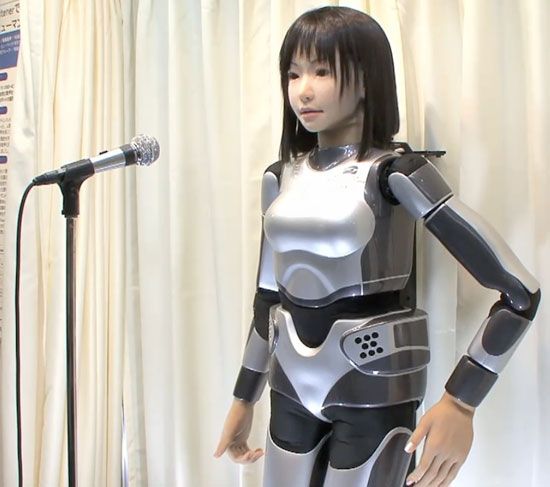 I recently had the opportunity to fool around with the iPad2’s new GarageBand suite. Enticed by the intuitive touch interface I soon found myself lost within the device’s labyrinthine architecture. Every poke, prod and press brought me to a new screen with a bevy of exciting options. A touch to create a drum loop, a tickle to evoke some reverb, and a brush to strum a guitar. I was one with the machine; it was a truly cybernetic, kinesthetic moment. This may sound naïve, but I had never realized how many tools were available to electronic musicians, or how intuitive using these tools could be. As digital tools to create music become more accessible and more intuitive, what is the role of the human in understanding their use? Further, what strategies can we adopt when listening to these creations?
This question may seem a bit outdated to those who have been researching post-humanist phenomena since the digital boom in the mid-nineties. Often conflicting perspectives regarding the negotiation of the human and the digital have been considered in the last decade or so. Some like Donna Haraway, Pierre Lévy, and even Ray Kurzweil offer particularly optimistic readings of the post-human (although for radically different reasons). While scholars like Nancy Baym and Jaron Lanier have offered decisively more sober readings of the problematic. They argue that splits between the human and post-human, or analog and digital are false dichotomies. Truth be told, none of the theorists above adequately address my feelings on this topic. Producing music with a digital audio suite makes me defensive of my humanism and it is by its very nature a project of preservation.
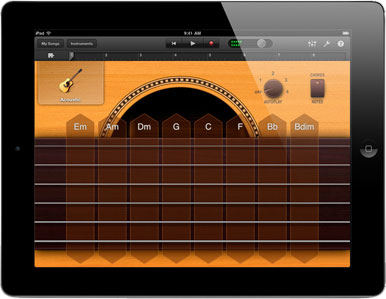 The algorithmic tools packaged within digital audio suites encourage a sense of aesthetic preservation. Tools like GarageBand’s Smart Guitar, Smart Drums, Smart Bass, various arpeggiators and Appleloops encourage the user to program music on a high level where the nuance of serendipity and improvisation play second fiddle to the overall sonic contours of a piece. Although the user is provided the tools to intervene and program music in a very specific way, it is by default a distinctly different experience than that of playing a guitar or piano. The ghost of the algorithm haunts such performances; reminding the user that these acts of spontaneous creation are no longer the default but deliberate…. This sense of deliberate improvisation forces me into a reflexive space where I am acutely aware of the mediations occurring within my performance. Succinctly, I must defend a sense of self within my creation. If I yield to the algorithms that seek to help me compose, I destroy all sense of the human within my work. Simply turning on robots and watching them sing.
For this reason, I propose an aesthetic of preservation as a way to understand the ways in which we listen to works created by digital audio suites. As algorithmic aids become more advanced and commonplace in music, the human becomes a less essential aspect of the form. Understanding what has been deliberately included in spite the seductive algorithmic environment is ultimately a project that seeks to recover the human in the machine; perhaps even, a project doomed from the start, as we grow ever closer to the means of our artistic production.
AT
Magnasanti – Check out the results of my collaboration with Colin Germain on GarageBand!


Share this:


Current Top Posts





April 2021

January 2020

November 2019

October 2019

August 2019

April 2014

November 2017

March 2015

December 2017

October 2015
 Sounding Out!
Recent Comments