
Afecto Caribeño / Caribbean Affect in Desi Arnaz’s “Babalú Aye”

Recently, the new biopic and telenovela Celia, La Serie on the life of Celia Cruz reminded me of how her iconic call “Azucar!”(translated as sugar) engaged audiences to feel the sabrosura of her music. The soap-opera included documentary footage of the larger iconic events in Celia’s career that could not be recreated, scenes that captured how Cruz and the audience connected. The scenes that best captured this are when Celia performs with Fania at Yankee Stadium in 1973 and in Zaire in 1974. When she felt the audiences’ joy in her performance she’d share that expressive sentiment of the sweetness in the moment, taking audiences to a deeper ecstatic place.
I also felt and witnessed this myself when I saw Cruz perform at the Hollywood Bowl decades ago. It’s akin to what I sensed when also hearing Damaso Pérez Prado’s guttural “Maaam-bO” in his “Mambo No 5.” While watching Celia, La Serie, I asked my mom if she had ever watched Desi Arnaz on I Love Lucy. Her response included a dislike for Arnaz, while I remembered enjoying his performance of “Babalú Aye.” Our exchange raised the question: can Arnaz’s performance, like Cruz’s expressive phrasing or Pérez Prado’s musical cue, unify a Latinx and African diaspora through sound and affect?
 I posit that Arnaz’s televised performances of “Babalú Aye” like Celia’s “Azucar” or Prado’s “Mambo” exemplify what Alejandra T. Vazquez calls in Listening in Detail “vocal armament and ornament” (132), a sound that cultivates an afecto caribeño among Spanish-speaking diasporic migrants and their descents. My use of afecto here is a key sonic detail, playing upon the Spanish meaning to show tenderness and emotion. I also appreciate affect theory as it provides a framework by which to explore the emotionality and connection to experiences that have not been named. For example, in “Feeling, Emotion, Affect,” Eric Shouse writes about affect as “the body’s way of preparing itself for action in a given circumstance by adding a quantitative dimension of intensity to the quality of an experience. The body has a grammar of its own that cannot be fully captured in language.” I attempt here to cultivate a language that address how Arnaz’s physical and sonic articulation sets an entry to examine contributions by members of the Latinx Caribbean diaspora and its reach to those of us hearing and seeing them in a US context.
Growing up bilingual and bicultural in Los Angeles, I saw how my mom retained a bit of her homeland by watching a variety show called Siempre en Domingo. Many of the artists who performed were also heard on the local Spanish language station K-Love. The ritual gathering on Sunday nights as we watched the show metaphorically united my mom with her family.I believe that viewing and hearing her Mexico made the distance away from her family soften. For me, listening to the songs I heard on Siempre en Domingo then replayed on the radio helped codify something more than Mexican; it was pan-Latino. These moments of engaging with television shows mediate my experience of sound and affect, which I’ve named afecto caribeño (translated to “caribbean affect”).
 My fondness of Desi Arnaz stems from a familiarity of Spanglish when I saw my first episodes of I Love Lucy (1951-1957) on Saturdays on KTLA. Its stars, Lucille Ball and Desi Arnaz, played a married couple, and the comedy of errors would inevitably involve “Lucy Ricardo” trying to scheme something. In real life, Ball and Arnaz were a Hollywood power couple who produced their show, establishing a practice of syndication rights paid to the actors. Arnaz played “Ricky Ricardo,” the owner of the Tropicana nightclub where he was also the bandleader. When scenes featured him at the club he would always play the congas, thus creating a continuum of his earlier career as a musician to now television star.
Hearing Desi Arnaz speaking inglés with a Cuban accent was familiar to my ears. I knew that sound of English blended with español because it was what I heard from my parents and their acquaintances. In the show, misunderstandings happened because one could not decipher what “Ricky” meant or said. The mistranslations led to some comedic moments and the establishment of a long-running comedic television trope at the expense of Latino characters and actors, as explored by Dolores Inés Casillas and Sebastien Ferrada in “Listening to Modern Family’s Accent.” However, in Life on the Hyphen, Gustavo Pérez-Firmat describes Arnaz’s nilingüe–someone who speak neither Spanish nor English—and argues his nilingüe-ism was personified through “Ricky Ricardo” as “Spanish utterances shot through anglicisms so that the monolingual viewer can understand what he was saying” (43). But, Arnaz did not reach only “English-only’ ears. To my pocha ears Arnaz spoke a familiar—and not incorrect—spoken Spanish. As a young viewer, I had no reference for his mistakes. Sonically “Ricky’s” familiarity came through when he complained about “Lucy” in Spanish. Hearing the español I spoke at home on “I Love Lucy” is how I connected to the hyphened Americano via tv. Nowhere was this more pronounced than with Ricardo’s frequent performances of “Babalú”.
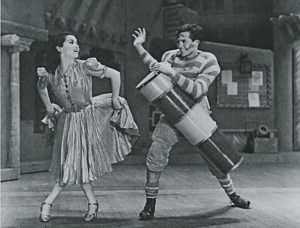
Diosa Costello and Desi Arnaz in Too Many Girls (1939)
Before his film career, Arnaz was known as the mambo king. Due to his lackluster rise as a “Latin Lover” in Hollywood, Arnaz returned to work as a musician and began singing his signature “Babalú” around 1943. The song is attributed to Margarita Lecuona and published in 1939. “Babalú” conflates the popular 1940s-50s big band sound with a Cuban folksong (or son) sung to the Orishas (deities or gods). Babalú is an Orisha deity who oversees health and is revered because of his power over life and death, and is also known as San Lázaro within the pantheon of Catholic saints. By the time Arnaz made the song popular in the United States, the song had also been associated with Miguelito Valdés, who was known as “Mr. Babalú.” Other musical contemporaries like Damaso Pérez Prado were also making a name for themselves by developing a new sound that Latinized dance music in the U.S. According to Ed Morales in Living in Spanglish, it is in the 1950s that Prado creates his signature sound in Mexico City by “mixing North American swing and bebop” known as mambo (152). However, it is Arnaz’s performance that I reference because of its reach to a multi-generational audience through syndication of the “I Love Lucy” show.
 Each time Arnaz performs “Babalú” it serves as an offering to the Orisha to heal the longing for a homeland he left long ago, as experienced by many musicians like Cruz who live in exile. With each performance on the “I Love Lucy Show,” Arnaz reconnects to his cultura. Performing this on national television it’s not about the Anglo viewer who only sees Arnaz as the “Rhumba Rhythm King” (sic) (Pérez-Firmat, 52) made famous in movies; rather it is about Arnaz creating a space of agency through a prayer and healing ritual in song, thus an expression of Afecto Caribeño connecting the Latinx diaspora to something beyond national borders and generations.
For example, in Season 2 episode 21 “Lucy Takes a Job at the Bank,” Arnaz (as Ricky Ricardo) brings out his son Ricky Jr. to play the congas alongside him. Ricky as proud father shares his joy in this moment. The camera pans out to Lucille Ball and her co-star Vivian Vance sitting at the table. Arnaz instructs his son to “say thanks” and he replies in Spanish “gracias.” This exchange is profound because it accentuates the bilingualism and bicultural exchanges that happen in the home space now introduced to many via television. Arnaz continues, “Even though Little Ricky was born in America, there’s lots of Cuban in his heart.” The Cuban in his heart plays out in sonic beats through a father-and-son performance on the congas and the calling upon “Babalú Aye.” Both Lucille Ball and Desi Arnaz are happy parents, not just stage parents, who revel in this moment. As Ricky Jr. plays, his mother bangs on the table too and Arnaz looks up to the sky as if in gratitude for this moment to the Orisha Babalú.
Upon reflection, I am aware of how television informed my childhood search for something that reflected how I spoke and heard the world. In these linguistic-sonic moments I reconnected to my mother’s homeland and sought to make sense of my pocha identity when I heard English spoken with a Spanish accent. In Relocations, Karen Tongson names these moments of connection that occur through a technological network as “remote intimacies” that can “account both technically and affectively, for the symbiosis that can happen between disparate subjects. . .I like to think that these imaginary correspondences sometimes have to happen across greater distances, both conceptually and topographically with other ethnicities, accents, nations (130)” The conceptual and topographical correspondence informs afecto caribeño as a means to enable critical connections to a Latinx diaspora centered en el Caribe highlighting the mestizaje of African and Spanish heritage, thus expanding upon Paul Gilroy’s notion of the “black Atlantic” on how the Atlantic slave trade also impacted culturally el Caribe. Upon singing “Babalú Aye” Arnaz’s performance not only is a disruption to Anglo American viewers, but also “disrupts the myth of Cuban whiteness” (Vasquez, Listening in Detail, 150).
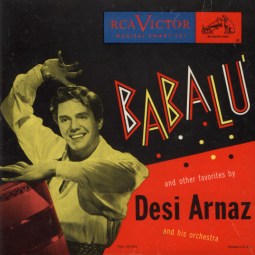 I am drawn to sonic experiences that can help unpack Latinidad and the multicultural roots that are informed by other migrations of Africans, Asians, and Spaniards to the Américas. I am a descendant of these mestizajes, as Gloria Anzaldúa writes in her canonical text Borderlands / La Frontera. A concept like afecto caribeño addresses the social and emotional exchanges that emanate from the complexity of these migrations and how they reveal themselves in momentary connections. When Arnaz performs as “Ricky,” he breaks that character upon playing the congas. Here he does not act as the nightclub owner; the reverberation of the conga mediates an embodiment of his true self exemplifying un afecto caribeño.
—
reina alejandra prado saldivar is an art historian, curator, and adjunct lecturer in the Women, Gender and Sexuality Studies Program and Liberal Studies Department at CSULA and in the Critical Studies Program at CALArts. As a cultural activist, she focused her earlier research on Chicano cultural production and the visual arts. Prado is also a poet and performance artist known for her interactive durational work Take a Piece of my Heart as the character Santa Perversa (www.santaperversa.com) and is currently working on her first solo performance entitled Whipped!
—
Featured Image: Desi Arnaz performing with Diosa Costello, 1948.
—

REWIND!…If you liked this post, you may also dig:
The Sweet Sounds of Havana: Space, Listening, and the Making of Sonic Citizenship – Vincent Andrisani
SO! Amplifies: Shizu Saldamando’s OUROBOROS–J.L. Stoever
SO! Reads: Dolores Inés Casillas’s ¡Sounds of Belonging! – Monica de la Torre
Share this:

Look Who’s Talking, Y’all: Dr. Phil, Vocal Accent and the Politics of Sounding White
From the first time Phillip C. McGraw, Ph.D.—better known as “Dr. Phil”—appeared on the Oprah Winfrey Show in 1998, dropping lines like, “My dad used to say, boy, don’t let yer alligator mouth overload yer hummin’ bird ass,” I was hooked. That accent! That no-nonsense, Southern sauce! From what fount of otherworldly knowledge did Phil drink? An insecure teen, gnawing and thrashing my way through high school’s convoluted social milieu (not to mention the murky waters of multiraciality), Dr. Phil’s frank, accented approach to life’s difficulties appeared as a god-send. It didn’t matter much what Dr. Phil was actually saying or whether his words when strung together formed logical thoughts, it was more the way he said things that affected me so. His deep, sing-songy lilt—preachy and avuncular—brought to mind a grandpappy smoking a pipe, whose wisdom was drawn from a hard day’s farmin’, not a god-forsaken textbook.
With Oprah’s endorsement, the Cult of Phil grew fast and strong. Dr. Phil became a national figure–the corporate media’s version of a public intellectual and my own personal hero. His daytime talk show provided him with a regular platform from which to dispense more of that golden, “Texan-dipped” advice, as The New York Times put it. Selling over 2 million copies, his 2003 classic Self Matters began the onslaught of McGraw-family oeuvre, including several by his wife, Robin, and son, Jay–the face of Phil’s teen self-help brand. Not just a sage, Dr. Phil’s commitment to the McGraw family brand let us know he walked the walk. As evidenced by Dr. Phil’s opening credits, which feature behind-the-scenes glimpses of Mr. and Mrs. McGraw canoodling and his smiley next of kin, this family was for real. They loved and laughed together while cross-promoting each other’s book projects. Teenage Me wondered, did white people get better than this?

Screen capture from the opening credits to Dr Phil
Today, Dr. Phil’s star, and my admiration for him, have faded significantly, but one thing remains the same. Ever since I can remember, my older sister and I have communicated almost exclusively via over-the-top, celebrity impersonations and Dr. Phil became a particular mainstay; even now, we religiously observe the maintenance of the Phil “voice.” Pre-Phil, I can recall my sister addressing me in a raspy, befuddled tone startlingly akin to the Keanu Reeves of yesteryear. Not soon after Bill and Ted’s Excellent Adventure became a permanent piece of our home VHS library, Reeves’ trademark method of delivering lines amidst staggered, nonsensical pauses became an obsessive, sisterly tick. “Dude, shut the door when you pee” she might say, staring blankly at me and cocking her head abruptly to the side.
The use of certain impersonations shifted with the ebb and flow of popular culture’s somewhat predictable tide, depending on whose video was “TRL’s” most requested or whose face most frequently graced the cover of TV Guide. I rehearsed George Herbert Walker Bush’s famous “thousand points of light” campaign ad in front of the stained glass mirror adjacent to the family room television; after that, it was all about Phil Hartman’s witty and endearing impersonation of Bill Clinton.
https://screen.yahoo.com/clinton-mcdonalds-000000491.html
It went on that way until Dr. Phil’s shit blew up, and everything became solidified–as if, finally, my sister and I had found our one true voice. With age, I came to understand that Phil wasn’t the prophetic genius I’d hoped he was and that our compulsive Phil-talk was an oddity, to say the least. I began to wonder why, even as adults, we continued to embarrass ourselves in public and take such pains to text each other in mock-“Texan” (thank goodness for smart phones’ “add word” function).
It’s actually quite common for people to adopt alternate voices or speech patterns. Take, for example, child-directed speech (“babytalk”) or pet-directed speech. Both are customized forms of vocal communication or “prosodic modification,” which, while differing dramatically from normative adult speech in their intonation and grammatical structure, are considered customary forms of address. In fact, cross-linguistic studies show that babytalk and pet-directed speech are common across other European languages, Japanese and Mandarin Chinese. As such, parents and pet owners can rest well knowing that prosodic modification of the child and dog varieties are nearly universal human ticks. Unfortunately, research into child- and pet-directed speech didn’t provide much insight into the unique phenomenon of “Phil-talk.” I had hoped to find other accounts in the literature, a history of similar episodes that might lift the shroud of tomfoolery, explain it away as all too common or evidence of psychological disorder x, y or z, something treatable with an esoteric name.
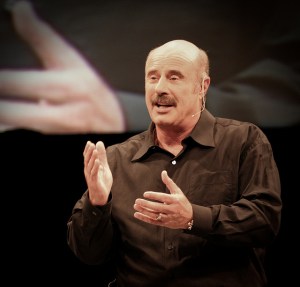
“Dr. Phil in Jacksonville” by Flickr user Craig ONeal, CC BY-NC-ND 2.0
While at this point in my life Phil-talk is more or less an asinine charade, it continues to function as a key component of our familiar vernacular. Interestingly, when re-visiting the many impersonations that have come to define our adolescent years (the Keanu years, the Bush Sr. years, the Phil years), one thing becomes clear: all the voices we’ve adopted have been those of white, male, cultural standard-bearers (Ironically, Keanu Reeves also happens to be Hapa, though I never knew as much. His breakout role as “Ted” helped to popularize the “California dude” archetype). Additionally, I should note, that at no time did any female impersonations enter my repertoire. If you’re going to gain a voice, better make it a male one, no? The racial and gender dissonance that Phil-talk begets drives the urge to perform it.

The author’s mother, with the author’s sister and the author. Picture is property of the author.
From an early age, my mother would tell me tales of her sacrifice—how hard she worked when she came to this country and how difficult life could be in 1960s post-war South Korea—all in a voice with barely a shred of mispronunciation or foreign intonation. My father, a second-generation Swiss-Italian American, scrupulously corrected her syntactical missteps and any other vocal nuances that sounded un-American. It was important to my mother to succeed as an American, and most importantly, that her children succeed too. The pressure I felt to make her content was borderline unbearable. When I started doing the voices, it made my mother happy. She sometimes tried joining in, attempting to mimic key Phil phrases like, “You have gawt to get reee-al,” but to no avail. “You do it better than me,” she’d say, “…my accent.”
When I was young, people looked at me and asked, “what are you?” OR “where are you from?” “America,” I would say. “I’m an American.” These questions were provoked by the racial ambiguity of my mixed-race heritage–the hint of Asianness that marked me as something else. I could not change the shape of my eyes, the contour of my cheeks or the fact that my mother was Korean. But, I could try my hardest to act and sound like an American. Phil-talk became a way to obscure the Asianness, to prove beyond a shadow of a doubt that I did, in fact, belong.
Rather than being merely a childhood performance of celebrity impersonations, I have come to think these various chapters were actually an attempt to perform sonic whiteness. Whether it was Keanu’s California dude cadence, George Bush Senior’s waspy nasality, or Phil’s prolonged Texan twang, I tried to perform in what Aja Martinez defines as “white voice” in her article “‘The American Way’: Resisting the Empire of Force and Color-Blind Racism” (593). She talks about Latino/a students using a “white voice” at school because they equate it with the voice of higher education, but I am really using it here as an explicit racial performance. As a a half Korean, half Euro-American teen girl (now woman) who decides to very literally adopt the voice of a White, 50-something, Texan, TV psychologist, “white voice” was the name of the game, and people loved it–especially my Korean immigrant mother.
For Asian Americans in particular, a people whose national belonging has been culturally questioned and legally denied, accents substantiate and make audible what the eye sees as un-American. In Shilpa Dave’s recently published Indian Accents: Brown Voice and Racial Performance in American Television and Film, she explores accents as they relate to cultural citizenship, national belonging and “the allocation of power.” Someone with an accent is “designated as an outsider to the dominant culture,” writes Dave. In contradistinction to “foreign” sounding accents, Southern accents are a classic symbol of American cultural belonging, like apple pie for the ears.
Would Phil’s wisdom sound as powerful or palatable without the accent? His appeal stems not only from his sometimes entertaining “Phil-isms” (e.g. “You can’t hide the sunrise from a rooster”), but from all that he and his voice signify. A white, male doctor giving advice on TV is hardly noteworthy, but Phil’s recognizably Southern accent separates him from the pack and softens the blow of his often severe advice.
![Angela George [CC-BY-SA-3.0 (http://creativecommons.org/licenses/by-sa/3.0)], via Wikimedia Commons](https://soundstudiesblog.com/wp-content/uploads/2014/11/philmcgrawhwofmay2013.jpg?w=300&h=243)
Angela George [CC-BY-SA-3.0 (http://creativecommons.org/licenses/by-sa/3.0)%5D, via Wikimedia Commons
Constantly searching for ways to be seen, heard, and accepted within an American system of racial binarism that privileges whiteness, denigrates blackness, and locates yellowness somewhere in a No Man’s Land of racial categorization, sound’s flexibility has always seemed to me like a means to belonging. Furthermore, as a multiracial, Korean/White woman, even no man’s land can seem out of reach. As Michael Omi notes in the Introduction to The Sum of Our Parts: Mixed-Heritage Asian Americans, within the historical and political context of the United States, (the “one-drop rule,” eugenic fears of racial intermixing, anti-miscegenation laws, etc.) multiracial identities have consistently been “contained, disregarded, [and] denied.” Multiraciality disorients and confuses insofar as it can discredit entrenched signifiers which make race perceptible to the eye and ear.
Previously on Sounding Out!, I discussed my identification with Nas and the rap world as both a move towards color and the formation of an authentic, multiracial self. A move in the opposite direction, experimenting with “white voice,” functions as another attempt to navigate America’s system of racial identification, albeit in a much more problematic vein. After years of Phil-talk and vocal impersonations of the white male variety, I am finally putting a stop to the charade. However earnest (or subconscious) an attempt to belong, the loss of time spent mimicking Phil represents an era of racial silencing that is somewhat difficult to stomach. Despite the amusement it has brought to friends and family, I am putting the voice to rest in service of getting real.
—
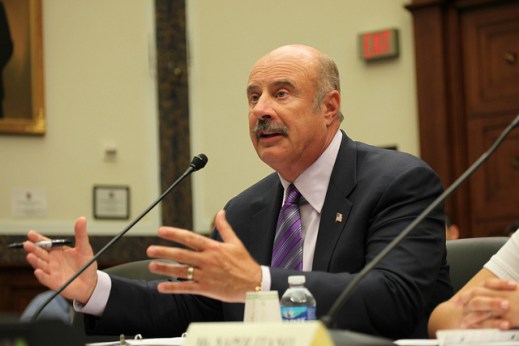
Featured image: “Dr. Phil” by Flickr user House Committee on Education and the Workforce Democrats, CC BY-NC-ND 2.0.
—
Christie Zwahlen is the Assistant Director at Binghamton University’s Center for Civic Engagement, where she has worked for four years to develop, expand and promote community engagement opportunities for students, faculty and staff. Previously, Christie worked for two years as an AmeriCorps VISTA, designing Service-Learning courses in conjunction with faculty at Thiel College and as the Coordinator of the Bridging the Digital Divide Program at Binghamton University. Christie earned her Master’s Degree in English and a Graduate Certificate in Asian & Asian American Studies from Binghamton University in 2009. She is currently enrolled in the English PhD program at Binghamton University.
Share this:


Current Top Posts





April 2021

January 2020

November 2019

October 2019

August 2019

April 2014

November 2017

March 2015

December 2017

October 2015
 Sounding Out!
Recent Comments