
In Defense of Auto-Tune

Lil Wayne, I Am Still Music Tour, Photo by Matthew Eisman
I am here today to defend auto-tune. I may be late to the party, but if you watched Lil Wayne’s recent schizophrenic performance on MTV’s VMAs you know that auto-tune isn’t going anywhere. The thoughtful and melodic opening song “How to Love” clashed harshly with the expletive-laden guitar-rocking “John” Weezy followed with. Regardless of how you judge that disjunction, what strikes me about the performance is that auto-tune made Weezy’s range possible. The studio magic transposed onto the live moment dared auto-tune’s many haters to revise their criticisms about the relationship between the live and the recorded. It suggested that this technology actually opens up possibilities, rather than marking a limitation.
Auto-tune is mostly synonymous with the intentionally mechanized vocal distortion effect of singers like T-Pain, but it has actually been used for clandestine pitch correction in the studio for over 15 years. Cher’s voice on 1998’s “Believe” is probably the earliest well-known use of the device to distort rather than correct, though at the time her producers claimed to have used a vocoder pedal, probably in an attempt to hide what was then a trade secret—the Antares Auto-Tune machine is widely used to correct imperfections in studio singing. The corrective function of auto-tune is more difficult to note than the obvious distortive effect because when used as intended, auto-tuning is an inaudible process. It blends flubbed or off-key notes to the nearest true semi-tone to create the effect of perfect singing every time. The more off-key a singer is, the harder it is to hide the use of the technology. Furthermore, to make melody out of talking or rapping the sound has to be pushed to the point of sounding robotic.

Antares Auto-Tune 7 Interface
The dismissal of auto-tuned acts is usually made in terms of a comparison between the modified recording and what is possible in live performance, like indie folk singer Neko Case’s extended tongue-lashing in Stereogum. Auto-tune makes it so that anyone can sing whether they have talent or not, or so the criticism goes, putting determination of talent before evaluation of the outcome. This simple critique conveniently ignores how recording technology has long shaped our expectations in popular music and for live performance. Do we consider how many takes were required for Patti LaBelle to record “Lady Marmalade” when we listen? Do we speculate on whether spliced tape made up for the effects of a fatiguing day of recording? Chances are that even your favorite and most gifted singer has benefited from some form of technology in recording their work. When someone argues that auto-tune allows anyone to sing, what they are really complaining about is that an illusion of authenticity has been dispelled. My question in response is: So what? Why would it so bad if anyone could be a singer through Auto-tuning technology? What is really so threatening about its use?
As Walter Benjamin writes in “The Work of Art in the Age of Mechanical Reproduction,” the threat to art presented by mechanical reproduction emerges from the inability for its authenticity to be reproduced—but authenticity is a shibboleth. He explains that what is really threatened is the authority of the original; but how do we determine what is original in a field where the influences of live performance and record artifact are so interwoven? Auto-tune represents just another step forward in undoing the illusion of art’s aura. It is not the quality of art that is endangered by mass access to its creation, but rather the authority of cultural arbiters and the ideological ends they serve.
Auto-tune supposedly obfuscates one of the indicators of authenticity, imperfections in the work of art. However, recording technology already made error less notable as a sign of authenticity to the point where the near perfection of recorded music becomes the sign of authentic talent and the standard to which live performance is compared. We expect the artist to perform the song as we have heard it in countless replays of the single, ignoring that the corrective technologies of recording shaped the contours of our understanding of the song.
In this way, we can think of the audible auto-tune effect is actually re-establishing authenticity by making itself transparent. An auto-tuned song establishes its authority by casting into doubt the ability of any art to be truly authoritative and owning up to that lack. Listen to the auto-tuned hit “Blame It” by Jaime Foxx, featuring T-Pain, and note how their voices are made nearly indistinguishable by the auto-tune effect.
It might be the case that anyone is singing that song, but that doesn’t make it less bumping and less catchy—in fact, I’d argue the slippage makes it catchier. The auto-tuned voice is the sound of a democratic voice. There isn’t much precedent for actors becoming successful singers, but “Blame It” provides evidence of the transcendent power of auto-tune allowing anyone to participate in art and culture making. As Benjamin reminds us, “The fact that the new mode of participation first appeared in a disreputable form must not confuse the spectator.” The fact that “anyone” can do it increases possibilities and casts all-encompassing dismissal of auto-tune as reactionary and elitist.
Mechanical reproduction may “pry an object from its shell” and destroy its aura and authority–demonstrating the democratic possibilities in art as it is repurposed–but I contend that auto-tune goes one step further. It pries singing free from the tyranny of talent and its proscriptive aesthetics. It undermines the authority of the arbiters of talent and lets anyone potentially take part in public musical vocal expression. Even someone like Antoine Dodson, whose rant on the local news, ended up a catchy internet hit thanks to the Songify project.
Auto-tune represents a democratic impulse in music. It is another step in the increasing access to cultural production, going beyond special classes of people in social or economic position to determine what is worthy. Sure, not everyone can afford the Antares Auto-Tune machine, but recent history has demonstrated that such technologies become increasingly affordable and more widely available. Rather than cold and soulless, the mechanized voice can give direct access to the pathos of melody when used by those whose natural talent is not for singing. Listen to Kanye West’s 808s & Heartbreak, or (again) Lil Wayne’s “How To Love.” These artists aren’t trying to get one over on their listeners, but just the opposite, they want to evoke an earnestness that they feel can only be expressed through the singing voice. Why would you want to resist a world where anyone could sing their hearts out?
—
Osvaldo Oyola is a regular contributor to Sounding Out! He is also an English PhD student at Binghamton University.
Share this:

Pushing Play: What Makes the Portable Cassette Recorder Interesting?
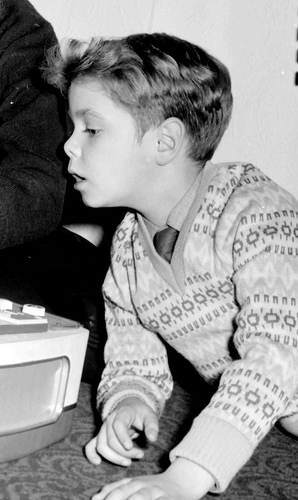
"Change the Speed": image from the "Vintage Kids" archive of flickr user theirhistory
One of my earliest memories of sound recording is one of my earliest memories, period: an isolated image of my own index and middle finger trying to push down the “record” and “play” buttons on my father’s portable cassette tape recorder. More prominent than the visual element of this memory is the haptic one: I can still call up the sensation of the effort required to make the red button go down and latch and the stress on the top joint of my index finger as the resistance bent it backward. Also still with me is a trace sense of the threat of sharp pain, as if at some point previous I had been wounded (perhaps pinched?) by these buttons. How young must I have been to have experienced this degree of opposition from such a small, unassuming device? And whence this desire to persist in the face of it?And: how and where does this object–so unprepossessing with its five big buttons, volume slider, cartridge tray, and little speaker–fit into sound studies and the history of sound recording technology?
There’s a small, rich, growing body of work on tape recording–including work by scholars as different as Kathleen Hayles, Steven Connor, Michael Davidson, and this blog’s doyen, Jennifer Stoever-Ackerman–but almost invariably it focuses on the reel-to-reel recorder, the device the cassette recorder was meant to simplify and miniaturize, at the expense of sound quality. The reel-to-reel was a vital contributor to the development of stereo and hi-fi hobbyism; it was also the mechanism at the center of a series of bold modernist literary experiments with tape recording by Samuel Beckett, William S. Burroughs, David Antin, and others.
Aside from Andy Warhol’s use of it to tape huge swaths of his everyday life (in 1965, he “wrote” a novel consisting of 24 largely consecutive hours of transcribed cassettes) the cassette recorder has no such avant-garde pedigree. The name of the first model, the Norelco Carry-Corder 150, which appeared in 1963, shows the primary focus of its manufacturers’ vision. Ads and trade journal articles from around this time touted the ease with which the device could be toted around on a vacation with the aim of producing an “audio album” of the trip. Doubtless, such albums were made and some may even still exist. But I suspect that the most vibrant history of the Carry-Corder and its descendants lies in the device’s easy adapability into the play world of children. As I and many others of my generation remember it, the pleasure of playing with the device was the way it instigated various sorts of performance, usually based in mimicry of ones we’d consumed through other electronic media. In a manner not unlike Warhol, we created our own little media empires: Dj-ing, news announcing, sportscasting, hosting talk shows with the baby and the dog as guests, singing like Cher on TV, re-enacting TV comedy sketches, recording one’s own comedy sketches, and on and on.
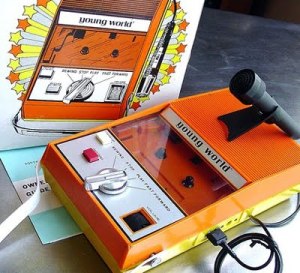
Child's play?: Young World BIC-202 Cassette Recorder
It’s not obvious how sound figures in the context of children’s play. Certainly, the quality with which the tape recorder recorded and played back sound mattered little, if at all. What mattered was the way the device initiated and constructed scenes, provided roles to play. Analogously, as David E. James has noted, one of the most powerful aspects of Warhol’s practice of bringing his Carry-Corder 150 everywhere he went (he was an early adopter, purchasing one in 1964) was that it “ma(de) performance inevitable” and “constitute(d) being as performance” (Allegories of Cinema, page 69). Even playback itself was a matter of secondary interest; how many times do you think I listened to the tape of myself “broadcasting” two innings of a random mid-70s Mets game, delivered as I watched on TV with the sound turned down? My wager is on none. Still, sound is the raison d’etre of the cassette recorder. A few years later, kids might have done similar things with a video camera, but to a lot of kids, the early mass-marketed versions of that device felt much more formal, complicated, authoritative. That was the instrument through which the “official” history of the family was to be told; the tape recorder picked up the creative fragments, the bored interstices, the embarrassments, the extremes–parts of a world that wasn’t to appear before guests. Plus, the sound-based device actually offered greater reach and flexibility along with more forms of integration into other media like television.
My early memory of the recorder, however, seems more primal. Given its intensity, it seems clear that the tape recorder served as a vehicle toward several important forms of self-demarcation, helping me to discover and negotiate certain limits: of my body, of my agency vis-à-vis machines, of my relationships to my parents, of my family’s position in a larger social and economic world. (And in fact, the device was an important part of my family’s livelihood, vital to my father’s work as a radio reporter.) In retrospect, I seem almost impossibly young to be left to my own devices with the machine, and I also have a vague sense that I had been violating some prohibition, perhaps a decree that the recorder is “not a toy.” I wonder how much the force of such a decree originated precisely in the ease with which it could and did become a toy.
gramophone, film, typewriter, and cassette tape recorder?
It’s unlikely that Friedrich Kittler was going to list “cassette tape recorder” next in his book title after “gramophone, film, and typewriter.” It’s unlikely he had an image of the device in mind when he wrote his bravura dictum, “media determine our situation.” Some technologies don’t stand up to such sweeping statements, toward which media studies sometimes seems particularly drawn. Certain devices, I think, necessitate a broadened and diversified understanding of the things both sound and technology do—even things that aren’t “about” sound in a conventional sense. For many historical narratives of sound reproduction, the cassette tape recorder is a regressive device, a drag on the pursuit of greater audio fidelity, with fidelity defined as “presence.” But the qualities of the cassette recorder that make it significant to our field are manifold, and some of them will be qualities that arise out of their adjacency to the central fact of recording and playing back sound. The “forgotten” areas of the history of sound reproduction technologies aren’t the notable failures—the 8-track players, which after all still draw camp-retro interest–but the most mundane successes. The portable cassette tape recorded never truly failed, it just got left back.
—
Gustavus Stadler teaches English and American Studies at Haverford College. He is the author of Troubling Minds: The Cultural Politics of Genius in the U. S.1840-1890 (U of Minn Press, 2006) and co-editor (with Karen Tongson) of the Journal of Popular Music Studies. His 2010 edited special issue of Social Text on “The Politics of Recorded Sound” was recently named a finalist for a prize in the category of “General History” by the Association of Recorded Sound Collections. He is currently working on Andy Warhol’s sound world, Woody Guthrie’s sexuality, and other stuff.
Share this:


Current Top Posts





April 2021

January 2020

November 2019

October 2019

August 2019

April 2014

November 2017

March 2015

December 2017

October 2015
 Sounding Out!
Recent Comments