
“This is Not a Sound”: The Treachery of Sound in Comic Books
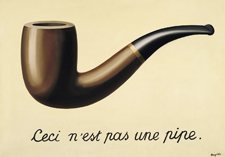
“This is not a pipe.”
In comics theorist Scott McCloud‘s seminal work Understanding Comics (1993), there comes a point following his convoluted description of Magritte’s “The Treachery of Images” where he asks the reader, “Do you hear what I’m saying?” In the next panel he adds, “If you do, have your ears check because no one said a word.” The joke is, of course, that while his comic doppelganger is depicted as talking through the use of word balloons, no words are being spoken. We are reading, not hearing. And yet, sound (or rather, its representation) remains a crucial part of reading and enjoying comic books.
Magritte was trying to get us to think about the treachery of visual representation, while McCloud points us of the treachery of aural representation. A stylized “SPLAT!” is certainly not a sound, but our instinctual understanding of sound helps us to interpret what is otherwise a silent medium in ways beyond the mere the descriptive effect of a sound’s depiction. The way comics use sound can teach us about the function of sound in understanding the visual and textual. As McCloud asserts, comics depend on the reader to create closure between parts of an imagined whole in order for disparate panels to make sense. While it second-nature for the comic reader to interpret the depiction of sound in comics, the closure enacted to make stylized textual elements into “a sound” is a central way that this is enacted.

The most famous use of comic sound effect words is probably from the old 1960s Batman TV series—where the “SOCK!” and “BONG!” of superhero and sidekick reinforced the campy aesthetic of the program. It is telling that the Batman-theme (and the fight scenes in general) uses horn flares to emphasize those “POW!” and “BIFF!” moments. The suggestion is that the ostentatious representations of sound that these textual flare sound effect words provide are an empty signifier. There is no sound behind that sound. The weak-sounding slaps and smacks of knuckles on flesh would never suffice for the larger than life world of comic superheroes, and the more out-there comics get the more difficult it is to trace a relationship between the textual/visual representation and any sound in the real world. There is no point of comparison by which to understand the “SHREEEEEE!” of a launching “zirrer” in Kurt Busiek’s Astro City, but only the vague evocation of some loud shrill noise.
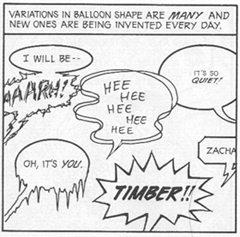 And yet, comic readers not only understand these representations as sound, but there are also a variety of visual clues given that help the reader interpret some quality of those sounds. The most ubiquitous example of sound in comics is, of course, the word balloon—so ubiquitous in fact that it is easy to take for granted the fact that comics have their own conventions for handling and describing sound without recourse to adjectives. The irony is that the shape and texture of word balloons (just like the shape and texture of sound effect words like “BOOM!”) that help to convey the quality of sound become nearly invisible to the reader. Just as any literate person sees a word they know and interprets it for what it is meant to represent and not a collection of individual letters, the dripping icicle-like shape of a word balloon is read as a cold tone or the sharp points of the balloon are read as loud and abrupt.
In her essay “The Comic Book’s Soundtrack” from The Language of Comics (2001), Catherine Khordoc provides a very good overview of the use of sound in comics using the example of Goscinny and Uderzo’s Asterix to provide examples of the various ways word balloons and the implanting of onomatopoeic words directly into the panel image itself are used to represent sounds in comic books. Yet, the function of the representation of sound in comic runs even deeper than simply translating the quality of sound itself; it also serves to help establish timeframes for panels (or sets of panels) and functions in establishing the closure the reader performs in making sense of both individual panels and their context within a sequence of panels. Discrete sounds—whether it’s the “FWOOSH!” of the Human Torch flaming on or long-winded pseudo-scientific explanation of the Negative Zone by Mr. Fantastic—require the passage of time to be intelligible. In order for sounds to be differentiated, they must have some form of beginning, middle and end (or in the parlance of synthesized sound, “attack, decay, sustain, release”). This means that in comics, a medium where space and time merge, representations of sound are crucial to making sense of action, in particular, to the passage of time within a singular panel—for while time can be shown to pass between two or more panels through the process of closure (implicitly understanding the movement or occurrence not depicted between panels that makes them sequential), a singular panel is not necessarily a discrete moment, as an entire conversation can occur within it, requiring readers to perform closure even within the scope of a single panel.
For example, in the second panel below, despite the static image, the passage of time suggested by the conversation about Spider-man’s wounds and payment leads the reader to make sense of the sequence between it and the panel that follows. It is the reader’s understanding that it takes time to talk and listen out loud that helps make the time of the panel apparent.
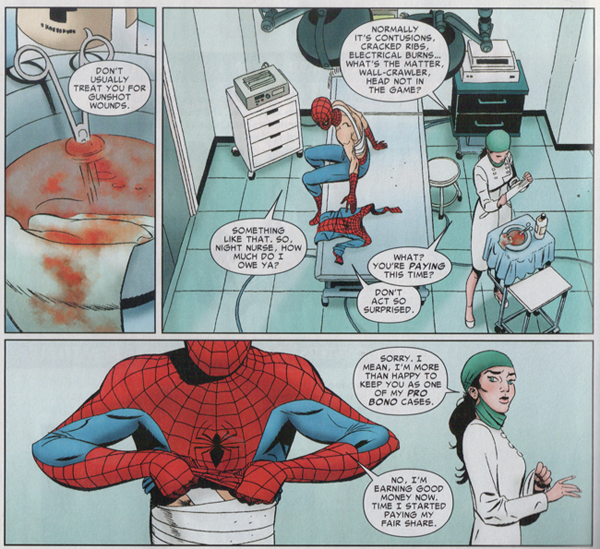
Click to Enlarge.
Perhaps the most telling evidence of the centrality of sound, at least to the superhero comic genre, was Marvel’s decision to include a synopsis and explanation of the action at the end of each issue of the “‘Nuff Said,” “silent” month of comics back in 2001—wherein there was no dialogue or captions.
There is still a lot to consider when it comes to sound in comics—not just the rhetoric of sound or sound as a signifier of time, but sound as identity. Representations of sound in comics can serve as a form of character signature, and I do not mean only famous lines like Superman’s “Up, up and away!” (which really emerged from Superman radio plays), but iconic sounds such as Spider-man’s web-shooters going “THWIPP!” or Wolverine’s claws, “SNIKT!” that over time have come to be more than just descriptive sound-words, but signifiers that are unique for the characters themselves. (See TV Trope’s page on signature sound effects)
In the end, this brief overview will hopefully serve as a starting point in generating more thoughts on not only how our familiarity with sound informs our reading and interpreting of comics, but how this (admittedly) very general idea can be applied to other ostensibly silent and primarily visual media. The use of sound in comics is a perfect example of how the transparency of sound can make it presence and function easy to overlook. Furthermore, the way in which it is used to orient the reader and help provide closure between and within panels, and identify characters clues us in to the importance of its role and the importance of considering where and how else it might function. I, for one, am going to keep thinking on it and looking for examples of in comics and hope that others join their thoughts to the discussion. Until then, as Stan Lee would “say,” Excelsior!


Share this:

Becoming a Bad Listener: Labyrinthitis, Vertigo, and “Passing”
 For the past three weeks I have been sick with labyrinthitis. It started with a bout of vertigo while picking up some essentials at a local pharmacy and has since recurred in various other locations. In the morning, when I stroll for coffee, it feels like I am walking a tightrope. Shelves after shelves of boxes at a local store have made the world spin. A determined trip to Manhattan (for a friend’s film release) quickly transformed into an incomprehensible blur of light and sound. Because of this lapse in cognition I have found myself listening to the world, and my body, in fascinating (although frustrating) new ways. The most frightening moments of vertigo I experienced have followed moments of both visual and audio overload. When I can no longer understand what I hear, panic is sure to follow. Worst of all, even though negotiating my day-to-day responsibilities has become a trial in patience, to most observers, I seem perfectly fine. I have decided to share these experiences because of how well they inform the ways that sound, specifically the practice of listening, informs the process of “passing” as normal in everyday life.
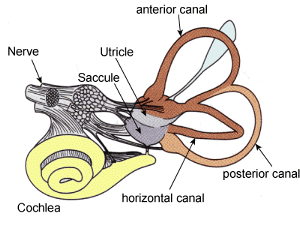
Labyrinthitis is often related to an inner ear infection. When the series of canals within the ear are damaged, a sense of balance is lost. This lack of balance completely skews all visual cues: things look blurry, there is an unsteadiness to things (as if on a boat), bright and flashing lights are extremely distracting . . .imagine being drunk, but with none of the perks. Another symptom of labyrinthitis is an occasional ringing in the ear. For me, this ringing is at its worst when I am trying to focus on a conversation in an environment with lots of ambient noise. For instance, if I try to hold a conversation while walking down the street and several cars pass by, the ringing will begin to overwhelm both the cars and the conversation. It’s like my brain is dialing back the volume of all the sounds around me. As mentioned earlier this is the most terrifying of all the symptoms that I experience – it feels, uncannily, like I am waking from a dream.
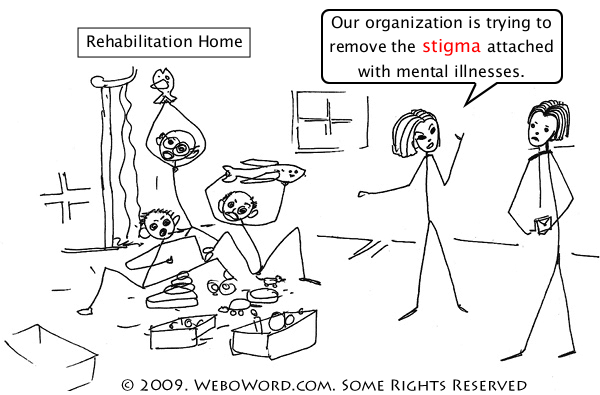
One labyrinthitis support site suggested that prolonged coping with the above symptoms in everyday life is, perhaps, the most difficult part of recovery. In an interesting twist they drew on sociologist Erving Goffman’s 1963 work Stigma to support this claim, “An individual carries a stigma if s/he is unable for any reason to fulfil society’s sterotypic criteria for normality – if this deviation is obvious (eg: physical deformity) the person is at once ‘discredited’. Failings that are less obvious or may be concealed (eg: vestibular problems) render the individual ‘discreditable’ in the sense that his/her identity is vulnerable. Whereas a discredited person must adopt a stigmatised identity – a discreditable individual may prefer the effort and risks attached to trying to ‘pass’ as normal to the frank stigma of admitting the attribute.” Has labyrinthitis rendered me discreditable? Although it is tempting to critique the armchair diagnosis above, I believe that it is a valuable basis for theoretical inquiry. What are the risks of acquiring the stigma of vestibular problems? In other words: do I choose to reveal my illness tactically?
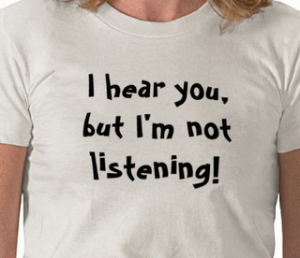
Surely, as this blog post attests, I am not too frightened by the stigma of revealing my illness. It is likely to pass in the next few months and I assume that most of our readers are not particularly judgmental. I am scared, however; when I lose track of conversations. Sometimes even to the point that I choose, as Goffman suggests, to “pass” and keep my lapse of understanding secret. As the ringing in my ear grows: I will often keep quiet, smile, and nod my head. There have been several times in recent memory that I have even forced a chuckle, or a short, daft, answer. Often these replies are deliberately vague, peppered with just enough key words to convince my companion that I was listening. At these times, in my head, I am lost – reeling with confusion. I’m trying to figure out where I am (what street is this, how can I get home quickly?), what has triggered this confusion (is it the noises behind me, or the lights ahead?), and if there is cause to be concerned (is this business as usual, or am I about to faint?). I want, at these moments, to “pass” as normal because I am scared of becoming too much of a burden to those around me. My Achilles’ heel in these situations is contingent on my ability to listen, passing, at least, as a good listener.
 The sense of stigma I imagine, as a bad listener, is infinitely worse than the sense of stigma I could accrue as a sick individual. Goffman, in 1963, had been writing in a late Fordist economy. As such, the stigma of illness related more to physical labor than one’s ability to socialize and fit in. In these context of illness could suggest an inability to produce; the diseased body set apart from all others. As immaterial and affective labor become valorized in new ways, stigma comes to relate to the inter-social processes of control that form the new societal knot. Chief among these stigmas, for myself at least, is the inability to listen. Listening cues others in to how well one is able to socialize, participate, and contribute to a tight web of everyday activities. When I cannot listen, yes, I am vulnerable. I am vulnerable, mostly, because I am suddenly and inexplicably alone.
The worst part of becoming a bad listener is recognizing how very little is required in a conversational exchange. As noted earlier, vagaries and key words are, for the most part, sufficient. Is there a final irony here, while my ability to listen to and understand others is diminished has my ability to listen to and understand myself increased? Many have argued that mimesis, or imitation, is, in fact, central to the way people communicate. “The whole of human culture,” according to Anna Gibbs, “then, is, perhaps, predicated on imitation, in which difference and innovation are as central as reproduction and similarity” (p.202). This notion sends eerie chills up my spine. Bad listening, is, from this perspective, simply an alternative mode of identity. Words come in through the ear, rattle around for a bit in the brain, and then come out of the mouth with sparse changes and a different order. Where difference and innovation can be considered the bi-products of good listening, reproduction and similarity stem from bad listening.
Perhaps bad listening is not all that bad. Gibbs also suggests that mimetic communication, “is the cement of parent-child, peer, friendship, and love relations” (p. 202). When “passing” for normal, I shift gears. I use my listening instincts to further a set of affective and emotional bonds which are equally important to my everyday life. Listening is central to “passing,” but there is a fine distinction between modes of listening. Listening analytically is the practice of listening in order to decipher, decrypt, suggest and parse new ideas from a statement or song. Listening affectively is, then, the binary. Not a mode which drives conversations, and/or innovates, but one which actively seeks to create bonds of comfort, compassion, and support. Listening for timbre, tone, and vibe instead of composition, consistency and argument.
AT


Share this:


Current Top Posts





April 2021

January 2020

November 2019

October 2019

August 2019

April 2014

November 2017

March 2015

December 2017

October 2015
 Sounding Out!
Recent Comments