
Listening to and through “Need”: Sound Studies and Civic Engagement

 This April forum, Acts of Sonic Intervention, explores what we over here at Sounding Out! are calling “Sound Studies 2.0”–the movement of the field beyond the initial excitement for and indexing of sound toward new applications and challenges to the status quo.
Two years ago at the first meeting of the European Sound Studies Association, I was inspired by the work of scholar and sound artist Linda O’Keeffe and her compelling application of the theories and methodologies of sound studies to immediate community issues. In what would later become a post for SO!, “(Sound)Walking Through Smithfield Square in Dublin,” O’Keeffe discussed her Smithfield Square project and how she taught local Dublin high school students field recording methodologies and then tasked them with documenting how they heard the space of the recently square and the displacement of their lives within it. For me, the idea was electrifying, and I worked to enact a public praxis of my own via the ReSounding Binghamton project and the Binghamton Historical Soundwalk Project. Both are still in their initial stages; the work has been fascinating and rewarding, but arduous, slow, and uncharted. Acts of Sonic Intervention stems from my own hunger to hear more from scholars, artists, theorists, and/or practicioners to guide my own efforts and to inspire others to take up this challenge. Given the exciting knowledge that the field has produced regarding sound and power (a good amount of it published here), can sound studies actually be a site for civic intervention, disruption, and resistance?
In the forum we will catch up with Linda O’Keeffe‘s newest project, a pilot workshop with older people at the U3A (University of the Third Age) centre in Foyle, Derry “grounded in an examination of the digital divide, social inclusion and the formation of artists collectives.” Artist Luz Maria Sanchez will give us privilege of a behind-the-scenes discussion of her latest work, “detritus.2: The Sounds and Images of Postnational Violence in Mexico.” We will also hear from artist, theorist, and writer Salomé Voegelin, who will treat us to a multimedia re-sonification of the keynote she gave at 2014’s Invisible Places, Sounding Cities conference in Viseu, Portugal, “Sound Art as Public Art,” which revivified the idea of the “civic” as a social responsibility enacted through sound and listening. Today we begin with longtime SO! community member and writer, Christie Zwahlen, Assistant Director at Binghamton University’s Center for Civic Engagement, who argues that any act of intervention must necessarily begin with self-reflexivity and examination of how one listens. If you decide that a community is in need, can you still hear what they have to say?
–JS, Editor-in-Chief
—
Community engagement is an important piece of Sound Studies 2.0, the latest iteration of the field that moves beyond discovering and justifying sound as an object of study and toward a politics and praxis of intervention. New knowledge about sound and listening can both be produced through and actively inform community-based work. Likewise, sound studies can inform the theory and practice of community engagement in meaningful ways.
Listening plays a critical role in the field of community engagement, insofar as our work is undertaken in response to community-articulated needs. Though needs can be expressed through various modes, listening to residents and community partners remains crucially important to our work as practitioners. As has been reiterated countless times, the strength of relationships is what drives and sustains community-based work and enables collaborative endeavors. Yet, as important as listening is to this work, it is rarely, if ever, discussed in sonic terms. We know that listening both produces and perpetuates power inequity, yet have neglected to examine how listening mediates our understanding (or lack thereof) of community needs.
Thus, as Jennifer Stoever’s recent Sounding Out! post argues for the importance of a civically engaged sound studies, I am also arguing for the importance of a sonically informed community engagement praxis, one that demands self-reflexivity about our own listening practices as we attempt to identify community needs. What does “need” sound like? To whom? How has the state of being “in need” been sonically constructed by dominant modes of listening and the sonic color-line? How can we, as Community Engagement practitioners, guard against the compulsion to hear needs articulated in the absence of their verbal expression? In other words. what do we hear–or not hear–when we listen through the power-laden filter of “neediness”?

Old Navy Community Service, Image by Flickr User Jorge Quinteros
Like Sound Studies, Community Engagement is considered a relatively new field. Often equated to a movement within higher education, it has built steam on the strength of its learning outcomes for students engaged in Service-Learning and other high impact learning experiences. Furthermore, many higher education institutions explicitly prioritize working with their communities towards positive public outcomes in their mission statements, positioning outcomes for community residents as equally important to student learning.
Both research and practice have taught us that community engagement is most effective when based on community-articulated needs. Projects should address genuine needs as voiced by the community. As Barbara Jacoby writes in Service-Learning in Higher Education, “an effective [service-learning] program allows for those with needs to define those needs” (42). This central tenet of community engagement praxis issues a power check on community-campus partnerships and attempts to shield community members from the sometimes arrogance of University “experts” who falsely believe in their ability to speak on behalf of Others, re-enacting the very processes of silencing and oppression this work seeks to eliminate. Community voices are often stifled in unequal research or “service” encounters and are also often mis-heard by what Stoever calls the listening ear, which hears non-normative speech as an indication of need. Furthermore,the idea that need can be self-identified implicitly speaks to the recognition that visual markers of social difference affect our opinions and perceptions of others–particularly when those Others are from marginalized communities. Because of this, the voices of community residents are often figured as the gateway to “pure” knowledge about community needs.
While the concept of “voicing” needs in community-engaged work is broader than its sonic meaning (e.g. referring to the collection of data via surveys, needs assessments, other written communications, etc.), meeting face-to-face and speaking with community residents is still considered a best and necessary practice in the development of mutually beneficial relationships. The material “touch” manifested through the vocalic body connects us in ways that email, needs assessments, and other forms of digital communication cannot compete. Of constant concern to community engagement practitioners is how we can better respond to community-articulated needs and how best to inform ourselves of their existence. Missing from the discussion, however, is an interrogation of how listening shapes the way we hear needs articulated. What does someone in need sound like, or rather, what has our culture determined what someone in need sounds like? Are we hearing needs articulated where they do not exist? As much as the field of Community Engagement prioritizes listening in its praxis, the process itself is not understood as a material one. If we are basing our work on the voiced needs of community residents, how can we do this well without investigating our own listening practices or acknowledging at the most basic level that listening is a social process, not just a physiological one? Delving more deeply into these questions can help us to develop a sonically-informed community engagement praxis, one which takes into account our own biased ears as we engage with community members.

Fairview Spanish Service Learning 2011, Image by Flickr User Mosaic36
To think through the damage that mis-hearing need can do, I want to examine the case study of Rachel Jeantel, the young woman who was a key witness for the prosecution in the George Zimmerman trial in July, 2013. Zimmerman was acquitted for the murder of Trayvon Martin, the teenager whom Zimmerman stalked and shot to death as Martin walked home from the corner store to his father’s house in Sanford, Florida. Many commentators placed blame for Zimmerman’s acquittal on Jeantel’s voice and use of African American Vernacular English, which were denigrated and dissected by courtroom officials, the media, and the Twittersphere. When the trial was over, a self-dubbed “village” of mentors descended on Jeantel, determined to provide her with a plethora of services that she, in fact, resisted. Krissah Thompson’s Washington Post article “For Trayvon Martin’s friend Rachel Jeantel, a ‘village’ of mentors trying to keep her on track,” details Rachel Jeantel’s “transformation” after the George Zimmerman trial. A prime example of the way certain voices and bodies are figured as expressing need without ever saying a word, this “village” of mentors inferred from Jeantel’s voice a great longing for help.
As courtroom officials and many in the social media cosmos painted a sonic image of Jeantel as untrustworthy and unintelligible, Karen Andre–an African American lawyer and old friend of Jeantel’s lawyer Roderick Vereen–was thinking about what she could do to help the young woman she heard and saw on the stand. Taking the lead in Jeantel’s cultural makeover, Vereen is referred to as the “village elder.” Since the case ended, he has made Jeantel his project, despite, as Thompson reports, their expectations “differing wildly.”

Rachel Jeantel and Mentor Roderick Vereen
As Karen Andre watched Jeantel’s testimony on television, she contacted Vereen directly to offer herself up as a mentor, because “simply, it looked to her as if the young woman needed one.” But it was not only Jeantel’s appearance (which was itself highly criticized) that motivated Andre to contact Vereen. Regina Bradley uses the term “sonic ratchetness” to describe Jeantel’s testimony and its reception as “an antithetical response to (hetero)normative politics of respectability currently in place in the black (diasporic) community.” It was this sonic ratchetness which signaled to Andre that Jeantel needed assistance–assistance becoming the “respectable” black woman to which she undoubtedly aspired. Though many spoke out in defense of Jeantel, the degree to which negative portrayals of her were accepted as fact further evidence the pervasiveness of the sonic color-line in guiding our response to black vocalics–as deficient, non-normative and indicative of need. In essence, through her speech, Jeantel has been characterized and interpreted by many (including members of the black professional class) as a charity case.
On Jeantel’s “progress” thus far, Vereen remarks, “her word choice was terrible [during the trial]. She didn’t know how to communicate or express herself clearly. Rachel has learned to confide with adults. She has become very open now.” As a black professional operating daily within the cultural norms of the U.S. court system, Vereen hears Jeantel’s use of African American vernacular as objectionable. By emphasizing her improved proficiency with white heteronormative discourse and increased “openness” as major accomplishments vis a vis her “progress,” Vereen highlights Jeantel’s manner of speech as both a determinant of need and a barrier to her functioning within the normal parameters of American social life. Vereen “helps” Jeantel by disciplining her speech to conform with normative white speaking and listening practices.
When asked about the public commentary surrounding her and her testimony, Jeantel says she “had to laugh it off.” Suddenly interrupted by Rose Reeder, another village mentor, who urges, “No. Be Honest,” Jeantel concedes that she was angry about being judged. Reeder’s censuring here evidences the ways in which Jeantel is silenced by the “assistance” being provided her. Interrupting Jeantel in this manner forces her to disclose personal information, at the risk of seeming like a liar. In capitulating to her mentor, Jeantel gives up a very basic right of expression. In effect, Jeantel’s improved “openness” to adults (thanks, village!) functions to silence and distort her authentic voice.

Rachel Jeantel during her makeover from Ebony Magazine post-Zimmerman trial.
“I think the thing that moved me most,” says Tom Joyner, another of Jeantel’s mentors and host of the nationally syndicated Tom Joyner Morning Show, “was when the attorney kept asking her questions and she kept saying, ‘You’re not listening to me.’ And it occurred to me, ‘Yeah, not only was that attorney not listening to her, but I think that none of us were listening to the Rachel Jeantels of the world.” Ironically, Joyner who has offered to pay for Jeantel’s tuition at any historically black college of her choosing, is not listening well either. As the Washington Post piece also highlights, Jeantel and her Creole-speaking mother were rarely (if ever) consulted as to what types of aid were actually needed or desired (if any). Instead, Joyner and the village interpreted Jeantel’s voice alone as adequate evidence of need sans investigation.
What Joyner and others hear and what Jeantel is actually asking for continue to be incongruous. Jeantel would like to pursue a career in fashion. Joyner’s foundation refuses to pay. Vereen’s prescription is for Jeantel to attend Florida Memorial, a small historically black university in Southern Florida. As to whether the “village teachings” actually worked, Vereen condescendingly avows, “We took her to the water, and now the rest is up to her.”
The manner in which Jeantel has been forcibly coerced to abandon her “sonic ratchetness” (at least in public), provides an important warning to those of us engaged in work which advances the “public good.” It should lead us to question whose good we are enacting and how our ideas about the public good are informed by what we hear and mis-hear.
As is often the case in community-based work, it is fruitful to return to Kretzmann and McKnight’s asset-based community development (ABCD) model in thinking through an ethical course of action. The ABCD model focuses its attention on a community’s assets instead of its needs or deficiencies, empowering even the least empowered members of a community to use what skills and talents they possess to work towards changes they desire. Viewing alternative modes of articulation as an asset (vs. an indicator of inherent need) may prove useful in staying attentive to our listening practices as they relate to marginalized communities. Though denigrated as improper speech, culturally specific modes of articulation convey meaning in their distance from the norm. These modes of articulation are complex in their practical and historical constitutions. Both in what is said and not said, we must acknowledge that our listening ears fabricate meaning beyond the verbal, and that sonic constructions of Otherness can distort and inform how we hear needs articulated.
—
Featured Image: MANTA, Ecuador (May 19, 2011) Mass Communication Specialist 1st Kim Williams talks with a student while painting a wall at Angelica Flores Zambrano school during a Continuing Promise 2011 community service event. Continuing Promise is a five-month humanitarian assistance mission to the Caribbean, Central and South America. (U.S. Navy photo by Mass Communication Specialist 2nd Class Eric C. Tretter/Released) 110519-N-NY820-275
—
Christie Zwahlen is the Assistant Director at Binghamton University’s Center for Civic Engagement, where she has worked for four years to develop, expand and promote community engagement opportunities for students, faculty and staff. Previously, Christie worked for two years as an AmeriCorps VISTA, designing Service-Learning courses in conjunction with faculty at Thiel College and as the Coordinator of the Bridging the Digital Divide Program at Binghamton University. Christie earned her Master’s Degree in English and a Graduate Certificate in Asian & Asian American Studies from Binghamton University in 2009. She is currently enrolled in the English PhD program at Binghamton University.
—
 REWIND!…If you liked this post, you may also dig:
“Quebec’s #casseroles: on participation, percussion and protest”-Jonathan Sterne
“Deejaying her Listening: Learning through Life Stories of Human Rights Violations”-Emmanuelle Sonntag and Bronwen Low
“Listening to the Border: ‘”2487″: Giving Voice in Diaspora’ and the Sound Art of Luz María Sánchez”-D. Ines Casillas
Share this:

Learning to Listen Beyond Our Ears: Reflecting Upon World Listening Day

World Listening Day took place last week, and as I understand it, it is all about not taking sound for granted – an admirable goal indeed! But it is worth taking a moment to consider what sorts of things we might be taking for granted about sound as a concept when we decide that listening should have its own holiday.
One gets the idea that soundscapes are like giant pandas on Endangered Species Day – precious and beautiful and in need of protection. Or perhaps they are more like office workers on Administrative Professionals’ Day – crucial and commonplace, but underappreciated. Does an annual day of listening imply an interruption of the regularly scheduled three hundred and sixty four days of “looking”? I don’t want to undermine the valuable work of the folks at the World Listening Project, but I’d argue it’s equally important to consider the hazards of taking sound and listening for granted as premises of sensory experience in the first place. As WLD has passed, let us reflect upon ways we can listen beyond our ears.
At least since R. Murray Schafer coined the term, people have been living in a world of soundscapes. Emily Thompson provides a good definition of the central concept of the soundscape as “an aural landscape… simultaneously a physical environment and a way of perceiving that environment; it is both a world and a culture constructed to make sense of that world.”(117) As an historian, Thompson was interested in using the concept of soundscape as a way of describing a particular epoch: the modern “machine age” of the turn of the 20th century.

“Rock Series – Microphones” by Flickr user Stefano Tambalo, CC BY 2.0
Anthropologist Tim Ingold has argued that, though the concept that listening is primarily something that we do within, towards, or to “soundscapes” usefully counterbalanced the conceptual hegemony of sight, it problematically reified sound, focusing on “fixities of surface conformation rather than the flows of the medium” and simplifying our perceptual faculties as “playback devices” that are neatly divided between our eyes, ears, nose, skin, tongue, etc.
Stephan Helmreich took Ingold’s critique a step further, suggesting that soundscape-listening presumes a a particular kind of listener: “emplaced in space, [and] possessed of interior subjectivities that process outside objectivities.” Or, in less concise but hopefully clearer words: When you look at the huge range of ways we experience the world, perhaps we’re limiting ourselves if we confine the way we account for listening experiences with assumptions (however self-evident they might seem to some of us) that we are ‘things in space’ with ‘thinking insides’ that interact with ‘un-thinking outsides.’ Jonathan Sterne and Mitchell Akiyama, in their chapter for the Oxford Handbook of Sound Studies, put it the most bluntly, arguing that
Recent decades of sensory history, anthropology, and cultural studies have rendered banal the argument that the senses are constructed. However, as yet, sound scholars have only begun to reckon with the implications for the dissolution of our object of study as a given prior to our work of analysis.(546)
Here they are referring to the problem of the technological plasticity of the senses suggested by “audification” technologies that make visible things audible and vice-versa. SO!’s Jennifer Stoever-Ackerman has also weighed in on the social contingency of the “listening ear,” invoking Judith Butler to describe it as “a socially-constructed filter that produces but also regulates specific cultural ideas about sound.” In various ways, here, we get the sense that not only is listening a good way to gain new perspectives, but that there are many perspectives one can have concerning the question of what listening itself entails.

“listen (069/365)” by Flickr user Tim Pierce, CC BY 2.0
But interrogating the act of listening and the sounds towards which it is directed is not just about good scholarship and thinking about sound in a properly relational and antiessentialist way. It’s even less about tsk-tsking those who find “sound topics” intrinsically interesting (and thus spend inordinate amounts of time thinking about things like, say, Auto-Tune.) Rather, it’s about taking advantage of listening’s potential as a prying bar for opening up some of those black boxes to which we’ve grown accustomed to consigning our senses. Rather than just celebrating listening practices and acoustic ecologies year after year, we should take the opportunity to consider listening beyond our current conceptions of “listening” and its Western paradigms.
For example, when anthropologist Kathryn Lynn Guerts first tried to understand the sensory language of the West African Anlo-Ewe people, she found a rough but ready-enough translation for “hear” in the verb se or sese. The more she spoke with people about it, however, the more she felt the limitations of her own assumptions about hearing being, simply, the way we sense sounds through our ears. As one of her informants put it, “Sese is hearing – not hearing by the ear but a feeling type of hearing”(185). As it turns out, according to many Anlo-ewe speakers, our ability to hear the sounds of the world around us is by no means an obviously discrete element of some five-part sensorium, but rather a sub-category of a feeling-in-the-body, or seselelame. Geurts traces the ways in which the prefix se combines with other sensory modes, opening up the act of hearing as it goes along: sesetonume, for example, is a category that brings together sensations of “eating, drinking, breathing, regulation of saliva, sexual exchanges, and also speech.” Whereas English speakers are more inclined to contrast speech with listening as an act of expression rather than perception, for the Anlo-Ewe they can be joined together into a single sensory experience.

“Listening, Regent Street, London, 17 December 2011” by Flickr user John Perivolaris, CC BY-NC-ND 2.0
The ways of experiencing the world intimated by Geurts’ Anlo-Ewe interlocutors play havoc with conventionally “transitive,” western understandings of what it means to “sense” something (that is, to be a subject sensing an object) let alone what it means to listen. When you listen to something you like, Geurts might suggest to us that liking is part of the listening. Similarly, when you listen to yourself speak, who’s to say the feeling of your tongue against the inside of your mouth isn’t part of that listening? When a scream raises the hairs on the back of your neck, are you listening with your follicles? Are you listening to a song when it is stuck in your head? The force within us that makes us automatically answer “no” to questions of this sort is not a force of our bodies (they felt these things together after all), but a force of social convention. What if we tried to protest our centuries-old sensory sequestration? Give me synaesthesia or give me death!
Indeed, synaesthesia, or the bleeding-together of sensory modes in our everyday phenomenological experience, shows that we should loosen the ear’s hold on the listening act (both in a conceptual and a literal sense – see some of the great work at the intersections of disability studies and sound studies). In The Phenomenology of Perception, Maurice Merleau-Ponty put forth a bold thesis about the basic promiscuity of sensory experience:
Synaesthetic perception is the rule, and we are unaware of it only because scientific knowledge shifts the centre of gravity of experience, so that we have unlearned how to see, hear, and generally speaking, feel, in order to deduce, from our bodily organization and the world as the physicist conceives it, what we are to see, hear and feel. (266)
Merleau-Ponty, it should be said, is not anti-science so much as he’s interested in understanding the separation of the senses as an historical accomplishment. This allows us to think about and carry out the listening act in even more radical ways.
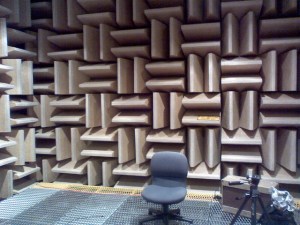
“Listening Room” by Flickr user Consumerist Dot Com, CC BY 2.0
Of course all of this synaesthetic exuberance requires a note to slow down and check our privilege. As Stoever-Ackerman pointed out:
For women and people of color who are just beginning to decolonize the act of listening that casts their alternatives as wrong/aberrant/incorrect—and working on understanding their listening, owning their sensory orientations and communicating them to others, suddenly casting away sound/listening seems a little like moving the ball, no?
To this I would reply: yes, absolutely. It is good to remember that gleefully dismantling categories is by no means always the best way to achieve wider conceptual and social openness in sound studies. There is no reason to think that a synaesthetic agenda couldn’t, in principle, turn fascistic. The point, I think, is to question the tools we use just as rigorously as the work we do with them.
—
Owen Marshall is a PhD candidate in Science and Technology Studies at Cornell University. His dissertation research focuses on the articulation of embodied perceptual skills, technological systems, and economies of affect in the recording studio. He is particularly interested in the history and politics of pitch-time correction, cybernetics, and ideas and practices about sensory-technological attunement in general.
—
Featured image: “” by Flickr user woodleywonderworks, CC-BY-2.0
—
REWIND!…If you liked this post, you may also dig:
Snap, Crackle, Pop: The Sonic Pleasures of Food–Steph Ceraso
“HOW YOU SOUND??”: The Poet’s Voice, Aura, and the Challenge of Listening to Poetry–James Hyland
SO! Amplifies: Eric Leonardson and World Listening Day 18 July 2014–Eric Leonardson
Share this:


Current Top Posts





April 2021

January 2020

November 2019

October 2019

August 2019

April 2014

November 2017

March 2015

December 2017

October 2015
 Sounding Out!
Recent Comments