
In Defense of Auto-Tune

Lil Wayne, I Am Still Music Tour, Photo by Matthew Eisman
I am here today to defend auto-tune. I may be late to the party, but if you watched Lil Wayne’s recent schizophrenic performance on MTV’s VMAs you know that auto-tune isn’t going anywhere. The thoughtful and melodic opening song “How to Love” clashed harshly with the expletive-laden guitar-rocking “John” Weezy followed with. Regardless of how you judge that disjunction, what strikes me about the performance is that auto-tune made Weezy’s range possible. The studio magic transposed onto the live moment dared auto-tune’s many haters to revise their criticisms about the relationship between the live and the recorded. It suggested that this technology actually opens up possibilities, rather than marking a limitation.
Auto-tune is mostly synonymous with the intentionally mechanized vocal distortion effect of singers like T-Pain, but it has actually been used for clandestine pitch correction in the studio for over 15 years. Cher’s voice on 1998’s “Believe” is probably the earliest well-known use of the device to distort rather than correct, though at the time her producers claimed to have used a vocoder pedal, probably in an attempt to hide what was then a trade secret—the Antares Auto-Tune machine is widely used to correct imperfections in studio singing. The corrective function of auto-tune is more difficult to note than the obvious distortive effect because when used as intended, auto-tuning is an inaudible process. It blends flubbed or off-key notes to the nearest true semi-tone to create the effect of perfect singing every time. The more off-key a singer is, the harder it is to hide the use of the technology. Furthermore, to make melody out of talking or rapping the sound has to be pushed to the point of sounding robotic.

Antares Auto-Tune 7 Interface
The dismissal of auto-tuned acts is usually made in terms of a comparison between the modified recording and what is possible in live performance, like indie folk singer Neko Case’s extended tongue-lashing in Stereogum. Auto-tune makes it so that anyone can sing whether they have talent or not, or so the criticism goes, putting determination of talent before evaluation of the outcome. This simple critique conveniently ignores how recording technology has long shaped our expectations in popular music and for live performance. Do we consider how many takes were required for Patti LaBelle to record “Lady Marmalade” when we listen? Do we speculate on whether spliced tape made up for the effects of a fatiguing day of recording? Chances are that even your favorite and most gifted singer has benefited from some form of technology in recording their work. When someone argues that auto-tune allows anyone to sing, what they are really complaining about is that an illusion of authenticity has been dispelled. My question in response is: So what? Why would it so bad if anyone could be a singer through Auto-tuning technology? What is really so threatening about its use?
As Walter Benjamin writes in “The Work of Art in the Age of Mechanical Reproduction,” the threat to art presented by mechanical reproduction emerges from the inability for its authenticity to be reproduced—but authenticity is a shibboleth. He explains that what is really threatened is the authority of the original; but how do we determine what is original in a field where the influences of live performance and record artifact are so interwoven? Auto-tune represents just another step forward in undoing the illusion of art’s aura. It is not the quality of art that is endangered by mass access to its creation, but rather the authority of cultural arbiters and the ideological ends they serve.
Auto-tune supposedly obfuscates one of the indicators of authenticity, imperfections in the work of art. However, recording technology already made error less notable as a sign of authenticity to the point where the near perfection of recorded music becomes the sign of authentic talent and the standard to which live performance is compared. We expect the artist to perform the song as we have heard it in countless replays of the single, ignoring that the corrective technologies of recording shaped the contours of our understanding of the song.
In this way, we can think of the audible auto-tune effect is actually re-establishing authenticity by making itself transparent. An auto-tuned song establishes its authority by casting into doubt the ability of any art to be truly authoritative and owning up to that lack. Listen to the auto-tuned hit “Blame It” by Jaime Foxx, featuring T-Pain, and note how their voices are made nearly indistinguishable by the auto-tune effect.
It might be the case that anyone is singing that song, but that doesn’t make it less bumping and less catchy—in fact, I’d argue the slippage makes it catchier. The auto-tuned voice is the sound of a democratic voice. There isn’t much precedent for actors becoming successful singers, but “Blame It” provides evidence of the transcendent power of auto-tune allowing anyone to participate in art and culture making. As Benjamin reminds us, “The fact that the new mode of participation first appeared in a disreputable form must not confuse the spectator.” The fact that “anyone” can do it increases possibilities and casts all-encompassing dismissal of auto-tune as reactionary and elitist.
Mechanical reproduction may “pry an object from its shell” and destroy its aura and authority–demonstrating the democratic possibilities in art as it is repurposed–but I contend that auto-tune goes one step further. It pries singing free from the tyranny of talent and its proscriptive aesthetics. It undermines the authority of the arbiters of talent and lets anyone potentially take part in public musical vocal expression. Even someone like Antoine Dodson, whose rant on the local news, ended up a catchy internet hit thanks to the Songify project.
Auto-tune represents a democratic impulse in music. It is another step in the increasing access to cultural production, going beyond special classes of people in social or economic position to determine what is worthy. Sure, not everyone can afford the Antares Auto-Tune machine, but recent history has demonstrated that such technologies become increasingly affordable and more widely available. Rather than cold and soulless, the mechanized voice can give direct access to the pathos of melody when used by those whose natural talent is not for singing. Listen to Kanye West’s 808s & Heartbreak, or (again) Lil Wayne’s “How To Love.” These artists aren’t trying to get one over on their listeners, but just the opposite, they want to evoke an earnestness that they feel can only be expressed through the singing voice. Why would you want to resist a world where anyone could sing their hearts out?
—
Osvaldo Oyola is a regular contributor to Sounding Out! He is also an English PhD student at Binghamton University.
Share this:

Play it Again (and Again), Sam: The Tape Recorder in Film (Part Three on the 1980s)

[If you missed the first two installments, hit “pause” and rewind to June’s piece on Noir, and July’s discussion of Walter Murch].
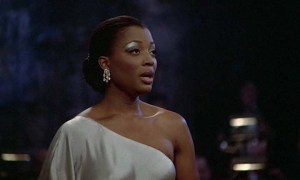
The Diva (Wilhelmenia Fernandez) Sings
At the center of this lust is the female voice, turned fetish in the 1980’s films Diva and Blow Out. Whether screaming in terror, singing the heights of the sublime, or confessing the depths of a passionate hatred, both movies construct women as emotive objects to be recorded, often against their will, and the recordists in these films clamor for and are repelled by the female sounds they capture. (For additional Sounding Out! of the “problem” of women’s voices in contemporary media culture see last week’s post, Liana Silva’s “Eye Candy” and Aaron Trammell’s recent “GLaDOS, the Voice of Postfeminist Control“). In fact, this series has traced the cultural construction of the “sound man”: how mainstream films naturalize recording as the province of men (and, with the exception of Touch of Evil, of white men). The tape recorder’s increasing accessibility should have meant that women were using the equipment in greater numbers, but according to Hollywood, tape recorders continued to mediate power relationships between (white) men. Think Walter Neff and Barton Keyes. Harry Caul and his anonymous boss. Ferris and Principal Rooney..
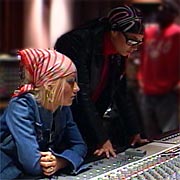
Christina Aguilera and Alicia Keys at the console recording "Impossible" (VH1)
With such a proliferation of representations of male recorders, it can be difficult to imagine a female hand twiddling the knobs, so much so that 95% of the professional recording industry is now male, according to the nonprofit organization Women’s Audio Mission, that works to increase the number of women behind the boards through youth outreach and training programs. While the sole responsibility for this chronic and widespread underrepresentation does not rest entirely on the shoulders of America’s dream factory—an NPR story from 2003 on Women Music Producersby Neda Ulaby discusses additional reasons “Why Female Producers Are a Rare Breed”—we must also acknowledge that cinematic images actively shape reality, they do not just passively reflect it. Representations limit our imaginations as much as as they embolden them. The images of recording in 1980s films remind us that the mere presence of women’s voices is not enough to enable gender equity in our increasingly mediated and technologized public sphere, women must also “man” recording equipment, structuring (and shifting) the conditions under which their voices are recorded, framed, heard, and remixed into public consciousness.
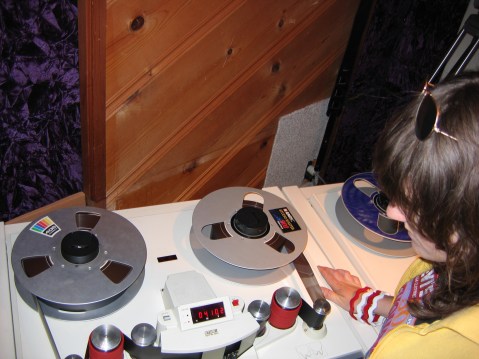
Changing the Face of Sound: Lauren Tabak Punches in (courtesy of Women's Audio Mission)
Okay, for all the completists out there, a quick recap, the first two films are: 1. Double Indemnity (1944) and 2. Blackboard Jungle (1955), with a little Mike Hammer for good measure: Kiss Me Deadly (1955). The second two are: 3. Touch of Evil (1958) and 4. The Conversation (1974), and a leap into the 1980s: Ferris Bueller’s Day Off (1986).
5. Diva (Les Films Galexie, 1981, Dir. Jean-Jacques Beineix):
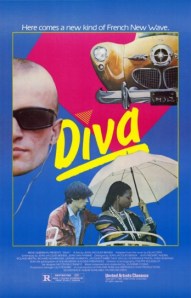 The global sex trade. Transatlantic circulation of music and capital. International piracy rings. The Vietnamese diaspora. Imperialist fetishizing of the bodies (and voices) of women of color. Taiwan as a rising force in the international economy. Police stings and gangland killings. Operatic performance and fan worship. Described by Frederic Jameson as “the first French postmodernist film” in Signatures of the Visible (1990), Diva is a rich, multilayered narrative that locates the tape recorder at the center of the vast cultural flows and postcolonial power struggles of late capitalism. As much fun Diva sometimes has with copies—there are duplicate cars, convenient doppelgangers, random mannequins, multiple decoy tapes—it also explores the melancholic cultural loss caused by a medium that holds out the promise of saving everyone, at the rate of 38.1 centimeters per second.
.
Well, it was secret. Until Jules lends it out to impress a preteen roller skating, record-stealing Vietnamese fashionista named Alba (Thuy An Luu) who plays it for the (way) older man she lives with in a creepy ambiguous arrangement, a fortysomething Zen Buddhist hipster tough guy named Gorodish (Richard Bohringer), who then tries to arrange a deal with two nameless, emotionless, mirrored-sunglass wearing, carbon copy Taiwanese business men (yellow peril much?) who are willing to pay top dollar for the tape. As Cynthia’s manager eventually warns her in the most realistic moment of an otherwise over-the-top film, “the quality of the recording is perfect. . .and Taiwan never signed any international copyright agreement!”
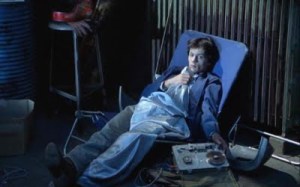
Jules (Frédéric Andréi) and his Nagra
Diva asks audiences to imagine that Cynthia has never been recorded—she wants to preserve the aura of her performances as “unique moments”—and she considers pirated recordings as akin to “theft, rape even.” The metaphor is uncomfortably extended by the sexualized recording sequence when Jules finally captures her voice, squirming and fiddling with his recorder, hidden underneath a jacket on his lap, as tears stream down his face. After the show, he steals the Diva’s dress and returns to his apartment to clutch it while listening, over and over, to her voice. Eventually even the illicit sonic reproduction cannot contain Jules’s desire to possess Cynthia; he tries to create a reproduction-in-the-flesh by seeking out a black prostitute and paying her to wear the stolen gown.
Through unsettling images such as these, Diva depicts the tape recorder as a technological phallus. It isn’t only that women are fetishized recording objects, but they are actively chased away from the machine.When an excited Alba reaches out to grab Jules’s Nagra, he pushes her away, barking “Don’t touch my stuff. It is precious. Don’t touch it. . .The levels were precisely set.” She backs off, sighing, “You and your Nagra,” in a tone that is both taunting and resigned. The only woman to make her own recording, Nadia, ends up dead, although grateful that her tape will at least allow her to “pick the time and place to die. There will be witnesses and evidence.” At least she hopes so.
.
6. Blow Out (MGM 1981, Directed by Brian DePalma):
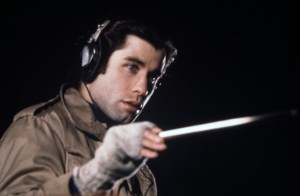
Jack Terry (John Travolta) and his shotgun mic
Fresh off the success of Grease and Urban Cowboy, 70s hearththrob John Travolta brings macho swagger to the role of Jack Terry, a burned out sound designer who is complacent about getting the “perfect” female scream for B-grade horror flicks. When his director busts his chops about finding some “new wind”—he had been squeaking by with library sounds—he finds himself doing some midnight lurking in a Philadelphia park. Armed with his trusty shotgun microphone, he is ready when an out-of-control car careens around a corner and plunges off a bridge. Instantly casting his equipment to the ground—oh! not The Nagra III!!!—he pulls a drowning woman from the car, the woefully vulnerable Sally (Nancy Allen). As if this isn’t bad ass enough to beef up the rep of “sound guys” for eternity, Jack cockily lets the investigating detective have it when he insinuates that Jack misheard what happened on the bridge: “I know what an echo sounds like, all right? I’m a sound man! The bang was before the blow out, all right?”
Carrying overtones of Chappaquiddick, the incident that Jack earwitnessed involved the death of a very prominent governor who was headed to the White House. The powers that be want to silence Sally and erase all traces of her presence in the passenger seat, so they turn a deaf ear toward Jack’s insistence that he has a tell-tale shot on tape that proves the “accident” was really murder. Ostensibly about the tenuous relationship between politics and “the truth,” Blow Out also asks audiences to press pause and consider the disposability of women in our contemporary culture–how their real lives are often mixed down, edited out, and even erased, while their recorded representations are hyperamplified and hungrily consumed.
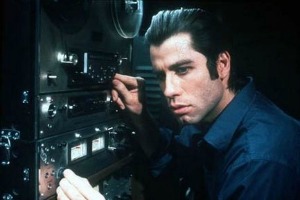
Terry, listening for the telltale shot
Inspired by The Conversation and Michelangelo Antonioni’s 1966 Blow Up—in which a swinging London photog enlarges a photo to reveal a killer—Blow Out depicts Jack on an obsessive rewind rampage, listening and re-living the incident on the bridge trying to prove the murder. The tape recorder is a both a necessary foundation of the film’s plot and a figurative device sparking audiences to listen again and to listen differently, to simultaneously question what they hear and to stake their lives on it. Interestingly, in a movie obsessed with sound and depictions of careful listening, audio itself cannot tell the whole story; it is only after Jack merges his soundtrack with a DIY film reconstructing the murder via newspaper photos that he feels his voice will finally be heard. Ultimately, however, the brash and principled sound man fails to find a listener. The haunting ending of the film, which I will not reveal, suggests that American culture mainly values “reality” and “truth” when it comes packaged as throwaway entertainment and that the female voice in terror is at the very heart of this titillating cycle of consumption.
.
And in a supporting role. . .
Real Genius (Tristar, 1986, Director Martha Coolidge. This film is notable for having five women on the sound team, editors Anna Boorstin, Virginia Cook-McGowan, Julia Evershade, Roxanne Jones, and assistant editor Christy Richmond).
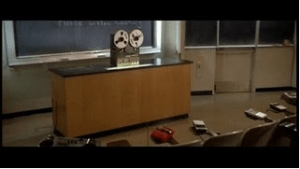
"Math on tape is hard to follow, so please listen carefully!"
The tape recorder slyly appears in the midst of this sarcastic blast to the late cold war that chronicles the revenge exacted by a band of brilliant college students (led by a young Val Kilmer) when they find out that the laser they developed for their university was intended for use by the U.S. government as an airborne weapon. Appearing in the first of two iconic 80s montages—this one set to the Comsat Angels’ “I’m Falling”—the vector-like proliferation of tape recorders silently communicates much anxiety about the technological landscape of the 1980s. When our irrepressible uber-nerd protagonist Mitch (Gabriel Jarrett) first begins his semester, he arrives at a full math lecture, barely noting the peppering of small personal recorders nudged to the corners of his classmate’s desks. As time passes, the camera revisits Mitch, still earnestly scribing notes alongside what is now only a handful of other students; he is surrounded by a sea of boom boxes the size of bread boxes and flat black slimline recorders, with a few candy apple red models thrown in for ‘80s hipness.
Finally, the earnest Mitch arrives alone, notebook in hand, only to find a completely empty lecture hall, save for the spinning spools of various tape recorders. The professor, too, has left the building—a reel to reel drones on at the head of the classroom, in front of a chalkboard that states, “Math on tape is hard to follow: so please listen carefully.” The pained look on Mitch’s face says it all: the meritocratic world of ideas that he once expected to inherit quite simply no longer exists, if it ever had. And, in a contemporary moment where online courses and “webinars” are the rule of the day and we stockpile podcasts like we have thousands of years to live, the humor of the tape-to-tape lecture cuts a little too closely. Suddenly I want to tap the mic and ask: “is this thing on? Bueller? . . .Bueller?”


Share this:


Current Top Posts





April 2021

January 2020

November 2019

October 2019

August 2019

April 2014

November 2017

March 2015

December 2017

October 2015
 Sounding Out!
Recent Comments