
Yellow Rain and The Sound of the Matter: Kalia Yang’s Sonorous Objection to Radiolab

The critically acclaimed WNYC program Radiolab found itself embroiled in a controversy for its recent broadcast segment “Yellow Rain.” Released on September 24, 2012 as part of the episode entitled “The Fact of the Matter,” the 20 minute segment “Yellow Rain” recounted the slaughter of hundreds of thousands of the Hmong by the Viet Cong and the Pathet Lao after the United States left Vietnam and the subsequent debates surrounding the chemical weapon called “yellow rain. The episode pitted the witnessing of Eng Yang, a survivor and documenter of the genocide—whom producer Pat Walters describes as the “Hmong guy” at one point—and his niece, award-winning writer Kao Kalia Yang—referred to only as “Kalia” by hosts Robert Krulwich and Jad Abumrad—against the research of university scientists and the relentless questioning of Krulwich.
Following the episode’s broadcast, many listeners and critics argued that Radiolab’s treatment of their the Yangs was Orientalist and unethical. Jea, writing on Radiolab’s “Yellow Rain” comment page suggested “Ms. Yang and her uncle were dismissed and even reduced to pawns in the larger scheme of RadioLab’s agenda.” Others, such as Bob Collins, writing for Minnesota Public Radio worried that “the story appeared […]to invalidate the Hmong loss and suffering in Laos.” Aaron, a commentor on Current Magazine’s coverage of the controversy called Radiolab’s coverage “inexcusable science, nothing close to journalism, and if only ‘a story,’ one that cements erroneous ideas in the minds of its listeners.” Kirti Kamboj, writing for Hyphen, a magazine dedicated to Asian American arts, culture, and politics, described the episode as “heartbreaking,” “utterly infuriating,” and an exemplar of “Orientalist, ethnocentric framing” designed to privilege Western knowledge.
From my perspective as a scholar of rhetoric, communication, and debate, to call Radiolab’s game rigged would be an understatement. The interview was not conducted on an even playing field and it smacks of a white Western privilege that the writers and producers failed to fully acknowledge even in their on-air discussion following the interview. Radiolab determined the questions, edited the exchange, and retained the capacity to both frame and amend the discussion (there is a debate concerning whether or not the Yangs knew the questions prior to the interview—this discussion can be found here, Radiolab’s response here , and answer to Radiolab’s claims here.).
In addition to the whether or not Radiolab misrepresented the Yangs and downplayed the mass murder of the Hmong in their pursuit of “truth,” I find that this episode is important for the insights it contains into argumentative invention, journalism, and new media ethics, all sparked by the grain of Kalia Yang’s voice in response to Krulwich’s questions. I argue that Kalia’s sounded distress functioned as what I call a “sonorous objection,” instigating the critique of Radiolab’s tactics. Borrowing from argumentation theory, an objection describes an argument that draws the context of an argumentative exchange into view. Research on objections has most often examined the use of visual images, such as the controversy sparked by the photographs coming from of Abu Ghraib. In this short piece, I will wed prior research on objections with theories about sound to argue that Kalia used the grain of her voice to call out—and call into question—the opaque assumptions that governed the interview and its reception.

Kao Kalia Yang, Image courtesy of the Fox Cities Book Festival
“Yellow Rain” recalls the Hmong genocide following the Vietnam War. The Hmong were recruited by the CIA to help disrupt supply lines to Ho Chi Minh City (or Saigon). After American troops withdrew, the Viet Cong and the Pathet Lao persecuted the Hmong for aiding the US. The communists attacked the Hmong, eradicating villages and blanketing populations with a sticky, yellow substance. Attempting to escape systemic annihilation, the Hmong receded into the jungle, where many still reside today. Some of the Hmong that were able to escape brought with them leaves covered in the yellow stuff, which they gave to local aid workers. These workers then shipped the samples back to the United States where labs diagnosed it as a chemical agent known as “yellow rain.” A concerned Reagan administration reasoned that only the Soviet Union had the technical capacity to produce such a weapon. As a result, Reagan restarted the Unites States’ then-dormant Chemical and Biological Weapons (CBW) program. Radiolab’s hosts, Abumrad and Krulwich take issue with this narrative; troubling the assertion that yellow rain was in fact a chemical weapon and insinuating that Reagan used the Hmong incident as an excuse to start producing CBWs.
“Yellow Rain” progressed like many other segments of Radiolab. Abumrad and Krulwich began by recounting the story of the Hmong from the perspective of retired CIA agent Merle Prebbenow and the Yangs. Next, they interview Harvard professor Matthew Meselson and Cornell professor Thomas Seeley, using their testimony to suggest that “yellow rain” was actually bees releasing their bowels en masse after hibernation. Then Abumrad and Krulwich brought this provocative hypothesis to the Yangs. Here, the show intensifies, the music fades, and Krulwich begins to question the Yangs, “as if he were a cross-examining attorney” according to Bob Collins, blogger for Minnesota Public Radio. As the interview goes on, Krulwich’s tone increasingly stiffens as he repeats a similar line of questioning: “But, as far as I can tell,” Krulwich asserts, “your uncle didn’t see the bee pollen fall, your uncle didn’t see a plane, all of this is hearsay.”
Kalia’s voice beings to fray:
My uncle says for the last twenty years he didn’t know that anyone was interested in the deaths of the Hmong people. He agreed to do this interview because you were interested. What happened to the Hmong happened, and the world has been uninterested for the last twenty years. He agreed because you were interested. That the story would be heard and the Hmong deaths would be documented and recognized. That’s why he agreed to the interview, that the Hmong heart is broken and our leaders have been silenced, and what we know has been questioned again and again is not a surprise to him, or to me. I agreed to the interview for the same reason, that Radiolab was interested in the Hmong story, that they were interested in documenting the deaths that happened. There was so much that was not told. Everybody knows that chemical warfare was being used. How do you create bombs if not with chemicals? We can play the semantics game, we can, but I’m not interested, my uncle is not interested. We have lost too much heart, and too many people in the process. I, I think the interview is done [This is Kalia’s transcription of her statements, from Hyphen].
Kalia reflects on her experience with Radiolab in a post for Hyphen, characterizing the interview as more of an interrogation. I add an additional layer: that of the deliberative exchange. While it is certainly true that there was a great discrepancy between the interlocutors, both parties adduced reasons for their respective positions producing an argumentative encounter that challenged the norms that govern discourse and language.
In the above quotation, Kalia claims that Radiolab ambushed her and their meeting occurred under a pretense of telling the Hmong story. She then rhetorically situates her interlocutor within a broader history of silencing the Hmong. While it may be tempting to look at the Radiolab interview as an isolated event, Kalia’s arguments cast it as another iteration of the Hmong being discounted. We cannot, in other words, cleave “Yellow Rain” from a history of oppression.

August 2004, Image by Flickr User Awning
Additionally, Kalia chides Radiolab’s concerns, calling them a “semantics game.” Here, both the use of semantics and game is instructive. Semantics speaks to the trivial nature of Krulwich’s questions. His focus on yellow rain and its dubious status as a chemical weapon obfuscates the fact that weapons were used against the Hmong. Or, to reformulate Kalia’s argument, Radiolab is trading purely in language and ignoring the material reality of her people. The invocation of game is also important because it suggests that Krulwich does not understand the historical gravity of his actions. And, perhaps more importantly, that Radiolab is not taking the incident seriously. These arguments coalesce to trouble the assumption that the interview –and the inclusion of the Yang’s voices–was fair, equal, and inclusive. This culminates in Kalia wresting her agency from this context by ending the interview.
However, an exclusive focus on language ignores the intersecting effects of histories–personal, interpersonal and social–sounds, cultures, moods, and affects. Indeed, the grain of Kalia’s voice operates as an affective vector. Teresa Brenna, in The Transmission of Affect, explains, vocal rhythm “is a tool in the expression of agency, just as words are. It can literally convey the tone of an utterance, and in this sense, it does unite word and affect”(70). Different vocal inflictions invoke both biographic and cultural histories, as the body attempts to discern meaning. Political theorist William Connolly, in Neuropolitics, calls this space between sound and meaning the virtual register of memory. Virtual memory describes a background below conscious recollection that discerns sensory data, like sound, and renders it intelligible (24). We often see this register at work when we watch a movie, as different scenes are stored below the level of reflection and are called up to interpret a scene. Virtual memory is recursive, folding in present experiences to help guide future encounters and using previous encounters to make sense of the present. Thus the rhythm of Kalia’s voice guides the entrainment of affect by drawing on listeners’ previous encounters with similar sounds. This process infuses listeners’ perceptions and resulted in what commentators called “painful” and “emotional.”
While Kalia’s words claim Radiolab ambushed her and her uncle, the grain of her voice draws the unequal distribution of power into sharp relief. Her vocal cracks resonated with listeners, imparting an intense, visceral experience and provoking an outcry. One listener, Mathew Salesses sums up the response: “Every time I listen to this, I start to cry. Every time. About ten times now.” It demonstrates that Kalia was through reasoning with Krulwich; his use of Western science to discredit indigenous knowledge made sincere argumentation impossible. Her cry was not only an act of resistance, but also an objection that troubled Radiolab’s claims of journalistic excellence, highlighting vexing issues with editing and story construction.
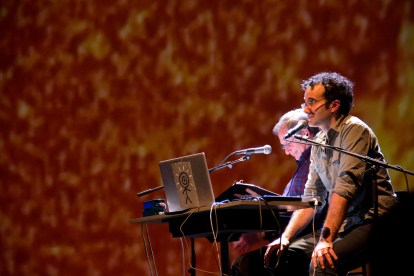
Robert Krulwich and Jad Abumrad, Image by Flickr User Carlos Gomez
In argumentation parlance, Kalia’s voice operated as an “objection.” In “Entanglements of Consumption,” argumentation scholars Kathryn M. Olson and G. Thomas Goodnight (1994) explain how an objection functions within an argumentative encounter: “absent a common agreement as to the means of reaching consensus, debate over the ‘truth’ of an asserted claim is set aside, in whole or in part, and challenges are raised as to the acceptability of the communicative context within which the argument is offered as secured”(251). That is, when deliberation occurs within a shared context—agreed upon values, goals, rules, and facts—the argument progresses smoothly. However, when there is a disjunction between interlocutors, such as in “Yellow Rain” where both parties disagree on basic facts, hegemonic beliefs take precedence. Objections function to evidence this differential, making both parties (and often an audience) aware of this gap. As such, objections are not concerned with refuting previous claims—the way that Kalia states neither she nor her uncle are interested in having a semantic debate—but questions the very context—and the conditions–of the debate itself.
Despite Radiolab’s attempts to fetishize her voice to evidence the “fact of the matter” and the “complicated nature of truth,” Kalia’s voice retained her agency. Through the invocation of the sonorous objection, she eluded capture and demonstrated the unequal terrain of the interview. Her pain enveloped the listener, leaving a resonance that Radiolab listener Cecilia Yang called “painful to listen to” in her personal blog. As Olson and Goodnight remind us, objections arise in a repressive context, when people are denied a voice. For Kalia, histories of racism and colonialism infused the argumentative encounter, making it impossible for her to “reason,” a framework she exposes as a stacked game. As such, her sonorous objection functioned to evidence this disparity, while directing the listener’s attention to her cause. Just as the pictures of prisoners coming out of Abu Ghraib incited outrage about U.S. imperialism and violence, Kalia’s sonorous objection provoked a conversation about the Hmong, Radiolab, and the ethics of journalism in the new media age.
—
Justin Eckstein is a doctoral candidate and former director of debate at the University of Denver. His work explores the intersection of listening, affect, and argumentation. Justin’s writing has appeared in Argumentation & Advocacy,Relevant Rhetoric, and Argumentation in Context. Currently, he is writing his dissertation on the micropolitics of podcasting in the post-deliberative moment.
Share this:

In the Flesh: Embodiment, Listening, and Transcription
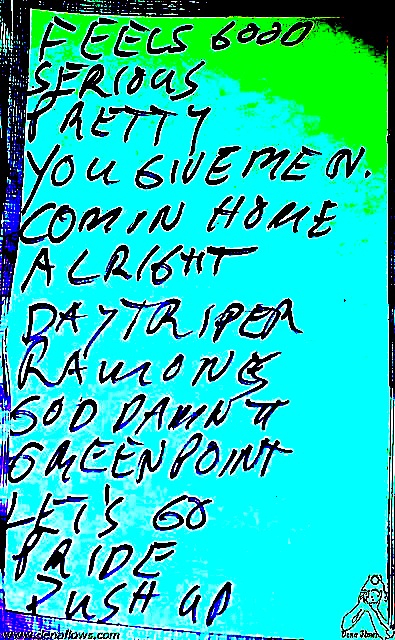
The Fleshtones Setlist, 9/11/12 show in Bilbao, Spain,
 Editor’s Note: July 18th, 2012 has been designated as World Listening Day by the World Listening Project, a nonprofit organization founded in 2008 “devoted to understanding the world and its natural environment, societies and cultures through the practices of listening and field recording.” World Listening Day is a time to think about the impacts we have on our auditory environments and, in turn, its affects on us. This year, Sounding Out! has decided to observe World Listening Day by planning a month-long special forum of posts exploring several different facets of listening such today’s offering by SO!‘s Multimedia Editor Aaron Trammell on listening’s relationship to the body and next week’s discussion by novelist Bridget Hoida on the impact of listening on her writing process. We will also explore questions that we need to remember when we celebrate listening as a cultural, embodied act. What happens when listening is interrupted? distorted? A post on tinnitus by Mack Hagood will help us think through what happens when we take listening (and the able body) for granted as a universal, normative experience. We’ll also publish a special bonus multi-sensory post by our newest regular writer, Maile Colbert, on World Listening Day itself and we will launch our regular quarterly spring podcast for on July 12th, which will feature Eric Leonardson, director of the World Listening Project. In addition to being interesting as all hell, the podcast will suggest some ideas for how to get involved in WLD activities–or how to embark on a listening project of your own this July. Enjoy our ear-opening extravaganza and please keep those comments coming. We’d love to hear from you! –JSA, Editor-in-Chief
—
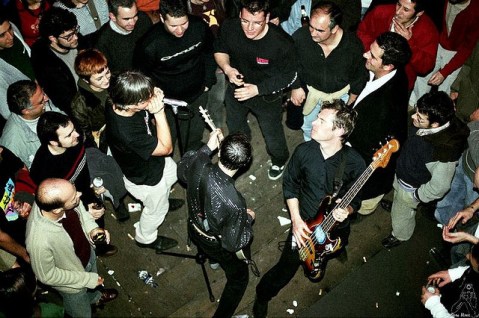
The Fleshtones, October 23, 2008, Image by Flickr User Dena Flows
What happens when the body translates sound from one medium to another? How is the body both affected by a song (when listening), and affecting it’s content (when writing)? In this post, I will relate my experience transcribing the lyrics of the song “Hexbreaker!” by The Fleshtones in an effort to answer these questions.
I love to sing. Often, I feel that it is only through singing that I feel that I can adequately relate to the emotions, ideas, and narrative of the songwriter. This relational practice is called embodiment. While psychologists such as Sigmund Freud and Carl Jung had at one point considered this sort of emotional relationship to be a libidinal drive – either to the phallus (in Freud’s case), or a unifying mythological symbol like the mandala (in Jung’s). These feelings, or drives, in classical psychoanalytic theory are part of our interior psyches, the unconscious mind.
Contemporary physiological research has departed from the sharp dichotomy of the conscious/unconscious mind. Instead, emotions are looked at as exterior phenomena – invisible links which form between bodies. As Lisa Blackman (2010) explains in her essay Embodying Affect: Voice-hearing, Telepathy, Suggestion and Modelling the Non-conscious: “The voices can be materialized through particular technologies of inscription such as neuro- imaging scans, and can even be located within the right temporal-parietal lobe, showing the capacity of the right brain not only for psychological attunement, but also for registering the affects of others” (166). Other theorists such as Sara Ahmed (2004) have argued that emotions float between and stick to bodies. Julian Henriques (2010) has even noted the ways that sonic vibrations work to activate reciprocal affective moods in others (75), a point very much in line with Blackman’s musings on the voice’s centrality to “psychic,”right brain, linkages. To these points, it is important to consider exactly what it means for the body to work as a medium of translation. What emotions can a song activate in my body, and how do these feelings become words, stored in the mnemonic confines of paper?
Because listening is central to the transmission and construction of emotional bonds, I will now detail my experience transcribing “Hexbreaker!”.
The Fleshtones are a band that I love. Their songs find the perfect balance of Animal House cool, Swinging Medallions style garage rock, and campy B-movie flavor. They have cred too, as they were a frequent act in the late-70s CBGB punk scene who shared a rehearsal space with The Cramps (a similar, but notably more famous band). Their song “American Beat” was key in the soundtrack of Tom Hanks’ shlocky 1984 film Bachelor Party. Peter Zaremba, the group’s singer, was a host on MTV’s interview based program, I.R.S. Records Presents the Cutting Edge. And, best of all, The Fleshtones have been largely eclipsed by bands with more visible albums, members, and histories. The band is all mine, and they serve as the perfect accent to any mixtape or conversation trivia at a mixer.
The digital footprint left by The Fleshtones is surprisingly sparse. Only a handful of key songs (from movie soundtracks) come up when a search for “fleshtones lyrics,” is queried on Google. A search for guitar notation or chord charts is completely fruitless, a rare feat in today’s search ecosystem. Even their vintage releases, 1982’s Roman Gods and 1983’s Hexbreaker!, were hard to pin down until the Australian label Raven re-released them on CD in 2011. For whatever reason, this sense of scarcity does nothing but excite me. It makes me feel an increased sense of intimacy and ownership. The Fleshtones, in this sense, are a knowledge commodity that has been underappreciated. By transcribing “Hexbreaker!”, and submitting it to the lyrics archive at lyrics.com (yet to be posted), I feel that I am laying claim to a space of knowledge and expertise neglected by many others.
Transcription is generally dull. Having transcribed many interviews in the past, I admit to regarding it as a job that requires patience more than practice: Press play. Listen for ten seconds. Jot down what was said. Forget half of what I was writing. Rewind five seconds. Listen again. Not quite enough to replace when I missed. Rewind eight seconds. Finish constructing the first sentence. Repeat. Hang in there for a few hours. Slow, repetitive, and monotonous is the work of interview transcription. In lieu of my previous experiences, I was happy to learn that the work of song transcription is notably more pleasurable. Although it came with its own share of frustrating and repetitive points, the presence of melody, cadence, and rhyme schemes made the entire process much more endearing and predictable.
One of the most engaging portions of song transcription came with the puzzling-out of unintelligible lyrics. The second verse of “Hexbreaker!” begins with a line that sounded like “With ____-____ mud and a hoodlum stack, finding fire in a mangled park” on first listen. It wasn’t until I had listened to each phrase five times in a row that I was able to revise to, “Well knee-high mud, and a moon lit shack, fightin’ flies in a mangled marsh.” Still not confident with that wording, I decided to do a dictionary search for similar words. To my elation after I had typed m-a-n-g into the dictionary the first word to appear was “mangrove,” the perfect word which I would never have guessed (it’s a weed-like tree found in coastal swamps!). Next I was spirited to discover that the following line evoked images of conquistadors sailing and exploring: “Well knee-high mud, and a moon lit shack, fightin’ flies in a mangrove marsh / Sendin’ sabres across the seven seas, or any foreign shores they may wash / I need a hexbreaker!”
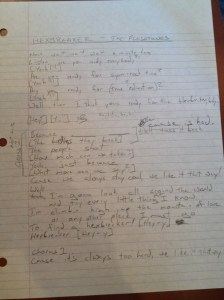
A transcript well done!
After I was able to get a gist of the overall narrative through transcription, I went back through the piece and was better able to make educated guesses about what the lyrics were. Although Zaremba often takes an unintelligible pitch when singing, the context of 17th century exploration helped me to piece together many of the tougher bits of the song. For instance, I revised the beginning of the chorus from “Well toss it back / [The bottles they break],” to fit the overall theme of colonial exploration, “The cause is had. / [The bodies they break].” Although, I’m not certain that these are the words to the song, I’m very confident because they match the overall theme. The practice of song-transcription has been fulfilling in the same way that figuring out a jigsaw, or tangram is exciting. It is a creative sort of problem solving, one that combines both analytic (left brain) and spatial, metaphoric (right brain) intelligence.
Emotionally, however, I did not feel the same satisfaction that I do when singing. Perhaps this has something to do with transcription alternate mode of embodiment. Transcription, and the pleasures associated – problem solving, precision, and permanence – are all of an analytical, and somewhat strategic sort. These are the pleasures of a conduit, processes associated more with the enduring construction of emotional bonds (belonging, and community), than the lucid enjoyment of them. It is my hope that one day another Fleshtones fan plumbs the depths of Google to find the lyrics of “Hexbreaker!” and that the fruit of my efforts, a completed transcript on lyrics.com, greets them and helps them to sing along and revel. Until then, it is enough to know that the work of transcription, for myself at least, is analytic and dry–definitely worlds apart from the euphoric mode of singing where my entire body vibrates in rhapsody to the melody, rhythm, and harmony of song.
—
Aaron Trammell is co-founder and multimedia editor of Sounding Out! He is also a Media Studies PhD candidate at Rutgers University.
Share this:


Current Top Posts





April 2021

January 2020

November 2019

October 2019

August 2019

April 2014

November 2017

March 2015

December 2017

October 2015
 Sounding Out!
Recent Comments