
Only the Sound Itself?: Early Radio, Education, and Archives of “No-Sound”
 Early cinema scholars are faced with statistics that suggest that possibly eighty percent of moving pictures produced in the first thirty years of their existence are lost—that is, they were thrown away because they were no longer profitable, or destroyed through fire or overuse. Likewise, radio historians researching early radio programming formats are confronted with a daunting inability to listen to many of the programs we write about. What does it mean to write about sound without being able to listen to the sounds firsthand? Where can radio scholars like myself track down sound in other places besides recorded media? Must we have to access “the sound itself” in order to be able to write about and understand it? While missing or incomplete sound archives in some ways narrow the depth and breadth of the historical inquiries possible, I find that these gaps of “no-sound” open up other possibilities for examining the material that does remain, in the form of station records, document archives, and programming notes.
For example, my research examines the discourse around the multifaceted campaigns for the classroom and living room educational use of (old) new media, specifically film in the 1910s, radio in the 1920s, and television in the 1950s. Often I find that the discourse around proposed and actual programs details their content quite specifically, including how these shows planned to address their audiences. But sometimes what I am looking for is a paper trail of sorts that will help me visually recreate the missing audio of these lost programs.
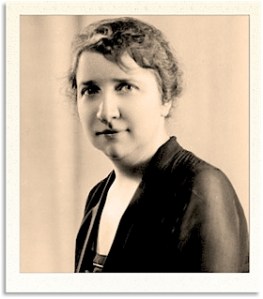
Judith Waller in the mid-1920s
In this regard, as I delved into the events around early radio and education, I became interested in Judith Waller, whose “accidental” radio success began in Chicago in 1922 as programming manager at WMAQ and continued as the Educational/Public Service Director for NBC’s Central division. At WMAQ in the 1920s, Waller helped craft a number of educational programs, including a joint venture between the Chicago Public Schools that successfully connected city-wide special exhibits and the Chicago Daily News into an audio/visual/experiential learning experience.
However, by the 1930s Waller had grown disillusioned with “educational radio.” In 1934 Waller gave an address titled “Achievements of Educational Radio,” where she spoke of her “pessimism” at what she felt was the lack of accomplishments and advancements in education by radio. She felt that most listeners were “frankly bored” by educational radio and that it only appealed to those who wanted to “appear to be very highbrow before their friends and associates.” One of her chief complaints was that many educational programs were “usually a dull and stupid reading of a prepared geography, history, or arithmetic lesson.” Besides further experimentation, she suggested a name change, from “educational” radio to “public service” broadcasting. This superficial remedy seemed like an ideal first step in reclaiming the types of programs that had elements worthy of larger audiences, but that had largely been ignored. This name change did little to suggest, however, any actual changes that might benefit the construction of educational programming.
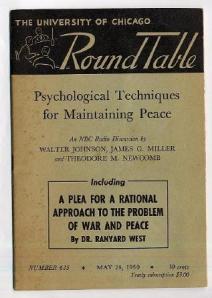 I use this example for the sheer fact that I would very much like to listen to these “dull” programs in order to examine what Waller perceived to be their fatal flaws. Now, some of the programs that Waller created and produced do still exist. The University of Chicago Round Table, for example, was a popular public service program Waller worked on for many years—which has an extensive archive of transcripts, although not recordings. In terms of other educational programming, some of the more prominent commercial network programs like the American School of the Air appear to have some availability. The programs I am interested in hearing, however, used the radio, a program guide, the newspaper, and local city events to weave an intricate educational lesson. Were programs like this, so seemingly well crafted and specifically engineered, really as “boring” as Waller lamented? Would it be clear to me, as a listener nearly a century removed, that there are clear issues or faults with their presentation of educational lessons? Or would Waller’s problems with these programs stem from more complex issues, involving her own personal ideals of what education by radio constituted and how it should be conceived?
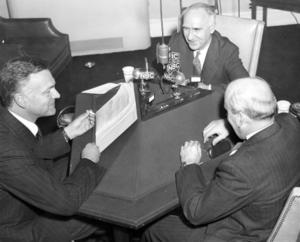
Robert M. Hutchins, Floyd Reeves, and John McCloy record The University of Chicago Roundtable, November 26, 1944
Regardless of the answerability of these questions, they are still worth thinking about in order to understand as much as possible about these missing programs in the context of their “no-sound” status. Not having these sounds to refer to forces us to pose different questions, while tougher to address, that force us to look beyond the audio text to understand what exactly about these programs produced their contemporary reactions. Reading what Waller wrote may supplant the need to hear these programs, but it does not necessarily replace our innate curiosity about them.
The discourse around these “no-sound” programs gives historians a particular reception, in this case, a critical perspective from one radio producer. However, Waller’s public disavowal of educational radio cannot speak to the private consumption of these programs, which may or may not have produced the same negative reaction. Really, then, the Waller example suggests two avenues of inquiry, both equally difficult—a full understanding of what these programs sounded like and contained, and how other listeners felt about them. At the very least, a record of these programs and a selected set of reactions lives on in the print media that avidly reported on and debated so many facets of radio programming.
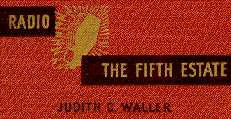
Waller's book, Radio: The Fifth Estate (1946)
—
Sate a little of your curiosity and hear Waller speak in this October 2000 re–broadcast of a 1948 interview she gave on the early days of WMAQ, from broadcaster/historian Chuck Shaden’s “Those Were the Days” radio program.
—
Amanda Keeler (Ph.D., Indiana University, 2011) is a Visiting Assistant Professor at Bucknell University. She teaches courses in film and media studies. Her current research focuses on historical emergent film, radio, and television; media history; media industries; and contemporary television.
Share this:

What Are You Listening to When youarelistening.to/losangeles ?
 Earlier last week I came across this post by GOOD regarding a new site called youarelisteningtolosangeles.com. Eric Eberhardt’s (http://twitter.com/url2la) web creation uses an LAPD radio feed and plays Creative Commons-licensed music in the background. (According to Olsen Bright at NBC Los Angeles, the URL was registered only last week, but since it went live it has gone viral. As of this post, it has links for New York, Chicago, San Francisco, and Montreal). The site that has gotten more news coverage has been, by far, the Los Angeles site. Nicola Twilley from GOOD calls it “hypnotic, beautiful, and utterly compelling.” When I first tuned in, I couldn’t stop listening. It is certainly haunting and leaves behind a feeling of uncanniness: the disembodied voices of police dispatchers far away mesh with the soothing sounds of ambiance music.
What caught my eye about the article was Twilley’s description of what it was like to listen to LAPD’s radiofeed:
“To listen to it is to be plugged into the pulse of the city; lost in fragments of someone else’s story. Urgency alternates with frustration and low-level routine; some incidents are reported while others are resolved; and jaywalking tickets are issued in the same breath as lives are lost.”
I like her idea that the site allows you to tune into “the pulse of the city.” The feed is a sonic representation of what is happening on LA’s streets. I had the feeling that I was listening to some subversive channel of LA life, narrated by a police dispatcher. However, there are two things that come to mind: a) the sounds of urban life are being filtered through the police department, and b) what are the sounds we hear on the feed telling us about the sonic dimensions of cities?
This online radio station of sorts mashes up city sounds with background music, but once you pause the music what we get are conversations between police officers. The result is that those sounds (voices, codes, numbers, addresses) filter the soundtrack of the city. When we click on youarelisteningtolos angeles.com we are actually listening to the keepers of peace and order on the city streets. The city has already been distilled for us through a radio dispatcher and officers.
The sounds are haunting. Interestingly, what attracts some listeners is the fact that they can eavesdrop on the police feeds, like we’re tuning into what our neighbors are doing. Others point out how soothing the sounds meshed with the dispatcher feed can be. However, the site serves as an example of how city sounds are filtered to us. We don’t hear the actual people who the dispatchers talk about, but the stories of their actions. In that sense, what we hear about them is really a narrative of order, chaos, authority, and traffic violations. Who is stepping outside of the lines?
But…can we ever really listen to The City? This is why audio projects such as soundwalks are important, because they make that aural experience multisonoral. The same way we must reject single stories (like Chimamanda Ngozi Adichie pointed out in her TED talk) we must also bring to light different soundtracks of the city around us, lest the radio feed of a police dispatcher become the one that stands out.
This brings me to my second concern: what are we actually listening to? What was initially problematic for me was that we don’t actually hear urban sounds. We hear voices talking about citizen activity on the streets. Once you mute the music, what you get are voices narrating what is happening on the street level. But then I realized that I was be limiting what sounds are classified as city sounds. In that sense, youarelistening.to is opening up what it means to listen to cities. The citizens also make sounds; their voices are part of the soundscape of the city.
I’d love to hear from our readers from these different cities, see what their reaction to listening to the transmission is.
By the way: can we get a youarelistening.to/kansascity?
Bonus tracks:
Here is Soul Coughing’s “Screenwriter’s Blues,” whose line “You are listening to Los Angeles” provided inspiration for the title. (via laist.com)


Share this:


Current Top Posts





April 2021

January 2020

November 2019

October 2019

August 2019

April 2014

November 2017

March 2015

December 2017

October 2015
 Sounding Out!

Recent Comments