
Teach Me How To Dougie Like A Mediocre White Man

In the third episode of Twin Peaks: The Return (2017), we meet Dougie Jones, a new character who is, as an otherworldly being will tell him, “manufactured.” Dougie’s sonic presence on the show is primarily marked by repetition, as the majority of his dialogue involves him parroting those around him. Though Dougie has been received as a symbol of purity or a magical conduit for others’ best selves (14:53-19:00), a close listen to his repetitions suggests that he is instead what Sarah Hagi has dubbed the “mediocre white man.”
DAILY PRAYER TO COMBAT IMPOSTOR SYNDROME: God give me the confidence of a mediocre white dude
— Sarah Hagi (@geekylonglegs) January 21, 2015
Hagi’s so-called prayer is a brilliantly concise instance of intersectional analysis that can also provide a framework for understanding Dougie Jones. In a few short words, she’s able to 1) demonstrate how white supremacist patriarchy makes her life more difficult, 2) call into question the achievements of those who hold so much power that it’s doled out to the most mediocre among them, and 3) situate the entire critique in a systemic framework. That is, though one possible reading of this tweet is that Hagi suffers from a shortcoming she is responsible to correct–a lack of confidence–the fact that she frames her critique as a prayer suggests that this confidence isn’t so much an inner belief in oneself as it is a privilege granted to some but not others. Twin Peaks: The Return offers, in the vocal interactions of Dougie, an extended meditation on the systemic mechanizations that produce the kind of mediocre white man Hagi laments.
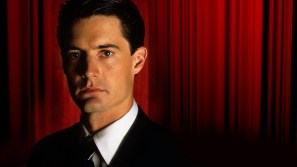
“Twin Peaks Returns to Television in 2016” by Flickr user BagoGames, CC BY 2.0.
For readers who aren’t Twin Peaks viewers, hang on: explaining the origin of Dougie Jones requires a few sentences that may read as something bordering on nonsense outside the show’s bizarre universe. Dougie is played by Kyle MacLachlan, who also plays the show’s main character, Agent Dale Cooper, as well as The Return’s Mr C, Cooper’s evil doppelganger who overcame Cooper in an extradimensional realm in the Season 2 finale and who has been living in the “real world” ever since, while Cooper is stuck in another dimension. The show implies that Mr C has only 25 years–roughly the amount of time since the show’s first run in the early 90s–before Cooper switches places with him (extradimensional bureaucracies, amiright?). As a ploy to stay in the real world, Mr C “manufactures” Dougie Jones so that when Cooper is finally released from extradimensional detention, he replaces Dougie, not Mr C. For the bulk of The Return, Mr C continues wreaking havoc across the Midwest and Western US, while Cooper, adversely affected by his transit across dimensions, is trapped in Dougie’s life, barely able to function beyond the level of a small child. Technically, then, the character called Dougie Jones is really Dale Cooper, but Cooper’s episodes-long inability to regain control of himself leads to an extended case of mistaken identity, where everyone in Dougie’s life believes Cooper to be Dougie.
Significantly, Dougie’s family and co-workers are barely phased by his ineptitude. At worst, like when he doesn’t know how to use the bathroom, people are annoyed by Dougie. But, more often than not, Dougie’s moments of silence and often erratic behavior — including befuddlement over how to feed or dress himself — are interpreted as quirky, humble, and endearing. More than that, Dougie’s boss believes him to be a courageous and principled whistle-blower whose cryptic drawings on insurance forms outs one of his co-workers for defrauding the company’s clients.
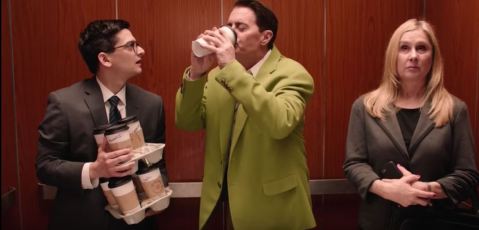
Screenshot of Twin Peaks: The Return
Dougie is beyond mediocre, yet over the course of the season, he falls into hundreds of thousands of dollars, a luxury car, a family life that seems to be fulfilling for his wife and son, and the respect and gratitude of his boss. Confidence isn’t something this mediocre white man possesses; rather, it’s a trait projected onto him by everyone around him. In riffing on the way people exist in systems of inequity, Sylvia Wynter notes in On Being Human As Praxis (2015) that we end up keeping “the reality of our own agency opaque by attributing that agency to extrahumanly mandating entities” (45). Put another way, the god who would grant us the confidence of a mediocre white man isn’t a deity but a system of patriarchal white supremacy that makes itself opaque behind the rationale that a person like, say, Dougie Jones couldn’t possibly be as successful in his life if he hadn’t earned it.
The primary marker of the mechanization of Dougie’s confidence is a sonic one: we can hear his ascendence in moments of repetition. Twin Peaks is a show comprised of overlapping aural and visual loops, recurring sounds, and doubled and tripled characters, so keying in on the sound of Dougie’s repetition fits into the series’ aesthetic. Early in Dougie’s presence in the series, when Cooper is fresh from the other dimension, his repetition is delayed, partial, and generally out of synch with regular patterns of conversation; people react to this repetition with concern. The following scene occurs in the moments just after Cooper has replaced Dougie Jones; his scene partner, Jade, was in the shower when the switch happened.
This clip is cut so that the phrase “Jade give two rides” happens back-to-back, but in the episode, there’s over a minute of a screen time between Jade saying (a grammatically correct version of) it and Dougie repeating it. Dougie’s imprecise and ill-timed repetition suggests to Jade that something may be wrong with him, and she rightly advises him to find some help. A similar interaction occurs in Episode 6, which opens with Dougie standing outside his work at night, unaware of what people do when work is over. When a police officer tries to shoo him away, Dougie is able to repeat back information he had heard several days earlier, and his delayed reaction again elicits concern from the person he’s with. A few scenes later, “Jade gives two rides” returns.
As the season progresses, however, Dougie begins to repeat back exact phrases or words that have just been spoken to him. The effect is one of understated agreement or even prescience, as if he’s repeating something he’s known for some time and has been waiting for others to realize, too. Note the way Dougie responds in the following two videos. In the first, he’s asked a question, which rises in pitch in the final syllables, and Dougie repeats the phrase with a falling pitch figure, which his conversants interpret to be confirmation. In the second, he’s given advice, and he responds by repeating the last word in uptalk, which his conversants interpret as a hilarious joke rather than the limitations of a person whose interdimensional travel has left his verbal skills lacking.
As Dougie’s repetition locks into a quicker, more immediate responsorial pattern, the people around him no longer worry about his well-being and, in fact, begin to project onto him a confidence he’s incapable of possessing. This repetition, the kind that immediately plays with or confirms what his boss or potential murderers say, suggests a couple different theoretical constructions of repetition. Butler, in describing the performativity of gender, notes that gender norms are “the stylized acts of repetition through time,” the rehearsed and rehashed ideas that we ascribe, in this case, to white men: well-timed humor on the one hand, and wise confirmation on the other (520). Sara Ahmed underscores a similar idea, noting that “compulsory heterosexuality” is “the accumulative effect of the repetition of the narrative of heterosexuality as an ideal coupling” (145). Here, Dougie’s white masculinity isn’t all that makes him the target of others’ projections of confidence and competence; his nuclear family also marks him as a productively repetitive person, a person capable of reproduction. To modify Hagi’s tweet a bit, the world projects onto Dougie the confidence of a mediocre, white, reproductive man.
Both Butler and Ahmed also gesture toward distinctly sonic phenomena present in Dougie’s repetitions. Repetition accumulating over time becomes not just distinct events happening in succession but a discrete, singular thing unto itself. When thinking in terms of systemic oppression like white supremacy or cisheteropatriarchy, the repetitive privileging of white masculinity congeals into a continuous power flow. In musical terms, we hear the accumulative, rapid retriggering of a sound as pitch rather than many distinct events. Timing matters here: if the repetition is delayed or metered just so, we can perceive instances of the same events as moving in concert either melodically or harmonically. The shift in Dougie’s repetitions over the course of The Return is the sound of institutional privilege tuning white masculinity, retriggering moments of repetition–which sounds like a rise in pitch as the repetitions move closer together, a literal ascent–until those around Dougie stop worrying about him and start believing that this mediocre white straight man must have earned the success he seemingly enjoys.
Though a perusal of Twin Peaks: The Return analyses and recaps demonstrates that viewers and critics have been far more interested in the archetypal Jekyll/Hyde duality of Dale Cooper and Mr C than they have been in the nature of Dougie Jones, Dougie’s relative lack of drive or desire offers the opportunity to hear how white male mediocrity is made. The Return checks in on Dougie regularly from his introduction in the third episode until he transforms back into Cooper, then is remanufactured and sent home to his family in the sixteenth and eighteenth episodes. What we’re privy to in that time is a different kind of manufacturing, where Dougie is constructed by his surroundings to be wise, caring, attentive, upright, and brave, though we know he’s none of those things. The slow burn of Twin Peaks: The Return means that we’re stripped of any easy excuses for Dougie’s upward momentum in the season beyond the obvious explanation that the gods of mediocre white men have gifted him with treasures out of reach for others. Dougie repeats what he hears, and what he hears is that his mediocrity is good enough.
—
Featured image: Screenshot from “‘Dougie’ Cooper – All Phrases (Twin Peaks Compilation)” by Youtube user AKA.
—
Justin Adams Burton is Assistant Professor of Music at Rider University. His research revolves around critical race and gender theory in hip hop and pop, and his book, Posthuman Rap, is available now. He is also co-editing the forthcoming (2018) Oxford Handbook of Hip Hop Music Studies. You can catch him at justindburton.com and on Twitter @j_adams_burton. His favorite rapper is one or two of the Fat Boys.
—

REWIND! . . .If you liked this post, you may also dig:
DIANE… The Personal Voice Recorder in Twin Peaks-Tom McEnaney
Malcolm Gladwell’s Bad Aesthetics–Justin Burton
Listening to Sounds in Post-Feminist Pop Music-Robin James
Share this:

You Got Me Feelin’ Emotions: Singing Like Mariah

Mariah Carey’s New Year’s Eve 2016 didn’t go so well. The pop diva graced a stage in the middle of Times Square as the clock ticked down to 2017 on Dick Clark’s Rockin New Year’s Eve, hosted by Ryan Seacrest. After Carey’s melismatic rendition of “Auld Lang Syne,” the instrumental for “Emotions” kicked in and Carey, instead of singing, informed viewers that she couldn’t hear anything. What followed was five minutes of heartburn. Carey strutted across the stage, hitting all her marks along with her dancers but barely singing. She took a stab at a phrase here and there, mostly on pitch, unable to be sure. And she narrated the whole thing, clearly perturbed to be hung out to dry on such a cold night with millions watching. I imagine if we asked Carey about her producer after the show, we’d get a “I don’t know her.”
These things happen. Ashlee Simpson’s singing career, such as it was, screeched to a halt in 2004 on the stage of Saturday Night Live when the wrong backing track cued. Even Queen Bey herself had to deal with lip syncing outrage after using a backing track at former President Barack Obama’s second inauguration. So the reaction to Carey, replete with schadenfreude and metaphorical pearl-clutching, was unsurprising, if also entirely inane. (The New York Times suggested that Carey forgot the lyrics to “Emotions,” an occurrence that would be slightly more outlandish than if she forgot how to breathe, considering it’s one of her most popular tracks). But yeah, this happens: singers—especially singers in the cold—use backing tracks. I’m not filming a “leave Mariah alone!!” video, but there’s really nothing salacious in this performance. The reason I’m circling around Mariah Carey’s frosty New Year’s Eve performance is because it highlights an idea I’m thinking about—what I’m calling the “produced voice” —as well as some of the details that are a subset of that idea; namely, all voices are produced.
I mean “produced” in a couple of ways. One is the Judith Butler way: voices, like gender (and, importantly, in tandem with gender), are performed and constructed. What does my natural voice sound like? I dunno. AO Roberts underlines this in a 2015 Sounding Out! post: “we’ll never really know how we sound,” but we’ll know that social constructions of gender helped shape that sound. Race, too. And class. Cultural norms make physical impacts on us, perhaps in the particular curve of our spines as we learn to show raced or gendered deference or dominance, perhaps in the texture of our hands as we perform classed labor, or perhaps in the stress we apply to our vocal cords as we learn to sound in appropriately gendered frequency ranges or at appropriately raced volumes. That cultural norms literally shape our bodies is an important assumption that informs my approach to the “produced voice.” In this sense, the passive construction of my statement “all voices are produced” matters; we may play an active role in vibrating our vocal cords, but there are social and cultural forces that we don’t control acting on the sounds from those vocal cords at the same moment.
Another way I mean that all voices are produced is that all recorded singing voices are shaped by studio production. This can take a few different forms, ranging from obvious to subtle. In the Migos song “T-Shirt,” Quavo’s voice is run through pitch-correction software so that the last word of each line of his verse (ie, the rhyming words: “five,” “five,” “eyes,” “alive”) takes on an obvious robotic quality colloquially known as the AutoTune effect. Quavo (and T-Pain and Kanye and Future and all the other rappers and crooners who have employed this effect over the years) isn’t trying to hide the production of his voice; it’s a behind-the-glass technique, but that glass is transparent. Less obvious is the way a voice like Adele’s is processed. Because Adele’s entire persona is built around the natural power of her voice, any studio production applied to it—like, say, the cavernous reverb and delay on “Hello” —must land in a sweet spot that enhances the perceived naturalness of her voice.
Vocal production can also hinge on how other instruments in a mix are processed. Take Remy Ma’s recent diss of Nicki Minaj, “ShETHER.” “ShETHER”’s instrumental, which is a re-performance of Nas’s “Ether,” draws attention to the lower end of Remy’s voice. “Ether” and “ShETHER” are pitched in identical keys and Nas’s vocals fall in the same range as Remy’s. But the synth that bangs out the looping chord progression in “ShETHER” is slightly brighter than the one on “Ether,” with a metallic, digital high end the original lacks. At the same time, the bass that marks the downbeat of each measure is quieter in “ShETHER” than it is in “Ether.” The overall effect, with less instrumental occupying “ShETHER”’s low frequency range and more digital overtones hanging in the high frequency range, causes Remy Ma’s voice to seem lower, manlier, than Nas’s voice because of the space cleared for her vocals in the mix. The perceived depth of Remy’s produced voice toys with the hypermasculine nature of hip hop beefs, and queers perhaps the most famous diss track in the genre. While engineers apply production effects directly to the vocal tracks of Quavo and Adele to make them sound like a robot or a power diva, the Remy Ma example demonstrates how gender play can be produced through a voice by processing what happens around the vocals.
Let’s return to Times Square last New Year’s Eve to consider the produced voice in a hybrid live/recorded setting. Carey’s first and third songs “Auld Lang Syne” and “We Belong Together”) were entirely back-tracked—meaning the audience could hear a recorded Mariah Carey even if the Mariah Carey moving around on our screen wasn’t producing any (sung) vocals. The second, “Emotions,” had only some background vocals and the ridiculously high notes that young Mariah Carey was known for. So, had the show gone to plan, the audience would’ve heard on-stage Mariah Carey singing along with pre-recorded studio Mariah Carey on the first and third songs, while on-stage Mariah Carey would’ve sung the second song entirely, only passing the mic to a much younger studio version of herself when she needed to hit some notes that her body can’t always, well, produce anymore. And had the show gone to plan, most members of the audience wouldn’t have known the difference between on-stage and pre-recorded Mariah Carey. It would’ve been a seamless production. Since nothing really went to plan (unless, you know, you’re into some level of conspiracy theory that involves self-sabotage for the purpose of trending on Twitter for a while), we were all privy to a component of vocal production—the backing track that aids a live singer—that is often meant to go undetected.

The produced-ness of Mariah Carey’s voice is compelling precisely because of her tremendous singing talent, and this is where we circle back around to Butler. If I were to start in a different place–if I were, in fact, to write something like, “Y’all, you’ll never believe this, but Britney Spears’s singing voice is the result of a good deal of studio intervention”–well, we wouldn’t be dealing with many blown minds from that one, would we? Spears’s career isn’t built around vocal prowess, and she often explores robotic effects that, as with Quavo and other rappers, make the technological intervention on her voice easy to hear. But Mariah Carey belongs to a class of singers—along with Adele, Christina Aguilera, Beyoncé, Ariana Grande—who are perceived to have naturally impressive voices, voices that aren’t produced so much as just sung. The Butler comparison would be to a person who seems to fit quite naturally into a gender category, the constructed nature of that gender performance passing nearly undetected. By focusing on Mariah Carey, I want to highlight that even the most impressive sung voices are produced, and that means that we can not only ask questions about the social and cultural impact of gender, race, class, ability, sexuality, and other norms may have on those voices, but also how any sung voice (from Mariah Carey’s to Quavo’s) is collaboratively produced—by singer, technician, producer, listener—in relation to those same norms.
Being able to ask those questions can get us to some pretty intriguing details. At the end of the third song, “We Belong Together,” she commented “It just don’t get any better” before abandoning the giant white feathers that were framing her onstage. After an awkward pause (during which I imagine Chris Tucker’s “Don’t cut to me!” face), the unflappable Ryan Seacrest noted, “No matter what Mariah does, the crowd absolutely loves it. You can’t go wrong with Ms. Carey, and those hits, those songs, everybody knows.” Everybody knows. We didn’t need to hear Mariah Carey sing “Emotions” that night because we could fill it all in–everybody knows that song. Wayne Marshall has written about listeners’ ability to fill in the low frequencies of songs even when we’re listening on lousy systems—like earbuds or cell phone speakers—that can’t really carry it to our ears. In the moment of technological failure, whether because a listener’s speakers are terrible or a performer’s monitors are, listeners become performers. We heard what was supposed to be there, and we supplied the missing content.

Sound is intimate, a meeting of bodies vibrating in time with one another. Yvon Bonenfant, citing Stephen Connor’s idea of the “vocalic body,” notes this physicality of sound as a “vibratory field” that leaves a vocalizer and “voyages through space. Other people hear it. Other people feel it.” But in the case of “Emotions” on New Year’s Eve, I heard a voice that wasn’t there. It was Mariah Carey’s, her vocalic body sympathetically vibrated into being. The question that catches me here is this: what happens in these moments when a listener takes over as performer? In my case, I played the role of Mariah Carey for a moment. I was on my couch, surrounded by my family, but I felt a little colder, like I was maybe wearing a swimsuit in the middle of Times Square in December, and my heart rate ticked up a bit, like maybe I was kinda panicked about something going wrong, and I heard Mariah Carey’s voice—not, crucially, my voice singing Mariah Carey’s lyrics—singing in my head. I could feel my vocal cords compressing and stretching along with Carey’s voice in my head, as if her voice were coming from my body. Which, in fact it was—just not my throat—as this was a collaborative and intimate production, my body saying, “Hey, Mariah, I got this,” and performing “Emotions” when her body wasn’t.
By stressing the collaborative nature of the produced voice, I don’t intend to arrive at some “I am Mariah” moment that I could poignantly underline by changing my profile picture on Facebook. Rather, I’m thinking of ways someone else’s voice is could lodge itself in other bodies, turning listeners into collaborators too. The produced voice, ultimately, is a way to theorize unlikely combinations of voices and bodies.
—
Featured image: By all-systems-go at Flickr, CC BY-SA 2.0, via Wikimedia Commons
—
Justin Adams Burton is Assistant Professor of Music at Rider University, and a regular writer at Sounding Out! You can catch him at justindburton.com.
—

REWIND! . . .If you liked this post, you may also dig:
Gendered Sonic Violence, from the Waiting Room to the Locker Room-Rebecca Lentjes
I Can’t Hear You Now, I’m Too Busy Listening: Social Conventions and Isolated Listening–Osvaldo Oyola
One Nation Under a Groove?: Music, Sonic Borders, and the Politics of Vibration-Marcus Boon
Share this:




Current Top Posts





April 2021

January 2020

November 2019

October 2019

August 2019

April 2014

November 2017

March 2015

December 2017

October 2015


Recent Comments