
“Caught a Vibe”: TikTok and The Sonic Germ of Viral Success

“When I wake up, I can’t even stay up/I slept through the day, fuck/I’m not getting younger,” laments Willow Smith of The Anxiety on “Meet Me at Our Spot,” a track released through MSFTSMusic and Roc Nation in March of 2020. Despite the song’s nature as a “sludgy alternative track with emo undertones that hits at the zeitgeist,” “Meet Me at Our Spot” received very little attention after its initial release and did not chart until the summer of 2021, when it went viral on TikTok as part of a dance trend. The short-form video app which exploded in popularity during the COVID-19 pandemic, catalyzed the track’s latent rise to success where it reached no. 21 on the US Billboard Hot 100, becoming Willow’s highest charting song since her 2010 hit, “Whip My Hair”.
The app currently known as TikTok began as Musical.ly, which was shuttered in 2017 and then rebranded in 2018. By March of 2021, the app boasted one billion worldwide monthly users, indicative of a growth rate of about 180%. This explosion was in many ways catalyzed by successive lockdowns during the first waves of the COVID-19 pandemic. Despite the relaxation and subsequent abandonment of COVID mitigation measures, the app has retained a large volume of its users, remaining one of the highest grossing apps in the iOS environment. TikTok’s viral success (both as noun and adjective) has worked to create a kind of vibe economy in which artists are now subject to producing a particular type of sound in order to be rendered legible to the pop charts.
For anyone who has yet to succumb to the TikTok trap, allow me to offer you a brief summary of how it functions. Upon opening it, you are instantly fed content. Devoid of any obvious internal operating logic, it is the media equivalent of drinking from a fire hose. Immersive and fast-paced, users vertically scroll through videos that take up their entire screen. Within five minutes of swiping, you can–if your algorithm is anything like mine–see: cute pet videos, protests against police brutality, HypeHouse dance trends, thirst traps, contemporary music, therapy tips, attractive men chopping wood, attractive women lifting weights, and anything else you can fathom. Since its shift from Musical.ly, the app has also been a staging ground for popular music hits such as Lil Nas X’s’ “Old Town Road”, Lizzo’s “Good As Hell”, and, recently, Harry Styles’ “As It Was.”
The app, which is the perfect–if chaotic–fusion of both radio and video is enmeshed in a wider media ecosystem where social networking and platform capitalism converge, and as a result, it seems that TikTok is changing the music industry in at least three distinct ways:
First, it affects our music consumption habits. After hearing a snippet of a song used for a TikTok, users are more likely to queue it up on their streaming platform of choice for another, more complete listen. Unlike those platforms, where algorithms work to feed a listener more of what they’ve already heard, TikTok feeds a listener new content. As a result, there’s no definitive likelihood that you’ve previously heard the track being used as a sound. Therefore, TikTok works the way that Spotify used to: as a mechanism for discovery.
Second, TikTok is changing the nature of the single. Rather than relying upon a label as the engine behind a song’s success, TikTok disseminates tracks–or sounds as they’re referred to in the app–widely, determining a song’s success or role as a debut within a series of clicks. Particularly during the pandemic, when musicians were unable to tour, TikTok’s relationship to the industry became even more salient. Artists sought new ways to share and promote their music, taking to TikTok to release singles, livestream concerts, and engage with fans. Moreover, Spotify’s increasingly capacious playlist archive began to boast a variety of tracklists with titles such as, “Best TikTok Songs 2019-2022”, “TikTok Songs You Can’t Get Out Of Your Head”, and “TikTok Songs that Are Actually Good” among others. The creation and maintenance of this feedback loop between TikTok and Spotify demonstrates not only the centrality of social media ecosystems as driving current popular music success, but also the way that these technologies work in harmony to promote, sustain, or suppress interest in a particular tune.
Most notoriously, the bridge of Olivia Rodrigo’s “drivers license”, went viral as a sound on TikTok in January 2021 and subsequently almost broke the internet. Critics have praised this 24-second section as the highlight of the song, underscoring Rodrigo’s pleading soprano vocals layered over moody, syncopated digital drums. Shortly after it was released, the song shattered Spotify’s record for single-day streams for a non-holiday song. New York Times writer Joe Coscarelli notes of Rodrigo’s success, “TikTok videos led to social media posts, which led to streams, which led to news articles , and back around again, generating an unbeatable feedback loop.”
And third, where songwriting was once oriented towards the creation of a narrative, TikTok’s influence has led artists to a songwriting practice that centers on producing a mood. For The New Yorker, Kyle Chayka argues that vibes are “a rebuke to the truism that people want narratives,” suggesting that the era of the vibe indicates a shift in online culture. He argues that what brings people online is the search for “moments of audiovisual eloquence,” not narrative. Thus, on the one hand, media have become more immersive in order to take us out of our daily preoccupations. On the other, media have taken on a distinct shape so that they can be engaged while doing something else. In other words, media have adapted to an environment wherein the dominant mode of consumption is keyed toward distraction via atmosphere.

Despite their relatively recent resurgence in contemporary discourse, vibes have a rich conceptual history in the United States. Once a shorthand for “vibration” endemic to West Coast hippie vernacular, “vibes” have now come to mean almost anything. In his work on machine learning and the novel form, Peli Grietzer theorizes the vibe by drawing on musician Ezra Koenig’s early aughts blog, “Internet Vibes.” Koenig writes, “A vibe turns out to be something like “local colour,” with a historical dimension. What gives a vibe “authenticity” is its ability to evoke–using a small number of disparate elements–a certain time, place, and milieu, a certain nexus of historic, geographic, and cultural forces.” In his work for Real Life, software engineer Ludwig Yeetgenstein defines the vibe as “something that’s difficult to pin down precisely in words but that’s evoked by a loose collection of ideas, concepts, and things that can be identified by intuition rather than logic.” Where Mitch Thereiau argues that the vibe might just merely be a vocabulary tick of the present moment, Robin James suggests that vibes are not only here to stay, but have in fact been known by many other names before. Black diasporic cultures, in particular, have long believed sound and its “vibrations had the power to produce new possibilities of social attunement and new modes of living,” as Gayle Wald’s “Soul Vibrations: Black Music and Black Freedom in Sound and Space,” attests (674). We might then consider TikTok a key method of dissemination for a maximalist, digital variant of something like Martin Heidegger’s concept of mood (stimmung), or Karen Tongson’s “remote intimacy.” The vibe is both indeterminate and multiple, a status to be achieved and the mood that produces it; vibes seek to promote and diffuse feelings through time and space.
Much current discourse around vibes insists that they interfere with, or even discourage academic interpretation. While some people are able to experience and identify the vibe—perform a vibe check, if you will—vibes defy traditional forms of academic analysis. As Vanessa Valdés points out, “In a post-Enlightenment world that places emphasis on logic and reason, there exists a demand that everything be explained, be made legible.” That the vibe works with a certain degree of strategic nebulousness might in fact be one of its greatest assets.

Vibes resist tidy classification and can thus be named across a variety of circumstances and conditions. Although we might think of the action of ‘vibing’ as embodied, and the term vibration quite literally refers to the physical properties of sound waves and their travel through various mediums, the vibe through which those actions are produced does not itself have to be material. Sometimes, they name a genre of feeling or energy: cursed vibes or cottagecore vibes. Sometimes, they function as a statement of identification: I vibe with that, or in the case of 2 Chainz’s 2016 hit, “it’s a vibe.” Sometimes, vibes are exchanged: you can give one, you can catch one, you can check one, So, while things like energy and mood—which are often taken as cognates for vibes—work to imagine, name, and evoke emotions, vibes are instead invitations.
Not only do vibes serve as a prompt for an attempt at articulating experience, they are also invitations to co-presently experience what seems inarticulable. By capturing patterns in media and culture in order to produce a coherent image/sound assemblage, the production of a vibe is predicated upon the ability to draw upon large swathes of visual, aural, and environmental data. Take for example, the story of Nathan Apodaca, known by his TikTok handle as: 420doggface208. After posting a video of himself listening to Fleetwood Mac’s “Dreams” while drinking cranberry juice and riding a longboard, Apodaca went viral, amassing something like 30 million views in mere hours. This subsequently sparked a trend in which TikTok users posted videos of themselves doing the same thing, using “Dreams” as the sound. According to Billboard, this sparked the largest ever streaming week for Fleetwood Mac’s 1977 hit with over 8.47 million streams. Of his overnight success, Apodaca says, “it’s just a video that everyone felt a vibe with.” To invoke a vibe is thus to make a particular atmosphere more comprehensible to someone else, producing a resonant effect that draws people together.
As both an extension and tool of culture, vibes are produced by and imbricated within broader social, political, and economic matrices. Recorded music has always been confined—for better and worse—to the technologies, formats, and mediums through which it has been produced for commercial sale. On a platform like TikTok, wherein the emphasis is on potentially quirky microsections of songs, artists are invited to key their work towards those parameters in order to maximize commercial success. Nowadays, pop songs are produced with an eye towards their ability to go viral, be remixed, re-released with a feature verse, meme’d, or included in a mashup. As such, when an artist ‘blows up’ on TikTok, it does not necessarily mean that the sound of the song is good (whatever that might mean). Rather, it might instead be the case that a hybrid assemblage of sound, performance, narrative, and image has coalesced successfully into an atmosphere or texture – that we recognize as a/the vibe – something that not only resonates but also sells well. As TikTok’s success continues to proliferate, the app is continually being developed in ways that make it an indispensable part of the popular music industry’s ecosystem. Whether by exposing users to new musical content through the circulation of sounds, or capitalizing upon the speed at which the app moves to brand a song a ‘single’ before it’s even released, TikTok leverages the vibe to get users to listen differently.
@jimmyfallon This one’s for you @420doggface208 #cranberrydreams#doggface208#dogfacechallenge♬ original sound – Jimmy Fallon

We might indeed consider vibes to be conceptual, affective algorithms created in the interstice between lived experience and new media. “Meet Me At Our Spot,” the track through which I’ve framed this article, is full of allusions to youth culture: drunk texts, anxiety over aging, and late-night drives on the 405. It is buoyed by a propulsive bass line that thumps with a restless energy and evokes a mood of escapism. Willow Smith’s intriguing timbre and the pleasing harmonies she achieves with Tyler Cole invite listeners to ride shotgun. For the two minutes and twenty-two seconds of the song, we are immersed within their world. In the final measures the pop of the snare recedes into the background and Tyler’s voice fades away. The vibe of the track – both sonically and thematically – is predicated on the experience of a few, fleeting moments. Willow leaves us with a final provocation, one that resonates with popular music’s current mode: “Caught a vibe, baby are you coming for the ride?”
—
Featured Image: Screencap of Nathan Apodaca’s viral TikTok post, courtesy of SO! eds.
—
Jay Jolles is a PhD candidate in American Studies at the College of William and Mary currently at work on a dissertation tentatively titled “Man, Music, and Machine: Audio Culture in a/the Digital Age.” He is an interdisciplinary scholar with interests in a wide range of fields including 20th and 21st century literature and culture, critical theory, comparative media studies, and musicology. Jay’s scholarly work has appeared in or is forthcoming from The Los Angeles Review of Books, U.S. Studies Online, and Comparative American Studies. His essays can be found in Per Contra, The Atticus Review, and Pidgeonholes, among others. Prior to his time at William and Mary, he was an adjunct professor of English at Drexel University and Rutgers University-Camden.
—

REWIND! . . .If you liked this post, you may also dig:
Listen to yourself!: Spotify, Ancestry DNA, and the Fortunes of Race Science in the Twenty-First Century”–Alexander W. Cohen
Evoking the Object: Physicality in the Digital Age of Music–-Primus Luta
“Music is not Bread: A Comment on the Economics of Podcasting”-Andreas Duus Pape
“Pushing Record: Labors of Love, and the iTunes Playlist”–Aaron Trammell
Critical bandwidths: hearing #metoo and the construction of a listening public on the web–Milena Droumeva
TiK ToK: Post-Crash Party Pop, Compulsory Presentism and the 2008 Financial Collapse—Dan DiPiero (The other “TikTok”! The people need to know!)
Share this:

‘A Clateryng of Knokkes’: Multimodality and Performativity in “The Blacksmith’s Lament”

 Each of the essays in this month’s “Medieval Sound” forum focuses on sound as it, according to Steve Goodman’s essay “The Ontology of Vibrational Force,” in The Sound Studies Reader, “comes to the rescue of thought rather than the inverse, forcing it to vibrate, loosening up its organized or petrified body (70). These investigations into medieval sound lend themselves to a variety of presentation methods loosening up the “petrified body” of academic presentation. Each essay challenges concepts of how to hear the Middle Ages and how the sounds of the Middle Ages continue to echo in our own soundscapes.
The posts in this series begins an ongoing conversation about medieval sound in Sounding Out!. Our opening gambit in April 2016, “Multimodality and Lyric Sound,” reframes how we consider the lyric from England to Spain, from the twelfth through the sixteenth centuries, pushing ideas of openness, flexibility, and productive creativity. We will post several follow-ups throughout the rest of 2016 focusing on “Remediating Medieval Sound.” And, HEAR YE!, in April 2017, look for a second series on Aural Ecologies of noise! –Guest Editors Dorothy Kim and Christopher Roman
–
The “Blacksmith’s Lament” is late medieval alliterative poem that rails against the disruptive, urban sounds of blacksmiths working late into the night. Catalogued by Rossell Hope Robbins in his 1955 Secular Lyrics of the XIV and XV Centuries, and now broadly anthologized, the poem is a 15th century addendum to a largely 13th century Norwich cathedral priory manuscript, now BL Arundel 292. The manuscript is comprised of Latin, French, Anglo-Norman and Middle English texts, and contains bestiaries, prayers, sermons, romances, prophecies, riddles and alliterative poems. As such, Arundel 292 might be categorized as a miscellany, what Ralph Hanna argues in “Miscellenaity and Vernacularity: Conditions of Literary Production in Late Medieval England,” is a kind of bespoke production that “represent[s] defiantly individual impulses—appropriations of works for the use of particular persons in particular situations” (37). Because each text included in a miscellany reflects one person’s desire to inscribe and compile, there are no “customary generic markers;” instead one finds a rich admixture of hands, images, texts, styles, forms, languages, and histories (Hanna 37). I argue that the inclusion of “Blacksmiths” in this miscellany is congruent with the poem’s own odd relationship to sound. In its multimodal blending of the onomatopoetic and the lyric as well as its consideration of manual labor, the “Blacksmith’s Lament” can be understood as an instantiation of specifically masculine medieval identity.
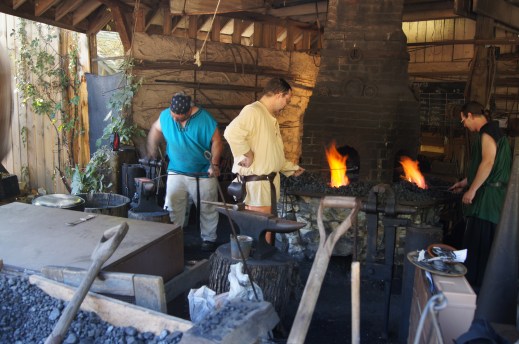
Modern medieval masculinity. Image by David Williss @Flickr CC BY.
Multimodality, Presentism and the Medieval Miscellany
The theoretical concept of multimodality is rooted in late 20th-century critique of semiotic systems. As the New London Group argued in “A Pedagogy of Multiliteracies: Designing Social Futures,” “effective citizenship and productive work” in the late 20th and early 21st centuries “now require that we interact effectively using multiple languages, multiple Englishes, and communication patterns that more frequently cross cultural, community and national boundaries” and that we the best way to do so is via methods that accommodate more than mere text (62-64). This engagement with the multiple modes of text, image, and video, among others, makes multimodality an ideal critical tool with which to analyze complex, hybrid compositions.
However, many theories of multimodality privilege a historical lens primarily afforded by 20th and 21st century literacy, dependent as it is on reading and looking (at screens or pages) as opposed to listening (to human voices). Indeed, Jeff Bezemer and Gunther Kress have observed in “Writing Multimodal Texts: A Social Semiotic Account of Designs for Learning” that because images predominate in 21st-century culture, textual “writing is now no longer the central mode of representation in learning materials” (166). In short, writing and images work in tandem to educate. Yet even though they note the different modes of text and image, Bezemer and Kress do not interrogate the fact that both depend on a single sensory ability: sight. Whether or not images have supplanted printed text in pedagogical documents, this assumption of the centrality of visuality as the singular mode of representation—in learning materials and elsewhere—is itself an historical phenomenon—as Walter Ong discusses in Orality and Literacy: The Technologizing of the Word—one dependent on the technology and dominance of print itself.
People do not depend only on seeing and reading text. They might also participate actively in “listening communities,” wherein one visually literate person reads aloud a text to a group who listens, ruminates over, and perhaps memorizes that text. Medieval “reading” is in fact an aural practice of recitation, memorization and listening as well as textual examination, a hybrid practice dating to the beginning of the medieval. Evidence of this hybrid practice can be found in the opening folio of Corpus Christi MS 61, which features Chaucer reciting Troilus and Criseyde to a royal audience. Studded with images and illuminations, musical notation and marginalia, medieval manuscripts often offer a complex multimodal relationship between graphics and written text, color and music, the visual and the aural.
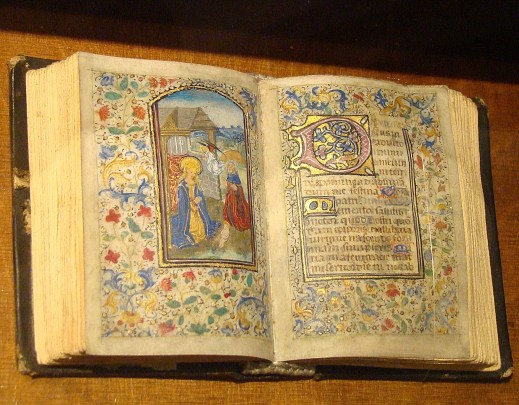
An example of an illuminated manuscript. Image by Richard White @Flickr CC BY-NC-ND.
Long before print or digital media, “reading” manuscripts required a sophisticated multimodal form of interpretation. Arundel 292 is minimally illuminated, but it too must be understood as a flexible, multimodal form composed for a mouth reading aloud the words on the folio page as well as a group of listeners receiving those words. It offers a heterogeneity that mixes languages, genres, images, hands and modes. Indeed, there is little about this miscellaneous manuscript that might be categorized as using exclusively what Kress defines as “formalized, monolingual, monocultural, and rule-governed forms of language,” given its multilingual, multicultural, multi-genre variety of language forms, none of which take precedence over any other.
Onomatopoeia and the Medieval Lyric
The dependence of poetry upon aural and oral performance complicates the relationship between writing, sound, the body, and the intentionality of “design,” or the deliberate visual arrangement of words, images, and ideas. Like other time-bound, performative aesthetic genres such as music, dance, or theater, poetry exists in the moment of its performance as much as it does on the fixed, static page and only peripherally occupies the written mode. Ancient poetry has been preserved by manuscript and print technology, but the roots of the genre include both oral recitation and memorization. Because it depends simultaneously upon the modes of reading, writing and recitation, both historically and into the present day, poetry might be considered quintessentially multimodal. This is particularly true for medieval poetry, given its use of sound-dependent effects such as alliteration, assonance, consonance, onomatopoeia, meter and rhyme.
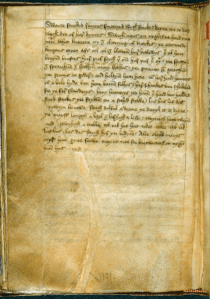
Figure 2 is BS MS Arundel 292, reproduced with permission from the British Library
Edmund Reiss has argued that “Blacksmiths” is the “earliest sustained onomatopoetic effort extant in English” in The Art of the Middle English Lyric: Essays in Criticism (167). But for an onomatopoetic poem that so carefully represents in language the sounds of men engaged in physical labor—from their “clateryng of knockes,” to the ringing exertion of iron on iron heard in “tik.tak.hic.hac.tiket.taket.tyk.tak/ lus.bus.lus.das” and the “stark strokes thei stryken on a stelyd stokke”—”Blacksmiths” is surprisingly unconcerned with its own visual appearance on the page. One turns the page in Arundel 292 and suddenly there is a neat chunk of prose with no other visual indication other than faint hashmark that one is looking at poetry. This is not unusual, for as Ardis Butterfield has recently observed in “Why Medieval Lyric?”, in many manuscripts containing lyric poetry or its traces, “there is no visual fanfare; nothing marks [the poetry] out” (322). Medieval scribes instead often use scripture continua—continuous script—to record the lyric, and “Blacksmiths” is no exception (Fig. 1). In short, “Blacksmiths” looks like prose, but sounds like poetry. Its insistent use of alliterative onomatopoeia, furthermore, suggests the poem might gain performative shape if addressed to both the mouth and the ear.
An aurally derived verbal pleasure, onomatopoeia exemplifies poetry’s general obsession with sound and performativity as it depends on the representational delight of hearing sounds that are the very things that they sound like. Onomatopoeia forces us into a strange ontological space in which a word is at once both signifier and sign. The bee buzzes, in other words; it has no other voice than the sound it creates, and we have no other way to describe that sound but to do so literally. This can produce the sounds of children’s babble as well as the more figurative pleasures found in “Blacksmiths.” The mimetic allure of using words that create the very sound of their own meaning is in many ways embedded in language itself. “Blacksmiths” calls our attention to sound, noise and listening, forcing further reflection upon the relationship between what is textually recorded and what is performed.
Blacksmithing and Masculine Poetic Labor
Salter argues persuasively in “A Complaint Against Blacksmiths” that the poem’s appearance in a priory cathedral manuscript suggests that the speaker’s resistance to blacksmithing may be the result of “older religious attitudes” about night labor and rioting (200). But given the fact that “Blacksmiths” is a poem concerned with labor likely written by a man about other men, I wonder if there is room as well for an additional consideration for the discourses of gender and labor that so consumed the late medieval period and how the poem interrogates these notions. While Salter resists categorizing the poem into any clear genre, noting that the poem is so realistic that it is frequently used as historical evidence [note], “Blacksmiths” draws attention to the lyric experiences and emotional expression of a presumably masculine first person speaker and in so doing might be categorized, as Robbins does, as a lyric.
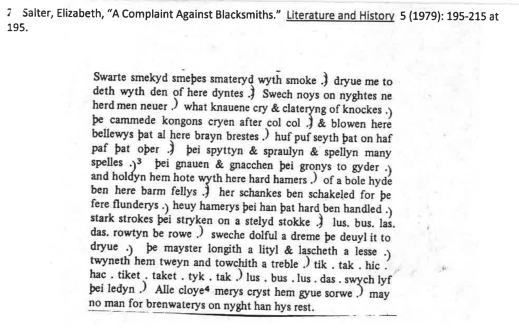
Beyond a single, reflexive pronoun, “me,” we know nothing about the poet except the evidence of his poetic making—the poem itself. In the poem, there are two literary skills at work. There is narrative exposition and description and there is onomatopoetic mimicry. Both are dependent on verbal artistry and are held together by the tensile patternings of alliteration. Narratively speaking, the poem identifies the blacksmiths by what they look like and what they wield. They are “swarte, smekyd” and “smateryd with smoke,” swarthy dirty men who “spitten and spraulyn and spellyn many spelles,” and “gnauen and gnacchen thei gronys togedyr.” They are addressed pejoratively as “knauene,” and “cammede,” pug nosed knaves, who “blowen here bellewys that al here brayn brestes.” These alliterative lines represent the work of the forge as rhythmic, repetitive, harshly sibilant. Brains might get hyperbolically blown out in blowing the fires needed to produce metal goods, and dissonance is created by the groans and cries and tooth-gnashing of the workmen. The edge of the human blurs into the flame of the forge. Men use “hard” and “heavy hamerys” and “her schankes ben schakeled for the fere flunderys;” they work so long standing near the forge it seems that their ankles are shackled to the sparks. As those fiery images suggests, there is a nightmarish element to the poem. The speaker laments: “sweche dolful a dreme the deuyl it to dryue.” And he uses that infinitive “to dryue” when he begins the poem; the workmen might “dryue me to death with den of here dyntes.” The heavy repetition of the “d” in these lines mirrors the thudding of hammers on hot metal.

Image borrowed from Hasib Wahab @Flickr CC BY-NC-ND.
It is only in the second line of the text that the speaker identifies himself. He is “me,” an “I” making a poem and speaking to an implied addressee. And in his use of the first person, he might be understood as having engaged in what A.C. Spearing has called “self-pointing,” those moments in late medieval poetry where the poet identifies himself as a poet, in a meta-commentary on vernacular poetry and its performance. Obviously, the poet does not state his profession in this line. But the fact that he speaks in the first person is significant. His is the voice, and the descriptive rage, that drives the poem. Further, the alliterative matrix of the poem’s lines unmistakably reminds us that this is a poem, a work of art, a made thing. The repetition of alliteration is a bending of ordinary language into something clearly and pointedly artificial, a rhythmic joinery that is obviously not prose, and it requires a certain sonic attention. The speaker expresses his frustration in a pattern of sibilants, voiceless palatal consonants and voiced palatal g’s, as well as hard stops at dental and palatal phonemes. Indeed, the poem mimics the sounds of the smith’s labors, placing their calls and cries and bellows within the poem. The smiths “kongons cryen after col col,” and “huf puf seyth that on haf paf that other.” The poem is ostensibly about the speaker being awoken by the night labor of “Blacksmiths.” “Such noys on nyghtes ne herd men neuer,” he says, hyperbolically. In describing this never-before-experienced problem, the speaker creates a smithing cacophony so loud that it overwhelms his own voice.
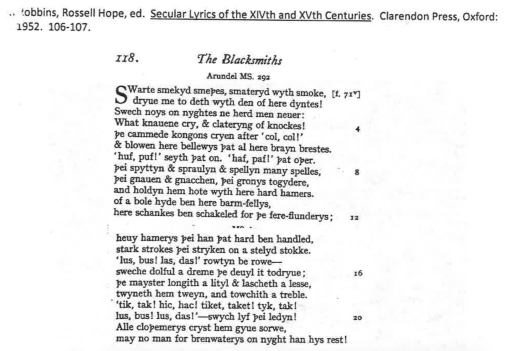
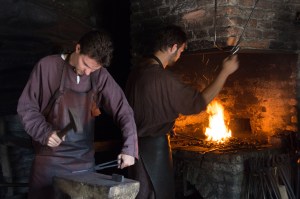
Image borrowed from Hans Splinter @Flickr CC BY.
The smiths are so loud, so noxious, and I would argue, so much more manly, that they threaten to hijack the poem itself. It is through this sleight of hand, wherein the labors of blacksmithing obscure the poet-cleric’s own small voice, that the speaker makes his implicit argument about masculinity, poetry, and labor. As Kellie Robertson has argued, late medieval writing is concerned with the common profit. Some forms of labor contribute to the common profit while others do not. For the most part, profitable labor is material; it produces actual goods that can be used and sold. And profitable medieval English labor is gendered as almost exclusively masculine, as only men can be masters and authorities. Only men are blacksmiths, and only men are priory scribes. Yet the practice of blacksmithing cannot be separated from materiality. The blacksmiths, however badly skilled the speaker may declaim they are, produce goods to be used for vital purposes. The newly-shod horse will pull the cultour through the fields; the sharp scythe will bring in the harvest; the knife will butcher animals. Moreover, the labor of the blacksmiths is productive even if it is done at night. It can be done as the work demands, all night long if necessary to finish the job. But the clerical poet cannot do scribal work at night without serious consequence. His labor—copying, scraping, blotting, correcting, reading, blotting— depends on daylight, silence, and decent sleep.
The clerical poet, like the speaker of “Blacksmiths,” is engaged in “immaterial labor,” to use Italian Marxist Maurizio Lazzarato’s term, which, as he explains in Radical Thought in Italy: A Potential Politics is “labor that produces the informational and cultural content of the commodity” (133). Clerical poetic labor is abstract, one of inscription, composition and performance. Within the material economy of the later middle ages, poetic labor produces nothing of concrete value. Making, inscribing and reciting poetry, in the words of Harry Bailly, “doost noght elles but despendest tyme” (VII.931). “Blacksmiths” thus asks: what does it mean to make poems—immaterial, multimodal, performative things that are not things at all—from within society where material production is consonant with masculine virility?
The sequestered clerical maker and scribe, scratching away in the silent priory, might have been furious over being disrupted by the athletic, kinesthetic activities of the blacksmiths. The poem might be read as a kind of homosocial lament about what men’s work is and what it means. To write is to not engage in more busily productive, material labor, and the anxiety around what writing is and what it does can also be seen throughout late medieval poetry. The workers make noise and heat deep into the night, producing metal goods. But the maker of the “Blacksmiths” offers a poem that represents the “Blacksmiths”’ loud labor and that also serves as evidence of his own “travaillous stillness,” in the words of Hoccleve (RoP l.1013). In doing so, he calls attention to his own skill as a maker of verse. His labor, however immaterial, can verbally represent noise and sweat and physicality. His prosopoeia is a contribution to the common profit, in that he can make you see and hear the blacksmiths long after their hammers have been laid away. And his hastily composed poem has outlasted even the best-made medieval horseshoe.
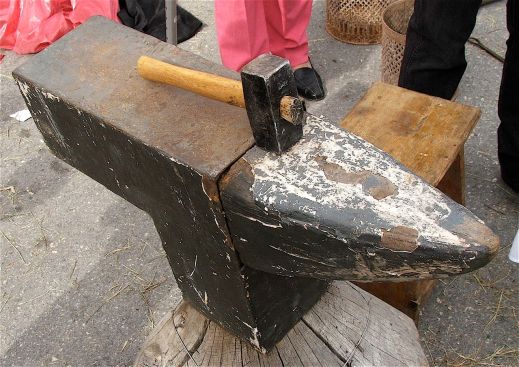
Image borrowed from Peter Grima @Flickr CC BY-SA.
To conclude, I’d like to point out that it is no wonder that “Blacksmiths” is set in the dark, and that the speaker himself cannot see his tormentors but only hear them. Because it is out of this darkness that the speaker can name, and in doing so—as Daniel Tiffany observes in Infidel Poetics: Riddles, Nightlife and Substance (97)—call attention to his own aesthetic power. As Martin Heidegger has argued in Poetry, Language, Thought (73), naming is “the lighting of what is,” and I wonder if verbal naming is in itself a wonderful kind of literary power. To name is to point out to another, to claim, to damn. To point out, however obliquely, who you might be and how your work might be remembered.
—
Featured image “Succor” by Walter A. Aue @Flickr CC BY-NC-ND.
—
Katharine Jager is a poet and medieval scholar. She is associate professor of English at the University of Houston-Downtown, where she teaches medieval studies, creative writing, literature, and composition. Recent publications include essays on aesthetics in Chaucer’s Sir Thopas (Medieval Perspectives) and masculine speech acts in Sir Gawain and the Green Knight (Medieval Feminist Forum, forthcoming); and poetry in such journals as Found Magazine, Friends Journal, The Gettysburg Review, Commonweal and the anthology on the religious lyric Before the Door of God (Yale University Press). She was for many years co-author with Jessica Barr of the Chaucer chapter for the Year’s Work in English Studies (Oxford), and is currently editing the interdisciplinary volume Vernacular Aesthetics in the Later Middle Ages: Politics, Performativity, and Reception from Literature to Music, to which she is also contributing an essay on lyric aesthetics, manuscript placement and the texts of 1381 (Palgrave’s New Middle Ages series, forthcoming).
—
 REWIND! . . .If you liked this post, you may also dig:
SO! Podcast #45: Immersion and Synesthesia in Role-Playing Games–Nick Mizer
“HOW YOU SOUND??”: The Poet’s Voice, Aura, and the Challenge of Listening to Poetry–John Hyland
Pretty, Fast, and Loud: The Audible Ali–Tara Betts
Share this:


Current Top Posts





April 2021

January 2020

November 2019

October 2019

August 2019

April 2014

November 2017

March 2015

December 2017

October 2015
 Sounding Out!
Recent Comments