
Of Resilience and Men: How Bieber, Skrillex, and Diplo Play with Gender in “Where Are Ü Now”

Justin Bieber caught me off guard last year. There I was, minding my own business, listening to a pop station, and this breathy little thing, this delicate vocal wrapped in a halo of shimmering effects starts piping through my car. I didn’t even realize it was him at first; it had been so long since I’d heard a new Bieber song. And I had no clue the production was from Skrillex and Diplo (from their 2015 Skrillex and Diplo Present Jack Ü), which is why I was probably also not ready for the drop, that moment when the song’s tension releases and I’m suddenly gliding across a syncopated bass synth while Bieber’s vocals are pinched into a dolphin call. Somehow, two of the most notoriously unsubtle producers and the posterboy for “too much, too soon” had snuck up on me with “Where Are Ü Now” (WAÜN).
 WAÜN’s drop from nowhere isn’t brand new. Subtle soars and understated drops are officially A Thing. More importantly, they do work beyond the sonic aesthetic. In this case, I want to listen to WAÜN in the context of Bieber’s performance of gender, specifically with an ear toward the way Skrillex and Diplo mix elements from dancepop’s 2015 toolkit to produce a track that plays on feminine tropes, which articulate a kind of masculinity. Listening to WAÜN alongside Robin James’s Resilience & Melancholy (2015) amplifies the male privilege at play in WAÜN. James calls attention to the way drops can sonify feminine resilience, and WAÜN’s surprise drop toys with that resilience in a thoroughly heteromasculine way. I’ll first set up how drops usually work, then read James in the context of Bieber’s gender performance as heard in WAÜN.
Drops, at their most basic, are climactic moments when a song’s full instrumental measure hits (hence “drop”), often after some key elements of the instrumental have been removed so that the climax can sound more intense. At that broad level, any genre can employ a drop of some sort. EDM and dancepop drops—the kind that most directly inform the music of Skrillex, Diplo, and Bieber—are bass-heavy and typically follow a soar that intensifies volume, texture, rhythm, and/or pitch: you soar to a sonic plateau or a cliff, and with a “YEEEEEES!!!!!” coast on some wobbly goodness to the next verse.
The pre-chorus soar in the Messengers/Sir Nolan/Kuk Harrell-produced “All Around the World” from Bieber’s 2012 Believe is a solid example. In the video below, the soar starts at 0:45, the chorus enters at 1:00, and the drop lands at 1:15. It’s textbook: the instrumental is stripped back and filtered, and in the opening moments, we hear a descending bass glide. A filter does what its name suggests–it filters out a prescribed set of frequencies so that we only hear a certain range, and in this case it’s the low end that comes through. The effect makes the synths sound like they’re pulsating through water, and the higher frequency overtones take on a shimmery quality. Over the course of the 8-measure soar, the higher frequency range is brought into earshot, and then, on the second half of the eighth measure…nothing. This nothingness is integral to James’s central argument in Resilience & Melancholy: nothingness intensifies what follows. In these eight measures, we’ve glided down to the low end only to soar up up up until all that’s left is Bieber’s voice, confident, nasally, with just a touch of autotune as he sings the titular line that will take us to the chorus. That chorus bangs harder because of the soar to oblivion before it.
WAÜN’s drop lands at 1:09. For full context, start from the beginning and listen for the soar. (If you also need to stare dreamily into Bieber’s eyes, then by all means.)
There’s not really a soar there. No intensifying volume, texture, rhythm, pitch. The not-soar (starting at 0:48) is even a weird length, clocking in at 12 measures after an 8-measure intro and 16-measure verse have established a multiples-of-8 structural rhythm; even if we were expecting a drop, it comes four measures early. The clearest sign we get that a drop is imminent is that moment where the instrumental reduces to a quiet hiss for two measures as Bieber sings “Where are you now?” That hiss is the structural equivalent of the nothingness we hear just before “All Around the World”’s chorus, and with no traditional soar before it, we have just enough time to think “Oh shit, are they gonna….?” before we’re off, clutching tight to Justin Bieber as we ride a dolphin through the more tender parts of Skrillex’s and Diplo’s musical oceans.
Until that nothingness, this could just as easily be one of those heartfelt Bieber tunes where he reaches to the high end of his range for a chorus full of feels. That Bieber? He’s incredibly self-assured, bearing his soul because he’s certain you’ll love him. The bait-and-switch of WAÜN’s soarless drop highlights Bieber’s insecurity in this song—he’s just dolphin calls and “Where are you now”s—by creating expectations for a different persona.
So what we have here is an atypical drop, a drop that calls attention to itself by behaving differently than we expect it to, a drop that’s a study in understatement–all courtesy of three of dancepop’s resident maximalists.

“143 Diplo and Skrillex at Burning Man 2014 Opulent Temple” by Flickr user Duncan Rawlinson, CC BY-NC 2.0
Atypical soars and drops aren’t new, as producers will always toy with musical conventions as a way to disrupt expectations. Skrillex’s own “Scary Monsters and Nice Sprites” (2010) includes a pre-drop that doesn’t soar at all. In 2015, two big acts in the dance scene, Disclosure and The Chemical Brothers, released singles that don’t soar right, either. Disclosure, whose big 2013 hit “Latch” soared rather traditionally into Sam Smith’s chorus, is coyer on “Bang That” and “Jaded.” “Bang That” includes three separate 8-measure phrases (at 0:30, 0:45, and 1:01, respectively, in the linked video) that never take off, finally settling into a descending bass line (starting at 1:09) that just repeats a rhythmic motif, running out the clock on the final four measures before the chorus. “Jaded,” at the other end of the spectrum, includes only a 4-measure pre-chorus (1:18-1:27) that seems to be sweeping upward like a traditional soar, then roller coasters down and back up over the final two measures. The instability of this soar/not-soar is punctuated with an additional eighth note tacked onto the end of the fourth measure, throwing the chorus off-kilter. The Chemical Brothers employ a similar roller coaster sweep in “Sometimes I Feel So Deserted” that marks out an even eight measures (0:58-1:13) without either intensifying rhythmically or pushing to a pitch ceiling at the drop.
These soars and drops stand out precisely because, like WAÜN’s, they aren’t the norm. To help theorize WAÜN’s not-soar, I want to think with Robin James, whose Resilience & Melancholy hears soars and drops in the context of contemporary race and gender politics. James situates soars and drops as the sonic equivalent of resilience–a performance of feminine overcoming that ultimately only strengthens the white supremacist capitalist patriarchy that inflicts the damage that is being surmounted. In other words, women can only attempt to overcome through the damage that white supremacist capitalist patriarchy inflicts upon them. Sonically, the soar is an accrual of damage that is spectacularly (and profitably) overcome in the drop, the music that resiliently endures on the other side of nothingness. Melancholy, on the other hand, is failed resilience, a handling of damage that does not directly profit white supremacist patriarchy and that could sound any number of ways, including like a non-traditional soar. While admittedly these soars and drops aren’t always about gender politics, R&M opens space for us to think about gender and soars/drops together.
I don’t think WAÜN’s non-soar/drop is resilient or melancholic, but I do think it’s helpful to think of it as being about resilience and melancholy. This is where Bieber’s performance of masculinity comes into play. From his earliest poofy-headed, babyfaced performances, Biebs has done a modified bro thing: his heart’s on his sleeve, but mostly as a strategy for sexual conquest. “All Around the World,” again, is exemplary. In the lyrics, Bieber uses his worldly experiences to woo a potential lover, who he also negs, keeping himself in a position of power as someone who knows more, has seen more, and is willing to accept this woman despite her obvious flaws.

“143 Diplo and Skrillex at Burning Man 2014 Opulent Temple” by Flickr user Duncan Rawlinson, CC BY-NC 2.0
In WAÜN, though, I hear his performance of masculinity complicated further, as he tries out a number of more feminized tropes all at once. Lyrically, Bieber is the scorned lover who claims to have done all the care work in his relationship. Visually, he’s the pop icon whose body is ogled, scrutinized, and marked. Vocally, he receives the pitch-shift treatment that has most recently been associated with DJ Snake’s production of diva vocals (think “You Know You Like It” and “Lean On”). He also sings in a breathy style that James has elsewhere noted mimics Ellie Goulding’s vocals. Musically, Skrillex and Diplo give him the soar/drop construction to undergird his pain, a musical technique that most often signifies feminine resilience.
What bubbles up is a heteromasculine play on resilience and melancholy. Skrillex and Diplo liquidate the soar until all that’s left is a nothing-hiss before the drop. In the context of the other feminized tropes Bieber is messing with in WAÜN, this failed soar could feel melancholic, a refusal to spectacularly overcome. Overcome what, though? Bieber gets to sound resilient or melancholic without ever experiencing damage. That’s his male privilege. James points out that one of the most violent outcomes of resilience discourse is the re-enforcement of damage. If resilience is the way women become legible and profitable, then the damage inflicted by ablist white cisheteropatriarchy becomes a necessity, something that must be endured to gain access to power and resources. This is the lynchpin of James’s critique: resilience is a harmful discourse because it ultimately benefits the system it purports to overcome. Melancholy turns resilience logic on its head by refusing to treat damage as something an individual is responsible for overcoming. WAÜN, though, erases damage altogether in its initial drop. WAÜN’s feminized tropes ultimately highlight instead of unsettle Bieber’s performance of hetero-masculinity: what’s more man-ly than accessing power and resources without the threat of institutional violence?
Importantly, these feminized tropes don’t undermine Bieber’s heteromasculine performance; rather, they only seem to add nuance to the slightly bro-ier [that’s a word] Bieber performance we’ve become accustomed to. That’s what I mean when I say WAÜN is about resilience and melancholy; Skrillex and Diplo use the markers of queer or feminine overcoming and failed overcoming to re-construct Bieber’s masculinity, to toss some more ingredients into his manly mix, and the not-soar is a big component of that. Skrillex and Diplo tap into this soar experimentation, then drop it into the middle of a slightly more gender-fluid Bieber.

Screenshot from “Where Are Ü Now” official video
WAÜN’s high water mark is a few months behind us at this point, but Bieber remains hotter than ever, with “What Do You Mean?,” “Sorry” (another Skrillex production credit), and “Love Yourself” still dominating US and UK charts. Several more singles from Purpose (including two more Skrillex collaborations) are poised to do the same in 2016. Each of these singles extends some of the same tropes Bieber, Skrillex, and Diplo explore in WAÜN—breathy vocals, misunderstood and mistreated pop icon, resilience and contrition and care in the face of a failed relationship—and I hear WAÜN’s initial drop as the sonic moment that preps Bieber’s return to the pop charts. He wades back into the mainstream with a more complex performance of heteromasculinity and reaps the profits that come with it.
—
Justin D Burton is Assistant Professor of Music at Rider University, and a regular writer at Sounding Out!. His research revolves around critical race and gender theory in hip hop and pop, and his current book project is called Posthuman Pop. He is co-editor with Ali Colleen Neff of the Journal of Popular Music Studies 27:4, “Sounding Global Southernness,” and with Jason Lee Oakes of the Oxford Handbook of Hip Hop Music Studies (2017). You can catch him at justindburton.com and on Twitter @justindburton. His favorite rapper is Right Said Fred.
—
 REWIND!…If you liked this post, you may also dig:
Vocal Gender and the Gendered Soundscape: At the Intersection of Gender Studies and Sound Studies — Christine Ehrick
They Do Not All Sound Alike: Sampling Kathleen Cleaver, Assata Shakur, and Angela Davis — Tara Betts
Tomahawk Chopped and Screwed: The Indeterminacy of Listening–Justin Burton
Share this:

Finding My Voice While Listening to John Cage

Editor’s Note: Today I bring you installment #4 of Sounding Out!‘s blog forum on gender and voice! Last week Regina Bradley put the soundtrack of Scandal in conversation with race and gender. The week before I talked about what it meant to have people call me, a woman of color, “loud.” That post was preceded by Christine Ehrick‘s selections from her forthcoming book, on the gendered soundscape. We have two more left! In the next few weeks we’ll have A.O. Roberts with synthesized voices and gender, and lastly Robin James with an analysis of how ideas of what women should sound like have roots in Greek philosophy.
This week guest writer and professor Art Blake shares with us a personal essay. He talks about how his experience shifting his voice from feminine to masculine as a transgender man intersects with his work on John Cage. So, lean in, close your eyes, and try not to jump to conclusions before you listen. –Liana M. Silva, Managing Editor
—
When I walked into the packed lecture theatre at the start of the Fall term 2012 I was hoping, more than any other year, to sound convincing. I had been teaching for 11 years by that time so I knew what I was doing. But I was walking into class as a man, for the first time. I was not sure if my newly thickening vocal chords would hold me at a convincing “male” pitch or if I would be able to project that developing voice to the back of the room. I thought I looked “manly” enough; but would I sound manly?
I had been researching and teaching about sound since 2003 but had not confronted myself as a potential object of study until I was preparing to return to teaching in 2012 following the early phase of my transition from female to male. My notions of “masculinity” have never been conventional: as a somewhat incompetent butch-ish lesbian I’d attempted but never “mastered” the appropriate vocal or bodily swagger. I abandoned those conventions to evolve my own more elfin, more queer swish. But on that first day back in the classroom, and for much of that term, I felt I needed to produce “normal guy”—a gender-identity category I didn’t believe in or want to become—so I might feel secure enough later to explore and tweak my newly gendered voice and body. I wanted a baseline from which I could re-build. I wasn’t ready to be out as trans* in the classroom. Yes, I was in a closet; but I needed it to serve as a dressing room, a place of private preparation, rather than as a long-term hiding place.
I started testosterone therapy in January 2011, on a low dose as is the standard of care. As my doctor increased my dose over the months, I noticed the beginning of the physical changes I’d been waiting for: more body hair, muscle development, and a hoarsening voice. I earnestly weighed and measured myself, worked out at the local YMCA, chose a new name and made it legal … and dealt with months of severe anxiety and depression. Puberty isn’t fun, and doing it again in my forties, as part of gender transition, was not the seamless story of celebration familiar from the YouTube videos I’d watched obsessively charting other guys’ transitions. Those videos were mostly about looking male, not sounding male, and rarely addressed transitioning at work, within a profession.
I spoke to a transman, also an academic, to discuss the challenges of transitioning in our profession. His version of masculinity was more conservative than I had expected, and a bit homophobic, but what really worried me was his concern about my voice: “I really hope for your sake your voice changes,” he said. What did he mean? Would I fail the test of public masculinity not only because I wasn’t wearing a jacket and tie but because I sounded feminine?

“Byron Pitts Lecture” by Flickr user roanokecollege, CC BY 2.0
All those images of authoritative, sonorous, academic masculinity flooded me with panic. Testosterone wasn’t going to make me any taller, give me an Adam’s apple, or bigger hands and feet. I was going to be a small guy, standing at the front of the classroom with years of academic expertise, but a mismatched voice might undermine that basic authority. Female academics, like most female professionals, have to work harder for the respect of students as well as colleagues; we all have seen or know of evidence for this sexism. Men, just by being perceived as male, get more generous teaching evaluations from undergraduates. As I transitioned I found myself grasping for that authority in a way I hadn’t imagined before.
In search of help, I went to see Dr. Gwen Merrick, a therapist in the Speech Pathology section of Toronto’s St. Michael’s Hospital. Gwen is known in the trans* community and trans* health networks for her work with transwomen. To my surprise I was her first transmale patient. While admitting her lack of experience she also welcomed the challenge to help masculinize my voice and lessen my anxiety around my vocal-gender dysphoria.
So we began: she examined my vocal chords (properly “vocal folds”). We then moved on to discuss my goals and concerns, and began the process of recording my voice—measuring its volume and tone, listening to the digital recordings, and training me to hear and then adjust my vocal pitch and speech rhythms. She gave me vocal exercises for homework, and taught me how to relax and move my larynx lower in my throat to lengthen it and create a lower pitch. Gwen also encouraged me to imagine myself into the vocal change I sought. I tried taking up more space as I sat in her office, head up and chest out, adopting an attitude of greater confidence, channeling the burliest and butchest of my cismale friends.
My scholarly life took a nosedive during those months on medical leave. The first piece of scholarship I re-engaged with during this time was something I’d been thinking about for years: an article about the composer John Cage‘s voice. I wanted to write about the disconnect I had heard between Cage’s speaking voice and my assumptions about him based on his appearance. I sought to hear Cage’s voice in the context of the post-1945 period when he rose to great prominence as a composer. What I gradually came to hear as I returned to this research was how and why Cage’s voice, within the context of the 1950s in particular, spoke to me so profoundly as I emerged publically as trans*.

“Photograph of John Cage talking to another guest at a drinks reception at the Cage/Cunningham Residency at the Laban Centre, Laurie Grove, London, July 1980” by Flickr user Laban Archive,
I first heard his recorded speaking voice while teaching some of his work in an early iteration of my sound studies seminar. I’d seen photographs of Cage as a middle-aged and older man; from those images of a tall, craggy-faced guy in a sports jacket or woolly sweater, I had expected to hear a baritone, chest-resonant, rich “masculine” voice. Instead, Cage’s voice was light, with very little chest register, almost breathy sometimes, and inflected with the rhythm and occasional sibilance of what I “recognized” as a gay male (American) voice.
How had Cage navigated the homophobia of the 1950s with a voice like that? Was what I heard as his audible difference perceived that way in the postwar period as he rose to prominence as a modernist composer? According to some older gay men I’d interviewed for my 2004 radio documentary on the early gay leather scene in the 1950s, they had consciously altered their voices in everyday situations where they didn’t want (or couldn’t risk) being heard as gay. As one guy mentioned, for such circumstances he adopted his “gas station voice”—a vocal pitch and style to get him through such commonplace moments of public masculinity as talking to the gas station attendant. I wondered if Cage also kept one voice in the closet and adopted another one he needed based on circumstance.
As I sought my own “gas station voice” in the fall of 2012, returning to Cage and listening to his voice in his 1956 composition Indeterminacy helped gradually lessen my anxiety about audibly “passing.” Listening to Indeterminacy, a series of stories occasionally interwoven with a piano, allowed me to not only hear but also admire Cage’s voice and the political resonance it may have held in McCarthy-era America.
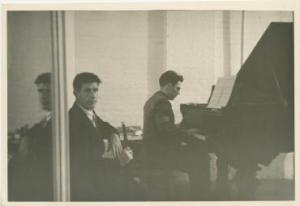
John Cage with David Tudor
I looked for examples of Cage speaking outside of his own compositions, someplace more public—someplace where I might hear him put his voice in the closet and butch himself up for the public ear. I looked for ways to contextualize Cage’s voice in the era of determinacy — mainstream 1950s America, high modernist, planned, and in love with postwar military-industrial efficiency and the performance of expertise.
My urban history self focused on New York in the 1950s, listening for other voices resonant with the era’s “structure of feeling.” If heard by a 1958 resident of New York City, Indeterminacy might have sounded somewhat familiar. The experience of listening to all or parts of Indeterminacy resonated with the interruptions, the drowned-out words, the overlapping and oppositional sounds, the proximity of people and machinery, which characterized Manhattan (in particular) in the late 1950s. Cage spent periods of time in New York City as well as upstate in the 1950s, moving between different art scenes. What did New York sound like in the 1950s? The Puerto Rican migration and urban renewal re-shaped the city’s soundscape on the west side, as documented by sound recordist Tony Schwartz and re-presented through the musical West Side Story. I had written about those encounters with audible difference but now wanted to listen more closely. What did the city’s infamous urban planner, master of urban renewal, Robert Moses sound like? What did his outspoken critic Jane Jacobs sound like? And how might I hear their contemporary John Cage in this context with reference to the notion of “indeterminacy”?
Within a Cold War-McCarthyist context, voices represented an aspect of the suspect-self available for investigation, interrogation, and pathologizing. I identified, to an extent, with such a predicament, such a fear of exposure and of the negative consequences I presumed would follow. While I listened to John Cage’s and others’ voices from this period, I listened for how Cold War authorities may have heard them. John Cage’s voice offers indeterminacy itself, hovering in the margins of the tonal, rhythmic, and pitch ranges of conventionally “masculine” and “feminine” voices at mid-century. Despite our contemporary resistance to stereotyping, one hears in Cage’s gendered oscillation, mixing minor chest resonance with the higher, softer, breathier sounds, a definitive type of “gay” male voice: the sissy voice. As Craig Loftin has argued in “Unacceptable Mannerisms: Gender Anxieties, Homosexual Activism, and Swish in the United States, 1945-1965,” during the 1950s gay men as well as the heteronormative majority, produced intense hostility to the archetype of the “sissy,” whose voice and body movements marked him as politically problematic in the context of both homophile activism and Cold War homophobia.
Paul J. Moses aimed to analyze in his 1954 book, The Voice of Neurosis (one of the many works in the field of “personality studies” popular in the 1950s) the personality from the speaking voices of his subjects with a method he called “creative hearing.” Moses’s work suggested that the voice revealed the “true” personality, belying a person’s efforts to disguise themselves through dress, work or relationships. Such secrets could be heard, or listened for, through Moses’ “creative hearing.” Of course, when he published his work in 1954, the Cold War made aural surveillance, the use of listening devices, as well as the “creative hearing” of expert listeners, a crucial weapon in a war of secrets.

“IGASLogo” by Source. Licensed under Fair use via Wikipedia –
In January 1960 John Cage appeared as a contestant on the popular television game show I’ve Got a Secret (CBS, 1952-1967), a show that perfectly channeled concerns about hidden identities at the heart of public and Congressional anti-Communism within Cold War politics in the United States. Derived from the radio show What’s My Line in which a celebrity panel tried to discover a person’s job, in I’ve Got a Secret the panel tried to uncover the contestant’s “secret,” normally something unusual or perhaps embarrassing. The I’ve Got a Secret format played with the tension between who knew and who did not know the contestant’s “secret.” After being introduced by name and hometown, the show’s host asked each contestant to whisper their secret in his ear. During the on-camera intimacy of mouth-to-ear divulgence, text of the revelation scrolled up over the TV screen for the viewers at home and was visible to the studio audience. The panel of celebrity inquisitors could only observe the studio audience’s responses of laughter, shock, or titillation.
John Cage’s appearance on the show was devoted to the performance of his “secret.” Cage whispered to host Garry Moore that he had made a musical composition using a bathtub, jugs, a blender, radios, a piano, a tape recorder, a watering can, and other common household objects. In an absurdist version of a laboratory experiment, Cage darted from one to the other object, pressing buttons, pouring liquids, hitting radios, putting flowers in a bathtub, all the while holding and responding to the stopwatch in his hand. Cage performed inefficiency and absurdity, inviting laughter, the opposite of industrial modernism’s demand for logic, order, and compliance to norms. Cage’s non-compliant, queer performance and composition satirized the efficiency experiments of twentieth century time-management experts; the “Water Walk” “instruments”, all objects from everyday life, bear no productive relation to each other and are not arranged in a manner producing efficiency. Cage thus queered the modern, as typified in mid-20th century American industry, corporate capitalism, and national infrastructure projects such as urban renewal.
Cage’s voice provides an added and unexpected queer flourish to his TV appearance on I’ve Got a Secret. The sound of Cage’s voice (soft, higher-pitched, lilting, slightly sibilant) contrasts with his formal attire and hetero-normative environment. Cage’s voice reveals a “secret”—his homosexuality—different from the “secret” featured on the show. Like most Cold War secrets, it was not a secret to him or his close friends but was supposed to function as a secret in that historical context. Cage resisted, consciously or not, the vocal closet; he made no attempt, as far as I can hear, to alter his voice in the very public context of a live television show. John Cage appears happy, playful, and delighted to perform for the audience. His antic performance of “Water Walk” endeared him to a mid-century audience who came ready to enjoy the show’s pleasurable revelation of secrets.
Other “hearings” of Cage’s non-normative self might well have produced a less relaxed response from those same audience members: his voice at a Congressional HUAC hearing; his voice overheard on the street or in a cafe. The gay or gender non-conformist audience members may have thrilled to Cage’s double-edged performance of his “secrets,” or they may have cringed at such possible revelations, in fear of their also being heard as different but lacking the protection of Cage’s (albeit limited) celebrity.
Standing at the front of the lecture theatre in September 2012, I felt I too had a secret, and my heart pounded, my stomach jittered for fear of its revelation. But, as I continued to listen to Cage’s voice on a recording of Indeterminacy, and to think through his TV performance on I’ve Got a Secret, I grew more able to let go of my fear of being heard as trans*. I heard and saw Cage as a man who resisted convention and a culture of fear and judgment.
Four years on, I no longer worry whether or not my voice signals my transmasculinity. I can’t control how my students or anyone else hears me, or the joy, confusion, curiosity, or disgust their hearing me may produce in them. My last term’s teaching evaluations, from Fall 2014, for that same large lecture class I first taught in Fall 2012, included many positive comments about my teaching; they also included a student’s written comment describing my voice as “gentle” and thus sometimes harder to hear. I will wear a microphone for volume, if needs be, to increase my audibility. But I feel no need to alter what that student heard as “gentle.” I can live with gentle, for which I thank John Cage.
—
Featured image: from Issue Project Room
—
Art Blake is an Associate Professor in the Department of History at Ryerson University, Toronto, where he also teaches and supervises grad students in the Communication and Culture program. He is completing his second book, Talk To Me: Mediated Voices in 20th Century America. His new research concerns contemporary international urban “maker” cultures.
—
REWIND!…If you liked this post, you may also dig:
Music to Grieve and Music to Celebrate: A Dirge for Muñoz—Johannes Brandis
On Sound and Pleasure: Meditations on the Human Voice—Yvon Bonefant
Sound as Art as Anti-environment—
Share this:


Current Top Posts





April 2021

January 2020

November 2019

October 2019

August 2019

April 2014

November 2017

March 2015

December 2017

October 2015
 Sounding Out!
Recent Comments