
“I’m on my New York s**t”: Jean Grae’s Sonic Claims on the City
 Hellooooooo, Cyberspace! Are you ready to rock??? Welcome to our February Forum on “Sonic Borders,” a collaboration with the IASPM-US blog in connection with this year’s IASPM-US conference on Liminality and Borderlands, held in Austin, Texas from February 28 to March 3, 2013. Expertly organized by Sounding Out!’s Managing Editor Liana Silva and IASPM’s Web Editor/Webmaster Justin Burton (and curated for SO! by yours truly), the “Sonic Borders” forum is a Virtual Roundtable cross-blog entity that will feature six Sounding Out! writers posting on Mondays beginning today and running through February 25, and four writers from IASPM-US, posting on Wednesdays starting February 6th and ending February 27th. We envision plenty of excitement and cross blog commenting from authors, audiences, and IASPM-US conference attendees. Consider this your ticket to the show, so please come on in and mix it up!
And what will we be talking about across our platforms? The “sonic borders” between sound studies and popular music studies. . .where their methods, objects of study, and approaches overlap, where they rub raw, where they challenge the people on either side to do do better, and where they meet to generate some of the finest scholarship in the contemporary humanities.
And who will you be hearing from over here at Sounding Out!?: Liana Silva, SO! regular Regina Bradley, Marcus Boon (York University, The Wire), Daphne Brooks (Princeton), Tavia Nyong’o (NYU), and Art Jones (film-maker, photographer, artist, mixer, raconteur, School of the Museum of Fine Arts, Boston).
And what topics do you have a front row ticket for? Some real New York shit. Django. Body-regenerating vibrations on the dance floor. Cabaret, jazz, and funk/soul, plus musical memory, dance, performance art, race, gender, sexuality, and politics. Sound gatherings in Pakistan.
Feel free to camp out and shine your cell phone lights at each day of our Forum, because we’re turning it up to 11 over here at Sounding Out! and IASPM-US!—Jennifer Stoever-Ackerman, Editor-in-Chief
***
If you had to guess whether the singers of the following lyrics were male or female, how would you fare? Click on the lyrics to hear the song and find out who’s the rap artist.
“We gon’ hold it down for Illadel for life
Came through made a name, nigga nailed it tight
An’ now we shine, been knew, shit, it was about time
Switched from streets, the beats, platinum lines
Used to struggle in the hood just to brodie the mic
Took the fame ’cause they ain’t give it us, now we excite
The biggest crowds an’ they screamin’ loud, “Philly the shit”
“They hear Brooklyn, and we up to no good
Well, here we come, so there goes your neighborhood
Timbos scuffed up, sess bein’ puffed up
Mess with the wrong one, kid, you get ruffed up”
“My city do it best, whether it’s East or West
We feelin’ good fine, love it when it’s summertime
Detroit in summertime, summer time in Detroit,
Detroit in summertime, summertime in Detroit”
Although it is somewhat unfair to judge the gender of a rapper by the lyrics of a song, it is commonly thought that if a rapper is talking about the city, they are more than likely a man. Are there borders in hip hop around the content that men or women can address?
Case in point: several years ago I wrote a paper on representations of the city in hip hop songs. It gave me the opportunity to look closely and write extensively about some of my favorite hip hop artists and songs. However, most of the songs I tackled in the paper, actually most of the songs that occurred to me, were written and sung by male rappers. When I realized this, I couldn’t believe my oversight. Surely there had to be female rappers invoking the city in their songs. Men couldn’t be the only ones claiming the city. So, over the years I have been on the hunt for songs by female emcees that talk about the city. (I recently started a Spotify playlist, but several of the songs I have come across are on mix tapes that don’t show up on Spotify. If you have any suggestions you’d like to add to this collaborative playlist, please add them or mention them in the comments!)
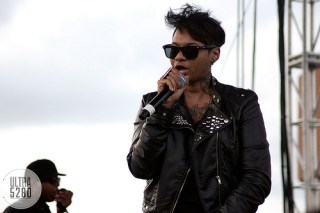
“Jean Grae” by Flickr user ultra5280 under Creative Commons 2.0 License
One of the female emcees that stands out most is Brooklyn-based Jean Grae. Born in South Africa in 1976, she moved to the United States with her parents shortly after she was born and grew up in New York City. In a 2006 interview with Robert Walsh for the academic journal Callaloo, Jean Grae reminisces about how hip hop culture was inescapable for a teen in New York City in the early nineties:
It was a thing when kids finally realized that you could put out your music yourself and you didn’t have to wait around and get signed. It was possible to learn for yourself and be able to put out music on your own or on an underground level. It was kind of unavoidable to be a part of it, I guess. (216)
After a brief stint as a DJ, she opted for rapping, as she was already writing (even if not necessarily rhyming). She took a hiatus from the hip hop scene in 2008 but later that year returned to performing and finally released a new mixtape named Cookies or Comas in 2011.
In hip hop, cities are often represented as masculine–what with the number of male rappers dropping stories about how things go down on the street–and Jean Grae complicates that representation. In Jean Grae’s version of Busta Rhymes’ “New York Shit,” she opens a door to thinking about female rappers and urban space, and her sonic intervention into Busta Rhymes’ narrative in his version of “New York Shit” illustrates how female rappers claim the city as well. I read her track as an act of urban homemaking: rapping about the city (and subverting the male voice that initially sung on the track, Busta) becomes a practice to claim the city as her home. In fact, it is not just through her lyrics but also through her voice that Jean Grae makes her presence felt.
Jean Grae’s version of “New York Shit,” a collaboration with rapper Talib Kweli, is an alternate version of Busta Rhymes’ hit track “New York Shit” from his 2006 album The Big Bang, although both songs use the same sampled loop and constantly repeat the phrase “New York Shit.”
The track that “New York Shit” samples is from the opening of a 1976 song titled “Faded Lady” from The Soul Sensation Orchestra (featuring Douglas Lucas and The Sugar Sisters, who sing together throughout the whole song). The song itself tells the story of a “faded lady” who seems to have lost her hopes, dreams, and connection to the world around her. “New York Shit,” both the Busta Rhymes and the Jean Grae/Talib Kweli version, samples approximately the first 13 seconds of the song, so that in their version the voices are erased; all that is left is the even thump thump of a drum, a bass, and a guitar, with the clash of a top hat and the bass in between, finally rising up to a climax with what sounds like a flute or clarinet until it drops back into the thump thump. The loop invokes the soundtracks of blaxploitation films, several of which were set in urban locations. The sample choice then places “New York Shit” in an urban soundscape.
Busta’s original song weaves images of New York as the birthplace of hip hop, as the location of great sports teams, and expensive taste around this soulful, smooth loop. The chorus of the song (“If you’re from New York, stand up right now, If you’re from New York, hands up right now”) calling forth New Yorkers. In the song, Busta also pays homage to some of the big names in hip hop who come from New York: Ol’ Dirty Bastard, Notorious BIG, Big Pun, Jam Master Jay, while the video includes cameos from people like Q-Tip, RZA, Slick Rick, and Big Daddy Kane. In this way, the song celebrates their contributions to hip hop, but also recreates a narrow, gendered view of who is part of that musical history.
However, the sonic picture Busta Rhymes paints is one that is devoid of women. Before the loop starts, Busta Rhymes’ voice emerges from the quiet: “DJ Scratch you’re sick for this one,” which acts as the signal for a chorus of male voices. Some of them whoop, some of them whistle, and some of them sing. Eventually they make way for Busta Rhymes to serenade listeners with his tales of New York life. His voice sounds gruff and aggressive, a contrast with the smooth vibe of “Faded Lady.” In fact, it seems as if the “faded lady” of the title is not just faded but erased–the women in the city become the faded ladies whose erasure makes possible for this problematic representation of urban space.
Enter Jean Grae.
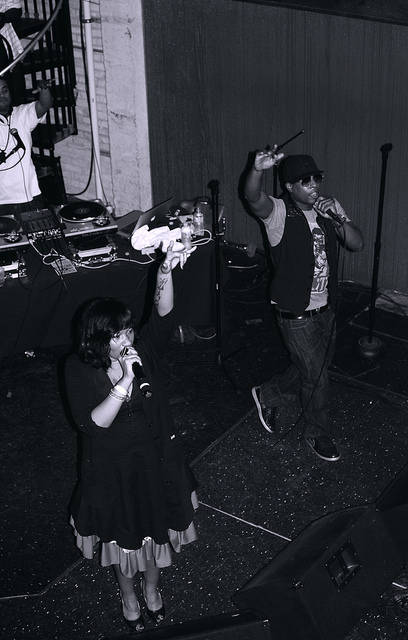
“talibjeangrae” by Flickr user HDShootsPhotos under Creative Commons License 2.0
In 2006, she and Talib Kweli released their version of “New York Shit” in a mixtape titled Hip Hop Docktrine: The Official Boondocks Mixtape which responds to Busta Rhymes’ sonic tribute to New York. (It also appeared on the mixtape Talib Kweli Presents Blacksmith the Movement.) Busta Rhymes’ song comes immediately to mind when listening to Jean Grae’s sixteen bars, especially when she starts with “Some of y’all forgot what New York is,” and in that vein it is hard not to hear Jean Grae’s track as a response to Busta Rhymes’.
Whereas Busta Rhymes’ song is ushered in by a chorus of disparate men’s voices, Talib Kweli and Jean Grae’s version starts with Talib Kweli’s introduction, followed by Jean Grae’s rapping. Talib Kweli’s introduction tricks the listener into thinking this version is just an echo of the original by Busta Rhymes (especially since the loop is virtually unchanged) until Jean Grae pops up by responding to Talib Kweli’s “I went for mine” with her “Go for yours, man.” The back-and-forth of the male and female voices, laid upon the same loop, acts as a subversion of Busta Rhymes’ male New York chorus.
But Jean Grae’s rapping is the most subversive element of the song. Jean Grae’s first line, “I’m on my New York shit,” calls forth Busta Rhymes’ song, even in her tempo. However, her verses take a swift turn from what Busta Rhymes puts forth in his song; at first listen, Busta Rhymes’ snappy, aggressive repetition of the phrase “New York [plus noun]” at the end of each verse is absent from Jean Grae’s rapping. Her voice seems to float on top of The S.S.O. loop, picking up speed when the loop reaches a climax, and dropping an octave or two (and slowing down a tad, too) when the climax of the track drops and loops back to the beginning. The resulting effect is that Jean Grae’s voice merges with the soulful flow of the song whereas Busta Rhymes’s voice is at war with it. Through her voice, Jean Grae disrupts Busta Rhymes’ sonic portrayal of a men’s-only New York. In fact, by subverting the vocal pattern Busta Rhymes sets up in the original version, Jean Grae creates a space in this New York hip hop narrative for female rappers to claim New York City as their own.
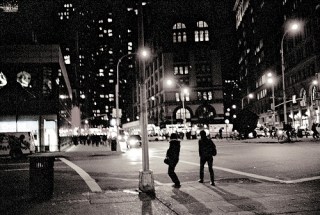
“New York City at Night” by Flickr user Alyssa L. Miller under Creative Commons License 2.0
In her verses, Jean Grae depicts a New York that is not glamorous or glitzy, like the one in Busta Rhymes’ song. Instead she talks about a “cement jungle,” and men who “struggle to their feet”; she also invokes the perils of gentrification when she talks about the Starbucks that pop up around the block (an indication of the white middle class coming to the neighborhood). But what catches my ear from this song is that Jean Grae mentions toward the end of her bars, “I just want to write and give back to the city that I’m a factor of.” Writing and rapping become a way for Jean Grae to practice her New York citizenship, an act of urban homemaking.
Even though Jean Grae busts her way into this narrative of urban masculinity, she is still a lonely female voice in the “New York Shit” repertoire. According to Wikipedia, there are several versions of the song, but Jean Grae is one of only two women to take on “New York Shit.” (Brooke Valentine has a version titled “H-Town Shit,” but I am limiting myself to the versions that look at New York City.) In that sense, Jean Grae’s female voice doesn’t necessarily fill a void in hip hop but rather points to it. On the other hand, her voice can be read/heard as highlighting a tradition of women rapping about the city. Whereas many rap songs invoke cities and urban locations, oftentimes these are portrayed as the sites of male dominance, normalizing a sonic cityscape that consists solely of men However, Jean Grae’s vocal track resists to that sonic cityscape, and that resistance too is an act of urban homemaking by virtue of claiming her space.
I continue to look for more tracks by female rappers and MCs that talk about U.S. cities, and this post has brought to mind more questions that I need to address. For example, what does it mean for a woman to rap about the city? Are there certain themes that echo throughout the songs (or throughout certain periods or subgenres)? Are there certain samples that are repeated? Do the sounds vary from city to city? These are questions that can be addressed by looking at a broader sample, but a close reading of one track can go a long way into thinking through these issues. Female rap artists like Jean Grae remind listeners that, to signify on Jay-Z, there is love in the heart of the city.
—
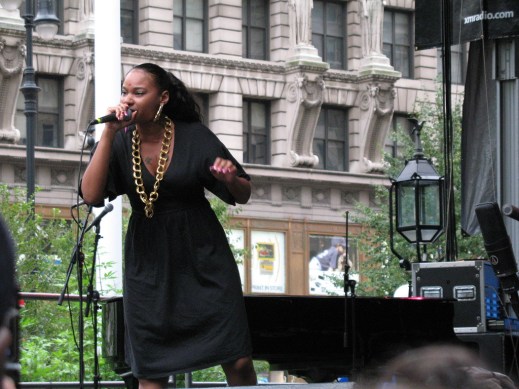
Featured Image of Jean Grae performing in New York City on August 26, 2006, Courtesy of Flickr User MrMoneda
—
Liana M. Silva is co-founder and Managing Editor of Sounding Out!
Share this:

“Once the word ‘sound’ was in the title, it opened up a kind of door”: A Conversation with Eric Weisbard

“Eric Weisbard” by Flickr user Joe Mabel undre Creative Commons 2.0 License
Last March, I attended the first Experience Music Project (EMP) Pop Conference in New York City. (See my pre-conference round-up for SO!, and my blog post for IASPM-US on my post-conference impressions.) Post-conference, I had the opportunity to interview Eric Weisbard, co-founder and organizer of EMP Pop Conference. One late March morning, we talked via phone about the story behind Pop Con, rock critics and academics, and the intersection of Sound Studies and Popular Music Studies.
Weisbard is currently a professor at the University of Alabama’s American Studies department. In addition to organizing Pop Con, he is also the Vice President of the International Association for the Study of Popular Music (US Branch) and Associate Editor of the Journal of Popular Music Studies. He has also edited three collections of essays drawn from Pop Con presentations: This Is Pop: In Search of the Elusive at Experience Music Project (2004), Listen Again: A Momentary History of Pop Music (2007), and Pop When the World Falls Apart: Music in the Shadow of Doubt (2012).
In 2001, Weisbard was invited, along with his wife (rock critic and journalist Ann Powers), by the Experience Music Project Museum in Seattle to organize their first rock music conference. “I was a grad-school-dropout turned New-York-media-rock-critic-guy” Weisbard explained, “and when I was asked to work on a conference my one framing idea was we will mix academics and non-academics.” The conference has been going strong for ten years now, and has expanded from Seattle to Los Angeles and, this year, New York City.
Part of Weisbard’s approach to Pop Con is rooted in his move from self-declared “grad-school-dropout” to music editor at The Village Voice and SPIN. Weisbard created the well-known Village Voice column “Sound of the City,” which he admits was inspired by Charlie Gillet’s 1970 book The Sound of the City. (Gillet’s book also inspired the theme of this year’s conference.) Weisbard saw in the conference a place where academics and non-academics alike could converse together about music. He pointed out, “this is a place where there’s room for enthusiasm, for intellectual work, but we call it a pop conference; we won’t put barriers to the ability of the ordinary person to come and put something out. The last few years it’s become a free conference, an important step to making it accessible and not just for academics.”
Considering the location of the conference, I asked him what the soundscape of this year’s Pop Con sounded like to him, in retrospect. Three things stood out to Weisbard: the collision of cultures in New York City’s soundscape, the sound of media (embodied in the voices present at the conference), and the music that came from the conference rooms. Weisbard reflected:

“Kimmel Center” by Flickr user edenpictures under Creative Commons License 2.0
“For me, I might point to three things: the most familiar and most cliché is the cultural collision side of the New York City soundscape. You’d have a conference panel at 905/907 [at the Kimmel Center, where the conference was held]; every time I was there I’d hear music from below [….] Another aspect, which is more specific and maybe undertheorized, is the sound of media. I don’t mean media as abstract tools for disseminating information but media in terms of people who have to say clever things on a regular basis and who have to use words all the time. To me, that’s a very particular kind of sound. One of the things that’s interesting of being in New York, and having the non-academic side of the conference (which had been ebbing and is suddenly coming back full swing) is that from academics to journalists to people in the business, [it] was a loud version of my sonic memory of being a media guy in New York. Media chatter, a kind of chatter that’s loudest in New York. New York allows you to be face to face with people all the time [….] Number three is how music itself floated through the other two realms. You might hear a song, as an example, or one night I saw vaudeville songs of the bowery, a late night offering. [This could be in reference to Poor Baby Bree’s presentation during the conference.–Ed.] We’re not a music conference, we are a music writing conference, but nonetheless music is at the core. That would be third thing; typically you listen to music at a conference, at home, in car, and there are all more directly ways of listening to music. Music permeated things but at intervals. It’s appearance was not predictable. You didn’t know where it would pop up.”
Yes, music was everywhere, and so was sound. The title of this year’s conference opened up the conversation to Sound Studies Scholars. Weisbard pointed out, “when we came up with the theme, which is a riff on Charlie Gillett’s line on “the sound of the city,” we recast it as ‘Sounds of the City,’ in keeping with what we’ve always wanted to do at the conference, which is emphasize different kinds of music. In an interesting way, once the word ‘sound’ was in the title, it opened up a kind of door: in exactly the same way that being in New York we think about the city, when you think about cities you think about sound.”
From the beginning of the interview, Weisbard explained that he was still trying to understand what Sound Studies comprises and where it intersects with Popular Music Studies. More importantly, Weisbard pointed out that some may talk about Sound Studies to avoid associating with Popular Music Studies, which may point to a tension between the fields: “My biggest concern about the phrase ‘Sound Studies is that it is a defensive way for critics who think that if they talk about ‘Popular Music Studies,’ they won’t sound as serious.” Weisbard acknowledged that these questions of legitimacy have plagued Popular Music Studies for a while.
When I asked Weisbard about what Sound Studies can learn from Popular Music Studies, he admitted that he still didn’t have a clear grasp of Sound Studies to be able to offer a strong opinion. However, he shared an example of what he thought was a strong contribution to the field that was, also, accessible to people outside of the field: “The latest pop music collection, Pop When The World Falls Apart, has an essay from Martin Daughtry on listening as it’s undertaken by soldiers in Iraq. That was a presentation. When I saw the presentation as a 20-minute talk, I remember feeling more moved than any presentation on music I had ever heard. That’s where I feel like Sound Studies work can be as satisfying as any work on music [….] Daughtry wrote with a sense of almost confronting something terrifying, while trying to understand how people listen.”
The tension between the academic and the popular is something Weisbard grapples with in his own work. (He stated, “Anything that’s a purely academic version of how to present work is flawed and has to be challenged”). At the moment he is working on a book on commercial radio formats. He describes it as such: “I’m interested in how formatting music (different from genres) creates parallel mainstreams. I’m interested in how every button can represent a different construction of the middle.” For Weisbard, his academic work and the work he does as a rock critic bleed into one another. “It’s about using the rock critic’s ability to enjoy cultural weirdness” he said, “and the historian’s tendency to keep on digging and get to the bottom of it. I definitely see my work in conversation with people who are grappling with the nature of pop music in general. I love that the word “pop” emphasizes the commercial, trashy, places where it’s least likely called authentic, or [seen as an] embodiment of progressive values. It simply has to live or die on its own. I think academic work should too.”
What’s next for EMP? It will return next year to Seattle, but the theme has not yet been decided. In fact, Weisbard says that EMP’s return the year after is never a sure thing:”There was no guarantee in 2002 that we’d become big [….] The provisional nature [of the conference] is one of its best qualities. There’s absolutely nothing guaranteeing whether it comes again. There’s no organization attached to it, you don’t have a job from it. It depends on the people working. A gathering doesn’t work if people don’t come.”
—
Liana M. Silva is co-founder and Managing Editor of Sounding Out!
Share this:


Current Top Posts





April 2021

January 2020

November 2019

October 2019

August 2019

April 2014

November 2017

March 2015

December 2017

October 2015
 Sounding Out!
Recent Comments