
(Dis)orienting the Bell: Aural Assault from A Game of Thrones to Richard Coer de Lyon


series co-editors Dorothy Kim and Christopher Roman
Hear YE! Below is the introduction to the latest installment of Medieval Sound, Aural Ecology, by series co-editors Dorothy Kim and Christopher Roman. To read their previous introduction, click here. To read the first run of the series in 2016, click here.
Aural Ecology
What is considered music, noise, or harmony is historically and culturally contingent. For example, some medieval musical theory, or musica speculative, such as Jan Herlinger’s “Music Theory of the Fourteenth and Early Fifteenth Centuries” in Music as Concept and Practice in the Late Middle Ages, defined music as “contemplation that serves the moral edification of the mind” (293). Influenced by the work of Boethius’s De Musica, music is not just everyday music but “connotes harmony conceived broadly enough to encompass the relationships obtaining in the human body and psyche and governing the motions of planets” (293). This kind of ecological harmony is explored in the work of Boethius, especially in his discussion of abstract qualities in the prelude to the De Musica, The Book of Arithmetic (as translated by Calvin Martin Bower) “Indeed these things themselves are incorporeal in nature and thrive by reason of their immutable substance, but they suffer radical change through participation in the corporeal, and through contact with variable things they change in veritable consistency” (24). For Boethius these “essences” are concordant with mathematical properties expressed in music. Thus, music was both speculative and moral, and these intertwining purposes derived from music’s phenomenological pleasures derived in the environment, “for nothing is more consistent with human nature than to be soothed by sweet modes and disturbed by their opposites” (Bower 32).
Boethius also comments on the psychological effects experienced in hearing music as they “affect and remold the mind into their own character” (Bower 34). Boethius gives examples of how certain groups of peoples, such as the Thracians or Lacedaemonians, delight in different kinds of music that harmonizes with their natures. For Boethius, music is transcendent in that it exists as a kind of eternal sound, but also an immanent sound, in that it appeals to various peoples depending on their nature and environment. Boethius’ speculations lead him to think about harmony and sound as available to reason and sensory perception. Thus the notion of harmony itself is “the faculty of considering the difference between high and low sounds using the reason and senses. For the senses and reasons are considered instruments of this faculty of harmony” (Bower 295). Harmony (and disharmony in the form of noise) became a marker of the aural ecology for an individual or group.
The essays in “Aural Ecologies” also address the issue of unharmonious sounds, sounds that often mark dissonant critical identities—related to race, religion, material—that reverberate across different soundscapes/landscapes. In this way, this group of essays begins to open up the stakes of Medieval Sound in relation to what contemporary sound studies has begun to address in relation to cultural studies, architectural and environmental soundscapes, and the marking of race through the vibrations of the body. —Dorothy Kim and Christopher Roman
In the neo-medieval A Game of Thrones (2011), the medieval Saracen-inspired and violent Dothraki utilize bells as a symbol of victories in battle. Each time a leader or khal defeats a foe, he incorporates the bells from his foe’s shorn black braid into his own braid. Khal Drogo, khal of the most powerful khalasar in Essos, sports an uncut braid sensuously described by George R. R. Martin as “black as midnight . . . hung with tiny bells that rang softly as he moved. It swung well past his belt, below even his buttocks” (37).
Dothraki bells serve both a hypermasculine and deterritorializing function: esteem and prowess for Eastern men comes from the symbolic castration of their enemies and the eradication of civilizations. For the Dothraki, sexualized and territorial conquest is centralized around amplitude of noise made by an aggregate of bells adorning a phallic braid. Drogo is frightening because of his noise: he wears “[b]ells so his enemies w[ill] hear him coming and grow weak with fear” (802). In the pilot episode of Season 1 of HBO’s Game of Thrones, writers David Benioff and D. B. Weiss and director Tim Van Patten emphasized the contrast in noise between the copper-skinned Dothraki and the white Valyrians of the Free Cities:
East disrupts West in this scene through a racialized auditory disruption of white silence.
The association of the Middle East with noise pervades Western culture. One need only recall juxtapositions of quietly carefully groomed news anchors in sterile American news sets conversing with correspondents struggling to be heard in earsplitting raucous streets embroiled in Middle Eastern crises in countries like Iraq and Syria. See Aron Brown of CNN announcing the U.S. War on Iraq in 2003, for example:
However, this association of the Arab world with noise is not a new one. In medieval literature, noise played a crucial role in distinguishing Saracen East from Christian West. Bells and particularly the cacophonous noise they cumulatively make came to be associated with a violent imagining of the East in literature of the medieval period. The late medieval crusading romance Richard Coer de Lyon, centered on the exploits of the twelfth-century crusading king, Richard the Lionheart, situates the pealing bell as its central object. [Note: Richard Coer de Lyon is cited by line number. All quotations come from the widely-used complete modern version, Richard Löwenherz, ed. Karl Brunner, Wiener Beiträge zur Englischen Philologie (Vienna and Leipzig, 1913)].
As in Dothraki warrior culture in A Game of Thrones, bells gain symbolic power in the romance through replication and accumulation. Richard Coer de Lyon features pealing bells in two crucial episodes concerned with the East and a maternal rather than phallic male body: 1) the exorcism of Richard’s demonic Eastern mother at Mass with a sacring bell (l.221-34); and 2) the appearance of Saladin’s demonic mare arrayed in clamorous bells attached to her crupper at the climactic battle of Acre (l.5532-49, 5753-8). Drawing on both medieval treatises on the function of bells and Gilles Deleuze and Felix Guattari’s theory of the refrain, I argue that the bell—initially a symbol of Christian order, the West, and patriarchy—becomes a disorienting aural force associated with chaos, the East, and maternity.
Early on in the romance, the king’s men try the piety of Richard’s mother, Cassodorien of Antioch, a bewitching foreigner whose only apparent fault is that she cannot remain in church to hear Mass, by physically restraining her during a service. To the shock of the English parishioners, at the ringing of the sacring bell, Cassodorien breaks free of her male captors, seizes two of her children, and flies through the church roof never to be seen again:
And whene þe belle began to ryng,
And when the bell began to ring,
The preest scholde make þe sakeryng,
And the priest was about to do the sacring,
Out off þe kyrke sche wolde away…
Out of the church she tried to go away…
Out of the rofe she gan her dyght,
Out of the roof she began to make her way/transform,
Openly before all theyr syght…
Openly before all of their sight…
— Richard Coer de Lyon, 221-5.
At this striking moment of contact between queen and masculine material object, the bell is forever altered, (re)oriented on a trajectory that transmogrifies it from a symbol of priestly power to a chaotic symbol of maternity and the East.

Sacring Bells in Aberdeen, Scotland. Image by Flickr User rethought (CC BY-NC 2.0)
Medieval thinkers conceptualized the church bell as an agent for revealing both foreign and demonic threats from within the community. In The Rationale Divinorum Officiarum of William Durand of Mende thirteenth-century French liturgical writer and bishop, William Durand,xplains the significance of the pealing of bells– “when the bell rings . . . the people are unified with the unity of faith and charity” (51) –but also expounds on this exorcising function of the church bell:
[T]he bells are rung in processions so that the demons who fear them will flee . . . They are so fearful when they hear the trumpets of the Church militant, that is the bells, that they are like some tyrant who is fearful when he hears in his own country the trumpets of some powerful king who is his enemy (51).
Durand conflates the demonic with the East, both qualities embodied by Cassodorien who hails from Antioch (near the border of Syria and Turkey). He also imbues the bell with an emasculating quality; it renders even a tyrant fearful. The measured sounding of the church bells forms a tonal refrain, an aural sequence to familiarize Christian space.
The purpose of the aural refrain, for Gilles Deleuze and Felix Guattari, is to deterritorialize and then reterritorialize unfamiliar space. In A Thousand Plateaus, they explain the refrain/‘ritournelle’ as a threefold place of disorientation, the familiar, and escape:
They are three aspects of a single thing, the Refrain (ritournelle)…. Sometimes chaos is an immense black hole in which one endeavors to fix a fragile point as a center. Sometimes one organizes around that point a calm and stable “pace” (rather than a form): the black hole has become a home. Sometimes one grafts onto that pace a breakaway from the black hole (312).
The bell was arguably the most important and pervasive aural symbol in medieval Europe, one whose refrain regularly demarcated Christian spaces in times of chaos. Sound theorist R. Murray Schafer has called the medieval church bell “the most salient sound signal in the Christian community” in The Tuning of the World (53), and a unifying force “acoustically demarking the civilization of the parish from the wilderness beyond its earshot” (55). Yet, as the bell multiplies through contact with Cassodorien and Richard wanders into the wilderness or black hole of the East, its sound is layered and its signification coopted by the East and transformed into a disorienting force that decenters Saladin’s enemies.

Richard battles Saladin, Luttrell Psalter, BL42130, 4v
The bell resurfaces once more as Richard prepares for his epic battle against Saladin at the gates of Babylon. In this climactic battle with a second pairing of mother and son, reimagined in the form of a demonic belled “mere” and her “colt” summoned by Saladin’s necromancer, bells occupy a central place of prominence on the mare’s accoutrements. In 1192, Saladin reportedly sent two new horses to Richard after his horse was slain in battle (For an overview of this event, see page 73 of Sir Steven Runciman’s A History of the Crusades, Vol.3: The Kingdom of Acre and the Later Crusades). The mare, as one of only two mothers in the romance, uses the same aural symbol to assault the English Christians that they had used to exorcise Cassodorien. As Saladin’s mare proudly strides onto the battlefield, the poet emphasizes the deterritorializing effect of her cacophonous bells:
þerffore, as þe book vs telles,
Therefore, as the book tells,
Hys crouper heeng al ful off belles,
The mare’s crupper hung all full of bells;
And hys peytrel, and his arsoun.
From the armor, too, and the saddlebow,
þree myle men my3ten here þe soun.
For three miles men could hear the sound.
Þe mere gan ny3e, here belles to ryng,
His mare began to neigh, her bells she rang
Ffor gret pryde, wiþouten lesyng.
With great pride, it is no lie.
–Richard Coer de Lyon, 5753-8.
Fascinatingly, Brunner again diverges in this passage from Caius 175, and changes “þe mere” to “his mere,” further stripping the demonic mare of her agency.
Whereas the church bell is a singular symbol of order, symmetrical and “acoustically demarking” space with its meted refrain, the bells of the mare are multiple, discordant, chaotic, and cacophonous, designed to disorient rather than to unify (see Schafer 55). The medieval illuminator of the Luttrell Psalter (c.1325-1335) similarly emphasizes the clamorous quality of the belled mare, and distinguishes Saladin’s mount from Richard’s by the vast array of bells attached to its crupper and the noise these bells suggest.
The noise, suggested in the Luttrell Psalter by the movement and detail given to the crupper bells, can be heard on a smaller scale in the following video clip of a horse merely walking noisily with a smaller bell-laden crupper:
One can easily infer the discordant sound a running mare might make with a crupper “hung all full of bells.” The poet suggests that the noise encompassed an aural disturbance of three-miles and disrupted the Christian crusaders. The bells also serve an insidious maternal purpose: they serve as a trap to lure her colt to abandon Richard and “knele adoun, and souke hys dame” (kneel down and suck his dame)” (Richard Coer de Lyon, 5547). In A Thousand Plateaus, Deleuze and Guattari suggest the layering of sounds, particularly maternal sounds, can disrupt and deterritorialize space. In their discussion of the reterritorializing effects of layered song, Deleuze and Guattari provide the strikingly maternal example of Debussy’s Sirens, which, they posit, integrates voice with orchestra to make the voices of child and woman inextricable from “the sea and the water molecule” (340). In much the same way in Richard Coer de Lyon, the mare’s imbrication of voice over bells seeks to make the dichotomies of the romance—mother and son, east and west, chaos and order, demonic and angelic—implode as the demarcated boundaries between them are dissolved in her cacophonous demonic lullaby.

Daenerys, Created in ArtRage Studio by Flickr User Happy Snapper 80 (CC BY-NC 2.0)
While A Game of Thrones and its HBO counterpart pick up on the resonances of medieval noise to differentiate between East and West, noise is gendered differently. In RCL the threat signaled by the sound of bells is that Richard will be emasculated by his inability to cut ties with the specter of his mother’s influence and disambiguate himself from the Eastern Saracens she represents. However, in Martin’s series, the Dothraki bells, like much of Dothraki culture, exist only to be subsumed under Daenerys’ imperial ambitions for an Iron Throne the Dothraki neither care about nor want. Daenerys’ bell, affixed to her hair after the death of Drogo and the dissolution of his khalasar, becomes a symbol of cultural and racial appropriation Martin stages under the guise of (white) feminism. That is, the issues noise signals have changed from the challenge of excising Christian West from Islamic East (a fear literalized in Richard’s cannibalistic consumption of Saracen flesh) to cultural appropriation (the devouring of Dothraki culture for the benefit of white colonialism).
—
Featured Image: Proceso Khal Drogo by Flickr User Orgita Sucubita, (CC BY-NC-ND 2.0)
—
Thomas Blake is Assistant Professor of English at Austin College.
—
REWIND!…If you liked this post, you may also dig:
Sounding Out! Podcast #54: The Sound of Magic-K.A. Laity
Mouthing the Passion: Richard Rolle’s Soundscapes–Christopher Roman
Playing with the Past in the Imagined Middle Ages: Music and Soundscape in Video Game–James Cook
Share this:

Make a Noise Joyful: Cirm in the Old English Exodus

Series co-editors Dorothy Kim and Christopher Roman
When the narrator of the Old English poem Exodus declares “Gehyre se ðe wille” (Let him hear who will), what sounds is he asking us to attend to? [Note: Text from Peter Lucas’s edition, 7b. All translations are author’s own.] This post argues that the Old English noun cirm (noise, shout, outcry) challenges our conceptualization of noise. In the Anglo-Saxon corpus, cirm most often refers to the indistinguishable, non-linguistic hum of a crowd, rather than the meaningful utterance of an individual. This accords with the popular view of noise in sound studies: whether medieval or modern, noise (as opposed to meaningful sound) is associated with alterity, disruption, and violence.
However, and strikingly, in the Old English Exodus, words for noise describe not only the terrible sounds of the drowning Egyptians as the roaring waters of the Red Sea rush over them, but also the survival of the Israelites. I argue that this cirm is a mark of the Israelites’ triumphal assertion of their continued presence and plenitude, a celebration of the fact that they can still be a multitude despite captivity. That cirm may not sit easily within our definition of noise should provoke not a redefinition of cirm’s joyful use, but a reconceptualization of Anglo-Saxon noise.

‘Amalek Attacks Israel and Is Defeated’, in the Old English Hexateuch, British Library, MS Cotton Claudius B IV
What is Noise?
“Noise” has a range of meanings, but most often implies “unwanted sound” as R. Murray Schafer argues in The Soundscape (73). Following the work of Jacques Attali and Jeffrey J. Cohen, noise has been associated with alterity, difference, and monstrosity. Noise, as opposed to sound, may be non-linguistic or disordered: nonsense, babble, the roar of a jet engine. According to David Novak’s contribution to Keywords in Sound, noise is not present in nature, but is created by modern technology (129). In the modern world, noise is often considered negative: cities have rules about noise pollution, apartment buildings set quiet hours, and airplane passengers don noise-cancelling headphones. In the pre-industrial age, noise was not exempt from criticism, though the word could also be applied to more pleasant sounds, like birdsong.
In the European Middle Ages, Valerie J, Allen argues in “Broken Air,” noise was often figured as violent, transgressing boundaries, inappropriately closing the distance between sound producer and sound receiver (310 and 317-318). According to Macrobius, it was not silence that was the opposite of sound, but noise (311). Grammar, which was “devoted to the pursuance of ratio through sound,” was ethical; noise was therefore considered “a kind of audible violence; corruption [wa]s something one can hear” (305). But some medieval noises were more ambiguous: the Old English word dream (joy, joyful sound) could also be applied to the terrible sounds of Hell or the terror of Judgment Day, as in Kazutomo Karasawa’s analysis in “OE dream for Horrible Noise in the Vercelli Homilies.” Likewise, “clamor,” which originated as a (mostly) negative noise, became an important legal instrument, as discussed by Richard Barton in “Making a Clamor to the Lord: Noise, Justice and Power in Eleventh- and Twelfth-Century France.” But in general, we tend to assume medieval noise is negative, or marks its producer as other.
Noises in Exodus
The Old English Exodus, found in the c. 1000 manuscript known as Bodleian MS Junius 11, is a notoriously difficult and complex poetic adaptation of the Old Testament Exodus 12-14. The author and date of composition are unknown, though it is often considered quite early, perhaps as early as the eighth century as Paul Remley and Lucas argue. Few institutions were rich enough to own a complete Bible. The author of Exodus may have had access to a written Latin version of Exodus, or may have been exposed to the text via the liturgy, especially the liturgy of the Easter Vigil.
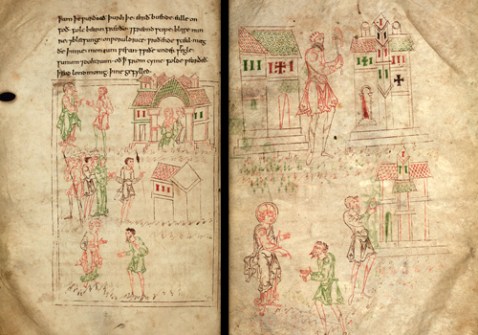
The Junius Manuscript, Oxford, Bodleian Library, MS. Junius 11, pp. 84-5
Exodus delights in sensory details, but until recently, I had always thought of Exodus as primarily visual – the gleaming of war-gear, the glittering of Egyptian spoils washed up on the shore, tents and a pillar of cloud to protect the Israelites from the desert sun, and a pillar of fire to guide them. But the poet is also attentive to the larger sensory world, including the world of sound and noise. Those who accept the poet’s opening challenge to his audience (“Gehyre se ðe wille!” [Let him hear who will!]) will recognize that the poem is in fact filled with sounds – the battle trumpets that provide order and structure to the movements of the army, the rushing and later silencing of waters, the terrible evening songs of wolves eager for battle, the awful rasping of the blade Abraham draws to sacrifice Isaac in the poem’s digression on the patriarchs, the triumphant songs produced by Israelite men and women in praise of God after the Egyptians are defeated. In what follows, I focus on the multiple deployments of a single word for noise (cirm), applied to both Israelites and Egyptians, asking what this word can reveal about Anglo-Saxon conceptions of noise.
It has often been remarked that the poet resists easy distinctions between Israelites and Egyptians, applying similar vocabulary to both, and this is certainly illustrated by the poet’s sonic play. In a climactic scene near the end of the poem, the drowning of the Egyptians in the Red Sea is accompanied by horrible noises:
Storm up gewat
heah to heofonum, herewopa mæst;
laðe cyrmdon (lyft up geswearc)
fægum stæfnum. Flod blod gewod:
randbyrig wæron rofene, rodor swipode
meredeaða mæst. Modige swulton,
cyningas on corðre. Cyrm swiðrode
wæges æt ende; wigbord scinon.
[A storm went up high to the heavens, the greatest of cries of the army; the hostile ones cried out with doomed voices (the air grew dark above). Blood pervaded the water: ramparts were broken, the greatest of sea-deaths lashed the sky. The brave ones died, kings in a troop. The noise fell silent at the end of the water; battle-boards shone. (460b-467; emphasis added)]
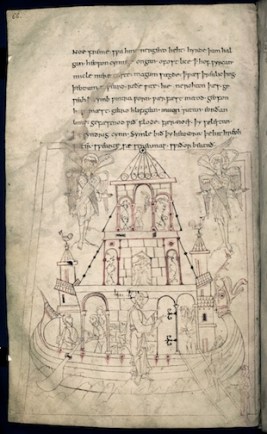
The Junius Manuscript, Oxford, Bodleian Library, MS. Junius 11, p. 66.
Cirm occurs twice in this passage, first as a verb (cyrmdon) and then as a noun (cyrm). The manuscript reading in 466b is cyre (choice). Lucas emends to cyrm because cyre is not a poetic word, and I would argue that the echo with the Israelites’ cyrm (107) must be deliberate. Even if we accept MS cyre, the passage still includes the verb cyrmdon (462a), and other sonic vocabulary (herewopa, “army’s cries” [461], and fægnum stefnum, “doomed voices” [463]). The noun occurs roughly 60 times in the corpus; the verb 17 times (DOE).
In the Old English corpus, cirm is often negative, applied to the tortures of hell or the terror of Judgment Day, and indicates a particularly loud sound (DOE, Lucas). According to the DOE, the noun means “shout, cry, shriek” or “noise of non-human origin, clamour.” The Egyptian cirm is obviously threatening, the meaningless cries of men who, like a raging storm, lash out in terror as the waters close over their heads. Even the visual horror of blood mingling with water maintains sonic affiliations: this line is a rare example of internal rhyme in Old English poetry (flod blod gewod). The end of the Egyptian threat is marked by the silencing of their voices and cirm, metaphorically a silencing of the army’s advance against the Israelites.
Given the negative associations with noise in both medieval and modern sound theory, that the Egyptian defeat is accompanied by their terrible cirm may not seem particularly surprising. Strikingly, this is not the only such noise in the poem. Near the beginning of the poem, the Israelites celebrate their initial escape from Egypt by producing not just any noise, but cirm. On the third day, after the pillar of cloud has appeared, the Israelites awaken with trumpets, and seeing the pillar,
Folc wæs on salum,
hlud herges cyrm.
[The people were joyful, loud was the noise of the army. (106b-107a; emphasis added)]
If cirm is threatening, loud noise, associated with difference and violence, why would the Israelites produce it? I would like to suggest that cirm suggests not merely loud noise, but crowd noise. The Israelites’ cirm is not an assertion of difference, or the meaningless babble of a drowning, almost non-human army, but an assertion of triumphant plenitude. Their joyful cirm is a fulfillment of God’s covenant with Abraham, which the poet will remind us of later in the poem (435-442). Just as God promised Abraham innumerable offspring, his support of the Israelites in their exodus signals that they will continue to be a multitude (as they certainly are in this battle, in which they have 600,000 fighting men (224-233).
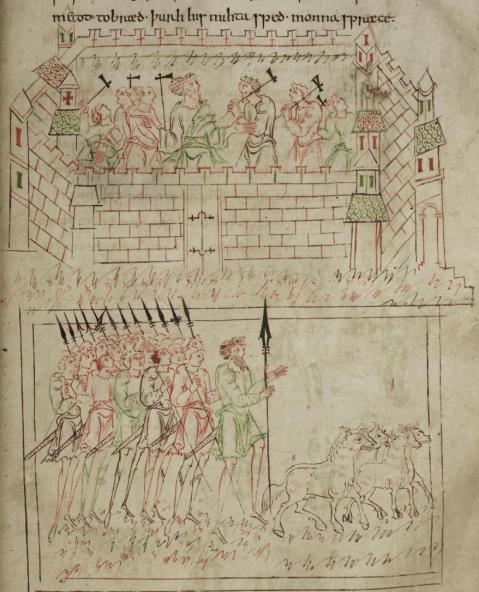
The Junius Manuscript, Oxford, Bodleian Library, MS. Junius 11, p. 81.
In fact, the Israelites’ triumphant crowd noise is echoed at the end of the poem as well. After the defeat of the Egyptians, who make terrible cirm as they perish in the Red Sea (460b-467), the Israelites issue more celebratory sound, this time transformed from crowd noise to harmonious music:
Æfter þam wordum – werod wæs on salum –
sungon sigebyman (segnas stodon),
fægerne sweg
[After these words – the troop was joyful – victorious trumpets sang a beautiful sound (battle-standards stood). (565-67a; emphasis added)]
The Israelites’ cirm (107), which they produced while on salum (joyful), is balanced and echoed by the celebratory sounds of the end of the poem, also produced by a people who are on salum (565). Whatever threat the Israelites’ assertion of plenitude and cirm may have made possible is mitigated by replacing that cirm (noise) with a beautiful sound (fægerne sweg), a harmonious, if also loud and multiple, expression.
According to Attali, music can be used to produce order, but “noise is violence: it disturbs. To make noise is to interrupt a transmission, to disconnect, to kill. It is a simulacrum of murder” (26). In this sense, the Israelites’ crowd noise in the desert is violent – it threatens the order of the Egyptians, or the hierarchy the Egyptians have sought to impose on the Israelites in their captivity. But because this story ends in the triumph of the Israelites, told from the point of view of their Christian descendants, it celebrates this assertion of communal power and communal violence without fully othering them. The true violence is inflicted on the Egyptians by God in the Red Sea, allowing the Israelites to reassert their normativity, their cohesion, their power, and their non-otherness. While the drowning Egyptians produce cirm, it is silenced because the cirm of the Israelites has conquered them. Noise, or at least cirm, is therefore not merely negative or disruptive; it is a powerful claim to be blessed by God, an assertion of belonging rather than a boundary crossing.
—
Featured Image:Detail of a miniature of the plague of hail (Exodus 9:22-25), Add MS 15277, f. 7r
—
Jordan Zweck is an assistant professor in the Department of English at the University of Wisconsin-Madison. She specializes in early medieval vernacular literature and culture, especially Old English, and is interested in documentary culture, media studies, and sound studies. She is currently completing a book on Anglo-Saxon epistolarity and early English media, examining the representation of letters in vernacular texts such as letters from heaven, hagiography, and poetry. She is also working on a second book on sound, noise, and silence in Anglo-Saxon England, a portion of which is forthcoming in Exemplaria. Zweck is a recipient of the University of Wisconsin-Madison Center for the Humanities’ First Book Award, has held a resident fellowship at the Institute for Research in the Humanities at UW-Madison, and has won several teaching awards.
—
REWIND!…If you liked this post, you may also dig:
‘A Clateryng of Knokkes’: Multimodality and Performativity in “The Blacksmith’s Lament”–Katherine Jager
Mouthing the Passion: Richard Rolle’s Soundscapes–Christopher Roman
Sounding Out! Podcast #54: The Sound of Magic-K.A. Laity
Share this:


Current Top Posts





April 2021

January 2020

November 2019

October 2019

August 2019

April 2014

November 2017

March 2015

December 2017

October 2015
 Sounding Out!
Recent Comments